Four Years

21 June 2008, Fourth anniversary as a blogger spent in Atlanta, Georgia workin for the man

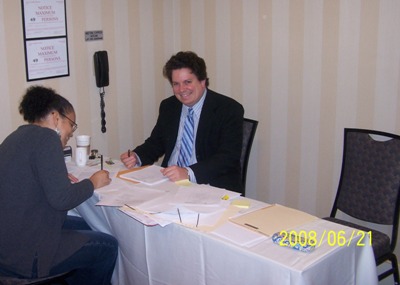
Saturday, 21 June 2008 was my four year anniversary as a blogger. I made my Inaugural Post that Monday in 2004. I had intended to post on the day-of, but I spent the day in question in Atlanta, Georgia on a business trip, running myself ragged for someone else’s year-end bonus. Colorless bureaucrat by day, intrepid blogger by night. Here I am at the Atlanta Peachtree Westin conference room A “continuous refreshment service” helping prospective linguists fill out the SF-86 Questionnaire for National Security Positions. Oh MedWatch 3500 where hast thou gone?

I lead a life devoted to little boxes. Mostly to making sure that people have correctly and completely crammed a continuous record of the last ten years of their lives into a series of little boxes over eleven to thirteen pages. But also comparing in meticulous detail the boxes on the sheets of paper to the corresponding boxes on a computer screen. And then checking off a list of little boxes to record that all content-bearing boxes have been adequately verified. I hate to admit it, but I think it’s my calling. I know that my record of spelling on this site has done nothing to prove the case, but baring the spellings, I am nothing if not meticulous. I am a relentless machine of attention poured into little boxes. I am a tireless warrior against the omission and the oversight. My favorite admonition is that “you have to write N/A as the investigator cannot tell the difference between an omission and a negative response.”

Anyway, the murderously mundane, death of a salesman workaday aside, the blog is great. I really feel like I’m in my groove. The goals no longer seem burdensome and I frequently kick it in confidence that any lull now will be more than made up for in a burst of activity later. And it’s stimulating. I spent almost the whole of today in a state of heightened agitation over the ideas that were swirling around in my head. The only problem is time, stick-to-it-ivness and the adequate eloquence to the task.

Part of the anniversary is the annual review, with an emphasis on the analytical. I switched to a third party product this year and turned over admin rights to John, so I have a helpdesk ticket in with him to get the permissions and whatnot necessary to produce the stats. Hopefully I can produce a more full assessment of the last year in a couple of days. For now it’s off to Miami this weekend: more errands in service to the man. Maybe some mile-high blogging though.
The Jules Verne of the Future Will be a Computer Scientist

Wired Magazine’s cover story this month on The End of Science / The Dawning of the Petabyte Age (Anderson, Chris, vol. 16, no. 7, July 2008, pp 107-121) has a very mundane answer to John’s enthusiasm: just scoop up tones of seawater, sequence every piece of DNA that you find, and compare it to a database of known DNA. The system will be able to flag each strand as existing species / new species.

We can throw the numbers into the biggest computing clusters the world has ever seen and let statistical algorithms find patterns where science cannot.

The best practical example of this is the shotgun gene sequencing by J. Craig Venter. Enabled by high-speed sequencers and supercomputers that statistically analyze the data they produce, Venter went from sequencing individual organisms to sequencing entire ecosystems. In 2003, he started sequencing much of the ocean, retracing the voyage of Captain Cook. And in 2005 he started sequencing the air. In the process, he discovered thousands of previously unknown species of bacteria and other life-forms.

Unfortunately this doesn’t do much to tell us about what the creature is like.

If the words “discover a new species” call to mind Darwin and drawings of finches, you may be stuck in the old way of doing science. Venter can tell you almost nothing about the species he found. He doesn’t know what they look like, how they live, or much of anything else about their morphology. He doesn’t even have their entire genome. All he has is a statistical blip — a unique sequence that, being unlike any other sequence in the database, must represent a new species.

This sequence may correlate with other sequences that resemble those of species we do know more about. In that case, Venter can make some guesses about the animals — that they convert sunlight into energy in a particular way, or that they descended from a common ancestor. But besides that, he has no better model of this species than Google has of your MySpace page. It’s just data.

But who knows, soon enough we’ll have software that will take a DNA sequence as input and produce a virtual model of a creature complete with visualization and tables of physiological data (bone density, blood chemistry, synapse count, etc.). We’ll never even have to find an instance of the creature.

Update, 25 June 2008: I think I’ve got my references a little crossed here. I titled the post The Jules Verne of the Future Will be a Computer Scientist for symmetry with John’s post, but Jules Verne is the author of the exploration stories, not the explorer himself, whereas the hypothetical computer scientist to which I am referring would be one of Jules Verne’s characters. The proper title should have been The Captain Nemo of the Future Will be a Computer Scientist.

Climate Change Comes to Flyover Country

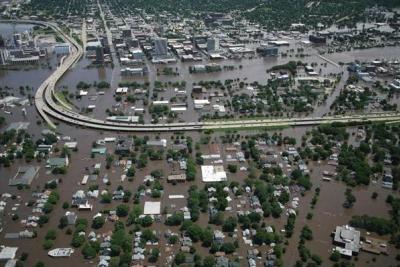
Flooding in downtown Cedar Rapids, Iowa, 13 June 2008

We’re not even getting the worst of it, just the feeble remnants, but still, the waves of storms that have been blowing through D.C. have been terrifying, violent, disruptive events. They have been apocalyptic, with the sky darkening and the air becoming restless as the storm approaches. Last week the street lights all came on at three o’clock in the afternoon, so dark had it become. We all gathered at the windows watching the oncoming storm in amazement. We looked across to the neighboring building where the occupants of nearly all eleven floors gathered at their windows too. I’ve lived in D.C. for five years now and I have never seen storms so violent as these.

A few days ago S. said that it turns out that New Orleans wasn’t the U.S. city that got wiped off the map, but rather, merely the first U.S. city to be wiped of the map. And in the perverse logic of the greenhouse effect, where the weather becomes not generally hotter or colder or wetter or dryer, but variably more extreme in every direction, I’ll bet by August the news of flooding has been replaced by stories of drought and wildfire.

It was pretty easy for middle-American public figures to be smug about climate change when it was just sinful, elitist coastal cities that were going to be destroyed by rising sea levels. But it turns out that the gods make no distinctions among we mortals between the righteous and the wicked. Climate change will come to the heartland just as much as it will to the decadent coastal cities.

Just as in Iraq, people tend to contrast the costs of a change in direction with the costs of doing nothing as if doing nothing were free. There are no costs to the status quo. The right digs out all these numbers about the drag on the economy of various plans to prevent climate change, but it is presented as if it were an absolute, rather than a comparative cost. Do nothing and continue along that same unencumbered glide-path to prosperity; change direction and it’s the road to serfdom. In fact, there has even been a spate of articles as of late on how climate change is going to be an economic boon — at least for some. But one no longer needs a month of simulation time on a supercomputer — a window and a cable subscription will suffice — to see that there are coasts to doing nothing.

Story of a Biker

Here’s how it works with bikes: first you don’t know how and don’t get those guys who dress like Indy cars with spandex diapers (Yglesias, Matthew, “Bikes,” TheAtlantic.com, 6 November 2007). Then some stupid user taunts you about being fat and lazy (Bloix, “comment,” TheAtlantic.com, 13 April 2008). So you buy a bike (Yglesias, Matthew, “Prepare for Bikeblogging,” TheAtlantic.com, 23 April 2008). A mere ten days later: I’d say that was some pretty effective taunt. Next thing you know you start getting all in the activist mentality and really enjoying it (Yglesias, Matthew, “Segway Boom,” TheAtlantic.com, 16 June 2008).

Sensuous Knowledge

The current issue of The New York Review of Books has an enjoyable essay on Indian eroticism (Dalrymple, William, “India: The Place of Sex,” vol. LV, no. 11, 26 June 2008, pp. 33-36). Alas, everyone prior to a certain era it would seem was possessed of the anti-life of Platonism and the sky cult:

… there has always been a strong tension in Hinduism between the ascetic and the sensual. The poet Bhartrihari, who probably lived in the third century AD, around the time of the composition of the Kamasutra, oscillated no less than seven times between the rigors of the monastic life and the abandon of the sensualist. “There are two paths,” he wrote. “The sages’ religious-devotion, which is lovely because it overflows with the nectarous waters of the knowledge of truth,” and “the lusty undertaking of touching with one’s palm that hidden part in the firm laps of lovely-limbed women, loving women with great expanses of breasts and thighs.”

“Tell us decisively which we ought to attend upon,” he asks in the Shringarashataka. “The sloping sides of wilderness mountains? Or the buttocks of women abounding in passion?”

Of the happier consequences of the death of god, one is that we can dispense with this never really existent dichotomy between the life of the mind and the sensuousness of the body. From beyond such strictures, they seem entirely arbitrary. Their abandonment is the aesthetic-ethical corollary of Kant’s dissolution of the rationalist-empiricist debate. I take it that this is what Nietzsche was getting at when he promulgating a collection of aphorisms under the title The Gay Science, or as it has occasionally been translated, The Joyous Knowledge. I think here of his discussion, as well as my own experience, that one’s best thoughts are often had while in motion.

A Herd of Goats in the Road

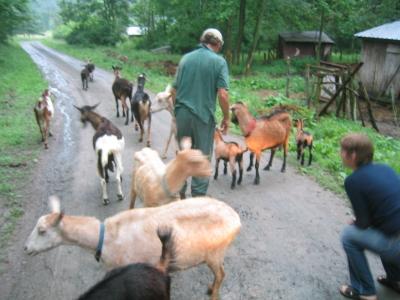
A herd of goats in the road, the corner of Greenwood and Meshoppean Creek Road, Dimock, Susquehanna County, Pennsylvania, 14 June 2008

I’m up in Pennsylvania for the weekend. Under pressure of rising energy prices, this region is being invaded by companies seeking to tap the area’s deposits of natural gas. S.’s parents are going to get a well on their property so we spent a drizzly afternoon driving all over the Pennsylvania countryside trying to see some of the existing wells to get an idea of what was going to happen to the W. farm.

Some of the wells are tucked away in some pretty secluded locations so we ended up driving through some surprisingly remote parts of Pennsylvania. At one point, we were driving down a single track dirt road through fields and forests, scarcely a human settlement around. We were following some switchbacks down a hill into another wooded area when around one of the switches we came to a sudden halt because a man was sitting in a chair along the roadside tending his flock of goats who ranged up and down the road.

It was bizarre, like a foreign country. We all piled out of the car, butted heads with the goats, petted the kids, exchanged pleasantries. He explained that he had so many goats because you’re supposed to sell off the males for slaughter, but he couldn’t bring himself to do it. He liked them too much. Sensitive types don’t make much of farmers.

My Apocalyptic Vision is Very Narrow

More than ten years ago I read Kevin Kelly’s interview with Vernor Vinge in Wired (“Singular Visionary,” vol. 3, no. 6, June 1995) and I have been repeating Mr. Vinge’s formulation of the robot apocalypse almost word for word ever since. But I was never able to locate the original article. Anyway, while reading around the wikipedia page on the technological singularity today I came across a reference to Mr. Vinge and recognized it as the long lost name. A few strokes of the keyboard at Google revealed my favorite dystopian vision:

Kelly: In your books, you sometimes focus on the idea of a singularity — the point at which a mathematical function goes infinite. What does that mean to you in terms of a cultural singularity?

Vinge: All sorts of apocalyptic visions are floating around, but mine is very narrow. It just says that if we ever succeed in making machines as smart as humans, then it’s only a small leap to imagine that we would soon thereafter make — or cause to be made — machines that are even smarter than any human. And that’s it. That’s the end of the human era — the closest analogy would be the rise of the human race within the animal kingdom. The reason for calling this a “singularity” is that things are completely unknowable beyond that point.

…

Kelly: Do you see any evidence that we are headed toward a singularity?

Vinge: I think the singularity may explain Fermi’s paradox: where is all the other intelligent life in the universe? For years, there have been two theories: the first is that civilizations exterminate themselves, and the second is that these outer civilizations are so weird there’s no way to interact with them. That second explanation has gained a lot of weight in my mind, because I can see us becoming weird — before my very eyes.

The striking thing to me is that qualification, “or cause to be made.” We won’t make the machine smarter than we are. We will only make the machine as smart as we are and then that machine will make the machine more intelligent than us. And then each more intelligent machine will be capable of making another even more intelligent still. Machine evolution will take over and, with software having reproductive cycles that will make bacterial reproduction glacial by comparison, will quickly outstrip human capability or comprehension.

The Singularity is Near

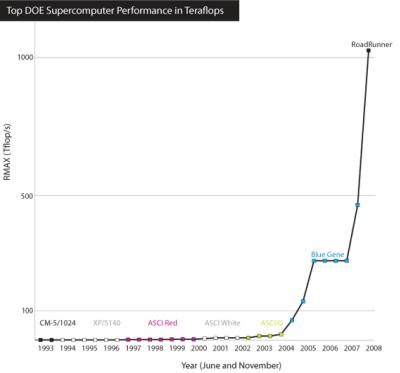
June 2008, Top Department of Energy Supercomputing Performance in Teraflops, RoadRunner tops one petaflop

Via ArmsControlWonk, the Department of Energy supercomputer called RoadRunner has become the first to achieve sustained petaflop performance. In scientific notation that’s 1015 floating operations per second. In little kid numbers that’s a thousand trillion floating operations per second (Lewis, Jeffrey, “RoadRunner,” 10 June 2008; “U.S. Department of Energy’s New Supercomputer is Fastest in the World,” U.S. Department of Energy press release, 9 June 2008).

The machine was built in conjunction with IBM. It consists of somewhere in the neighborhood of 3,500 compute nodes with each node consisting of two AMD dual core Opterons, four PowerXCell 8i processors for extra floating point capability and 24 GB of RAM. Overall the machine consists of 6,912 AMD Opterons, 12,960 IBM PowerXCell 8is and 80 terabytes of RAM. It will have access to a file server with 2,000 terabytes of hard disk storage. Roadrunner occupies approximately 12,000 square feet and cost $133 million. The AMD Opterons are a common desktop PC processor and the PowerXCell 8i is the processor from a Sony PlayStation 3. It runs RedHat Linux as its operating system. As Robin Harris from ZDNet points out, because the better part of this machine is off-the-shelf components, this really represents the commodification of supercomputing (“PS3 Chip Powers World’s Fastest Computer,” Storage Bits, ZDNet, 10 June 2008; “Roadrunner’s Backing Store,” StorageMojo, 11 June 2008).

RoadRunner will be housed at the at Los Alamos National Laboratory and will be used by the National Nuclear Security Administration to perform calculations to certify the reliability of the U.S. nuclear weapons stockpile through highly detailed simulation rather than conducting nuclear tests. Mr. Lewis at ArmsControlWonk has more on the implications of this for the U.S. nuclear testing regime. He points out that questions about the ability of the NNSA to certify the U.S. nuclear stockpile using simulation were a central issue in the Senate rejection of the Comprehensive Test Ban Treaty. So maybe reconsideration of the CTBT will be on the agenda for the next President and Congress?

But this is all detail. The important point is the graph of peak computing performance of DOE supercomputers. It is clear that the singularity is near.

As Mr. Lewis points out, the fastest supercomputer used in nuclear weapons simulations has, not coincidentally, historically also been the fastest supercomputer in the world. This tight coupling between computing and nuclear weapons is striking. It’s worth noting that the first computer, ENIAC, though not yet tethered to the nuclear establishment, was constructed during the Second World War for the purpose of calculating ballistics trajectory tables for Army artillery units. As J. Robert Oppenheimer said,

In some sort of crude sense, which no vulgarity, no humor, no overstatement can quite extinguish, the physicists have known sin, and this is a knowledge which they cannot lose.

It is not just the physicists that have known sin. The computer scientists have known sin as well. From this coupling hithertoo, it should be fairly obvious that the first androids and the first general artificial intelligence will be military in purpose. That is, the first androids and the first general artificial intelligence will be innately aggressive.

The singularity is near. It is more likely that it will be a cataclysm than a boon.

33

10 June 2008, 33rd birthday with bike

I turned over 33 years today.

I bought a bike over the weekend because I wanted to spend my birthday riding around town. It was surprising how easy it was to come into a new bike. I guess it shouldn’t have been. The previous bike came pretty easy too: it was left in the apartment by the previous tenant.

Anyway, I decided to ride the Mt. Vernon trail from Georgetown to Old Town Alexandria. People will often tout the Mt. Vernon trail as an aspect of what a livable city Washington, D.C. is. That this is a piece of D.C. livability speaks volumes. The Mt. Vernon trail is really just a sidewalk along the George Washington Parkway — and under the Reagan National Airport landing pattern. At one point, the trail is just a little berm between the Parkway and the airport runway. There are actually blast walls along part of the trail because they have backed up planes along it with their engines idling. It’s 95° out and the trail is a thin strip in the midst of 100 feet of blacktop on either side: one with thousands of cars averaging 80 miles per hour, the other with a jet landing every four minutes. Apparently D.C. people think this is a nice encounter with nature.

But it’s not so much the trail that’s miserable. The misery of the trail is only indicative of the larger problem, which is that D.C. has decided that the best use of the Potomac river is as a natural cut for freeways. On the Virginia side the river is walled off from the city by the George Washington Parkway. On the District side the river is more or less inaccessible all the way from Georgetown University to Anacostia Naval Base. The Mall, rather than ending at the river ends in one of the most confusing and nasty tangles of highway interchange in the country. The river is so cut off as to play no significant role in the life of the city. It may as well not be there. Washington, D.C. doesn’t even feel remotely like a river town.

Anyway, after the ride down, I said fuck it and took the train back into town.

Conviction Versus Expediency: A Quandary

The consensus on the left is that Senator Clinton’s 2002 vote to authorize President Bush to go to war was the top line problem that cost her the nomination. Ezra Klein says (“What Went Wrong?,” Tapped, 4 June 2008),

… among the more heartening and broadly applicable lessons of this campaign is that supporting a misguided, but politically expedient, war in 2002 turns out to have been a serious mistake.

For Matthew Yglesias it has been an ongoing theme, but in his post-Obama-victory analysis he says (“It’s the War,” TheAtlantic.com, 4 June 2008),

At the end of the day, Hillary Clinton had (and has) much more credibility with the liberal base than does the average person who shares her position on the war. If she can be held accountable, and if John McCain (until very recently the most popular politician in America) can be held accountable, then the sky’s the limit.

The problem here is that perhaps the majority of Democrats who voted to authorize the Iraq war in 2002 did so because they remember the consequences of opposing an earlier Bush’s war with Iraq in 1991. Back then the Democratic party was reflexively anti-war and voted in a large block to oppose war in 1991. They confidently predicted another Vietnam. Then the war went swimmingly, approval ratings of President Bush, Sr. went through the roof and Congressional Democrats were left with egg on their faces.

Any politician with presidential ambitions in 2004 or 2008 was sure to tick off the “willing to kick rogue country butt” requirement on their political CV — all except one, that is. But what’s a politician to do when it turns out that neither stout conviction nor craven expediency does the trick?