A Western Union?

Okay, I’m going to advocate one of those bigthink political ideas that has absolutely no possibility of becoming reality (see, e.g., Foreign Affairs).

The United States should join the European Union.

Commentators are concerned that the world may be breaking into competing trade blocks, with North America and Europe being the most contentious. Both are constantly at odds over their respective agricultural subsidies. The U.S. engages the E.U in an epic battle at the WTO over its banana import regime. European antitrust czar Mario Monti vetoes the merger of General Electric and Honeywell and finds Microsoft €497 million for anticompetitive practices after the U.S. gives both a free pass. Both countries have strategically critical airplane manufacturers, Boeing and AirBus. The U.S. complains that AirBus is E.U. subsidized. The E.U. retorts that the U.S. hides its subsidies of Boeing in the Department of Defense budget. Why not take all these high-stakes squabbles out of the indeterminate realm of international disputes and bring them under the more normal procedures of federal politics?

In denial of its complete impracticality, the United States and Great Britain have already experienced a considerable amount of political harmonization — which I take to be the prerequisite to political union. Margaret Thatcher and Ronald Reagan ushered in simultaneous conservative revolutions in each country. Both were followed by short-lived toadies in the persons of John Major and George Bush, Sr.

But it doesn’t stop at Britain. Much of mainland Europe seems to be on a nearly synchronized political periodicity. As Thatcher and Reagan were putting their revolutions in place, French President François Mitterrand was backing off from his socialist program to become one of that country’s historic liberalizers. Germany was also headed by the conservative Helmut Kohl in the 1980s, to be followed by the third-way Gerhard Schröder in 1998. Indeed the trio of like-minded politicians Bill Clinton, Tony Blair and Gerhard Schröder seemed quite a phenomenon at the time.

The United States already has a treaty of military alliance with Europe in the form of NATO. At the WTO the U.S. and the E.U. form a more or less unified negotiating block against the G-20 group of developing nations and Mercosur.

There is much idol discussion of a league of democracies so supplement or maybe supplant the United Nations. A U.S.-E.U. union would get us most of the way there. Throw in the British Commonwealth of Nations — Canada, Australia, New Zealand, India and so on — and what more is left?

If we’re on the way to one world government, but convergence is what is required, this seems like the next most logical step.

Finally, there is a persistent, nagging, Spenglerian fret over the decline of the West. Call it civilizational status anxiety. If the United States is serious about the idea of the West and defending it, why not make it official. Instead of the West being an idea from books or a lose political affiliation, make it a real political entity.

On the downside, it would really get us well on the way to Oceania, Eurasia and Eastasia and would reify the clash of civilizations.
Deranged Narcissism

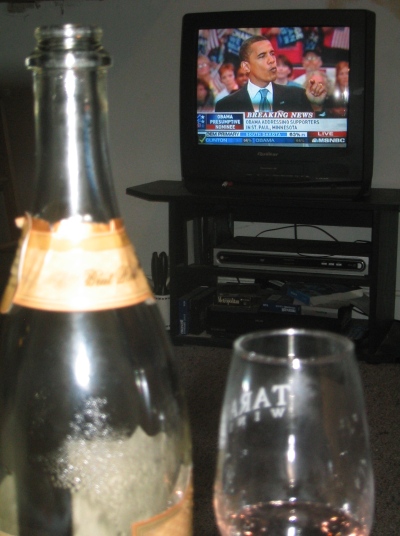
The funniest moment of the night: Jeffrey Toobin called out “the deranged narcissism of the Clintons” and David Gergen looked like an android blowing a fuse. Huffington Post has the video here.

Update, 4 September 2011: The Huffington Post video is no longer available, but Media Matters has it here.

Markets: Plan A or Plan B?

In an aside to an article on genetic determinism, The National Review comments on markets and the limits of information science (Manzi, Jim, “Undetermined,” vol. LX, no. 10, 2 June 2008, pp. 26-32):

In the middle of the 20th century, Friedrich Hayek and the libertarians he inspired faced those who asserted that the economy could be successfully planned. The libertarian position was not that such planning could be proved impossible in theory, but that we lacked sufficient information and processing power to accomplish it. The world of economic interaction was so complex that it overwhelms out ability to render it predictable; hence the need for markets to set prices.

I don’t for a moment believe that the Libertarian Party will disband once we cross some floating point operation threshold on supercomputers. There is the practical and there is the principled reason for subscribing to the libertarian position and I have read some of its proponents specifically state that even if the command economy could deliver superior performance, they would still be libertarians because of the component of human freedom.

The State of Brain-Machine Interface

Given that in the last five days it has been reported that scientists were able to read signals off the brain of a monkey and use the information to control a robotic arm in a useful manner, that Dean Kamen has done the same with for humans reading the signals off the nerve endings and that another team has been able to use fMRI and some adaptive software systems to guess what noun a subject is thinking with 77 percent accuracy, I’d say that we’re cusping on a sudden leap forward in the field of brain-machine interface, no?

Carey, Benedict, “Monkeys Think, Moving Artificial Arm as Own,” The New York Times, 29 May 2008

Tweney, Dylan, “Dean Kamen’s Robot Arm Grabs More Publicity,” Wired, 29 May 2008

Randerson, James, “Scientists Move a Step Closer to Mind-Reading,” The Guardian, 30 May 2008

Malcolm Gladwell’s Infinite Monkey Theorem

The Infinite Monkey Theorem apparently still holds if you substitute mediocre humans for monkeys. Here is Malcolm Gladwell writing on how to brute force genius (“In the Air,” The New Yorker, 12 May 2008):

In the nineteen-sixties, the sociologist Robert K. Merton wrote a famous essay on scientific discovery in which he raised the question of what the existence of multiples tells us about genius. No one is a partner to more multiples [simultaneous scientific discovery], he pointed out, than a genius, and he came to the conclusion that our romantic notion of the genius must be wrong. A scientific genius is not a person who does what no one else can do; he or she is someone who does what it takes many others to do. The genius is not a unique source of insight; he is merely an efficient source of insight. “Consider the case of Kelvin, by way of illustration,” Merton writes, summarizing work he had done with his Columbia colleague Elinor Barber:

After examining some 400 of his 661 scientific communications and addresses . . . Dr. Elinor Barber and I find him testifying to at least 32 multiple discoveries in which he eventually found that his independent discoveries had also been made by others. These 32 multiples involved an aggregate of 30 other scientists, some, like Stokes, Green, Helmholtz, Cavendish, Clausius, Poincaré, Rayleigh, themselves men of undeniable genius, others, like Hankel, Pfaff, Homer Lane, Varley and Lamé, being men of talent, no doubt, but still not of the highest order. . . . For the hypothesis that each of these discoveries was destined to find expression, even if the genius of Kelvin had not obtained, there is the best of traditional proof: each was in fact made by others. Yet Kelvin’s stature as a genius remains undiminished. For it required a considerable number of others to duplicate these 32 discoveries which Kelvin himself made.

This is, surely, what an invention session is: it is Hankel, Pfaff, Homer Lane, Varley, and Lamé in a room together, and if you have them on your staff you can get a big chunk of Kelvin’s discoveries, without ever needing to have Kelvin — which is fortunate, because, although there are plenty of Homer Lanes, Varleys, and Pfaffs in the world, there are very few Kelvins.

Our tendency is to imagine Newton, Darwin or Einstein as the pinnacle of genius, but they are merely the peak performance of that draft design kludge we all carry around in out heads. One can easily imagine ranks of genus many levels beyond our showings to date, ranging all the way from the Star Trek character Data to the gods (I uses these literary examples merely to demonstrate that we’re capable of imagining higher orders of genus). Each ranking of genius, all the way up to the gods, bears the same relation to the rank just below as Kelvin does to Homer Lanes, Varleys, and Pfaffs: not one of qualitative difference, but merely one of efficiency. And that relation obtains not just between each level, but over the entire span from pinnacle to base as well. It’s the wet machine corollary of Turing completeness.

This is, of course, why the proof from design for the existence of god fails, because one can imagine the universe being created in an instant by a supergenius, but it is equally plausible that it was created by a committee with some time on their hands. And the more time available or the larger the committee, the less capable any of its members has to be to produce a given output.

Commercial Pleasures

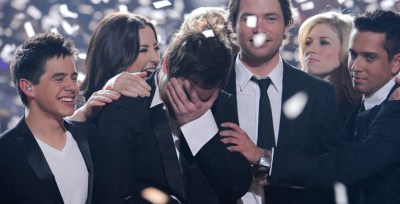
21 May 2008, David Cook wins American Idol

When I first moved to D.C. I had a roommate who was such a Redskins fan that I almost couldn’t be in the house when a game was on, so loudly did he scream at the television. I didn’t get it. There’s no excuse for getting that emotionally wrapped up in something so alien from one’s own life. Then I discovered Ninja Warrior on G4 (G4 | wikipedia). S. and I scream and wave our hands at the television with an increasing fanaticism as the contestant nears the finish line and the announcer goes ballistic with Japanese excitement.

Last night when they declared David Cook the winner of American Idol I lost it in a way that I never have before over television. From the time it of the final six (Carle, Brook, Castro, Syesha, Archuleta and Cook) it has been apparent to both S. and I that it was going to come down to a contest of the Davids and both of us have pretty much figured that Archuleta had the teenie-bops with their text-dexterous fingers all lined up and thus was going to win. Last week when Syesha was voted off I though Archuleta was going to win. Cook seems burned out and you could see the disappointment he had with himself after many of his performances. Meanwhile Archuleta’s been on the rise. “Stand by Me” couldn’t have been a better choice for him. Then on Tuesday night Archuleta’s rendition of Elton John’s “Don’t Let the Sun Go Down on Me” was perfect. Meanwhile Mr. Cook’s songs were sufficiently mediocre that after his final performance (“The World I Know“) he too was so certain that he had lost that the moment he finished his song, before Randy Jackson had said his first “Yo,” Mr. Cook started to cry. The judges all gave him consolation complements.

And I had long since made my peace with Mr. Cook coming in second. He has a tendency toward incipient pop rock as it is and being saddled with the obligations of being the American Idol was only going to further hamper him. They were going to hoist a few television commercials and a really marketable, over-produced album on him, when what he needs is to get together with someone edgier, someone who realizes that the explosive, dramatic power ballads are Mr. Cook’s forte. Better that Mr. Archuleta ends up the America Idol. He’s already a one-man boy band.

And so last night when Ryan Seacrest started, “And the winner is … ,” I interjected “Archuleta.” “David”; Seacrest paused having revealed nothing with two finalists both named David. Again I finished his sentence. “Archuleta.” When Mr. Seacrest finally let out “Cook” I leapt off the sofa. “No fucking way!” I shouted in disbelief. After fore explicatives and expressions of disbelief I tuned around in a circle and stared at the television in disbelief. Out of 97.5 million votes, Mr. Cook won 54.75 million to Mr. Archuleta’s 42.75 million, or 56 percent of the vote, a 12 million vote margin of victory. I was sure that David Cook was going to lose, but he won and in the end it wasn’t even close.

And Mr. Cook thought he knew he had lost as well. He seemed resigned to his fate and already congratulatory toward Mr. Archuleta as Mr. Seacrest taunted them with the results. I think it was the shock as much as the adulation and excitement that caused Mr. Cook to become so emotional after the announcement.

This is part justice and part tragedy. Mr. Cook is 25 years old. He got a degree in graphics design, but before settling into the nine-to-fiver he told himself that he was going to give music a few more years to see if he could make it work. One of his friends and a band-mate had already given up on music and gone to real work. Mr. Cook was nearing the end of his experiment and already had his alternative waiting in the wings. He’s been given a new lease on his dream. On the other hand, his older brother, Adam, is dying o brain cancer. I heard, I think it was his mother, say that it’s like heaven and hell: for David to be doing so well while things are going so poorly for Adam. I can’t imagine the survivor’s guilt Mr, Cook must be feeling in front of his brother. It has been an emotional rollercoaster for Mr. Cook and his family.

How did it happen? Always the political blogger — can’t avoid analyzing election returns. A few episodes ago I saw a sign waving in the audience: “Cougars for Cook.” The average age of an American Idol viewer is significantly up — witness moi. I guess the cougars overruled the teenie-bops. The other factor was his trio of performances early in the season: Lionel Richie’s “Hello,” the Beatles’s “Eleanor Rigby” and Michael Jackson’s “Billie Jean.” I think he never did anything so spectacular as “Billie Jean” and he tired as the season wound to its climax, but on those three he built a winning reputation.

I took a little walk this afternoon to go buy lunch and some coffee. I found my pace brisk and my thoughts buoyant. In the background of my mind, David Cook had won, and it has caused the slightest uplift in my mood all day long. It’s stupid I know, to be such a fan-boy. But I can’t help it: I really like David Cook.

The Stakes in 2008

I have more or less figured that right-wing crossover-voting Democratic Congressmen would hamstring an Obama administration, guaranteeing that any of his significant initiatives go nowhere and forcing him into a Clintonian strategy of triangulation, centrism and micro-initiatives. But Kevin Drum intriguingly suggests that Republicans, chastened by the 2008 outcome, could have the opposite effect (“End of an Era?,” Political Animal, The Washington Monthly, 19 May 2008):

They won’t be willing to say this during a presidential campaign, but there are at least half a dozen smart Republican senators who understand this and don’t really want to go down with the ship. So even if Democrats don’t win a filibuster-proof majority in November — as they almost certainly won’t — it’s likely that there will still be enough survival-inspired GOP senators around to give Barack Obama the votes he needs to make a difference. If that’s the case, and if Obama has the courage of his convictions, his first two years could be historic.

Unfortunately for Senator Obama it’s structural factors such as this that make Senator Clinton such a tenacious foe: this year could promise a shoo-in victory for the opposition party. And as if that wasn’t a sweet enough pot, whoever gets the nomination could potentially — again for structural reasons, not cause of personal vision thing — have a historical administration. Wouldn’t you too fight tooth and nail for such an opportunity were you in Hillary Clinton’s position?

Playing Into bin Laden’s Hands

Last week President Bush (remember him?) took his message somewhere that people might listen without creating a media spectacle, the Israeli Knesset, where he made his now infamous, implicit criticism of Barack Obama (“President Bush Addresses Members of the Knesset,” The Knesset, Jerusalem, Israel, 15 May 2008):

Some seem to believe that we should negotiate with the terrorists and radicals, as if some ingenious argument will persuade them they have been wrong all along. We have heard this foolish delusion before. As Nazi tanks crossed into Poland in 1939, an American senator declared: “Lord, if I could only have talked to Hitler, all this might have been avoided.” We have an obligation to call this what it is — the false comfort of appeasement, which has been repeatedly discredited by history.

Yes, yes, appeasement has been discredited, except in all those other instances where its opposite, belligerence or intransigence has been discredited too (“The Contradictory Lessons of the Twentieth Century, smarties, 28 August 2004). The fact is that there is no diplomatic panacea — firm resolve always works — and what is required is that ever so subtle virtue, judgment, exactly what this administration has been lacking.

This all reminds me of the passage from Ron Suskind’s The One Percent Doctrine in which he describes the assessment of the CIA as to the meaning of Osama bin Laden’s 29 October 2004 statement , made just days before the 2004 presidential election:

Inside of the CIA, of course, the analysis moved on a different track. They had spent years, as had a similar bin Laden unit at FBI, parsing each expressed word of the al Qaeda leader and his deputy, Zawahiri. What they’d learned over nearly a decade is that bin Laden speaks only for strategic reasons — and those reasons are debated with often startling depth inside the organization’s leadership. …

Today’s conclusion: bin Laden’s message was clearly designed to assist the President’s reelection.

At the five o’clock meeting, once various reports on latest threats were delivered, John McLaughten opened the issue with the consensus view: “Bin Laden certainly did a nice favor today for the President.” (p. 335-336)

The fact is that the policies of President Bush and his administration have been an irreplaceable gift to al Qaeda. As Osama bin Laden himself said in the afore mentioned statement,

[It is] easy for us to provoke and bait this administration. All that we have to do is to send two mujahedeen to the furthest point east to raise a piece of cloth on which is written al Qaeda, in order to make generals race there to cause America to suffer human, economic and political losses without their achieving anything of note …

Osama bin Laden essentially told the world that he loves George Bush for playing right into al Qaeda’s hands.

Barack Obama and the left more generally have responded to the President’s implicit criticism, but it’s been entirely meta. It’s beyond the bounds of fair politics, the President shouldn’t make such criticisms while abroad, etc. The left should deal squarely with this issue. Appeasement — were it even true — would be one thing, but George Bush is America’s gift to Osama bin Laden. Senator Obama is not bin Laden’s candidate: George W. Bush is. For seven years now the West has danced to bin Laden’s tune. On 20 January 2009 that ends.