Mathematics Program, Excursion I: Polynomials

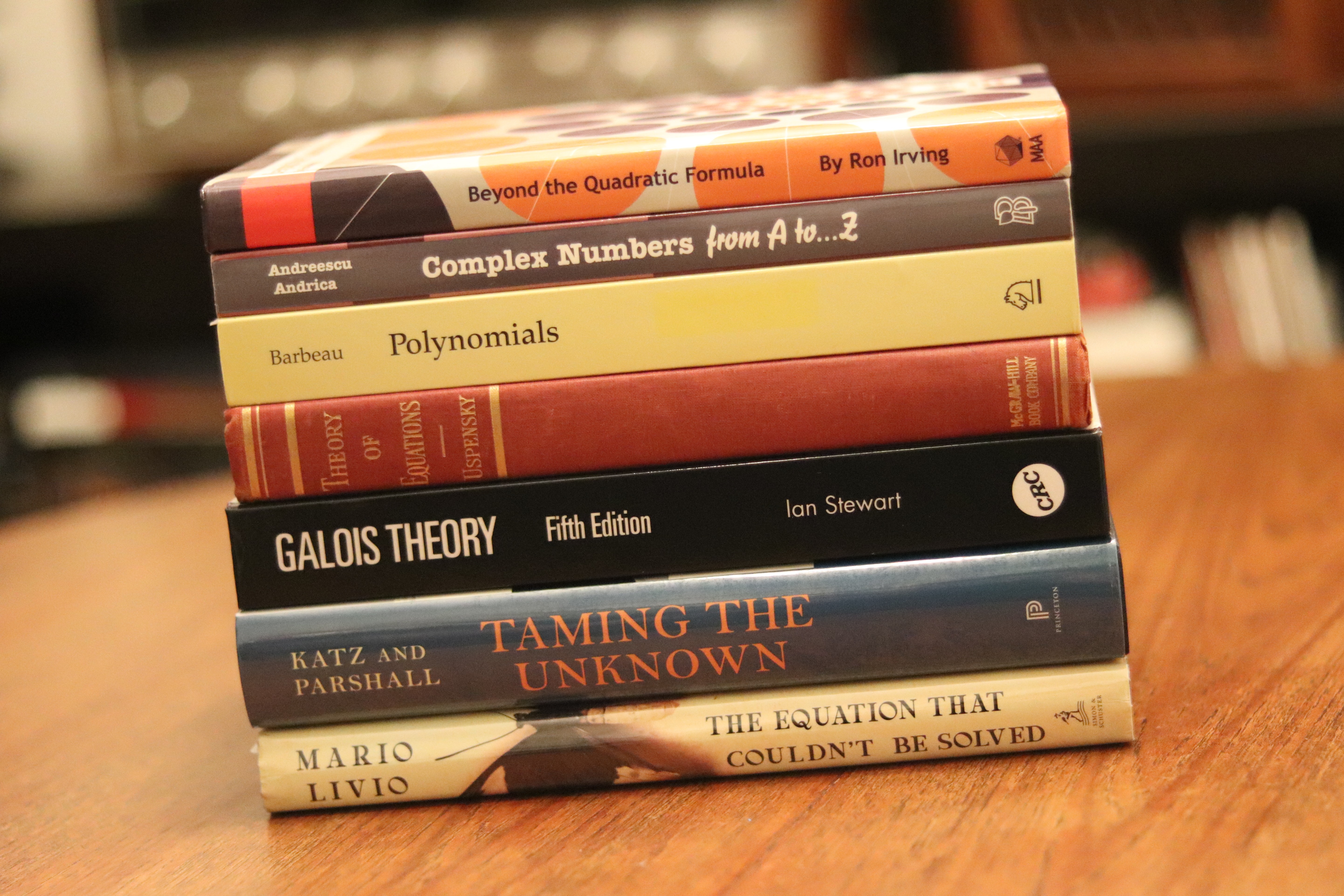
A photograph of a stack of seven small math books on a wooden table (authors and titles in post).

I know like two people in the world care about my pretensions, but (as much for me) here is a math study program update: I still have a long row to hoe before I am done with my textbooks on algebra and pre-calculus. I am actually pretty unhappy with how slow I am going. But I feel like I am at least over the hump of regaining lost understanding. But this far in, I have had three thoughts: (1) I am really enjoying polynomials; and (2) while I have done okay with these textbooks, I feel like what I have gained so far is merely a grab-bag of a few dozen tricks, not understanding; (3) since polynomials was once one of the primary areas that drove mathematicians crazy for literally hundreds of years, and solving its problems was the origin of group theory and abstract algebra, I feel like I should not treat this as merely on-the-way to calculus, but should spend a little time engaging with the subject of polynomials on its own. So I have gathered together this little pile of books for a study program on polynomials. They are:

  • Irving, Ronald S., Beyond the Quadratic Formula (Mathematical Association of America, 2013)
  • Andreescu, Titu and Dorin Andrica, Complex Numbers from A to … ℤ (Birkhäuser, 2005)
  • Barbeau, E.J., Polynomials (Springer, 2003)
  • Uspensky, J. V., Theory of Equations (McGraw Hill, 1948)
  • Stewart, Ian, Galois Theory (Chapman and Hall, 5th Edition, 2022)
  • Victor J. Katz and Karen Hunger Parshall, Taming the Unknown: A History of Algebra from Antiquity to the Early Twentieth Century (Princeton University Press, 2014)
  • Livio, Mario, The Equation That Couldn’t Be Solved: How Mathematical Genius Discovered the Language of Symmetry (Simon & Schuster, 2005)

Some brief notes on these books:

  1. The first five are mathematics books proper, and the last two are histories of mathematics.
  2. All of these books either claim in their introductions, or have been assessed by reviewers, to be at the level of an ambitious high school student.
  3. I think I am considering Barbeau’s Polynomials to be my primary text, with Irving’s Beyond the Quadratic Formula as a supporting text.
  4. Uspensky’s Theory of Equations is here for antiquarian interest (theory of equations is what the study of polynomials used to be called). Older books tend to have very different problems and I want to see how people used to think about polynomials.
  5. I dipped a little bit into Uspensky’s book when I first got it and quickly found myself overwhelmed by issues of complex (imaginary) numbers, so added Andreescu and Andrica’s Complex Numbers from A to … ℤ to my study program as a preliminary.
  6. Stewart’s Galois Theory will take me from the core study of polynomials, up through the beginning of abstract algebra. Again, I have read that Stewart’s book is so measured and stepwise, that even an intermediate reader can follow his presentation.
  7. Katz and Parshall’s book is a complete history of algebra, from cuneiform tablets to modern abstract algebra. Livio’s book focuses on the quandary of the quintic equation (a polynomial of degree 5) and, the two geniuses of Niels Henrik Abel and Évariste Galois, and the advent of group theory and abstract algebra.

Of course there is the whack-a-mole problem of prerequisites. One of those is already addressed by the book on complex numbers. But complex numbers at least seem core to polynomials. My real problem is that all of these books include in almost every one of their problem sets, questions asking you to prove this or that theorem. And being the completist that I am, I am not about to skip a whole class of problem. And besides, proofs seem integral to the depth of understanding I seek. It had been my intention to put off learning the techniques of proofs until somewhere in the midst of calculus. But I guess after my basic algebra books, I will work through a book or two on proofs before proceeding to this program.

I shouldn’t be disappointed. A significant motivation for this project has been the stature a certain collection of books hold in my mind. And one of those books, I book a spend a long time wondering over on a particularly memorable day spent in the University of Washington book store, with its amazing collection of math books (oh, to be able to go back), is Chartrand, Polimeni and Zhang’s Mathematical Proofs: A Transition to Advanced Mathematics (2nd ed., Pearson, 2007). I don’t even know if it is a good book on proofs. I just know that it has loomed in my imagination for 30 years. I am going on vacation next week and it is coming as one of my vacation books.
My Undergraduate Mathematics Study Program

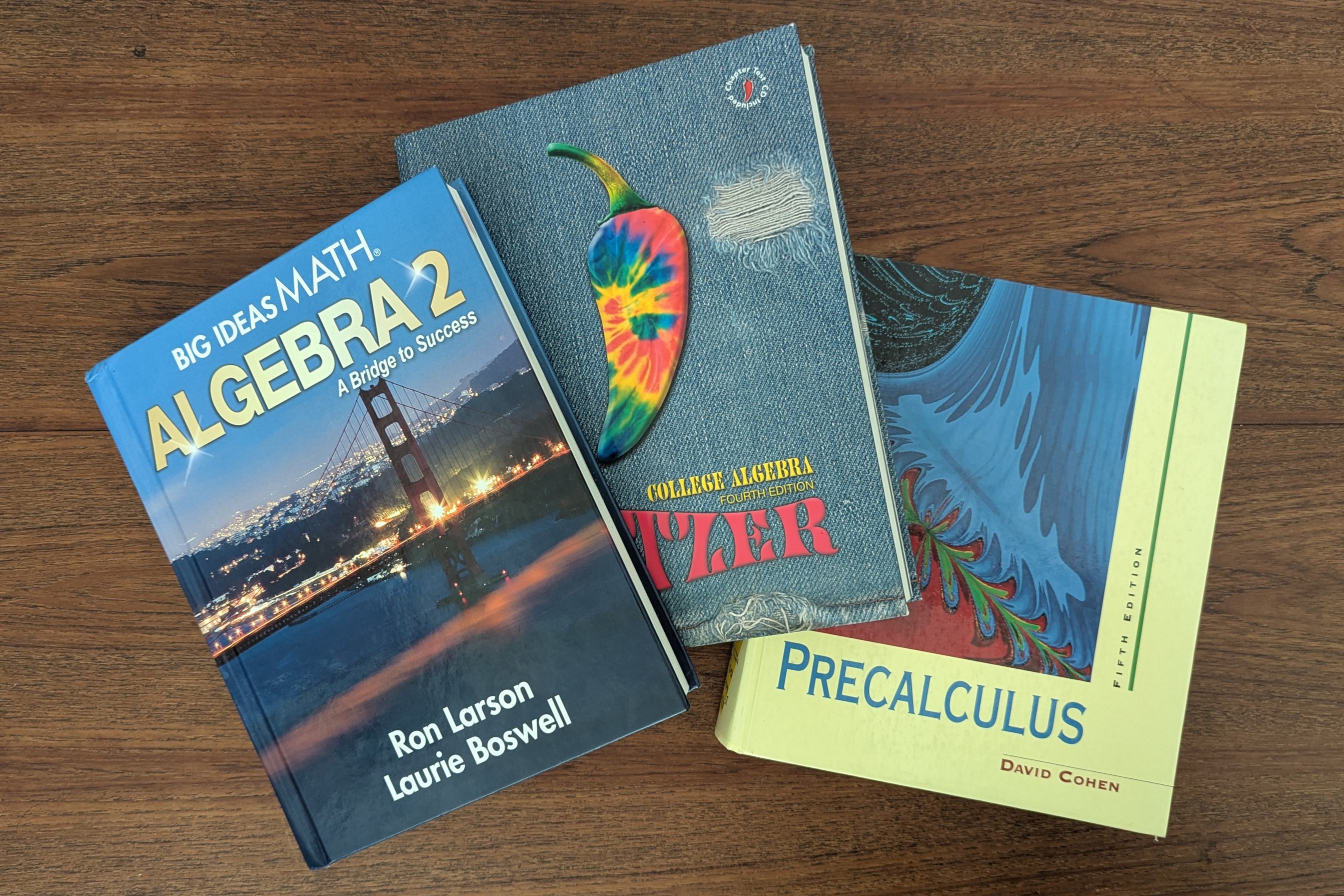
A photograph of three textbooks fanned out on a wooden table. They are Algebra 2 by Ron Larson and Laurie Boswell, College Algebra by Robert Blitzer and Precalculus by David Cohen.

I think my project for myself for the next couple of years (probably decade) is to work through the undergraduate sequence in mathematics. My goal is to get to the point where I can read a book on general relativity and on quantum field theory, as well as a few other math-heavy topics. So what I would like to do is:

  1. Calculus I, II, III
  2. Proofs
  3. Linear algebra
  4. Ordinary differential equations
  5. Abstract algebra
  6. Real analysis
  7. Partial differential equations
  8. Complex analysis

I don’t know where I am going to run out of steam, but if I want to get to general relativity, I will need to do a little more than this, at least some differential geometry. But I don’t know. That’s next level.

The standard sequence starts with calculus. I have taken calculus I & II twice in my life, once in college and once about 15 years ago. I started calculus III in college before temporarily dropping out. So even starting calculus over again is backing up for me. But when I took calculus, I was acutely aware that I wasn’t doing as well as I should have been because my algebra and trigonometry were too weak. So this time I want to make sure those skills are solid before proceeding. At first I decided that I wasn’t even ready for pre-calculus: I needed to go back and work on an algebra book first. The book I got is a college algebra book. Its first group of chapters is a review of intermediate algebra. After working through most of those chapters, I felt like I was too weak in even my basic algebra to proceed with this college algebra material. I could probably proceed and continue to improve basic skills as I went along, but having been burned by inadequate preparation the first time through, I want to make sure I am solid in one skill before moving on to the next. So now I am working through an intermediate algebra book.

It is kind of frustrating that I am moving backwards so quickly. At this rate I am never going to make it back to calculus. At this rate it’s going to take forever to get through calculus. It’s going to be years to get back to where I was thirty years ago. I am desperate to get to something new to me. I remember taking calculus and it just being so mind-blowing. I imagine since I did so little calculus III, it may have a similar effect (I remember the first time I saw a curve rotated about the x axis in the z plane and being, again, mind-blown).

I have spent my entire life wanting to be good at math. When I was a teenager, I wanted to be a physicist. In my early 20s, I wanted to be an economist. But for some reason I convinced myself that I couldn’t hack the math for either of these. Which is weird, because while I was never in the top math class in school, I never struggled with math.

But in the last few years I have decided that math isn’t an innate capacity, or at least requiring some core of innate ability. Well, maybe for like the top one percent of achievers there is some brain difference, but for middling achievement, what I am aiming for, it is a skill, like plumbing or painting: something that you get better at by practice. It is my plan to focus on doing the exercises and grind my way to understanding.

The problem is that I have been living my life at quarter speed. I have always just thought that there will be time later. But I am 50 years old now and there is not time. At this point in my life, one of the limitations on this project is that I am on the downside of my cognitive ability. At some point relatively soon, I am not going to be able to do this. I am spending the last 15 or maybe 20 years where it is still possible doing something I should have done thirty years ago.

Last Day of Room 11

Photograph of the interior of a bar. Glassware and gruit line the far edge of the bar. A bartender is pouring a drink a few seats down. In the background is large dark shelf full is liquor bottles.

On 8 September 2014 I walked to the Best Buy in my neighborhood and purchased the Canon SX700HS point-and-shoot that I had been researching for the previous few weeks. Then I walked on a few blocks to my favorite neighborhood bar, Room 11, for a celebratory drink to accompany opening the camera, fondling it and reading through the manual. This is the first picture I took with the camera. Shawn was my favorite bartender there. I never took this picture off the card, so if I scrolled forward through my pictures one arrow-press too far, I landed back at the beginning, on this one. I have looked at this picture probably thousands of times (I retired the point-and-shoot in 2019 after purchasing my fist DSLR).

Yesterday Room 11 posted on their Facebook page that they were selling the remains of their booze collection, glass and silverware, and closing indefinitely, owing to the pandemic.

In my former life, that I was a barfly was a huge part of my identity. As a boozehound, I have gone through so many phases that broadened and deepened my booze knowledge. My parents, a college duo, The Pearl, Flowers, The Monkey, the Tabard Inn, House of Foong Lin. Room 11 was one of the best bars I’ve ever known. It was intimate, dark, full of beguiling bottles shimmering in the low light. It was less a restaurant, more like a theater of bar tending, its bar a stage, it’s wall of bottles a set, it’s beautiful barware props. When I started going there, the Tabard Inn had taught me to love vermouth and Campari. Room 11 was a masterclass in Amari.

After each bar has passed out of my life, it has been hard to imagine it ever being equaled. And sometimes it has taken years. But there has eventually been some new gem. But I don’t know. I’m older now. I don’t drink so much anymore. I have a kid now. There is no time for lollygagging. And there is little spare money. Maybe Room 11 was the capstone of a drinking career that is past now. Still, it is terrible to see Room 11 as another casualty of COVID-19.

We Are Totally Fucked

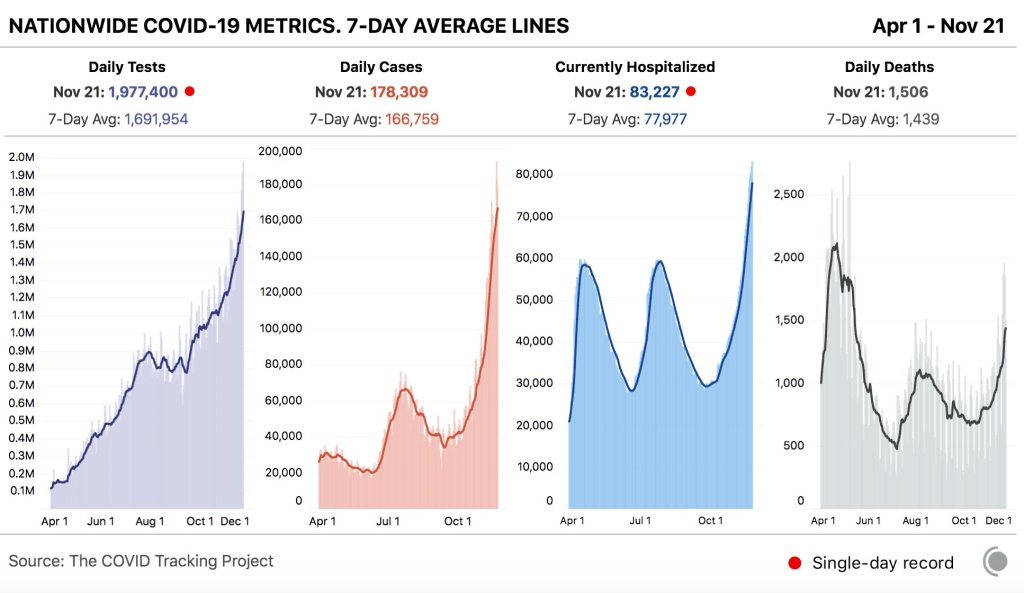
COVID Tracking Project's daily four graphs: Daily Tests, Daily Cases, Currently Hospitalized and Daily Deaths. All have two humps from earlier in the year that subside, and a third one rising wildly, far higher than any of the previous ones.

We are totally fucked. There is no way we’re not going back on lockdown. This is the way it goes: the rate of positive tests goes up, then, followed by a couple of week lag, the rate of hospitalization follows, followed by another couple of week lag, then the death rate goes up. 1,506 people died from COVID-19 today. The experts keep on making these predictions that keep on turning out to be too conservative. The current warning is that daily deaths could go over 2,000 per day. We are going to go over 2,000 deaths per day next week. The thing we should be thinking is that we are going to go over 3,000 death per day this winter. That’s going to be 100,000 Americans dead per month.

“But people aren’t dying at the same rate from COVID-19 as they were early in the pandemic” (compare the bumps in the pink and grey graphs). We’ve learned things. We have some treatments now. But remember that whole discussion we had about flattening the curve back in Spring? You will also remember that there were two lines on those graphs back then: one was COVID-19 infections and the other line was hospital capacity. The importance of flattening the curve was so as not to exceed hospital capacity. What doctors have learned and the treatments we’ve developed don’t do anything if you can’t get into a hospital where they can be administered. We are already at nearly 80,000 people currently hospitalized. We are about to start exceeding hospital capacity all over the country, at which point the death rate is going to skyrocket. “But we can surge capacity.” The only reason we could surge capacity in Spring was because COVID-19 outbreaks were limited to a few regions in California, Washington and New York. It’s everywhere now. There is no area that can afford to loan personnel to other states. Once hospital capacity is exceeded, that’s it: people are going to start dying anonymously at home.

For the next 60 days, the Federal government isn’t going to do a thing about this. In fact, insofar as the Trump administration can be said to have a policy at all, unchecked spread is it. Almost as shocking is the degree to which Democrats in Congress and Governorships are supine in the face of Trump’s total abdication. The next two months are going to be the most gruesome of any of our lives.

Paleolithic Punk and the Venus of Marseilles

Venuses of Willendorf (30-27ky) and Marseilles (1882)

To the left, the Venus of Willendorf, a 10.8 cm high stone statuette dating from the Paleolithic era, 30-27 kyr. To the right, the first anthropomorphic design for an atmospheric diving suite built by the Carmagnolle brothers of Marseilles, France in 1882.

The Carmagnolle brothers diving suite is the stuff of steampunk fantasy, but perhaps so situating it is time-out-of-joint in the wrong direction. Instead of designating it as a paleo-future, it is more properly a parachronism: perhaps we should call it the Venus (Ares) of Marseilles (with the Venus of Willendorf as old stone punk).

What Does Technology Lust After?

A Wearable Tech Hackathon sex app for Google Glass

So this was inevitable, right?

First thoughts:

  1. Really? Picture-in-picture?
  2. Seeing what my partner sees might make me never want to have sex again. I am reminded of Steve’s disquisition on “nether freckling” from Coupling s3:e5: “There are … angles. In a relationship you get seen from certain … angles.”
  3. With all the photos being stolen off of hacked mobile devices and posted to revenge porn websites, how could this possibly go wrong?
  4. Wasn’t Strange Days (1995) a great / terrible sci-fi film?

But more seriously, total immersion in the experience of another ranks along with immortality, total recall, omniscience, radical subjectivity, demediation of desire and fulfillment and a few others as ultimate goals of technology.

What I’m saying is that I think technology is teleological. The evolution of technology is not a random walk or a function of reachability or the traversal of a dependency network. Well, it is all those things, but it is not only those things. There are ends or extreme outer limits toward which technology is evolving. I think I listed a few off-the-cuff. Some systematic and dedicated attention to a fuller list is warranted.

But wence do the ends come? As I have framed them, they could be construed as merely the desiderata of the human makers of technology — technology has no end of it’s own: they are bestowed by their makers. But perhaps technology as a continuation of life, as a fourth domain, inherits these ends. Or perhaps these ends admit of a more objective formulation: eternity instead of immortality, idealist anarchy for radical subjectivity. Or perhaps for Kantian cyborgs, they are the transcendental illusions of technology.

Also, as if my digression hasn’t already been far enough, there’s this as a longing to supersede individuation:

An Internet of Creatures

Keanu Reeves in Johnny Mnemonic getting ghost-hacked by Ice-T's cyborg dolphin

Keanu Reeves in Johnny Mnemonic getting ghost-hacked by Ice-T’s cyborg dolphin

Non-human animals are late adopters. In 2009 cats started life logging. In 2012 dogs got into biometrics. Now sharks are getting on twitter. The Western Australia Department of Fisheries has started tagging sharks with radio transmitters. When the tagged sharks are detected within half a mile from beaches, the monitoring system updates the Surf Life Saving WA twitter feed with the shark’s species, size and location (“Roll Out of Tagged Shark Monitors Continues, 14 December 2013). The sharks do not yet post selfies to instagram.

“This kind of innovative thinking is exactly what we need more of when it comes to finding solutions to human-wildlife conflict,” says Alison Kock, research manager of Shark Spotters, apparently a shark social media PR firm in South Africa (Alan Yu, “More Than 300 Sharks In Australia Are Now On Twitter“, NPR, 1 January 2014). This is, of course, the sort of utopian thinking rampant among tech enthusiasts. But it’s only a matter of time before these vital shark voices are shouted down by a bunch of galeophobs, reminding us of Internet Rule 14.1: Don’t chum the trolls.

There is constant talk of the Internet of Things, about how all our devices are getting on-line and being internetworked with one another. But what about an Internet of All Creatures Great and Small? Instead of just us humans getting on-line, living in augmented reality, having brain computer interfaces, being enhanced by cognitive prostheses, we need to get all the other animals on-line too.

And look, we humans can’t stave off the robot apocalypse by ourselves. Presumably SkyNet and the Matrix don’t stop with the humans. Both SkyNet and the Matrix blot out the sun as a tactic. The other animals have a stake in the outcome of this as well. We animals need to pull together. Maybe even the plants too. Already we’re developing thought controlled power suits for monkeys and cockroaches that can interface with your iPhone (there’s an app for that). Raspberry crazy ants can detect electromagnetic fields and already have a vendetta against electronics. Now we just need to upgrade them to Raspberry Pie Ants. Maybe once we get this computation using protein folding and DNA, Craig Venter will engineer protozoa and yeast with wireless access and IP addresses to fight the nanobots.

Addendum, 17 January 2014: I should add that hot on the heels of kittens, a lot of animals are life logging these days — alligators, falcons, halibut, dolphins, sperm whales, eagles, a caracara and turkey vultures, more eagles and penguins. And of course National Geographic is like the BuzzFeed of animal cams.

Addendum II, 17 January 2014: This scientist is fitting honey bees with transponders and is running some sort of bee Aegis radar-type system to monitor their bee flash mobs.

Technology and the Profound, Part II: Apple’s Retort

A certain sector of nostalgic curmudgeons among us is driven to distraction by the fact that many people today are engaged in a significant amount of interpersonal communication and interaction with their environment mediated by their mobile devices and web technologies. This annoyance that the young people today don’t interact in the time-honored ways is expressed in a number of criticisms: that they are anti-social, isolated, rude, sedentary, disengaged, aesthetically foreclosed, temporally scattered, attention deficient and consumed by trite distractions. Sherry Turkle, the dean of cellular woe, was taped just last week by the New York Times to lament the presidential selfie. She goes so far as to suggest “device-free zones” as “sacred spaces” (“The Documented Life“, 16 December 2013, A25).

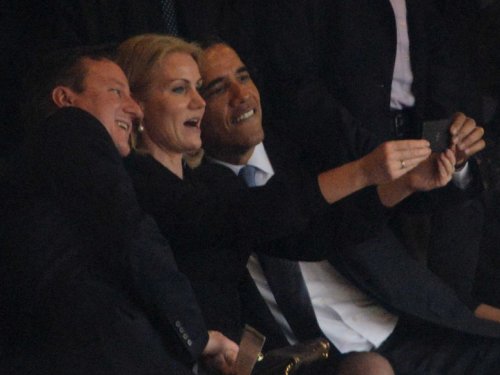
U.S. President Barack Obama, Danish Prime Minister Helle Thorning-Schmidt and U.K. Prime Minister David Cameron take a selfie at Nelson Mandela's funeral, Johannesburg, South Africa, 10 December 2013, by Steve Harvey

Back in June I wrote about two popular memes expressing this dismay and posed Apple’s then airing ad for the iPhone 5 as a corrective (“Technology and the Profound“, 18 June 2013). Watching the ad again now, it does address a number of these criticisms, but it is unclear whether the creators were thinking of something else and it is merely inadvertent how well the various episodes of the commercial line up with the criticisms; whether they were very subdued in their response; or whether something in between: they were generally aware of some negative perceptions of their product and attempting to show the iPhone in a sentimental, social, generative light without quite explicitly matching their critics.

With their new Christmas advertisement there’s no mistaking it: Apple it using its Madison Avenue genius to directly engage this debate. And for its emotional delicacy, it’s quite a salvo.

We are presented with exactly the teen that critics of our technological mediation obsession portray: bored, disengaged, one hand always unfree, constantly removing himself from important family events to fiddle with his device. But then, a third of the way through the commercial, the reveal: all those moments when he wouldn’t put down his phone, when he dropped out of family events, what he was actually doing was making a very personal video Christmas card to the entire family. We now rewatch all the moments from the first part of the commercial from a new perspective — in both the positioning of the camera, and in our understanding of what’s going on. As the mise en abyme — our protagonist’s video within the video — ends, he signs off with a bit of video of himself, the teenage veneer of boredom now replaced by an unselfconscious, sheepish happiness and pride. The title of the commercial is even “Misunderstood”. Not only is the teenage experience misunderstood by the adults around him, not only are his actions misunderstood, but here is the cutting edge of this soft light and sentimentality play. The title is not just descriptive of the events of the commercial: it is outwardly directed: it is an accusation against the critics of these technologies for which the events of the ad are the argument: you misunderstand what we are doing with these technologies; you mischaracterize the effects they are having on us.

I’ll add a personal story here, lest you write Apple’s commercial off as a contrivance of corporate propaganda. Toward the end of my college years I attended a birthday party. It began, as such things often do, as a late afternoon back yard cookout. But just after sunset one of the organizers brought out a slide projector and for about a half-hour told stories and played music while projecting onto the white wooden siding of the large side of the house photographs from the recent life of our celebree. It was beautiful and sentimental and poignant and really funny and just a wonderful celebration of this person — so much more so than had we just stood around in the yard eating hot dogs and getting slightly buzzed and then going through the heavily scripted song and cake ritual of birthdays. In other words, had we all only lived in the moment, it would have been just another meaningless collegiate afternoon. It was specifically the documentary consciousness and all those interruptions over the years and the need to share and the clever exhibitionism and the devices that created that evening’s sacred space with its deeply focused consciousness, its break from the ordinary, its reflection and appreciation.

This was the late 1990s, so the technologies of this presentation were the old ones: gelatin emulsion film, shoebox archives dug through over the course of weeks, order forms printed on the back of envelopes, photo developing booths isolated in the middle of the shopping plaza parking lots, cardboard mounted diapositives, that beige slide projector with the torus of black slide slots protruding from the top. So the documentary intrusions were fewer, the pace of production and archiving less frenetic, the sharing less ubiquitous. But also less of the life was available, there was no parallax view, the required bravery of the performance was greater (a slideshow!? so hipster).

This is what I really like about Steven Johnson’s response to Nicholas Carr’s book, The Shallows: What the Internet Is Doing to Our Brains (“Yes, People Still Read, but Now It’s Social“, The New York Times, 20 June 2010, p. BU3): Johnson frankly concedes that yes, we are losing something. But loss is not the entirety of the transformation. We are also gaining something. And neither the loss of the detractor, nor the gain of the enthusiast are to be weighed in isolation. The proper debate is: is what we have gained worth what we have lost?

Flaming December

Annie Leibovitz's December 2013 Vogue cover, Jennifer Chastain as Frederic Leighton's Flaming June

I love pre-Raphaelite women and I love homage, parody, covers, remix, mashup, etc., so I’m crazy for Annie Leibovitz’s photograph of Jennifer Chastain as Frederic Leighton’s Flaming June (1895) for the cover of the December 2013 Vogue. The Vogue website has a slideshow counterpoising the photo shoot with the inspirational source material.

This isn’t the first time I’ve posted about Annie Leibovitz and Vogue spoofing some vintage design. Perhaps the most popular post on this blog (not because anyone is interested in the rambling post; mostly because people are ripping off the image) is “Destroy This Mad Brute“, an analysis of the meaning of LeBron James and Gisele Bündchen mimicking an anti-old Europe First World War U.S. propaganda poster.

Banality Creep

Bradley Manning, If You See Something, Say Something ... Unless It's U.S. War Crimes

The thing to know about Bradley Manning and Edward Snowden is Sir Thomas Gresham’s principle that bad money drives out the good. So long as the government continues to prosecute a secret war beyond the principles on which this country was founded, people of conscience will continue to come forward with these kinds of revelations. We cannot drill into young people the American mythos and require new recruits into government service to take an oath to support and defend the Constitution of the United States against all enemies, foreign and domestic without planting the seeds of the very dissidents we now simultaneous seek to suppress. At some point the government will figure out how to screen out people of conscience, after which time our secret wars abroad and the surveillance state will be administered by scoundrels and unthinking bureaucrats. That power corrupts is as true of institutions as it is of individuals. Bad money drives out the good.