Mathematics Program, Excursion I: Polynomials

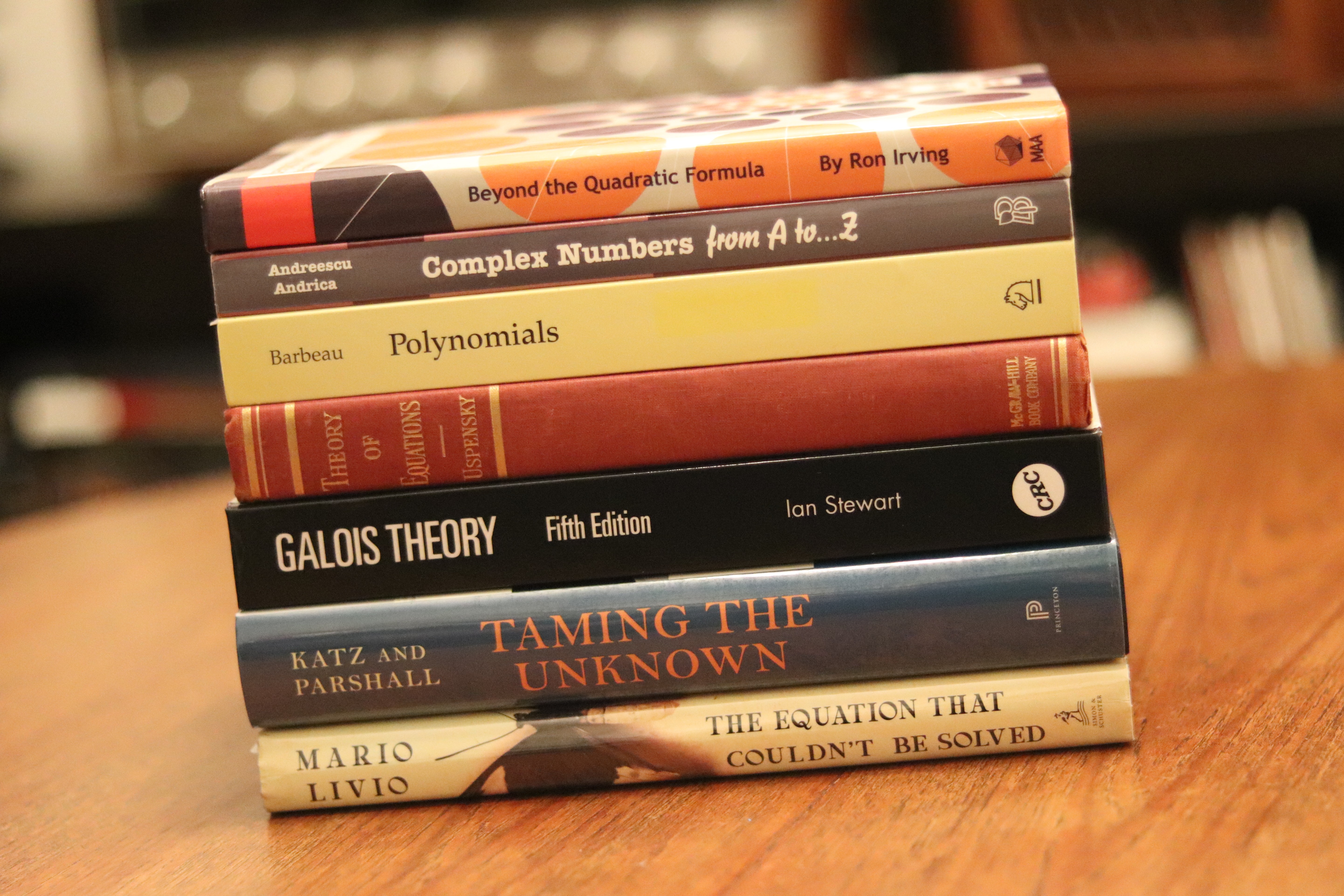
A photograph of a stack of seven small math books on a wooden table (authors and titles in post).

I know like two people in the world care about my pretensions, but (as much for me) here is a math study program update: I still have a long row to hoe before I am done with my textbooks on algebra and pre-calculus. I am actually pretty unhappy with how slow I am going. But I feel like I am at least over the hump of regaining lost understanding. But this far in, I have had three thoughts: (1) I am really enjoying polynomials; and (2) while I have done okay with these textbooks, I feel like what I have gained so far is merely a grab-bag of a few dozen tricks, not understanding; (3) since polynomials was once one of the primary areas that drove mathematicians crazy for literally hundreds of years, and solving its problems was the origin of group theory and abstract algebra, I feel like I should not treat this as merely on-the-way to calculus, but should spend a little time engaging with the subject of polynomials on its own. So I have gathered together this little pile of books for a study program on polynomials. They are:

  • Irving, Ronald S., Beyond the Quadratic Formula (Mathematical Association of America, 2013)
  • Andreescu, Titu and Dorin Andrica, Complex Numbers from A to … ℤ (Birkhäuser, 2005)
  • Barbeau, E.J., Polynomials (Springer, 2003)
  • Uspensky, J. V., Theory of Equations (McGraw Hill, 1948)
  • Stewart, Ian, Galois Theory (Chapman and Hall, 5th Edition, 2022)
  • Katz, Victor J. and Karen Hunger Parshall, Taming the Unknown: A History of Algebra from Antiquity to the Early Twentieth Century (Princeton University Press, 2014)
  • Livio, Mario, The Equation That Couldn’t Be Solved: How Mathematical Genius Discovered the Language of Symmetry (Simon & Schuster, 2005)

Some brief notes on these books:

  1. The first five are mathematics books proper, and the last two are histories of mathematics.
  2. All of these books either claim in their introductions, or have been assessed by reviewers, to be at the level of an ambitious high school student.
  3. I think I am considering Barbeau’s Polynomials to be my primary text, with Irving’s Beyond the Quadratic Formula as a supporting text.
  4. Uspensky’s Theory of Equations is here for antiquarian interest (theory of equations is what the study of polynomials used to be called). Older books tend to have very different problems and I want to see how people used to think about polynomials.
  5. I dipped a little bit into Uspensky’s book when I first got it and quickly found myself overwhelmed by issues of complex (imaginary) numbers, so added Andreescu and Andrica’s Complex Numbers from A to … ℤ to my study program as a preliminary.
  6. Stewart’s Galois Theory will take me from the core study of polynomials, up through the beginning of abstract algebra. Again, I have read that Stewart’s book is so measured and stepwise, that even an intermediate reader can follow his presentation.
  7. Katz and Parshall’s book is a complete history of algebra, from cuneiform tablets to modern abstract algebra. Livio’s book focuses on the quandary of the quintic equation (a polynomial of degree 5) and, the two geniuses of Niels Henrik Abel and Évariste Galois, and the advent of group theory and abstract algebra.

Of course there is the whack-a-mole problem of prerequisites. One of those is already addressed by the book on complex numbers. But complex numbers at least seem core to polynomials. My real problem is that all of these books include in almost every one of their problem sets, questions asking you to prove this or that theorem. And being the completist that I am, I am not about to skip a whole class of problem. And besides, proofs seem integral to the depth of understanding I seek. It had been my intention to put off learning the techniques of proofs until somewhere in the midst of calculus. But I guess after my basic algebra books, I will work through a book or two on proofs before proceeding to this program.

I shouldn’t be disappointed. A significant motivation for this project has been the stature a certain collection of books hold in my mind. And one of those books, I book a spend a long time wondering over on a particularly memorable day spent in the University of Washington book store, with its amazing collection of math books (oh, to be able to go back), is Chartrand, Polimeni and Zhang’s Mathematical Proofs: A Transition to Advanced Mathematics (2nd ed., Pearson, 2007). I don’t even know if it is a good book on proofs. I just know that it has loomed in my imagination for 30 years. I am going on vacation next week and it is coming as one of my vacation books.
My Undergraduate Mathematics Study Program

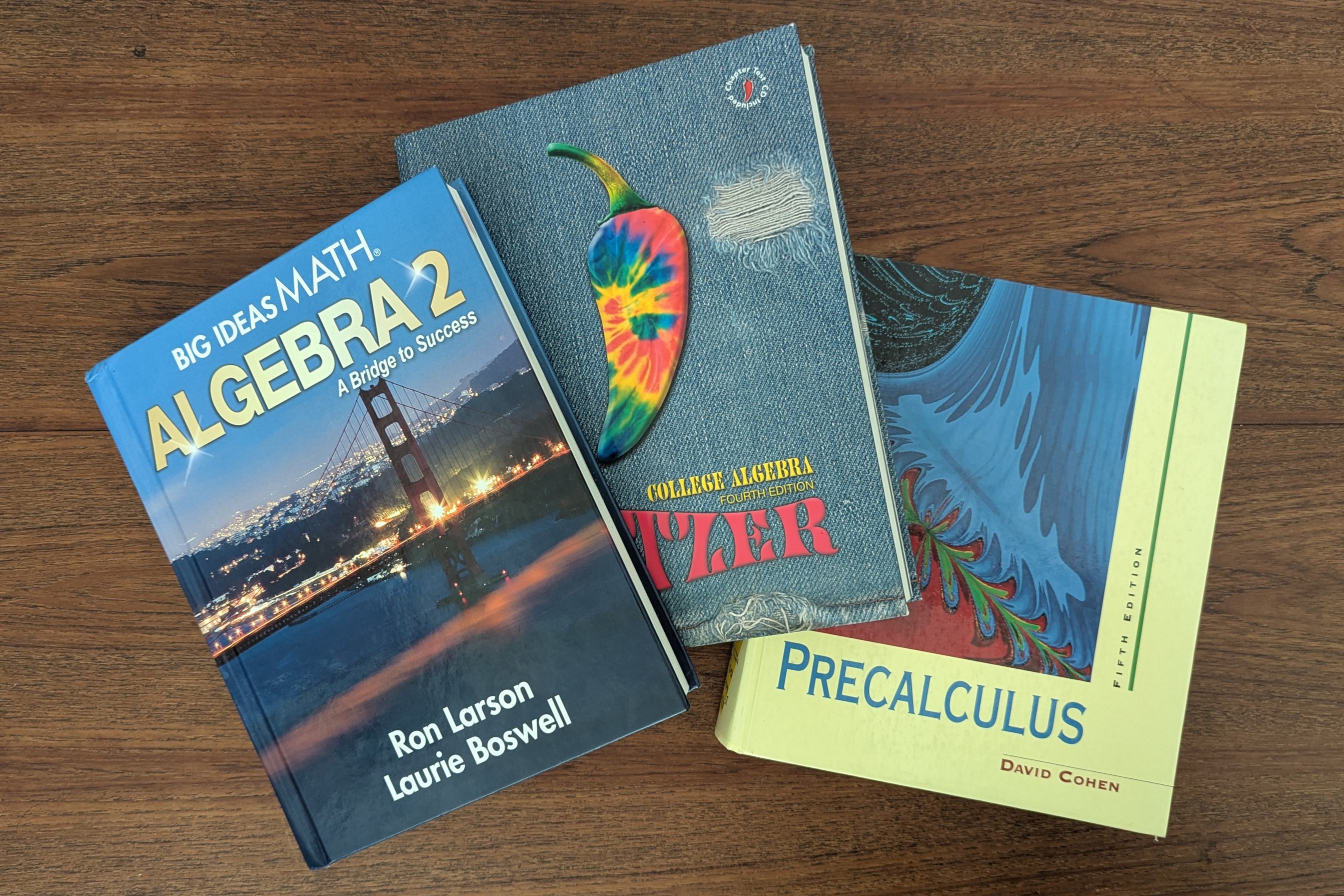
A photograph of three textbooks fanned out on a wooden table. They are Algebra 2 by Ron Larson and Laurie Boswell, College Algebra by Robert Blitzer and Precalculus by David Cohen.

I think my project for myself for the next couple of years (probably decade) is to work through the undergraduate sequence in mathematics. My goal is to get to the point where I can read a book on general relativity and on quantum field theory, as well as a few other math-heavy topics. So what I would like to do is:

  1. Calculus I, II, III
  2. Proofs
  3. Linear algebra
  4. Ordinary differential equations
  5. Abstract algebra
  6. Real analysis
  7. Partial differential equations
  8. Complex analysis

I don’t know where I am going to run out of steam, but if I want to get to general relativity, I will need to do a little more than this, at least some differential geometry. But I don’t know. That’s next level.

The standard sequence starts with calculus. I have taken calculus I & II twice in my life, once in college and once about 15 years ago. I started calculus III in college before temporarily dropping out. So even starting calculus over again is backing up for me. But when I took calculus, I was acutely aware that I wasn’t doing as well as I should have been because my algebra and trigonometry were too weak. So this time I want to make sure those skills are solid before proceeding. At first I decided that I wasn’t even ready for pre-calculus: I needed to go back and work on an algebra book first. The book I got is a college algebra book. Its first group of chapters is a review of intermediate algebra. After working through most of those chapters, I felt like I was too weak in even my basic algebra to proceed with this college algebra material. I could probably proceed and continue to improve basic skills as I went along, but having been burned by inadequate preparation the first time through, I want to make sure I am solid in one skill before moving on to the next. So now I am working through an intermediate algebra book.

It is kind of frustrating that I am moving backwards so quickly. At this rate I am never going to make it back to calculus. At this rate it’s going to take forever to get through calculus. It’s going to be years to get back to where I was thirty years ago. I am desperate to get to something new to me. I remember taking calculus and it just being so mind-blowing. I imagine since I did so little calculus III, it may have a similar effect (I remember the first time I saw a curve rotated about the x axis in the z plane and being, again, mind-blown).

I have spent my entire life wanting to be good at math. When I was a teenager, I wanted to be a physicist. In my early 20s, I wanted to be an economist. But for some reason I convinced myself that I couldn’t hack the math for either of these. Which is weird, because while I was never in the top math class in school, I never struggled with math.

But in the last few years I have decided that math isn’t an innate capacity, or at least requiring some core of innate ability. Well, maybe for like the top one percent of achievers there is some brain difference, but for middling achievement, what I am aiming for, it is a skill, like plumbing or painting: something that you get better at by practice. It is my plan to focus on doing the exercises and grind my way to understanding.

The problem is that I have been living my life at quarter speed. I have always just thought that there will be time later. But I am 50 years old now and there is not time. At this point in my life, one of the limitations on this project is that I am on the downside of my cognitive ability. At some point relatively soon, I am not going to be able to do this. I am spending the last 15 or maybe 20 years where it is still possible doing something I should have done thirty years ago.

We Are Totally Fucked

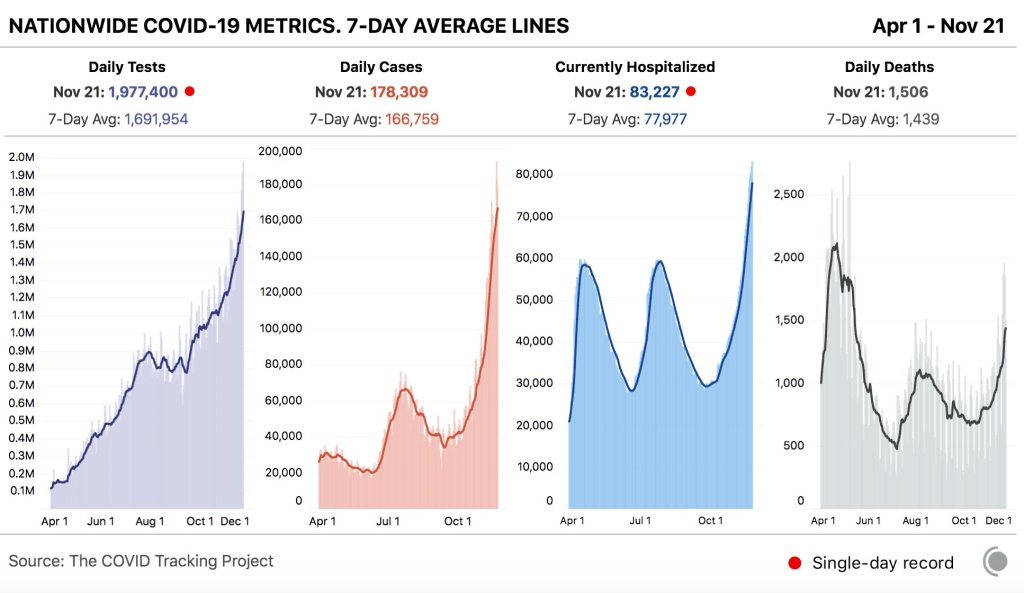
COVID Tracking Project's daily four graphs: Daily Tests, Daily Cases, Currently Hospitalized and Daily Deaths. All have two humps from earlier in the year that subside, and a third one rising wildly, far higher than any of the previous ones.

We are totally fucked. There is no way we’re not going back on lockdown. This is the way it goes: the rate of positive tests goes up, then, followed by a couple of week lag, the rate of hospitalization follows, followed by another couple of week lag, then the death rate goes up. 1,506 people died from COVID-19 today. The experts keep on making these predictions that keep on turning out to be too conservative. The current warning is that daily deaths could go over 2,000 per day. We are going to go over 2,000 deaths per day next week. The thing we should be thinking is that we are going to go over 3,000 death per day this winter. That’s going to be 100,000 Americans dead per month.

“But people aren’t dying at the same rate from COVID-19 as they were early in the pandemic” (compare the bumps in the pink and grey graphs). We’ve learned things. We have some treatments now. But remember that whole discussion we had about flattening the curve back in Spring? You will also remember that there were two lines on those graphs back then: one was COVID-19 infections and the other line was hospital capacity. The importance of flattening the curve was so as not to exceed hospital capacity. What doctors have learned and the treatments we’ve developed don’t do anything if you can’t get into a hospital where they can be administered. We are already at nearly 80,000 people currently hospitalized. We are about to start exceeding hospital capacity all over the country, at which point the death rate is going to skyrocket. “But we can surge capacity.” The only reason we could surge capacity in Spring was because COVID-19 outbreaks were limited to a few regions in California, Washington and New York. It’s everywhere now. There is no area that can afford to loan personnel to other states. Once hospital capacity is exceeded, that’s it: people are going to start dying anonymously at home.

For the next 60 days, the Federal government isn’t going to do a thing about this. In fact, insofar as the Trump administration can be said to have a policy at all, unchecked spread is it. Almost as shocking is the degree to which Democrats in Congress and Governorships are supine in the face of Trump’s total abdication. The next two months are going to be the most gruesome of any of our lives.

John Bolton Almost Knows What’s Happening

I tuned in to a little Fox News last night and watched Sean Hannity’s interview with John Bolton. Politics aside, the aggression and hysteria Sean Hannity are too suffocating to endure. However, while the political tone of his analysis is all wrong, John Bolton actually gave decent expression to a few insights (“In Defense of Democracy,” Hannity, Fox News, 22 June 2009). Specifically, he explained very well the cause of the administration’s reserve with respect to Iran:

The real reason that he [Obama] won’t speak out has nothing to do with this argument that we don’t want to meddle. The Iranian regime is already accusing us of that. The real reason is the president is determined to find a way to try and negotiate with the regime — with Khamenei, with Ahmadinejad — about their nuclear weapons program. This is a policy doomed to failure, but it explains why he won’t speak out in defense of representative government and individual liberty in Iran.

It’s not that President Obama’s position has “nothing to do with this argument that we don’t want to mettle.” Unlike certain other administrations for whom the sensitivities of foreign political cultures simply don’t exist, or are such trifles as not to figure in their calculations, President Obama is aware that the U.S. has an unpleasant past in Iran that is a significant part of Iranian national consciousness. The administration actually doesn’t want to meddle.

Qualification made, the administration’s policy toward Iran grows from multiple motives. One of which is the desire to do something about Iran’s nuclear weapons program, no matter the outcome of the election. And it’s not as if this is some bizarre act of cynicism. Iran’s nuclear program is an issue of paramount importance to the U.S. (as President Obama adequately said at a number of points in Tuesday’s press conference; video parts 1, 2, 3, 4, 5; transcript). And it’s not as if the assessment of the Obama Administration that a negotiated solution is possible is beyond imagining. It’s the policy that the Bush Administration would have pursued had Secretary of State Condoleezza Rice ever been able to outmaneuver Vice President Dick. But since The Decider never was much of a decider, the Bush Administration spent the whole of its second term paralyzed over what to do about Iran.

Which brings me to Mr. Bolton’s second point. The thing about Fox News is that it doesn’t even make sense on its own terms. Mr. Hannity asks if President Obama is giving the Iranian régime a green light for a crackdown by not saying enough. Mr. Bolton’s not so sure:

Well I think it’s mostly right except I would say this: because — including during the Bush Administration — we did not prepare adequately for this potential revolutionary moment, we’re not really in a position now to offer much concrete assistance and I don’t want America to be in a position where we urge people in the streets and then watch them die. I’d rather be a little bit prudent and prepare for the long term where we really can provide concrete assistance.

So after spending the bulk of the interview using President Obama’s restrained position on Iran as a cudgel with which to bludgeon the administration, Mr. Bolton turns around and admits that there’s really nothing we can do and that he would “rather be a little bit prudent.” So what’s wrong with President Obama’s position again?

We’ve been down this road before. In February of 1991, after the First Gulf War, President George Bush, Sr. encouraged the Shi’a and the Kurds to overthrow Saddam Hussein. When an uprising began, the United States then opted to do nothing, and Hussein crushed the rebellion, killing 60-100,000 Iraqis. Mr. Bolton is correct to suggest that we don’t want to repeat that catastrophe.

September 11th

In the days after 11 September 2001, as the disbelief and shock began to subside in favor of a sense of what had happened and what came next, CNN uncovered an old documentary, Building the World Trade Center, made by the New York Port Authority and aired it’s entire twenty minutes. I was lucky to catch it and it has since become a favorite piece of film for me. The first ten minutes of the video are an interesting, if stylistically dated, discussion of some of the features of the site and novel construction techniques and design features employed in the building. What makes me return to the film again and again is that at about time 10:05 — on the factual tidbit that after the foundational structures were in place construction proceeded according to a formula at the rate of about three floors every ten days — the film switches from informative documentary to whimsical art film. Set to Johann Strauss, Jr.’s Vianna Blood is an uninterrupted five minute dance of building rising. Watch a crane operator rotate a huge section of sheet metal at 12:25-12:36, the pan around the partly completed towers at 13:44-14:00 or the documentary makers themselves at 14:20-14:25 — it could be Stanly Kubrick. It’s a wonderful little paean to labor and ingenuity and capitalism.