Our Odyssey

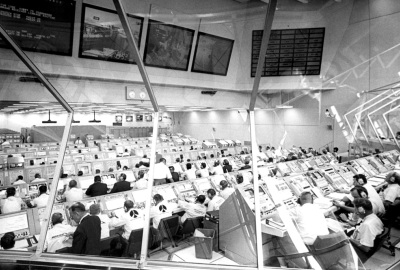
Countdown to launch of Apollo 11, Firing Room 1, Kennedy Space Flight Center, 16 July 1969

NASA is currently streaming the complete mission recording of Apollo 11 in real time in recognition of the 40th anniversary of the first manned Moon landing.

It feels appropriate to listen to an Apollo 11 cycle, so to speak. This is a performance of an incredible history and a true adventure. This is our Odyssey. The Iliad and the Odyssey were typically performed over three nights. Apollo 11 was four days from launch to touchdown on the Moon (16-20 July 1969; splashdown back on Earth 24 July). John F. Kennedy, Wernher von Braun, Neil Armstrong are our Homer, Agamemnon, Akhilleus and Priam.

I have heard it explained that part of the reason that Joyce’s Ulysses is such a pastiche is that he was trying to cram all the language of Dublin into a single work. Similarly, this week I was talking with some people about the way that David Foster Wallace appropriated the languages of commercial communication, technical writing, bureaucratic memoranda or the casual writing of e-mail to the purpose of literature. The language of our Odyssey is not Dublin bar talk, lyrical poetry or bard’s tale, but bureaucratese, engineering-speak: gage readings, mission book codes, equipment test reports, pre-burn checklists. Instead of the lyre and drum, we have the harmonics of white noise — a combination of the cosmic background radiation and electromagnetic interference of the communication and recording gear itself — and the synthetic electronic beeps of computers.

Fojol Do Lunch

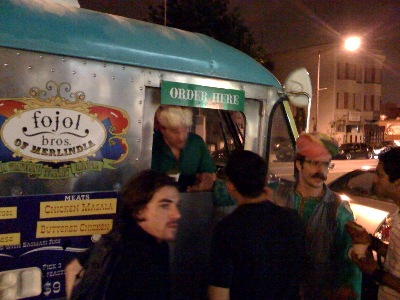
Fojol Brother Peter Korbel, weekday lunch in front of the IMF building, 16 July 2009

Fojol Brothers had their first (at least since I’ve been following them) weekday lunch. They parked at the corner of 19th and Pennsylvania Avenue, at Edward R. Murrow Park in front of the IMF building, necessitating a bit of a hike on my part, but always worth it.

While ordering, Peter (above) told me that a picture of me was included in their write-up in Brightest Young Things (Nicholson, Alex and Dakota Fine, “Hitting the Streets With: Fojol Brothers of Merlinida,”, 13 July 2009). This is not a surprise since they asked if I would pose for a food shot. I’m the guy in the bike helmet in the first large photo. Oddly enough this was my first time catching the Fojol Brothers. In the photograph accompanying my first post on the Fojol Brothers, I think that the guy in the foreground turning around to look back is Dakota Fine, the photographer for the Brightest Young Things piece.

I think that the Fojol Brothers have so far been limited to nights and weekends by their other commitments. I hope this is an indication that things are viable enough where they’re going to be doing it a lot more.

David Foster Wallace and Allen Ginsberg

There’s this big challenge amid Infinite Summer to try to characterize David Foster Wallace by ostension, or to try to best capture his project comparatively, preferably in twos. For instance, Paul Melancon tweets (1 July 2009), rather cleverly, I think, that David Foster Wallace is “like Proust and Philip K. Dick’s love-child.” The thing that I keep on thinking about as I read Infinite Jest is stanzas 14-19 from Allen Ginsberg’s Howl:

who chained themselves to subways for the endless ride from Battery to holy Bronx on benzedrine until the noise of wheels and children brought them down shuddering mouth-wracked and battered bleak of brain all drained of brilliance in the drear light of Zoo,

who sank all night in submarine light of Bickford’s floated out and sat through the stale beer after noon in desolate Fugazzi’s, listening to the crack of doom on the hydrogen jukebox,

who talked continuously seventy hours from park to pad to bar to Bellevue to museum to the Brooklyn Bridge,

lost battalion of platonic conversationalists jumping down the stoops off fire escapes off windowsills off Empire State out of the moon,

yacketayakking screaming vomiting whispering facts and memories and anecdotes and eyeball kicks and shocks of hospitals and jails and wars,

whole intellects disgorged in total recall for seven days and nights with brilliant eyes, meat for the Synagogue cast on the pavement,

Of course Ginsberg is about as New York as they come (come on, make Newark and other territories west of the Hudson boroughs already), whereas David Foster Wallace is Illinois corn fields. Still, the whole passage is all David Foster Wallace: the madness, the drugs, the intellectual nomadism, the schizoid schemata, the words, words, words. But the line that describes Infinite Jest to me more than any other is “whole intellects disgorged in total recall.” So far I am reading Infinite Jest after Annie Lowrey (“Inaugural Infinite Post,” A Supposedly Fun Blog, 29 June 2009): “It reads a bit like novel-as-mental-upload.” Infinite Jest is a 1,000-page brain dump of a man deeply in the throes of depression.

Ultimately the best comparison is that the first line of the poem is “I saw the best minds of my generation destroyed by madness …” Could there be anything more fitting to David Foster Wallace? I stopped at “destroyed by madness”, but the temptation to continue quoting (“starving hysterical naked, dragging themselves through the negro streets at dawn looking for an angry fix, angelheaded hipsters …”) is hard to resist.

The thing about Ginsberg is that he’s telling a gigantic inside joke of a grand circle — the Beats — comparable to earlier such groups: the Vienna Circle, Bloomsbury, the Algonquin Roundtable, Partisan Review, et cetera. For all of its counter-culture, there’s still something — or maybe only something in retrospect — élite about Howl. Infinite Jest is very inside-jokey too, or “highly colloquial,” as David Foster characterizes the Wallace family penchant for language in footnote three of “Tense Present” (“Democracy, English, and the Wars Over Usage,” Harper’s, April 2001, pp. 39-58). Infinite Jest may be formally avant garde, but its content is a bunch of anonymous nobodies. There’s a proletariat spirit to David Foster Wallace that Ginsberg aimed for, and perhaps hit in his time, but that has since rubbed off.

Update, 15 July 2009: Compare:

‘E.T.A.’s best minds on the problem. Whole thesauruses digested, analyzed.’ (Infinite Jest, p. 101)

It’s also worth nothing that after the sections waxing fantastic about tennis, Infinite Jest seems a lot less proletariat. But maybe that’s just me: I almost can’t walk past a tennis court without making a snide remark.

My Unconscious is Earnest; It’s Only My Ego That’s Nihilist

David Foster Wallace is already starting to get inside my head (I’m reading Infinite Jest as part of the Infinite Summer project). Last night I had a dream that S. and I were moving to a new place, an old facility building that had been converted into residential dwelling, located on a sparsely built, wooded former campus of some sort (E.T.A.?) on Lake Washington in Seattle. The current resident of the unit was David Foster Wallace and according to whatever dream logic was in effect, we were moving in a few days before he was moving out (it was revealed later in the dream — because you discover your dream personae as you discover those of other people — that the occupant prior to us of the place from which we were moving was also David Foster Wallace). We engaged in a series of joint activities in the period of our overlap, one of which included sitting together around a large table with a lot of simply cut, craftsman-type ornamentation as we painted it. Mr. Wallace was telling us how good these sorts of communal art works are when in a moment of cynical snark, of which I am want — at least dreamworld Donald is accurate in this respect — I insisted, “Yeah, but this sort of artistic self-indulgence is just a few steps removed from scrawling inscrutable messages on the wall in your own feces.” At which Mr. Wallace treated me to a considerable upbraiding regarding the failings of my detached, ironic stance. I struggled to defend my position of cynicism, but only flailed rather impishly in the face of his well reasoned criticisms. The argument, and my failings, continued through an afternoon’s shoreline scrub brush walk.

I know, I know, blogging your dreams! Is there anything more boring than other peoples’ dreams? It’s bad enough to have to hear about them while struggling for bathroom sink time in the morning; then to go and blog about them! I’ve tried to keep it brief, only to serve as an example of how quickly (I’m only on like page 50) and in what ways David Foster Wallace is getting in my head in a way that no novel has in a long time.

The Mullahs Killed Michael Jackson

[Editor’s Warning: elitist liberal moralizing to follow]

Dan Savage:

The Iranian regime has accused the CIA of killing Neda in order to win sympathy for the protesters and create disorder in Iran. I accuse the Iranian regime of killing Michael Jackson to end all coverage of the protests in Iran on CNN, Fox News, MSNBC, ABC, CBS, and NBC.

(“The Mullahs Killed Michael Jackson,” SLOG, The Stranger, 25 June 2009)

It’s unfortunate that the public and the media are so transfixed by the solipsistic, bread-and-circus phantasmagoria. Entertainment trumps world history every time.

Fojol Brothers and the Changing Face of Washington, D.C.

The Fojol Brothers traveling culinary carnival, 14th Street, just south of U Street, 20 June 2009, 1:45 AM

I’ve been following the Fojol Brothers traveling culinary carnival on twitter for approaching two weeks now. I just happened to choose the wrong time to follow them as there’s been no activity since that time. Then tonight I go to P and 21st and am oblivious that that they are catty-corner at 20th and Q, but they tweet that they will be reestablishing themselves on U Street at about midnight. I’m constantly refreshing my twitter feed to get the news. At about 12:30 they tweeted that they are serving food at 14th and U Street NW. I jumped on my waiting bike.

As I was leaving the house, I considered knocking on the door of the upstairs neighbors to ask if any of them wanted to join me (it would be safe to count on a significant portion of them to be awake and ready for spontaneous adventure at that hour). Turns out it was unnecessary. I had taken about two bites of cauliflower and potatoes when Duff walked up. He had played a gig on U Street. He got some Fojol Brothers food too and we leaned against the windows of the fast food places on the corner and talked for a few minutes. He commented that he keeps on finding little enclaves in the city that don’t feel like D.C. anymore. I concur. A similar thought struck me twice — I guess Fojol Brothers included, three times — just today. Increasingly I am seeing people who seem to be other than the usual social climbers, and engaged in activities outside the norm of the straight and narrow required by the power and influence track.

When explaining what’s wrong with D.C., I often tell people that it’s a one company town and that the imprint of the government is on everything in the whole city. D.C. just might be cusping on that critical mass where it starts to develop a culture autonomous from that of the strictures of political power.

On the other hand, a few years ago I had a Capital Hill barkeep, something of an institution himself, tell me that D.C. was a different town when the Democrats were in charge, that it was just more fun. Maybe the city independent from the government still sucks, it’s just that the government has upgraded.

I talked for a few minutes with one of the Brothers. They’re very much in promotional mode right now. He’s a lifelong D.C. resident and the son of a D.C. activist couple. His childhood meals were always strategy sessions of civil rights leaders or dialogues between Israelis and Palestinians and it’s that spirit of people coming together under extra-ordinary circumstances, but around food, that he hopes to create spontaneously on the street and in the virtual world. He talked about a getting together with other street food venders for a street party and his plans to work with District at-risk youth programs to have some of their kids join the Brothers in their culinary carnival (Anthony Bourdain profiled a similar program, the D.C. Central Kitchen, when No Reservations was in D.C.).

If the Federal Government has become more fun, the District remains determined to squelch any outbreak of unsanctioned quality of live improvements. At about 2:30 AM the po-po showed up and asked to see their street vendor’s license, which they promptly produced. But the officer began to sweat tem down over how this was non-vending zone and how they were past the hours allowed according to their permit. They quickly folded up shop and took off. I sent them a message later that evening encouraging them not to let this get to them. They messaged back that they’re still figuring out how things are going to work, but that they don’t intend to give up.

Protests in Other Countries

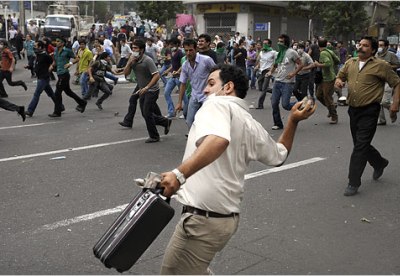
Businessman protester, Tehran, Iran, 13 June 2009

What’s amazing about protests in other countries is what pedestrian affairs they are. Look at this protester from Iran. In his right hand is a menacingly large piece of concrete. Obviously you don’t throw something that big and hard without intent to do serious damage. But look at his left hand. He’s got his briefcase and a folded up newspaper. And look at his outfit. He’s wearing his kakis and a work shirt. And are those the earphones of his iPod in front of his face? (I can just see Apple’s next iPod commercial: colored silhouettes of protesters in street battles, their white iPod earphone cords snaking about them as they hurl rocks and overturn cars strangely in time to, say, Rage Against the Machine or Public Enemy) This is like the Office Space of protesters. He’s in the middle of his commute when he decides that he’s mad as hell and not going to take it anymore. It was the same way with the lawyers’ protest in Pakistan where you had all these black besuited rock-hurlers.

Contrast this with the United States. If our black-robed mullah’s pronounce on an election, we all just roll over and take it. Meanwhile there’s a designated social class who participate in protests. They have a special set of tropes that includes a special garb, preferred hairstyles, a prescribed set of protest products. You go to a political protest in the United States and you could be excused for mistaking it for a 3k walk for breast cancer.

Petrified Onions

The latest controversy to sweep the blogosphere is the outing of previously pseudonymous blogger John Blevins, a.k.a. Publius by Ed Whelan (Whelan, Ed, “Exposing an Irresponsible Anonymous Blogger,” The Corner, National Review Online, 6 June 2009; Blevins, John, “Stay Classy Ed Whelan,” Obsidian Wings, 6 June 2009; Whelan eventually apologized, “My Apologies to Publius,” The Corner, 8 June 2009). This prompts some musings on the subject of on-line personae by Matthew Yglesias (“The Metaphysics of Pseudonymity,” Think Progress, 9 June 2009):

And of course it’s a fallacy to assume a perfect identity between any Internet persona and its author(s). A whole bunch of different writers collaborate on producing Think Progress and they write in what I think is a pretty uniform voice. But like the writers behind The Economist, they’re actually all beautiful unique snowflakes who are often quite different from the TP persona. And by the same token, Matthew Yglesias “in real life” is not the same as the character I play on the Internet. On the other hand, I’m not sure it’s quite right to say that the in-the-flesh [ME] is “real” and the on-the-Internet one is somehow “fake.” This blog has existed for over seven years now, and it’s almost certainly the case that more people “know” the persona than know me. And I think that should hold all the more strongly for any prominent pseudonymous bloggers. The well-known, stable character is a person with integrity, influence, a personality, a reputation, social connections, etc., the same as anyone else. To be sure, they may be artifice in terms of the presentation of the character. But our various “in real life” self-presentations (to a boss, to a first date, to family, to friends, to people we run into at a high school reunion) involve artifice as well.

In the past you body was at least the skeleton on which your personae hung. They depended on you to take them places, to animate them. The dutiful son only existed at the family get-together, after which he was de-emanated. The nightclub alter ego only came out to play when the costume was dawned.

Media personae persist. In the era of mass participation mass media, your personae don’t need you anymore. They’re out there, being recreated by anonymous onlookers while you are sleeping.

Auto-Impalement

When I was in college and struggling to get postmodernism in philosophy, I asked a friend who was a writing student what postmodernism in literature meant. His very brief description — he was dismissive like that — was that in modernist literature, ordinary, every-day occurrences drove the drama of the story. In postmodernist literature, extraordinary events drove the plot of the story. The example that he made was that a story might start one morning when a man realizes that there’s a tree growing out of his leg.

Today, Komsomolskaya Pravda Daily reports that Artyom Sidorkin of Izhevsk, in the Ural Mountain region of the Russian Federation, went for surgery to remove what doctors had believed to be a tumor, but in fact turned out to be a five centimeter tall spruce tree growing in Mr. Sidorkin’s lung (“5 cm. Fir Tree Removed from Patient’s Lung,” MosNews.com, 13 April 2009 [Warning: Images Not Safe For Dinner]).

Two observations:

  1. Life imitates art — and vice versa. It’s not just philosophy and literature that are post-modern. They are merely middling indicators. They have become so only to the extent that actual lived life has become post-modern. Trees are actually growing out of people. I’m concerned that tomorrow I might read news of a man who woke up to find that he had turned into a giant beetle, or that the latest trend among young people was to turn into a rhinoceros.

  2. Life is fucking relentless. I used to find it bizarre that a mile out into Lake Washington on the 520 floating bridge, weeds grew in the automobile soot that had accumulated in the crevices in the asphalt and spiders had spun webs amidst their stems and apparently caught enough food to survive. Here you have a tree that actually tried to make a feeder-log of a man.

Update, 2 May 2009: On Monday, Steven Colbert picked up the story for his segment, Craziest Fucking Thing I’ve Ever Heard. He offered that that’s why he uses Roundup Nasal Spray.