Sociobiology as the Transcendence of Biological Ecology

The central idea of sociobiology is that the emergence of social creatures (herd animals) coincided with the creation of what might be termed a socio-cultural environment. The socio-cultural environment is as much an environment that social creatures inhabited as the material environment. As social creatures evolve, two things happen to the socio-cultural environment:

  1. As with evolution of species morphology, the maximum complexity of socio-cultural environments increases (there is selection pressure on the entire socio-cultural environment as, say, predators develop way of thwarting or exploiting the social aspect of their prey and the social species evolve to countervail this development, e.g. parasitic cordyceps and ants; that is, there is species-level selection, since a social characteristic unrecognized by a counterpart comes to nothing; consider this as an analogy for fourth generation warfare).

  2. Subsequent generations of herd animals come to rely ever more heavily upon social cohesion — as opposed to horns, honed perceptive apparatus, efficient digestion, et cetera — as their primary means of survival.

As this socio-cultural environment becomes more sophisticated and intricate and increasingly important as a means of survival, the socio-cultural environment grows in importance as the universe of factors shaping the evolution of social animals, while the objective, geological, hydrological and biological environment recedes in its evolutionary force.

Sexual selection (a type of sociobiological selection, as opposed to natural or Malthusian selection) is the sort of selection pressure that a species faces when its fellows, rather than the environment becomes the main challenge to getting its genes into the future. The shifting balance of natural selection and sexual selection in the play of evolutionary forces is meta-evolutionary. Evolution is recursive, with developments in the subjects of evolution backpropigating into the mechanism itself. In this respect every new thing in the universe (or at least in the effective realm) can potentially alter the functioning of the evolutionary dynamic. In this broadened perspective, the idea of machine or meme evolution supplanting biological evolution should not be so surprising.

Among a certain sector of the wildly technologically enthusiastic (among whom I count myself, though Matthew Crawford’s Shop Class as Soulcraft: An Inquiry Into the Value of Work is presently doing a lot to kick the piss out of this pretention), there is a notion that humans are rapidly disencumbering themselves of the material world and constructing for ourselves a world of pure ideas, information, mind-stuff. At some point in human history saber-toothed tigers, virulent microbes, droughts and tar pits ceased to be the primary challenge to humans seeking to survive and reproduce. Such extra-human threats were replaced as the primary danger by human-originating threats such as careening contraptions, shoddy construction techniques, insufficient precaution with the kitchen fire, marauding hoplites, jilted dagger-wielding lovers, corrupt institutions and flawed regimes of succession in governance. It is at the point where today it is plausible that the human socio-cultural environment has attained a level of preponderance where even the level of environmental catastrophe such as an asteroid strike that caused the mass extinctions of the past might be thwarted by the constituents of the human socio-cultural environment (on the other hand, the complexity of our socio-cultural environment might be just the sort of run-away biological factor that caused past mass extinction such as the oxygen catastrophe or the Canfield ocean thesis of the Permian–Triassic extinction event). In this conception, it is usually the the information revolution, the invention of the computer — a brain-like device — that is the cause of this transcending of matter. The advent of technology was not the key turning point. The recognition of sociobiology is that this trend is an aspect of evolution; that it long predates not only technology, but also even predates humans. In this way, we are not unique, not the penultimate branch of the tree of life, but only the latest in a succession of forms.

Update, 15 September 2009: It’s worth noting that while computers are not the revolution, nor the source of the revolution, they do form a paradigm, shaping our conceptualizations in ways that allow us to perceive the revolution.
Vanity Fair

David Schmader’s description of Vanity Fair (“On Spoofing GOOP,” SLOG, The Stranger, 8 September 2009):

Vanity Fair, which was designed for me by God, who forced People and The New Yorker to have a baby, then swaddled the results in ambitiously art-directed fashion ads. It is one of America’s great narcotics …

I think that Vanity Fair is the best magazine in the U.S. today, a perfect combination of superficiality and seriousness, playfulness and piety.

How Time Narrows Life’s Sumptuous Branching Complexity

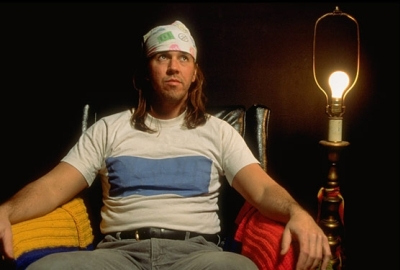
David Foster Wallace with bare lamp

Read on it’s own, the following passage from David Foster Wallace’s essay “A Supposedly Fun Thing I’ll Never Do Again” may sound pessimistic, fatalistic, oppressive. Read in context, I laughed so long and so hard that my face began to hurt. It is, nonetheless, a painful truth:

I am now 33 years old, and it feels like much time has passed and is passing faster and faster every day. Day to day I have to make all sorts of choices about what is good and important and fun, and then I have to live with the forfeiture of all the other options those choices foreclose. And I’m starting to see how as time gains momentum my choices will narrow and their foreclosures multiply exponentially until I arrive at some point on some branch of all life’s sumptuous branching complexity at which I am finally locked in and stuck on one path and time speeds me through stages of stasis and atrophy and decay until I go down for the third time, all struggle for naught, drowned by time. It is dreadful. But since it’s my own choices that’ll lock me in, it seems unavoidable — If I want to be any kind of grownup, I have to make choices and regret foreclosures and try to live with them.

For a sense of how funny this essay is, Mr. Wallace reads an excerpt here starting at 10:00 minutes in (the preceding story about the baton twirlers at the Illinois State Fair is better read here at the Harper’s Magazine 150th Anniversary on 25 May 2000).

Okay, Okay, I’ll Say Something Nice About D.C., Pt. I

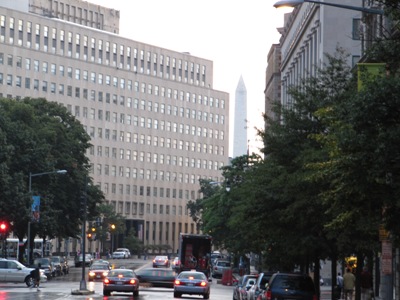
The Washington Monument peeking out from behind the Export-Import Bank and Dana buildings, L Street NW, looking south on 15th Street, Washington, D.C., 21 August 2009

Washington, D.C. is a miserable town and I am known to go on and on over the how and why (If D.C. is so miserable, why have you persisted in living here for six years? I plead complacency). But let me set that aside and say something nice about D.C. for once.

Something that I love about Washington, D.C. is how occasionally, when I don’t expect it, if maybe I get a little turned around in a neighborhood that I know less than others, or where I don’t have its relations to the adjacent areas down quite right — and I’m not saying that it happens all that often — but occasionally, all of a sudden the Washington Monument will pop into view where it’s totally unexpected. I don’t mean something like the view down 16th Street toward the White House, with the Washington Monument slightly off center, monumental kludge, throwing off the meridians of the district. That’s too obvious. I’m not saying that it happens all the time and that you can see the thing everyplace you go in town. If fact, it’s strange for all the height limitation and surrounding hills and all, for how much of the territory of D.C. the Washington Monument is not a presence at all.

I’m thinking of the obscure, peek-a-boo moments. The picture above is one of my favorite examples. This is the view from L Street NW, south on 15th, between the Export-Import Bank building (large blank facade on the left) and the Dana building (barely showing to the right). It’s such a narrow gap through which the Washington Monument appears that walking east, you come out from behind the corner of the building, cross the south-bound monumental sidewalk, step out into the street and have cleared the parallel-parked cars and taken your first step into the first lane of traffic before it pops into view. By the time you have traversed that first automobile lane, it’s already disappeared again behind the Dana building.

I’ve never been much of a fan of any particular architecture, but the play of building on building that comes from motion through a cityscape, the conciliance of many architectures that comprises a city is wondrous to me. Amidst praise, if I may briefly tack back in the direction of disparaging Washington, D.C., this is another place where the city comes up short. That said, the Washington Monument is a fun little game element of the cityscape in D.C.

First Naan

My first attempt at naan, a vegan cilantro version, 20 August 2009

My first attempt at making naan. I used cilantro instead of garlic and made the usual vegan substitutions to the first hit on Google, the AllRecipes naan. It came out listing a little in the direction of focaccia, but good.

Improvisation: Any of the family of pan-based breads are good for me as the entire six years I’ve lived at this residence, the stove has not worked. I don’t own a rolling pin so an empty wine bottle had to substitute.

Early bread making lesson: if you used the last of the flower in the dough and don’t have any left to dust your rolling surface, pin or hands, then you must abort. Thankfully the “Convenient Mart” (that’s what the sign says) stocks more than the usual quick food items.

Infinite Summer Informal-Irregular Get-Together IV

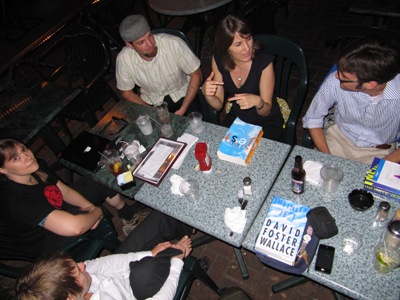
Infinite Summer Informal-Irregular Get-Together IV, Mr. Henry's, Capitol Hill, Washington, D.C., 6 August 2009

6 August 2009, Mr. Henry’s, Capitol Hill, Washington, D.C.: Infinite Summer Informal-Irregular Get-Together IV to discuss David Foster Wallace’s Infinite Jest. Clockwise from 12:00: typicalsquirrel, Miruna Stanica / Rrose Selavy, Daniel Ginsberg / NemaVeze, the photographer (off frame), Sarah Webster, Quinn Norton (blog | twitter | Wikipedia), Matt Dickerson / piscivorous. Oh, that’s right, piscivorous, you weren’t there.

Dumpling Soup

Last night I had a dream that I was making a dumpling soup.

So today I made one.

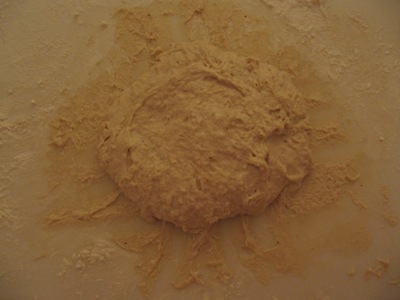
Until very recently I’ve never used anything more than a few tablespoons out of a bag of flower for a roux or a thickener. Lately I’ve been doing a lot of very flower-centered work in the kitchen, despite not having had a working stove for the entire six years that I’ve lived here (see “Tyler Durden’s House,” 15 April 2007). But tonight was the first time I’ve ever made anything that required me to knead and allow rest.

My first product requiring kneading, 28 July 2009

I could almost hear Alton Brown’s voice explaining the formation of the gluten structures and the importance of the right balance of kneading and rest to texture.

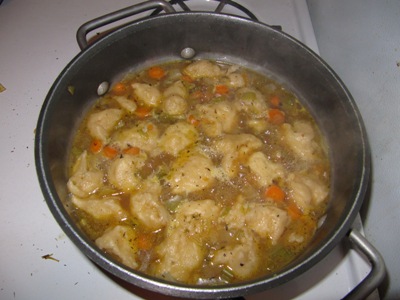
Anyway, cut off spoon-sized pieces, ball them up, drop them in the boiling pot and violà:

Boiling dumplings in soup, 28 July 2009

Dumpling soup.

Space Rendezvous

Okay, so my posts on Apollo 11 have been a little Stanley Kubrick-esque. In the film 2001 (Wikipedia | IMDB), the proto-human throws a bone into the air where it is suddenly replaced by ship engaged in an elaborate docking maneuver with a rotating space station, set to Strauss’s waltz, Blue Danube. It is one of my favorite scenes in all of cinematography because of its purely aural-visual implication of the technological continuum from the first tool through the most unrecognizably advanced, and then, in the dance of space ships, the humaneness of otherwise inhuman machines .

On space maneuvers being like dance, here’s the official NASA Apollo 11 Spacecraft Commentary from the radio broadcast of the mission explaining what’s going to happen during the docking maneuvers of Command Module Columbia and Lunar Module Eagle (APOLLO 11 MISSION COMMENTARY, NASA, Manned Spaceflight Center, Houston, TX, 7/21/69 CDT 13:40, GET 125:08, 413/1, p. 466):

In all of these maneuvers Mike Collins aboard Columbia is spring loaded to do what is called a mirror image maneuver approximately a minute after the Eagle is scheduled to make its maneuver, and if for some reason Eagle can not make the maneuver, Collins would do the exact same maneuver only in reverse so that Columbia would in effect begin a CSM active rendezvous with Eagle.

The dance analogy seems apt here because, like Ginger Rogers with Fred Astaire, Michael Collins had to do everything that Buzz Aldrin did, only backwards and in a command module.

Frenetic Fojol Cusping on Celebrity

It’s been a big couple of days for the Fojol Brothers. Thursday was their weekday lunch debut and they were back again on Friday (I parenthetically hedged, though they said right there in their tweet that it was their first weekday daytime appearance).

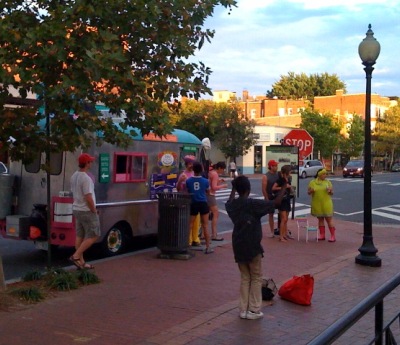
Fojol Brothers, Lamont Park, Mount Pleasant, 19 July 2009

Today they were in my neighborhood on the corner of Lamont Park in Mount Pleasant. And it was quite a show. There are two new Fojol sisters, Mewshah and Bhujaja. The AcroFiends were there, just to eat though, Peter / Kipoto, girlfriend in tow, was there out of costume as it was supposed to be his day off from Fojol.

Kahn, Howie, "Keep On Food Truckin'," GQ, August 2009, p. 34

On Thursday they told me that they were getting profiled in GQ. On Friday Justin / Dingo had the issue with him and they got the introductory page to a whole piece on food carts in various cities.

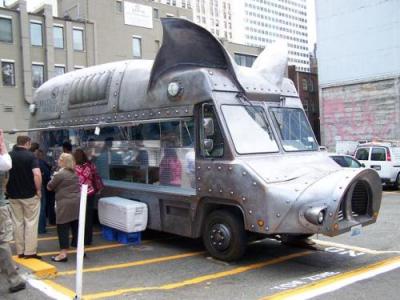
Seattle's Maximus Minimus pig truck

As is often the case with such articles, it’s somewhat arbitrary in selection. For instance, I have no idea how GQ could have missed Seattle’s mind-bogglingly tricked out Maximus Minimus (website | twitter).

After wrapping up in Mount Pleasant today, the Fojol Brothers tweet that they will be at Eastern Market all day tomorrow.