The Electromagnetic Sediment of the Noosphere

Regarding the possibility of the Earth remaining hidden from detection by alien civilizations by running silent, New Scientist points out that it’s already too late (Shostak, Seth, “It’s Too Late to Worry That the Aliens Will Find Us,” 3 July 2010):

We have been inadvertently betraying our presence for 60 years with our television, radio and radar transmissions. The earliest episodes of I Love Lucy have washed over 6,000 or so star systems, and are reaching new audiences at the rate of one solar system a day. If there are sentient beings out there, the signals will reach them.

(Related: “The Noosphere Visualized,” 1 January 2009)

“Working Around the Problem”

The IT Mentality:

User: “Help there’s an alligator in my cubical!”
IT: “Do you have to place your bum directly in the alligator’s mouth when you work, or can you work around the alligator?”
User: [reluctantly admits] “Well, the alligator isn’t taking up the entire cubical.”
IT: “Okay, well, I’m going to close this help ticket for now. If the alligator takes a limb, you can always reopen it.”

The Last Days of Nature

In reaction to last week’s The New Yorker article on synthetic biology (Specter, Michael, “A Life Of Its Own,” 28 September 2009, pp. 56-65):

The objective of synthetic biology is the final subsumption of the logic of nature into the logic of capitalism. Capitalism being the logic of human desire, the objective of synthetic biology is — as with the whole of the technological endeavor — the elimination of all intercession between desire and its fulfillment. It is the attempt to return to the purity of the hallucination of the breast, to do away with despised reality testing, the creation of a world of pure subjectivity.

For a cyberpunk rereading of Hegel: Freud as the last of the Young Hegelians.

One Ping Only, Vasili

A few weeks ago I met up with some friends and we were walking through the busy Gallery Place / Chinatown area, all three of us heads down studying our various hand-helds (two iPhones and an Android). I joked that the app that we need is something like the range-finders from the Alien movies, only that does picture-in-picture on our phones so we can see what’s coming without having to look up from our immersion in our respective virtual worlds as we walk through heavy pedestrian traffic.

The absurd extent of the anxiety of influence: not only if you’ve had a good idea can you count on someone having already had it, but if you make a joke about something absurd, you can rest assured that someone is already doing that too. It turns out there is already a sonar app for the iPhone (Frucci, Adam, “iPhone’s Sonar Ruler App Measures Distance Using Sound,” Gizmodo, 21 August 2009).

(Jokes about iPhone apps follow the same formula as jokes about hitherto unnamed but always Johnny-on-the-spot when convenient members of the Smurf village: think of an absurd or inappropriate function, append “smurf”; e.g. Cuckolding Smurf finds life in the Smurf village paradisiacal; or sumrfs keep themselves free of tropical disease by regularly licking Quinine Smurf; In the case of iPhone apps, name an absurd function, then say “There’s an app for that.”)

Sociobiology as the Transcendence of Biological Ecology

The central idea of sociobiology is that the emergence of social creatures (herd animals) coincided with the creation of what might be termed a socio-cultural environment. The socio-cultural environment is as much an environment that social creatures inhabited as the material environment. As social creatures evolve, two things happen to the socio-cultural environment:

  1. As with evolution of species morphology, the maximum complexity of socio-cultural environments increases (there is selection pressure on the entire socio-cultural environment as, say, predators develop way of thwarting or exploiting the social aspect of their prey and the social species evolve to countervail this development, e.g. parasitic cordyceps and ants; that is, there is species-level selection, since a social characteristic unrecognized by a counterpart comes to nothing; consider this as an analogy for fourth generation warfare).

  2. Subsequent generations of herd animals come to rely ever more heavily upon social cohesion — as opposed to horns, honed perceptive apparatus, efficient digestion, et cetera — as their primary means of survival.

As this socio-cultural environment becomes more sophisticated and intricate and increasingly important as a means of survival, the socio-cultural environment grows in importance as the universe of factors shaping the evolution of social animals, while the objective, geological, hydrological and biological environment recedes in its evolutionary force.

Sexual selection (a type of sociobiological selection, as opposed to natural or Malthusian selection) is the sort of selection pressure that a species faces when its fellows, rather than the environment becomes the main challenge to getting its genes into the future. The shifting balance of natural selection and sexual selection in the play of evolutionary forces is meta-evolutionary. Evolution is recursive, with developments in the subjects of evolution backpropigating into the mechanism itself. In this respect every new thing in the universe (or at least in the effective realm) can potentially alter the functioning of the evolutionary dynamic. In this broadened perspective, the idea of machine or meme evolution supplanting biological evolution should not be so surprising.

Among a certain sector of the wildly technologically enthusiastic (among whom I count myself, though Matthew Crawford’s Shop Class as Soulcraft: An Inquiry Into the Value of Work is presently doing a lot to kick the piss out of this pretention), there is a notion that humans are rapidly disencumbering themselves of the material world and constructing for ourselves a world of pure ideas, information, mind-stuff. At some point in human history saber-toothed tigers, virulent microbes, droughts and tar pits ceased to be the primary challenge to humans seeking to survive and reproduce. Such extra-human threats were replaced as the primary danger by human-originating threats such as careening contraptions, shoddy construction techniques, insufficient precaution with the kitchen fire, marauding hoplites, jilted dagger-wielding lovers, corrupt institutions and flawed regimes of succession in governance. It is at the point where today it is plausible that the human socio-cultural environment has attained a level of preponderance where even the level of environmental catastrophe such as an asteroid strike that caused the mass extinctions of the past might be thwarted by the constituents of the human socio-cultural environment (on the other hand, the complexity of our socio-cultural environment might be just the sort of run-away biological factor that caused past mass extinction such as the oxygen catastrophe or the Canfield ocean thesis of the Permian–Triassic extinction event). In this conception, it is usually the the information revolution, the invention of the computer — a brain-like device — that is the cause of this transcending of matter. The advent of technology was not the key turning point. The recognition of sociobiology is that this trend is an aspect of evolution; that it long predates not only technology, but also even predates humans. In this way, we are not unique, not the penultimate branch of the tree of life, but only the latest in a succession of forms.

Update, 15 September 2009: It’s worth noting that while computers are not the revolution, nor the source of the revolution, they do form a paradigm, shaping our conceptualizations in ways that allow us to perceive the revolution.

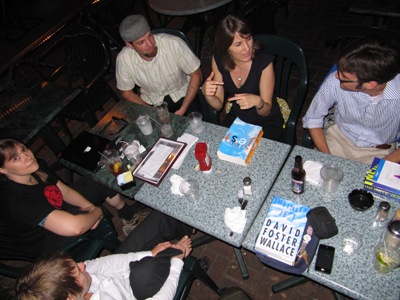
Infinite Summer Informal-Irregular Get-Together IV

Infinite Summer Informal-Irregular Get-Together IV, Mr. Henry's, Capitol Hill, Washington, D.C., 6 August 2009

6 August 2009, Mr. Henry’s, Capitol Hill, Washington, D.C.: Infinite Summer Informal-Irregular Get-Together IV to discuss David Foster Wallace’s Infinite Jest. Clockwise from 12:00: typicalsquirrel, Miruna Stanica / Rrose Selavy, Daniel Ginsberg / NemaVeze, the photographer (off frame), Sarah Webster, Quinn Norton (blog | twitter | Wikipedia), Matt Dickerson / piscivorous. Oh, that’s right, piscivorous, you weren’t there.

Singulitarian Panic Goes Mainstream

Last week both the New York Times and New Scientist featured articles seriously speculating about the danger posed to humans by intelligent, belligerent robots. This week The Telegraph follows suite (Markoff, John, “Scientists Worry Machines May Outsmart Man,” The New York Times, 26 July 2009, p. A1; Campbell, MacGregor, “Artificial Intelligence Researchers Confront Sci-Fi Scenarios,” New Scientist, 29 July 2009; “Military Killer Robots ‘Could Endanger Civilians’,” The Telegraph, 3 August 2009). Also this week, an older story made the rounds about a Swedish company that was fined 25,000 kronor ($3,000) after a malfunctioning robot lashed out and nearly killed a maintenance worker (“Robot Attacked Swedish Factory Worker,” The Local, 28 April 2009). The prosecutor stated that, “I’ve never heard of a robot attacking somebody like this,” but as Matthew Yglesias points out, it’s not just the proletariat that’s under attack: Japanese Prime Minister Junichiro Koizumi was attacked by a robot in 2005 (“Robot Attacks Aren’t Just for Comedy, ThinkProgress, 29 July 2009; “Robot Attacks Japanese Prime Minister,” we make money not art, 21 August 2005). Finally, not only do we fret and fantasize over disaster, we make satire of it as well, as in this extreme anti-smoking video (Woerner, Meredith, “Smoking: It’s Only Enabling The Machines,” io9, 3 August 2009).

That’s a lot of fretting over robots for one week. Even 25 years after The Terminator (IMDB | Wikipedia), the robot apocalypse has remained a pretty geeky fantasy / disaster, but I would say that it’s approaching NBC (nuclear, biological, chemical) / CERN accidentally creating a mini-black hole level consciousness as a destroyer of humanity. Now if we could just gin up a little more fear over nanotech / grey goo / ecophagy / ice-9.

Space Rendezvous

Okay, so my posts on Apollo 11 have been a little Stanley Kubrick-esque. In the film 2001 (Wikipedia | IMDB), the proto-human throws a bone into the air where it is suddenly replaced by ship engaged in an elaborate docking maneuver with a rotating space station, set to Strauss’s waltz, Blue Danube. It is one of my favorite scenes in all of cinematography because of its purely aural-visual implication of the technological continuum from the first tool through the most unrecognizably advanced, and then, in the dance of space ships, the humaneness of otherwise inhuman machines .

On space maneuvers being like dance, here’s the official NASA Apollo 11 Spacecraft Commentary from the radio broadcast of the mission explaining what’s going to happen during the docking maneuvers of Command Module Columbia and Lunar Module Eagle (APOLLO 11 MISSION COMMENTARY, NASA, Manned Spaceflight Center, Houston, TX, 7/21/69 CDT 13:40, GET 125:08, 413/1, p. 466):

In all of these maneuvers Mike Collins aboard Columbia is spring loaded to do what is called a mirror image maneuver approximately a minute after the Eagle is scheduled to make its maneuver, and if for some reason Eagle can not make the maneuver, Collins would do the exact same maneuver only in reverse so that Columbia would in effect begin a CSM active rendezvous with Eagle.

The dance analogy seems apt here because, like Ginger Rogers with Fred Astaire, Michael Collins had to do everything that Buzz Aldrin did, only backwards and in a command module.

Apollo 11

At 20:18 UTC / 4:18 PM Eastern time, Lunar Moduel Eagle landed on the surface of the moon. Six hours of checking over instrumentation, preparations and suiting up ensued. At 02:56 UTC / 10:56 PM Eastern time, forty years ago, Neil Armstrong climbed down the ladder of the Lunar Module and became the first human to walk on the surface of a planet other than the one on which he originated.

The clichéd original “Yes we can” refrain aside, I often reflect on the fact that humans have been to the Moon and find that I can hardly believe it. And we did it forty years ago. It’s a feat I would be hard pressed to imagine we could do today, and yet we did it forty years ago!

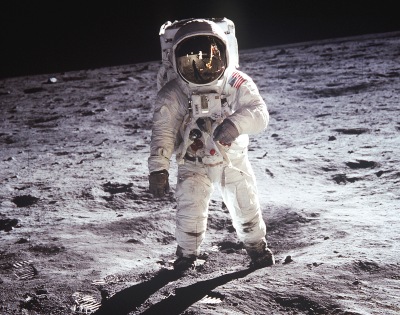
This is a picture of a human walking on another planet:

20 July 1969, Buzz Aldrin walking on the Moon

This is a man in the second half of the Twentieth Century.

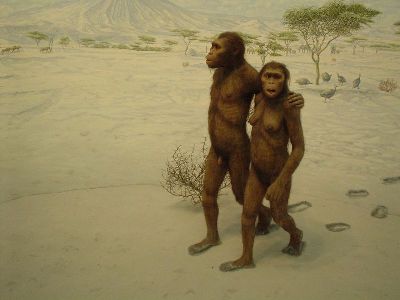
Three and a half million years earlier, humans looked more like this:

Australopithecus afarensis depicted in the Laetoli footprints diorama at the Natural History Museum, New York

This, a hairless ape, set out to explore the universe forty years ago.

This is a picture of a lander vehicle and an interplanetary vehicle conducting docking maneuvers in orbit around another planet (the Earth can be seen 384,403 km away in the distance):

21 July 1969, Lunar Module Eagle as seen from Command Module Columbia

We have actually constructed vehicles for the purpose of flying to other planets, and other vehicles for landing, and those vehicles have done so, and conducted maneuvers in orbit around another planet. There are people among us who know how to do this: engineers who can design and construct the vehicles, physics who can plot the course and lay out a mission plan, people capable of piloting the ships. It’s hard to believe.

That it has been forty years since we have done such a thing seems like a bit of a fall. What must it be like to be one of these people, a relic of the future?

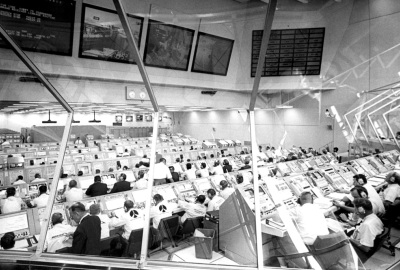
Our Odyssey

Countdown to launch of Apollo 11, Firing Room 1, Kennedy Space Flight Center, 16 July 1969

NASA is currently streaming the complete mission recording of Apollo 11 in real time in recognition of the 40th anniversary of the first manned Moon landing.

It feels appropriate to listen to an Apollo 11 cycle, so to speak. This is a performance of an incredible history and a true adventure. This is our Odyssey. The Iliad and the Odyssey were typically performed over three nights. Apollo 11 was four days from launch to touchdown on the Moon (16-20 July 1969; splashdown back on Earth 24 July). John F. Kennedy, Wernher von Braun, Neil Armstrong are our Homer, Agamemnon, Akhilleus and Priam.

I have heard it explained that part of the reason that Joyce’s Ulysses is such a pastiche is that he was trying to cram all the language of Dublin into a single work. Similarly, this week I was talking with some people about the way that David Foster Wallace appropriated the languages of commercial communication, technical writing, bureaucratic memoranda or the casual writing of e-mail to the purpose of literature. The language of our Odyssey is not Dublin bar talk, lyrical poetry or bard’s tale, but bureaucratese, engineering-speak: gage readings, mission book codes, equipment test reports, pre-burn checklists. Instead of the lyre and drum, we have the harmonics of white noise — a combination of the cosmic background radiation and electromagnetic interference of the communication and recording gear itself — and the synthetic electronic beeps of computers.