Dumpling Soup

Last night I had a dream that I was making a dumpling soup.

So today I made one.

Until very recently I’ve never used anything more than a few tablespoons out of a bag of flower for a roux or a thickener. Lately I’ve been doing a lot of very flower-centered work in the kitchen, despite not having had a working stove for the entire six years that I’ve lived here (see “Tyler Durden’s House,” 15 April 2007). But tonight was the first time I’ve ever made anything that required me to knead and allow rest.

My first product requiring kneading, 28 July 2009

I could almost hear Alton Brown’s voice explaining the formation of the gluten structures and the importance of the right balance of kneading and rest to texture.

Anyway, cut off spoon-sized pieces, ball them up, drop them in the boiling pot and violà:

Boiling dumplings in soup, 28 July 2009

Dumpling soup.

Sweltering Rain

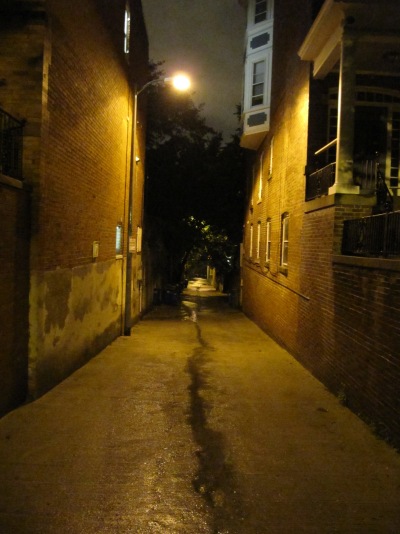
A hot, wet night in Washington, D.C., 23-24 July 2009

It alternated scorching heat and opaque, battering summer storms all day today. The monumental buildings may mislead that this is the seven hills of Rome — the Potomac is our Tiber, or perhaps given it’s inaccessibility, our Chao Phraya — but after you’ve lived here for a while there’s no mistaking it: the heat, the damp, the vegetation, the smells of decaying plant gonads, the short primitive trees, the cicadas: Washington, D.C. is a swamp.

Fojol Do Lunch

Fojol Brother Peter Korbel, weekday lunch in front of the IMF building, 16 July 2009

Fojol Brothers had their first (at least since I’ve been following them) weekday lunch. They parked at the corner of 19th and Pennsylvania Avenue, at Edward R. Murrow Park in front of the IMF building, necessitating a bit of a hike on my part, but always worth it.

While ordering, Peter (above) told me that a picture of me was included in their write-up in Brightest Young Things (Nicholson, Alex and Dakota Fine, “Hitting the Streets With: Fojol Brothers of Merlinida,”, 13 July 2009). This is not a surprise since they asked if I would pose for a food shot. I’m the guy in the bike helmet in the first large photo. Oddly enough this was my first time catching the Fojol Brothers. In the photograph accompanying my first post on the Fojol Brothers, I think that the guy in the foreground turning around to look back is Dakota Fine, the photographer for the Brightest Young Things piece.

I think that the Fojol Brothers have so far been limited to nights and weekends by their other commitments. I hope this is an indication that things are viable enough where they’re going to be doing it a lot more.

My Unconscious is Earnest; It’s Only My Ego That’s Nihilist

David Foster Wallace is already starting to get inside my head (I’m reading Infinite Jest as part of the Infinite Summer project). Last night I had a dream that S. and I were moving to a new place, an old facility building that had been converted into residential dwelling, located on a sparsely built, wooded former campus of some sort (E.T.A.?) on Lake Washington in Seattle. The current resident of the unit was David Foster Wallace and according to whatever dream logic was in effect, we were moving in a few days before he was moving out (it was revealed later in the dream — because you discover your dream personae as you discover those of other people — that the occupant prior to us of the place from which we were moving was also David Foster Wallace). We engaged in a series of joint activities in the period of our overlap, one of which included sitting together around a large table with a lot of simply cut, craftsman-type ornamentation as we painted it. Mr. Wallace was telling us how good these sorts of communal art works are when in a moment of cynical snark, of which I am want — at least dreamworld Donald is accurate in this respect — I insisted, “Yeah, but this sort of artistic self-indulgence is just a few steps removed from scrawling inscrutable messages on the wall in your own feces.” At which Mr. Wallace treated me to a considerable upbraiding regarding the failings of my detached, ironic stance. I struggled to defend my position of cynicism, but only flailed rather impishly in the face of his well reasoned criticisms. The argument, and my failings, continued through an afternoon’s shoreline scrub brush walk.

I know, I know, blogging your dreams! Is there anything more boring than other peoples’ dreams? It’s bad enough to have to hear about them while struggling for bathroom sink time in the morning; then to go and blog about them! I’ve tried to keep it brief, only to serve as an example of how quickly (I’m only on like page 50) and in what ways David Foster Wallace is getting in my head in a way that no novel has in a long time.

Fojol Brothers and the Changing Face of Washington, D.C.

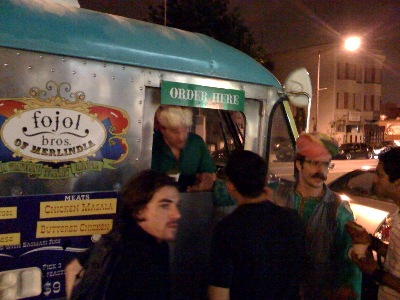
The Fojol Brothers traveling culinary carnival, 14th Street, just south of U Street, 20 June 2009, 1:45 AM

I’ve been following the Fojol Brothers traveling culinary carnival on twitter for approaching two weeks now. I just happened to choose the wrong time to follow them as there’s been no activity since that time. Then tonight I go to P and 21st and am oblivious that that they are catty-corner at 20th and Q, but they tweet that they will be reestablishing themselves on U Street at about midnight. I’m constantly refreshing my twitter feed to get the news. At about 12:30 they tweeted that they are serving food at 14th and U Street NW. I jumped on my waiting bike.

As I was leaving the house, I considered knocking on the door of the upstairs neighbors to ask if any of them wanted to join me (it would be safe to count on a significant portion of them to be awake and ready for spontaneous adventure at that hour). Turns out it was unnecessary. I had taken about two bites of cauliflower and potatoes when Duff walked up. He had played a gig on U Street. He got some Fojol Brothers food too and we leaned against the windows of the fast food places on the corner and talked for a few minutes. He commented that he keeps on finding little enclaves in the city that don’t feel like D.C. anymore. I concur. A similar thought struck me twice — I guess Fojol Brothers included, three times — just today. Increasingly I am seeing people who seem to be other than the usual social climbers, and engaged in activities outside the norm of the straight and narrow required by the power and influence track.

When explaining what’s wrong with D.C., I often tell people that it’s a one company town and that the imprint of the government is on everything in the whole city. D.C. just might be cusping on that critical mass where it starts to develop a culture autonomous from that of the strictures of political power.

On the other hand, a few years ago I had a Capital Hill barkeep, something of an institution himself, tell me that D.C. was a different town when the Democrats were in charge, that it was just more fun. Maybe the city independent from the government still sucks, it’s just that the government has upgraded.

I talked for a few minutes with one of the Brothers. They’re very much in promotional mode right now. He’s a lifelong D.C. resident and the son of a D.C. activist couple. His childhood meals were always strategy sessions of civil rights leaders or dialogues between Israelis and Palestinians and it’s that spirit of people coming together under extra-ordinary circumstances, but around food, that he hopes to create spontaneously on the street and in the virtual world. He talked about a getting together with other street food venders for a street party and his plans to work with District at-risk youth programs to have some of their kids join the Brothers in their culinary carnival (Anthony Bourdain profiled a similar program, the D.C. Central Kitchen, when No Reservations was in D.C.).

If the Federal Government has become more fun, the District remains determined to squelch any outbreak of unsanctioned quality of live improvements. At about 2:30 AM the po-po showed up and asked to see their street vendor’s license, which they promptly produced. But the officer began to sweat tem down over how this was non-vending zone and how they were past the hours allowed according to their permit. They quickly folded up shop and took off. I sent them a message later that evening encouraging them not to let this get to them. They messaged back that they’re still figuring out how things are going to work, but that they don’t intend to give up.

There Goes the Neighborhood

I’ve walked past the storefront remodel in progress. I’ve read the business license application postings. I’ve received the nearlybot direct messages on twitter (C., Donna, “Bliss Out(side) in Mt. Pleasant,” We Love DC, 12 June 2009). I’ve fretted about it in the past. But as of this afternoon Mount Pleasant crossed the line from gentrifying and marginal to fully yupped out. There’s fucking yoga in Lamont Park in Mount Pleasant.

Yoga in the triangle park in Mount Pleasant, Washington, D.C., 16 June 2009

Look at those SNAGs (I guess in the aught years they’re called metrosexuals) in the back rows — the better to check out the women’s bulging naughty bits as they assume genitally awkward positions. Leering Mexicans move it along. Leering is only allowed for those engaging in compensatory activities.

34

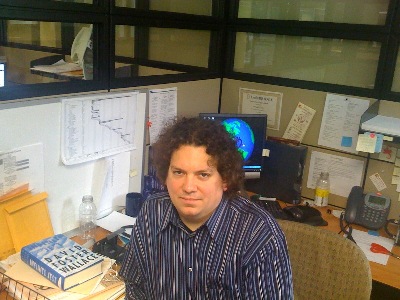
10 June 2009, 34th birthday, spent in my cubical

I’m 34 today.

I intended to take the day off and do some biking around like I did last year, but the project that I’m working on was presented to the client and the COO of the company today, so office birthday it was. During the run through yesterday we discovered a show-stopping system flaw and I spent one of the most stressful days of my career in a panicked flurry of debugging and emergency releases. I’m giving myself an IOU on birthday.

Amazon.com gave me a birthday present by delivering a copy of Infinite Jest two days in advance of their estimate (their logistics people are geniuses). Between the book, my twitter and this blog I’m all geared up for Infinite Summer.

8,000 Page Fantasy Life

I’m just wrapping up twelve weeks of Hitler and Stalin at the University of Maryland, and has been my experience with every class I have ever taken, I end with not much more than the sense of just how little I know about the subject. I then spend a postmortem of fantasy about actually becoming an expert in something-or-other. The 540 pages of Geyer and Fitzpatrick’s Beyond Totalitarianism: Stalinism and Nazism Compared and similar number of pages of selected journal articles weren’t enough. Thus, a Year of Hitler could be in my future as well (Barnett, Erica C., “My Year of Hitler: Six Things I Learned from Reading 8,000 Pages About the Nazis,” SLOG, The Stranger, 26 May 2009). Coincidentally, I’m tentatively titling my paper “Seven Ways to Think about Stalin during the Interbellum.”

Flowers of Evil on L Street

Nasty mushroom pile in the sidewalk planter box, L Street NW, between 15th and 16th Streets near the Washington Post building, 26 May 2009

I’ve been working where I have for starting on my fourth summer, which means the same commute for approaching four years. Modern society is clockwork so the monotony is murder. I know all the timing on all the lights at all the intersections from the bus stop to the office. And it’s that way for everyone so I swear that I must step in front of the same guy preventing him from make the same right turn on red every morning.

But there are cycles with cycles, so with enough perspective there are higher orders of monotony. Every year for four years now, after the first summer storm this same nasty pile of mushrooms bursts forth from the sidewalk planter box on L Street NW, between 15th and 16th Streets, near the Washington Post building.

Most years they are normal mushroomy brown. This year they look bizarrely like some flower of evil native to Mordor.

The Last Trace of 1968

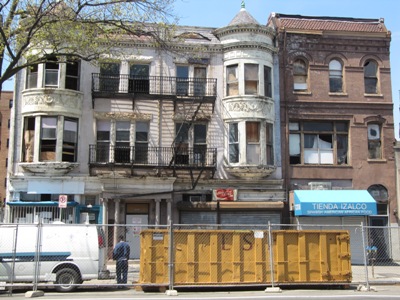
The last of the 1968 Martin Luther King, Jr. assassination riot damage, 14th Street NW, between N Street and Rhode Island NW, 24 April 2009

When I first moved to D.C. in 2003 I set out to explore. My aunt had told me that it was unwise to go east of 16th Street but I did anyway. I remember walking up 14th Street NW toward U Street and it being obviously a neighborhood in transition. There were a few new places, but much remained burned out and deserted. The middle class people who were there were the homosexual vanguard of gentrification.

I simply thought of it as the usual urban decay and renewal, but it turns out that 14th Street had something unique about its desolation. Here’s the AIA Guide to the Architecture of Washington, D.C. (Baltimore, Maryland: Johns Hopkins University Press, Fourth Edition, 2006):

The Logan Circle / Shaw area declined gradually until 1968, when a series of riots in the wake of the assassination of Martin Luther King, Jr. dealt a devastating blow. Angry mobs set fire to businesses that refused to close in mourning of the slain civil rights leader, and the physical and psychological scares of that tragic period are still evident in various corners of the neighborhoods. (p. 268)

Fourteenth Street wasn’t just any urban decay, but was where some of the most notable of the rioting and arson had occurred in 1968. The damage to the buildings that I was witnessing was the damage that had been done then and the area was only now, 35 years later, starting to be repaired. The scars were those rent in anger over the assassination of Martin Luther King, Jr.

I have lived in Washington, D.C. for six years now and during that time the 14th Street corridor has gentrified significantly and the street of which it would be unwise to go east has moved significantly further eastward. At this point 14th Street is more or less a continuously nice street from the Mall all the way up to Columbia Heights and on to … I don’t know where … probably where 14th Street terminates at Iowa Avenue out in the early generation suburbs (I’ve commented previously on the transformation of 14th Street at Columbia Heights here: “The Future of Columbia Heights,” 25 February 2007). The last remnants of the 1968 riots is the block between N Street and Rhode Island NW (pictured above) and now even it is being refurbished. When they are done there, the last physical remnant of the 1968 anger will finally have been erased.

In a city of monuments, I almost feel as if they should leave it as a monument to the end of an era, to a bad year, to a time when the populace wouldn’t take it, when misdeeds were met in kind and to the city that was. Cities need to change, but they need to show their history as well. When this refurbishment is complete, the District of Columbia will have gained a few thousand more square feet of places to go and to live and a few thousand dollars more in rent and taxes, and a neighborhood blight will have been eliminated, but the record of 1968 in our everyday, non-nostalgic, non-consciously historical lives will be gone.