No Sleep for George W. Bush

Celebrating the Obama victory, Pennsylvania Avenue in front of the White House, 3:35 AM, 5 November 2008

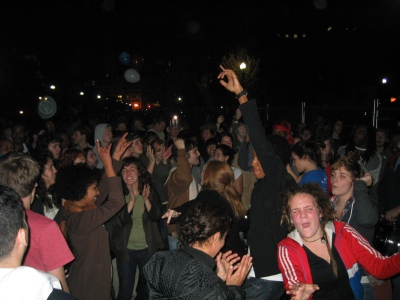
After results and President Elect Barack Obama’s victory speech, at about two in the morning, I got on my bike and rode down to the White House where a huge crowd had assembled along Pennsylvania Avenue to taunt the lame duck. President Bush probably didn’t sleep well last night. Hundreds of people were there screaming and carrying on. People brought improvised percussion instruments. People chanted, “Move your shit, move your shit” in the direction of the White House.

People were blaring their car horns all throughout the city, but I Street, the street just north of Lafayette Park, was the unrelenting car horn epicenter. Nearly everyone who drove past stood on their horn the whole way. People shouted out their car windows as they passed. Pedestrians took over streets, drivers too caught up to care. Over at Franklin Park someone with a built out car stereo opened the doors and cranked it. Another guy stripped down to his boxer-briefs and danced on top of his car. It was a true spontaneous street party.

DCist has pictures and stories at “Washington, D.C. Celebrates Obama Victory Well Into the Morning” and “More D.C. Election Night Dispatches.” Flickr has more from around D.C. SLOG has great pictures of the same from Seattle at “Where is the party right now?,” “More of Your Photos From Last Night” and “It’s 2:30 in the Morning….” Neighbors hauled the stereo up to the roof to blare a dance remix of “Don’t Stop Believing” to street revelers.

District of Columbia, Precinct 39, Ward 1

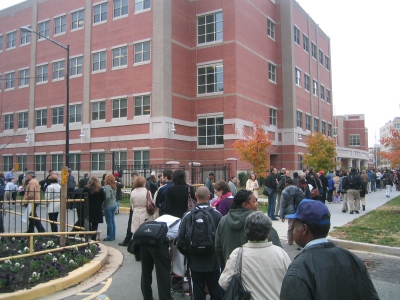
Election day, Precinct 39, Ward 1, Bell Multicultural High School, District of Columbia, 4 November 2008

I’ve only voted one time in my life, when at the age of 18 or 19 my mother requested an absentee ballot for me, sat me down at the dining room table and showed me how to fill it in. It was an off year and it was some issues and offices entirely forgettable. I consider voting to be mostly irrational behavior since the chance of my swaying my state’s slate of electors is somewhere on the order of < 0.5*10-7. Being permanently ensconced in the liberal archipelago, my vote matters even less. But this election is historic and I figure some children might ask me about it some day. Having to answer that I didn’t vote would be quite the wet blanket.

So for the first time in my life I drug my ass out of bed at some hour where birds and worms lock in mortal combat, hauled on last night’s clothes and walked a few blocks over to precinct 39, ward 1 voting center, namely the Bell Multicultural High School theatre and voted. I got there twenty minutes after polls opened. Nonetheless, the line stretched out the door, down the block, into the D.C. Parks Department parking lot, where it snaked around the perimeter, then back out onto the sidewalk, to the end of the block, across the street and part way down the next block. It was cold enough this morning that people were wearing gloves and hats and performing little mini-callisthenic foot shuffle dances while they waited.

We had an option of voting paper or electronic. Since I was unsure that I could properly navigate a grid of arrows, bubbles and names with my eyes, and since being victimized by Diebold seemed exciting, I opted for electronic.

Of course I voted for Senators Barack Obama and Joe Biden. For fun I also voted for House of Representatives Observer Elinore Holmes Norton, a friend of the Colbert Report, and as a cantankerous and cranky old lady, one of the few figures in public life with which this pessimist can identify somewhat.

After two hours and twenty minutes I was on my way back home. There wasn’t much by way of excitement. Some people took pictures. Some high school students shouted pro-Obama slogans from the upper-floor windows. Many cars honked as they drove past our long line. Everyone seemed a little excited when a Navy official of some sort came out and ran the flag up the pole in front of the school. It was pretty bureaucratic. The flag wasn’t folded into one of those neat little triangles like boy scouts and marine drill squads are taught. He just came out with it wadded under his left arm, like it were the laundry. It was a nice autumn morning. The sky was grey. The most beautiful tree on my block had covered the sidewalk with a layer of variegated, crunchy orange leaves. The hot shower between my civic duty and work felt wonderful after that long standing in the cold.

And now the waiting.

Story of a Biker

Here’s how it works with bikes: first you don’t know how and don’t get those guys who dress like Indy cars with spandex diapers (Yglesias, Matthew, “Bikes,” TheAtlantic.com, 6 November 2007). Then some stupid user taunts you about being fat and lazy (Bloix, “comment,” TheAtlantic.com, 13 April 2008). So you buy a bike (Yglesias, Matthew, “Prepare for Bikeblogging,” TheAtlantic.com, 23 April 2008). A mere ten days later: I’d say that was some pretty effective taunt. Next thing you know you start getting all in the activist mentality and really enjoying it (Yglesias, Matthew, “Segway Boom,” TheAtlantic.com, 16 June 2008).

33

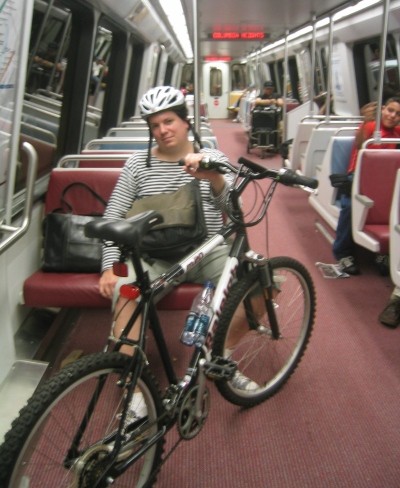
10 June 2008, 33rd birthday with bike

I turned over 33 years today.

I bought a bike over the weekend because I wanted to spend my birthday riding around town. It was surprising how easy it was to come into a new bike. I guess it shouldn’t have been. The previous bike came pretty easy too: it was left in the apartment by the previous tenant.

Anyway, I decided to ride the Mt. Vernon trail from Georgetown to Old Town Alexandria. People will often tout the Mt. Vernon trail as an aspect of what a livable city Washington, D.C. is. That this is a piece of D.C. livability speaks volumes. The Mt. Vernon trail is really just a sidewalk along the George Washington Parkway — and under the Reagan National Airport landing pattern. At one point, the trail is just a little berm between the Parkway and the airport runway. There are actually blast walls along part of the trail because they have backed up planes along it with their engines idling. It’s 95° out and the trail is a thin strip in the midst of 100 feet of blacktop on either side: one with thousands of cars averaging 80 miles per hour, the other with a jet landing every four minutes. Apparently D.C. people think this is a nice encounter with nature.

But it’s not so much the trail that’s miserable. The misery of the trail is only indicative of the larger problem, which is that D.C. has decided that the best use of the Potomac river is as a natural cut for freeways. On the Virginia side the river is walled off from the city by the George Washington Parkway. On the District side the river is more or less inaccessible all the way from Georgetown University to Anacostia Naval Base. The Mall, rather than ending at the river ends in one of the most confusing and nasty tangles of highway interchange in the country. The river is so cut off as to play no significant role in the life of the city. It may as well not be there. Washington, D.C. doesn’t even feel remotely like a river town.

Anyway, after the ride down, I said fuck it and took the train back into town.

Life in a Northern Town

Matthew Yglesias makes a point about U.S. cities that just hurts (“SoCal Tragedy,” TheAtlantic.com, 7 May 2008):

The thing you really forget about the deplorable land use and development patterns in southern California (and the Soutwest more generally) until you come back out here is how goddamn nice the weather is, a fact that takes the situation out of the realm of farce and into tragedy. You know what a good place to never walk anywhere would be? Boston or Chicago in the winter. Or maybe DC or New York in the summer. That’s some nasty weather to be walking around in.

But LA would be a great place to walk or ride a bike to work all year ’round. But it’s our bad weather belt that has the walkable cities, and our sunny and temperate all the time region that barely has sidewalks.

I have lived more or less my adult life in the Northwest, Seattle, briefly New York and for the last five years, Washington, D.C. I often consider the possibility of moving someplace nice. S., who doesn’t desist in sweater wearing until the temperature hits about 80 degrees, does so more often than me. But as soon as you start considering someplace nicer, you run into this impenetrable wall that everyplace in the sunbelt sucks. I’m not about to live in the old South or Texas for cultural reasons. Miami is physically very beautiful and almost serviceable from the standpoint of urbanism, but is one of the U.S. capitols of superficiality. And the entire Southwest is a wasteland of suburban environmental destruction.

How did this come about that the nicest parts of the country have nothing by way of great, people-friendly cities?

And then I think, even if Los Angeles were physically nice, would you really want to live there? I’m somewhat prone to those theories of cultural determinism based upon the temperate bands of the earth. The sun imposes a certain physicality which is why Los Angeles and Miami are the twin boob job capitols of the country and why, for all its avowed prudery, the old South is a hotbed of sexuality run amok (the counter-argument here is the ancient Mediterranean: both sunny and intellectually vibrant). I have somewhat just resigned myself to being a hunkered-down, rained upon northerner.

Falafel Quest

Pennsylvania working class aren’t the only bitter ones. Matthew Yglesias is bitter as well (“Bitters,” TheAtlantic.com, 13 April 2008):

I’m bitter about the way Meridian Hill Park and the street design in Adams Morgan makes it so difficult to get from my house to the Amsterdam Falafel Shop even though it’d be really close if I could fly.

I hear ya, brother! I live on 18th Street. Amsterdam Falafel is on 18th Street. Were it not for a gigantic gorge jutting out from Rock Creek Park between Irving and Harvard, it would be a straight shot. As it is, 18th doesn’t run through and I have to go a bunch of blocks east, then south, then jog a bunch of blocks back west again. As a result, I go to Amsterdam Falafel a lot less than I would like.

The First Casualties of Gentrification

I suspect that the first real consequences of the gentrification of Columbia Heights are starting to hit Mount Pleasant. I was walking home tonight when I noticed that the Mount Pleasant Super Market was closed with the usual signs up in the windows. A peep through the grates revealed ransacked, bare shelves. My personal favorite grocery store, the Super Save Market has been locked up tight for probably two weeks now, but with no explanation and all the merchandise untouched — suggestive of a landlord locking them out rather than an orderly loosing of the lease.

I have to wonder when the International Progresso Market, Los Primos and the Samber Market are next. All three appear to be just barely hanging on.

The survivor will probably be BestWay which irritates the hell out of me. It’s the biggest of the grocery stores in the neighborhood, but also the most inadequate. First of all, they close way too early. Since the Super Save Market closed I have redirected to BestWay, but am already reminded why the Super Save Market was my favorite. About two thirds of the time that I head over to BestWay I find them closed. And they keep on ratcheting the hours down. It used to be that they closed at 9:00, but the floors were already mopped, the place stinking of whatever foul substance they put in their mop buckets and someone at the door trying to intimidate you from entering at 8:50. So they recently made the closing time 8:50. But everyone has adjusted accordingly. Now the place is mopped and you’re not welcome at 8:40. I frequently don’t even leave the office until 8:30. A grocery store that closes at 8:40 is a store at which I will never shop.

And then there is BestWay’s strange monomania regarding stock. BestWay is the one most like what most people think of when they think grocery store. Most of the stores in Mount Pleasant are weird hodgepodges of products heavily skewed toward the ethnicities of the neighborhood piled on improvised and mismatched shelves in a shop that doesn’t even approach ADA standards. There is a lot of minding your manners, jostling and backing down an isle only wide enough for one. BestWay is large, well stocked and has enough space for people to pass in the isles. But it’s only well-ish stocked. They have most things you would want and offer variety in nearly all product categories, but for some reason never vary the products according to the factors that matter. In the canned vegetable isle they devote a couple of feet on two shelves to tomatoes. That’s quite a lot of tomatoes — as would be expected as people eat a lot of tomatoes. But it’s all a couple of different brands of only 28 oz. cans of whole stewed tomatoes; no 14.5 oz. cans and no diced or sliced. Who makes anything with whole tomatoes? There are like five different brands of catsup — Heinz, Hunts, Del Monte, RichFood, Value Brand — but only in small bottles. But for some reason they carry vinegar in industrial quantities.

As this list may suggest, Mount Pleasant is an over-groceried neighborhood and maybe overdo for a shakeup. It’s a tiny nook of the city with multiple grocery stores in which the norm is huge residential tracts without a grocery store for miles.

I just hope Samber Market isn’t next. It has become my late night fallback now that Super Save Market is closed. It is run by an older Japanese couple and I go there because they are both so overwhelmingly pleasant. They are both very good looking, always dressed like they consider their job at the till to be very serious work, and seemingly happy to see me every time. The man holds up each item as he rings them up and gets a certain look of pride at each one — especially a bottle of wine — like he were serving the community and providing for his family with each sale. Often a boy, I presume their grandson, but maybe their son — they could go either way — is in the store roller-skating laps or climbing the taller shelves way too rambunctiously, but unimpeded by his grandparents.

They must sleep in the stock room on top of pallets of Top Ramen given the expense of living in D.C. Hopefully they’ll survive the winnowing. Hopefully this won’t end up another neighborhood without a grocery store.

Update, 27 January 2008: Yep, it’s confirmed. I walked past the Super Save Market on Friday night and there was a notice up from the D.C. Tenant Court saying that the tenant was in arrears $14,000. They had been making all sorts of upgrades to the store lately and I thought it was because they were finally making a bit of a success of themselves. I guess that it was actually some last ditch gamble to attract more business. The tragedy is that the fancy new shelves probably cost a month’s rent.

J. M. W. Turner at the Smithsonian

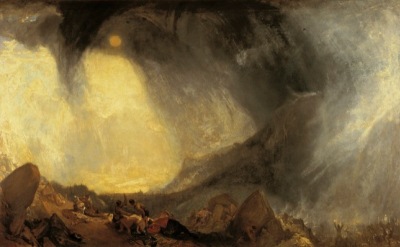
J. M. W. Turner, Snow Storm: Hannibal and his Army crossing the Alps, 1812, oil on canvas, Turner Bequest, Tate Britain, London

Snow Storm: Hannibal and his Army crossing the Alps, 1812, oil on canvas, Turner Bequest, Tate Britain, London

From 1 October 2007 through 6 January 2008 the Smithsonian had a historic exhibition of 164 works of J. M. W. Turner. I first came to know Mr. Turner on a brief visit to London in 2003 — I’m a bit of a philistine — when I saw Ulysses deriding Polyphemus (1829) and The Fighting ‘Temeraire’, tugged to her Last Berth to be broken up, 1838 (1839), and probably a few others that didn’t stick with me, on display at the National Gallery of London. Since that time he has only grown in my esteem. Getting to see Ulysses deriding Polyphemus again was like visiting an old friend. I went to see the exhibit twice in its three months in Washington, D.C., but still our time together was precious and passed altogether too quickly.

I think that a lot of art historians would say that he is not, as many amateur admirers would like to interpret him, some avant guard Twentieth Century painter, a sort of pre-Impressionist, mysteriously displaced in time. Obviously if you take the announced theme of his paintings, they are very much of their age. They aim at the sublime in nature, classical historical stories, moral edification, the contemplative and the visually soothing and pleasing. I just don’t know whether Mr. Turner would actually like us to consider the depicted event, or quickly brush past it as pretext to get to the real matter of painting, which is light, color, material — painting as the primitive actions of composition, application of material, seeing and pleasure in the most basic elements pf perception, prior to the engagement of the higher cognitive faculties.

Look for instance at Snow Storm: Hannibal and his Army crossing the Alps (pictured above). It’s a massive black swirl pushed up the side of a mountain, against a frothy, creamy snow. Anything that might constitute “the action” or the narrative of the painting is in the lower quarter of the frame, and even then only impressionistic. A lone silhouette of an elephant against an illuminated sky in the far distance is the only obvious sign of what is, at least ostensibly, being portrayed. It is a painting of the cloud, the sky, the light. The rest is pretext. It’s not even really that, I suspect. It’s a painting of the way colors interact and an experiment in what is pleasing to the mind, unbounded by depiction and representation.

From a distance the paintings may be depiction, but take a step closer. They are elaborate exercises in color and the application of paint. Your eye can cover square inch after square inch without coming upon a single recognizable feature — just differing layers of color and paint. I’m thinking here of Snow-storm, Avalanche and Inundation – A Scene in the Upper Part of Val d’Aouste, Piedmont (1837). Clip off the lower right corner and strip the title and it would be a wholly modern painting. Or some of his watercolor studies for the two Burning of the House of Parliament are depictive in title only.

In favor of this interpretation, Mr. Turner follows a trajectory similar to the Impressionists and Surrealist that would come later, in that he starts out making very realist, representational paintings in the 1790s and early Nineteenth Century, only gradually and experimentally becoming more abstract later. In the years 1810 through the 1830s you start to get these mixed representational and abstract paintings. After 1840 he starts to produce paintings that no longer have a narrative slice or corner that allows the field of abstraction to plausibly be interpreted as something — a stormy sea, a particularly tumultuous cloud — but rather entire fields of abstraction with but a shadow of depiction somewhere in the midst. Slavers throwing overboard the Dead and Dying — Typhon coming on (1840) approaches this. Snow Storm — Steam-Boat off a Harbor’s Mouth … (1842) or Yacht approaching the Coast (1850) show the full fruition of this development.

There is no substitute for being close to these paintings. The way that Turner depicts the effects of the sun on the layers and layers of cloud and other water vapor is not something that lends itself to flat, twentieth scale ink reproduction. The Decline of the Carthaginian Empire (1817) is a perfect example. You will never see what he does with the sun and the flurry of clouds above, or the way that the same light infuses the entire painting.

It’s worth noting that Mr. Turner was not a one trick pony. Venice: The Dogana and San Giorgio Maggiore (1834) and Venice, from the Porch of Madonna della Salute (1835) were quite a surprise to come upon late in the exhibit. After so many paintings listing abstract, two of such clarity of line and distinction of color was almost a shock to the senses. Obviously I wasn’t the only one with such a response as I overheard a number of other museum-goers comment to the same effect.

The painting that was missing from the collection was The Fighting ‘Temeraire’, tugged to her Last Berth to be broken up, 1838. It is perhaps his most romantic and nostalgic painting. As a part of the National Gallery collection, it was of a piece with my original acquaintance with Turner. If seeing the exhibit was like visiting old friends, it was like a visit where one of your ranks was not present.

It will be on display again in my neck of the woods at The Metropolitan Museum of Art, New York from 24 June – 21 September 2008. I may have to get up for one last peek before this once in a lifetime assemblage disbands for good.

The Vietnam War Memorial, 25 Years

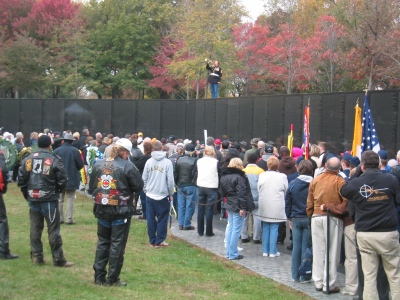
10 November 2007, The Vietnam War Memorial, 25th Anniversary, the reading of the names

This Memorial Day is the 25th anniversary of the dedication of the Vietnam War Memorial so there are a lot of events going on at the west end of the mall this weekend. Most significantly, volunteers have spent the week leading up to Memorial Day reading the names of all 58,209 people listed on the wall. In the picture above the readers took a break at noon for a Marine bugler to play taps.

When the Vietnam War and Vietnam War veterans first came to my consciousness, Vietnam vets were all pretty much people in their late thirties or forties, but it’s been forty years since the peak of the Vietnam War. Vietnam vets are old grey-hairs now. The number of people walking the wall with their wheeled walker or sitting on a bench to catch their breath was surprising. They look now more like my imagining of Second World War veterans than those of the Vietnam War. We tend to think of the Vietnam War as another generation’s war, but at this point more time has elapsed since the Vietnam War and the present day than between the Second World War and the Vietnam War.

Owing to their proximity, a larger number of people than usual were also visiting the Lincoln Memorial. I wonder how many realize that it is the memorial in Washington, D.C. of the Civil War, a war that is more commemorated on the various battlefields of the states where it was fought than in the capitol. S. and I biked past the First World War Memorial. It is a crumbling ruin in an untended and unvisited corner of the Mall. Time marches on.

As we were leaving, a rather large contingent of Native American veterans wearing their military uniforms under more traditional clothing was processing off the field. They paraded under the U.S. flag as well as the black POW/MIA flag, only their POW/MIA flag had a silhouette of a Native American. They stood in a semicircle off one of the paths greeting other passing vets. It’s weird to see someone in full Native American garb greet another Marine with “Semper Fi.”

The Vietnam War Memorial is one of the most well done monuments in Washington, D.C. To walk its length is to experience the War as a symbolic journey. The names are listed in the order they were killed. The first few panels list only a small number of names, a reminder that the war started gradually and covertly under Eisenhower and Kennedy. The panels are like a bar chart of that creeping war, until you reach the imposing nadir of the monument and start the ascent up the north wall. The last few panels, just a few inches high and with but a few names are the most tragic, each always reminding me of the young John Kerry’s words: “How do you ask a man to be the last one to die for a lost cause?”

As you ascend the north wall, it forms an arrow pointing east to the Obelisk. Further in the background you can see the dome of the Capitol. The Capitol building has always been hard to see for itself past the symbolry of its image. It’s always invoked the same thoughts as those oil paintings and illustrations of the great debates of Henry Clay, Daniel Webster or John Calhoun. It is the assembly place of the great debating society of democracy. After eight years of Republican rule the Capitol has acquired an insidiousness for me more like that of the Deathstar. It is the looming crown jewel in an empire of evil. It is an association that I don’t think will ever leave me and can almost certainly not be shorn by a few years of Democratic capers in governance.

Ascending from of the black pit of the Vietnam War to be greeted by the shining white of the Obelisk and the Capitol only serves as an indictment of the hypocrisy behind all the intended awe inspiration of the rest of the monuments of D.C. It is a reminder that those names aren’t just on the wall for a mysterious reason. The right arm of the monument points accusingly to the reason all those names are there. The Vietnam War Memorial is the only monument in Washington, D.C. that is not architecture cum propaganda.

Disparaging Comparisons Between Washington, D.C. and New York

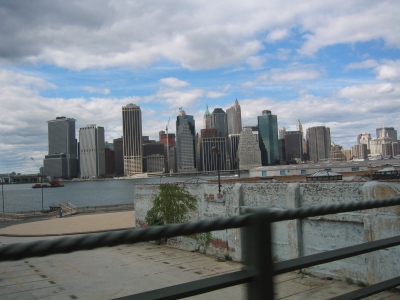
16 September 2007, the Financial District from the Brooklyn-Queens Expressway

Every visit I make to New York is a painful reminder what a grim and slender existence one leads living in Washington, D.C. For some time now two large comparisons have been part of my usual refrain.

  • The people in New York are so much more interesting and varied than in D.C. In Washington, D.C. it seems as if there is one perfect model and everyone is judged according to how closely they can approximate that one right way to be. To be fashionable in D.C. is about conformity. In New York everyone is struggling to differentiate themselves and people are judged by how unique they are. Every aspect of personae and identity is part of the pallet (though beyond one’s creative control, most unusual or inscrutable combination of ethnic background is in play).

  • People talk about a New York minute: everything in New York is so fast paced. But when I’m in New York I feel like I may as well be in Paris. New Yorkers understand joie de vivre. They do it in enough ways that it would be difficult to catalog. People take time to enjoy themselves. Everywhere you go there are little cafés where people are having a leisurely meal and talking with a friend or watching the crowds pass. Kitchens are small so food is most commonly very basic, focusing on quality of ingredients rather than labor in preparation. People lavish a lot of attention on their animals and are almost universally excited about the pets of others. The city may be gigantic, but the neighborhoods are small and everywhere you go there are meetings, planned and accidental and people talking. Everyone has an avocation to which they are very devoted.

A few other observations about New York and D.C.:

  • New York is a city with a staggering number of restaurants. On Saturday night S. and I were out wandering and decided that we wanted some Italian food. We simply wandered, confident that in a short time we would stumble upon exactly what we wanted. And in a few blocks we came to a tiny Italian place with tile floors, dark walls, little tables, a cramped bar half-way back surrounded by about a dozen older male waiters in white shirts and black ties running in every direction. The food was unpretentious, but quality. There are probably so many restaurants like that in New York than one couldn’t locate them all without the aid of technology. In Washington, D.C. there are maybe three or four such restaurants and they may be a dying breed (I’m thinking Giovanni’s Trattu on Jefferson Place or Trattoria Italiano in Woodly Park). Probably just the number of new restaurants that open and old restaurants that go out of business in New York exceeds the total number or restaurants in the entire District of Columbia.

  • While I was away for the weekend, Matthew Yglesias made an exuberant post about a new place in town serving late night breakfast (“Late Night Late Night Breakfast Blogging,” 16 September 2007). This is indeed a very big deal in D.C. To date, just about the only place in the city where breakfast was available at any time other than breakfast time was The Dinner. In fact, just about the only place that anything was available late — or at least later than the post-last-call places on bar rows — was again, The Dinner. This is unbelievable in a major city. In New York, as is well known, the opening or closing of such a place is a nonevent, so common are such places. And in New York they all deliver with a $5.00 minimum order. In D.C. the standard minimum for delivery is $20.00.

  • Both New York and Washington, D.C. are noisy cities. I find that increasingly I like the noise of New York. It is the noise of life and work: delivery trucks dropping things off, garbage trucks taking things away, crowds of people. In Washington, D.C. the noise is that of the delusions of the national security state: police sirens, emergency vehicles rushing around from one nonevent to the next, convoys for VIPs.

  • It’s amusing the degree to which New Yorkers match their city. New York is crumbling and second hand. So are a surprising number of its residents.

  • For months now I have been wanting to get to Mark Israel’s Doughnut Plant. Their signature, the Tres Leche, is indeed one dope-ass doughnut! When I walked up, there was a “back in five minutes” sign up in the window and a small crowd gathered around outside waiting. The store is completely inauspicious, consisting of just a little counter and a window back to the kitchen and some storage overflow, but if you find yourself in the Lower East Side it is definitely worth a jaunt.