Frenetic Fojol Cusping on Celebrity

It’s been a big couple of days for the Fojol Brothers. Thursday was their weekday lunch debut and they were back again on Friday (I parenthetically hedged, though they said right there in their tweet that it was their first weekday daytime appearance).

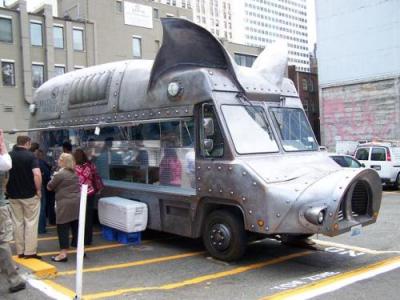
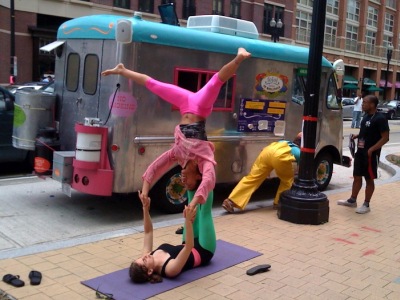
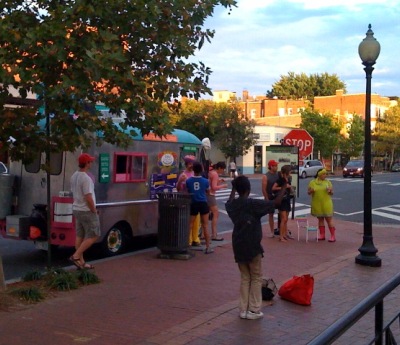
Fojol Brothers, Lamont Park, Mount Pleasant, 19 July 2009

Today they were in my neighborhood on the corner of Lamont Park in Mount Pleasant. And it was quite a show. There are two new Fojol sisters, Mewshah and Bhujaja. The AcroFiends were there, just to eat though, Peter / Kipoto, girlfriend in tow, was there out of costume as it was supposed to be his day off from Fojol.

Kahn, Howie, "Keep On Food Truckin'," GQ, August 2009, p. 34

On Thursday they told me that they were getting profiled in GQ. On Friday Justin / Dingo had the issue with him and they got the introductory page to a whole piece on food carts in various cities.

Seattle's Maximus Minimus pig truck

As is often the case with such articles, it’s somewhat arbitrary in selection. For instance, I have no idea how GQ could have missed Seattle’s mind-bogglingly tricked out Maximus Minimus (website | twitter).

After wrapping up in Mount Pleasant today, the Fojol Brothers tweet that they will be at Eastern Market all day tomorrow.

Fojol Do Lunch

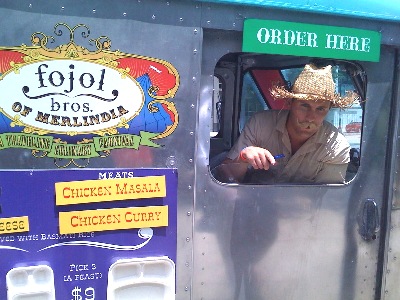
Fojol Brother Peter Korbel, weekday lunch in front of the IMF building, 16 July 2009

Fojol Brothers had their first (at least since I’ve been following them) weekday lunch. They parked at the corner of 19th and Pennsylvania Avenue, at Edward R. Murrow Park in front of the IMF building, necessitating a bit of a hike on my part, but always worth it.

While ordering, Peter (above) told me that a picture of me was included in their write-up in Brightest Young Things (Nicholson, Alex and Dakota Fine, “Hitting the Streets With: Fojol Brothers of Merlinida,”, 13 July 2009). This is not a surprise since they asked if I would pose for a food shot. I’m the guy in the bike helmet in the first large photo. Oddly enough this was my first time catching the Fojol Brothers. In the photograph accompanying my first post on the Fojol Brothers, I think that the guy in the foreground turning around to look back is Dakota Fine, the photographer for the Brightest Young Things piece.

I think that the Fojol Brothers have so far been limited to nights and weekends by their other commitments. I hope this is an indication that things are viable enough where they’re going to be doing it a lot more.

Fojol Brothers and the Changing Face of Washington, D.C.

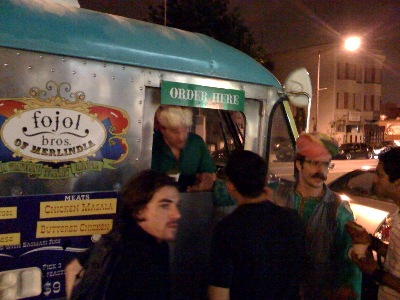
The Fojol Brothers traveling culinary carnival, 14th Street, just south of U Street, 20 June 2009, 1:45 AM

I’ve been following the Fojol Brothers traveling culinary carnival on twitter for approaching two weeks now. I just happened to choose the wrong time to follow them as there’s been no activity since that time. Then tonight I go to P and 21st and am oblivious that that they are catty-corner at 20th and Q, but they tweet that they will be reestablishing themselves on U Street at about midnight. I’m constantly refreshing my twitter feed to get the news. At about 12:30 they tweeted that they are serving food at 14th and U Street NW. I jumped on my waiting bike.

As I was leaving the house, I considered knocking on the door of the upstairs neighbors to ask if any of them wanted to join me (it would be safe to count on a significant portion of them to be awake and ready for spontaneous adventure at that hour). Turns out it was unnecessary. I had taken about two bites of cauliflower and potatoes when Duff walked up. He had played a gig on U Street. He got some Fojol Brothers food too and we leaned against the windows of the fast food places on the corner and talked for a few minutes. He commented that he keeps on finding little enclaves in the city that don’t feel like D.C. anymore. I concur. A similar thought struck me twice — I guess Fojol Brothers included, three times — just today. Increasingly I am seeing people who seem to be other than the usual social climbers, and engaged in activities outside the norm of the straight and narrow required by the power and influence track.

When explaining what’s wrong with D.C., I often tell people that it’s a one company town and that the imprint of the government is on everything in the whole city. D.C. just might be cusping on that critical mass where it starts to develop a culture autonomous from that of the strictures of political power.

On the other hand, a few years ago I had a Capital Hill barkeep, something of an institution himself, tell me that D.C. was a different town when the Democrats were in charge, that it was just more fun. Maybe the city independent from the government still sucks, it’s just that the government has upgraded.

I talked for a few minutes with one of the Brothers. They’re very much in promotional mode right now. He’s a lifelong D.C. resident and the son of a D.C. activist couple. His childhood meals were always strategy sessions of civil rights leaders or dialogues between Israelis and Palestinians and it’s that spirit of people coming together under extra-ordinary circumstances, but around food, that he hopes to create spontaneously on the street and in the virtual world. He talked about a getting together with other street food venders for a street party and his plans to work with District at-risk youth programs to have some of their kids join the Brothers in their culinary carnival (Anthony Bourdain profiled a similar program, the D.C. Central Kitchen, when No Reservations was in D.C.).

If the Federal Government has become more fun, the District remains determined to squelch any outbreak of unsanctioned quality of live improvements. At about 2:30 AM the po-po showed up and asked to see their street vendor’s license, which they promptly produced. But the officer began to sweat tem down over how this was non-vending zone and how they were past the hours allowed according to their permit. They quickly folded up shop and took off. I sent them a message later that evening encouraging them not to let this get to them. They messaged back that they’re still figuring out how things are going to work, but that they don’t intend to give up.

There Goes the Neighborhood

I’ve walked past the storefront remodel in progress. I’ve read the business license application postings. I’ve received the nearlybot direct messages on twitter (C., Donna, “Bliss Out(side) in Mt. Pleasant,” We Love DC, 12 June 2009). I’ve fretted about it in the past. But as of this afternoon Mount Pleasant crossed the line from gentrifying and marginal to fully yupped out. There’s fucking yoga in Lamont Park in Mount Pleasant.

Yoga in the triangle park in Mount Pleasant, Washington, D.C., 16 June 2009

Look at those SNAGs (I guess in the aught years they’re called metrosexuals) in the back rows — the better to check out the women’s bulging naughty bits as they assume genitally awkward positions. Leering Mexicans move it along. Leering is only allowed for those engaging in compensatory activities.

Flowers of Evil on L Street

Nasty mushroom pile in the sidewalk planter box, L Street NW, between 15th and 16th Streets near the Washington Post building, 26 May 2009

I’ve been working where I have for starting on my fourth summer, which means the same commute for approaching four years. Modern society is clockwork so the monotony is murder. I know all the timing on all the lights at all the intersections from the bus stop to the office. And it’s that way for everyone so I swear that I must step in front of the same guy preventing him from make the same right turn on red every morning.

But there are cycles with cycles, so with enough perspective there are higher orders of monotony. Every year for four years now, after the first summer storm this same nasty pile of mushrooms bursts forth from the sidewalk planter box on L Street NW, between 15th and 16th Streets, near the Washington Post building.

Most years they are normal mushroomy brown. This year they look bizarrely like some flower of evil native to Mordor.

Marx is Back!

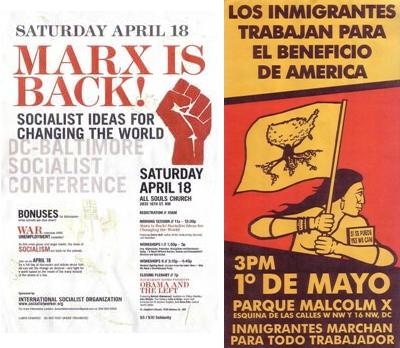
April-May 2009, Marx is Back! / 1 de Mayo immigrant's march posters

Out of character for the city, there have been a number of lefty signs around. Some of my recent favorites are the two above. The one on the right is for a Mayday immigrant march. Notice that the flag in the hands of the native American is the United States as a tree with its roots in the shape of the rest of the world. The little plaque on the man’s chest reads both “Sise puede” and “Yes we can.” And the rally is meeting in Malcolm X Park, the unofficial name for Meridian Hill Park (Google Maps | Wikipedia).

I love the socialist conference poster. “Marx is back!” One may wonder where he ever went. I guess some people though that Marxism went into remission after the end of the Cold War. But everyone is on notice that he’s back now.

March 2008-May 2009, Newsweek, Foreign Policy and BusinessWeek, varying degrees of questioning capitalism

With Newsweek going beyond declaring us merely Keynesians now and portraying George Bush, Jr. in the style of Che Guevara, Foreign Policy putting Marx on the cover of their “Big Think” issue (“Why he matters now”), BusinessWeek making Ben Bernanke look like Lenin and including Henry Paulson in Stalinist Soviet style collages and Richard Posner titling his current book A Failure of Capitalism, things are feeling positively European.

But the return of Marx is more than just media camp. With respect to national security, Charles Krauthammer referred to the liberal internationalism of the Clinton years as a “holiday from history” (The Washington Post, 14 February 2003, p. A31). Robert Kagan is now referring to the post-1990s as The Return of History and the End of Dreams. Supposedly September 11, 2001 and the ensuing clash of civilizations has woken us up from our Fukuyam-esque ex-historical state. Similarly, we might refer to the phenomena of “Marx is Back” as the return of history to the economic sphere after 20 years of economic dreams (given that the current crisis has wiped out nearly 15 years of stock market value, it does seem as if it was all a dream). Just as September 11, 2001 broke the exclusive claim of liberal internationalism upon the thinking of the foreign policy establishment and showed that the future would be one of continuing world-historical ideological contention, so the holiday of political-economy that was the Washington Consensus has been knocked askew. The future of the economy will be one of political conflict.

But I kid myself. The legitimacy of capitalism within a given polity has nothing to do with the soundness of ideas and little to do with events. It is primarily a function of the Gini coefficient: the more money there is sloshing around in the upper social strata, the more inassailable the reputation of capitalism. And since that’s hardly going to change in the current crisis, I doubt that the Washington Consensus will emerge with anything more than a few fast forgotten slights.

In this regard the conservatism of the Obama administration should be noted. They are doing whatever they can to handle the current situation with as little enduring systematic change or publicity as possible. And I guess I’m in favor of this. While I may sympathize with dialectical materialism and Marx’s critique of the corruptions of capitalism, he was grossly wrong in his assessment of capitalism as ineluctably hell-bent-for-crisis. I’m essentially an advocate of Keynesian tinkering in a mostly stable system. And besides, alienation is a feature of capitalism, not a bug. The last thing I want is to be railroaded into a syndicate with a bunch of hippies. Those guys are fascists.

Information Phenotype

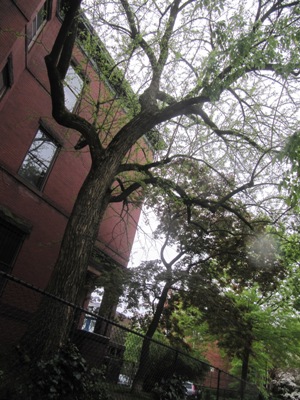
The fractal tree at the corner of 18th and Lamont, Washington, D.C., 29 April 2009

I have previously commented on my love of the movie π (“The Supernovae in Your Coffee Cup,” 2 November 2008). It left me with two enduring images: mixing coffee and cream as an example of turbulence, previously discussed; and the branching of tree limbs as an example of fractal symmetry. I love winter for its exposure of this fabulous phenomena, innocuously right over our heads. I am always a little sad for the arrival of spring and the enshrouding of all these thought-provoking fractals in greenery.

The picture above is of my favorite tree in the neighborhood where I live. The degree to which the pattern of major arc over two-thirds of growth length followed by sharp break and lesser arc over remainder of growth length is repeated trunk to twig is amazing. Notice the arc of the trunk: unlike many trees which follow one rule for trunk and a separate rule for the branches, this tree follows a single rule throughout.

We think of a fractal as a recursive algorithm, a mathematical formula. But there’s no math in that tree. The recipe for that fractal is coded somewhere in the tree’s DNA. But the DNA contains no fractal. The DNA is a bunch of nucleotides that are transcribed by messenger RNA that code amino acids that assemble into proteins that form the structures of cells. The cells then split and differentiate in response to a complex of internal chemical signals and environmental stimuli to grow in a pattern that is the fractal.

One might say that there is a fractal somewhere in that tree, but there are so many transformation rules between nucleotide sequence and fractal growth pattern, that it is only in a manner of speaking. I am reminded of Wittgenstein’s discussion of what constitutes following a rule and going against it (Philosophical Investigations, trans. G. E. M. Anscombe [Malden, Mass.: Blackwell, 1953]):

198. “But how can a rule shew me what I have to do at this point? Whatever I do is, on some interpretation, in accord with the rule.” — That is not what we ought to say, but rather: any interpretation still hangs in the air along with what it interprets, and cannot give it any support. Interpretations by themselves do not determine meaning.

“Then can whatever I do be brought into accord with the rule?” — Let me ask this: what has the expression of a rule — say a sign-post — got to do with my actions? What sort of connection is there here? — Well perhaps this one: I have been trained to react to this sign in a particular way, and now I so react to it.

But that is only to give the causal connection; to tell how it has come about that we now go by the sign-post; not what this going-by-the-sign really consists in. On the contrary; I have further indicated that a person goes by a sign-post only in so far as there exists a regular use of sign posts, a custom.

199. Is what we call “obeying a rule” something that it would be possible for only one man to do, and to do only once in his life? — This is of course a note on the grammar of the expression “to obey a rule.”

It is not possible that there should have been only one occasion on which someone obeyed a rule. It is not possible that there should have been only one occasion on which a report was made, an order given or understood; and so on. — To obey a rule, to make a report, to give an order, to play a game of chess, are customs (uses, institutions).

To understand a sentence means to understand a language. To understand a language means to be master of a technique.

200. It is, of course, imaginable that two people belonging to a tribe unacquainted with games should sit at a chess-board and go through the moves of a game of chess; and even with all the appropriate mental accompaniments. And if we were to see it we should say they were playing chess. But now imagine a game of chess translated according to certain rules into a series of actions which we do not ordinarily associate with a game — say into yells and stamping of feet. And now suppose those two people to yell and stamp instead of playing the form of chess that we are used to; and this in such a way that their procedure is translatable by suitable rules into a game of chess. Should we still be inclined to say that they were playing a game? What right would one have to say so?

201. This is our paradox: no course of action could be determined by a rule, because every course of action can be made out to accord with the rule. The answer was: if everything can be made out to accord with the rule, then it can also be made out to conflict with it. And so there would be neither accord nor conflict here.

It can be seen that there is a misunderstanding here from the mere fact that in the course of our argument we gave one interpretation after another; as if each one contented us at least for a moment, until we thought of yet another standing behind it. What this shews is that there is a way of grasping a rule which is not an interpretation, but which is exhibited in what we call “obeying the rule” and “going against it” in actual cases.

Of course Wittgenstein is writing about social phenomena where custom and training are factors, but the undecidability of rules is the point here. Socially dogmatic, we are dismissive of blatant divergence from consensus. Less dogmatic — but not free of dogma — science resorts to the metaphysical-aesthetic notion of Ockham’s razor with which to cut through the myriad of rules that might potentially be made to accord with observed behavior. Is there really a fractal in the tree’s DNA? The fractal pattern of tree growth is but an interpretation of the tree’s DNA — an interpretation that would be different given a differing machinery of RNA transcription, amino acid assembly, protein expression, etc.

The Last Trace of 1968

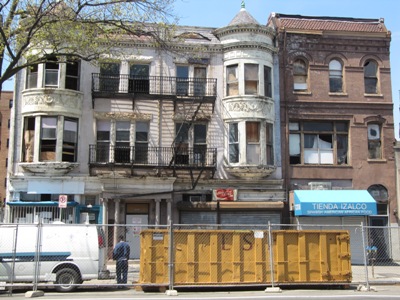
The last of the 1968 Martin Luther King, Jr. assassination riot damage, 14th Street NW, between N Street and Rhode Island NW, 24 April 2009

When I first moved to D.C. in 2003 I set out to explore. My aunt had told me that it was unwise to go east of 16th Street but I did anyway. I remember walking up 14th Street NW toward U Street and it being obviously a neighborhood in transition. There were a few new places, but much remained burned out and deserted. The middle class people who were there were the homosexual vanguard of gentrification.

I simply thought of it as the usual urban decay and renewal, but it turns out that 14th Street had something unique about its desolation. Here’s the AIA Guide to the Architecture of Washington, D.C. (Baltimore, Maryland: Johns Hopkins University Press, Fourth Edition, 2006):

The Logan Circle / Shaw area declined gradually until 1968, when a series of riots in the wake of the assassination of Martin Luther King, Jr. dealt a devastating blow. Angry mobs set fire to businesses that refused to close in mourning of the slain civil rights leader, and the physical and psychological scares of that tragic period are still evident in various corners of the neighborhoods. (p. 268)

Fourteenth Street wasn’t just any urban decay, but was where some of the most notable of the rioting and arson had occurred in 1968. The damage to the buildings that I was witnessing was the damage that had been done then and the area was only now, 35 years later, starting to be repaired. The scars were those rent in anger over the assassination of Martin Luther King, Jr.

I have lived in Washington, D.C. for six years now and during that time the 14th Street corridor has gentrified significantly and the street of which it would be unwise to go east has moved significantly further eastward. At this point 14th Street is more or less a continuously nice street from the Mall all the way up to Columbia Heights and on to … I don’t know where … probably where 14th Street terminates at Iowa Avenue out in the early generation suburbs (I’ve commented previously on the transformation of 14th Street at Columbia Heights here: “The Future of Columbia Heights,” 25 February 2007). The last remnants of the 1968 riots is the block between N Street and Rhode Island NW (pictured above) and now even it is being refurbished. When they are done there, the last physical remnant of the 1968 anger will finally have been erased.

In a city of monuments, I almost feel as if they should leave it as a monument to the end of an era, to a bad year, to a time when the populace wouldn’t take it, when misdeeds were met in kind and to the city that was. Cities need to change, but they need to show their history as well. When this refurbishment is complete, the District of Columbia will have gained a few thousand more square feet of places to go and to live and a few thousand dollars more in rent and taxes, and a neighborhood blight will have been eliminated, but the record of 1968 in our everyday, non-nostalgic, non-consciously historical lives will be gone.

New York Bagels

I see that over the weekend there was much consideration of the issue of New York and Bagels. Matthew Yglesias comments (“The Stuff that Matters,” ThinkProgress, 28 November 2008):

I’ve now lived in DC long enough that I forget how much I like real bagels. But then I come back to New York for Thanksgiving and the whole sad little fantasy universe I’ve constructed for myself in which DC’s bad bagels aren’t a big deal collapses.

Kevin Drum does a little wondering as well (“Bagels!,” MoJo, 28 November 2008)

It’s hard for me to remain on topic here because Washington, D.C. is such a miserable hole of a city. It would be hard to come up with a single factor in which New York was not vastly better of a city. The only reason that anyone tolerates D.C. is that it’s the political and intellectual capitol of the country.

That said, whenever I go to New York I have a list of things that I want to do and every time it includes bagels. This visit included bagels on two out of three mornings. My friend has been living three blocks from Tal Bagels so it has been pretty convenient, but on other visits I have commuted for bagels.

I’ve heard a number of the theories (the municipal water), but I’d have to say that I think it’s a gestalt. The bagels themselves are better: crunchier on the outside, chewier on the inside. But the schemers are better too (we brought back a tub of the olive cream cheese and another of the tofu, which rather than being some vegan concession has a flavor zestier and brighter than the cream cheeses). And most important is the ambiance. Woody places with a bunch of working-class artisans in black pants, white t-shirts, white aprons, and white paper hats, with a lot of hurry and attitude is different than the hired gun Ethiopians at Au-bon-Pan. A bagel shop is a stylized thing in New York. The cream cheeses are arrayed in gigantic bowls under glass, along with a host of other Jewish foods: smoked fish, knishs, couscous salads.

My favorite bagel places in New York are Ess-a-bagle (359 1st Avenue, Manhattan, New York 10010, official site here) and Tal Bagels (977 1st Avenue, Manhattan, New York 10022), both very Jewish, and The Bagel Store (247 Bedford Ave, Brooklyn, NY 11211), a Williamsburg hipster joint, but still unbelievably good.