Bread and Circus Versus Nuts and Bolts

The New York correspondent for the U.K Independent opines on the latest symbol of the decline of the United States and the means by which voters are kept distracted (Usborne, David, “Baseball and Bombs Get the Cash — Bridges Are Just Dull,” 6 August 2007):

You don’t have to visit this country for long to see how its transport infrastructure has deteriorated since the interstate system was built by Eisenhower in the Fifties.

Never taken that pot-holed ride from JFK to Manhattan? Fasten your seatbelts for more turbulence. Or covered your ears in the screeching tunnels of the city’s antiquated subways? As for a cross-country ride on Amtrak, good luck.

Money here tends to flow towards items that make the pulse race. That would be elections, wars and that other national passion, sports. If there was a World Cup for baseball – rather than the so-called World Series in October which involves only the US and Canada – then finding decent venues would barely be a problem. Name a big city that doesn’t have a brand new, state of the art stadium it wants to show off.

Actually, that would be New York. But that is about to change. Its two major baseball teams, the Yankees and the Mets, are in deadly competition right now and not just to land places in the World Series play-off games this autumn. It’s about which of them can get their spanking new stadium finished first.

That’s right, while the Brooklyn Bridge gathers rust (yes, it is on the critical care list), somehow this city is building not one but two baseball stadiums barely six miles from each other, one in the Bronx, the other in Queens. It doesn’t matter that the teams have perfectly good places to play for their fans already. They are not flashy enough.

Increasingly circus is not merely some free-standing distraction, but conjoined to the very decline it serves to dissemble.

Airport Security

The last time I traveled was to Thailand in November-December 2006, shortly after the binary liquid explosive scare and new screening procedures for carrying on liquids, gels, etc. had gone into effect. Prior to that, a number of work related recruiting trips were instructive. We always brought two fingerprinting kits that use a heat-sensative red ink that turns black when you stick the fingerprint cards in a panini-grill like heating element. The units are rather expensive and were critical to our events, so we always carried them on the plane. The person who carried the unit was always pulled aside to the special extra procedures area and questioned by security. They always inspected the units and on more than one occasion swabbed them for any traces of explosive materials. While I think the whole airport security routine is a farce and studies indicate that people can still pretty effectively sneak banned items onto planes, I have hitherto thought that I had been given a pretty thorough going-over.

My impression from my most recent experience is that airport security has seriously lapsed. On this trip I was somewhat careless about metal and liquids when I packed and was carrying a router, its power adapter and thirty feet of coiled ethernet cable. I thought that surely I would be required at least to take a few things out of my bag, but no. We all went through screening extremely quickly and I was just rushed right along with nary a question. The special screening section behind the partition wall seemed like it may be growing spider webs.

After I got through, I was sufficiently struck by it that I asked S., a gargoyle always heavy-laden with personal electronics. She had gone through a separate screening station and concurred that it seemed that things had gotten pretty lax. At Sea-Tac there was a person putting out a little effort to make sure that personal electronics and liquids were out of their bags and in separate bins, but things didn’t seem much better there.

Back from Seattle

29 July 2007, Seattle

I haven’t posted in a while as I’ve been visiting my family in the Northwest. It’s 10:00 in the morning here. S. and I took a red-eye back from Seattle and have been in airports, planes and airport shuttles since 10:00 PM Pacific time last night (eight hours). I will resume regular posting shortly, but first about ten hours of sleep.

And yes, it did rain while we were there.

America’s Revolutionary Guard

J.K. Rowling suggests a difference between the Christianists in the United States and those of other countries (“J.K. Rowling Reflects on Fame, Fans and Harry Potter,” The Associated Press, 19 July 2007):

I had one letter from a vicar in England — this is the difference — saying would I please not put Christmas trees at Hogwarts as it was clearly a pagan society. Meanwhile, I’m having death threats when I’m on tour in America.

Of course, even the letter from the vicar is preposterous as European Christians appropriated the decorated pine tree as part of the symbolry of Christmas from early European pagans in an attempt to compete with preexisting celebrations long before — fictional, mind you — pagans reappropriated the tree to themselves.

Money is always a compelling issue — witness our China policy just for starters — and we’ve got a lot of it so people have to deal, but I wonder at what point the rest of the word declares the U.S. a bunch of incorrigible kooks and throws up their hands? Will the day come when a foreign author simply avoids the United States market, when an author is subject to the Salman Rushdie treatment in the United States? One can already almost see the analogy between the United States and Iran. A young, costal, cosmopolitan elite committed to freedom and secularism oppressed by a self-appointed and semi-officially condoned bunch of religious thugs. I can almost hear the first report of a Christian enforcer throwing acid in the face of a feminist on a book tour.

Business Loves Hillary

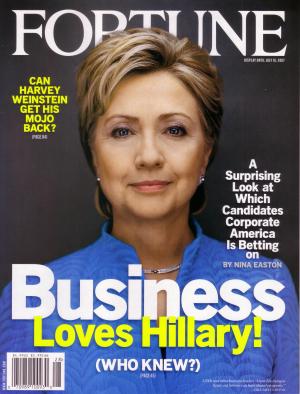
Business Loves Hillary Clinton, Fortune, 9 July 2007

Fortune reports (Easton, Nina, “Who Business is Betting on,” vol. 156, no. 1, 9 July 2007, pp. 45-52):

One of Hillary Clinton’s most important courtships began early last year, around a formal dinner table at Georgetown’s Four Seasons Hotel. Her targets were Morgan Stanley CEO John Mack and his wife, Christy. Mack was already active politically — but on behalf of Clinton’s political opponents. A Bush “Ranger,” he had raised at least $200,000 for the President’s reelection bid and was one of the most prominent business names on GOP donor lists. At one time his name had circulated as a potential Bush Treasury Secretary.

The conversation that night ranged widely, but always returned to one subject: health-care reform. …

Hillary Clinton was on familiar territory — and managed to charm the couple not only with her “intelligence and educated responses,” as Christy Mack recalls, but also with her one-on-one charisma. “You have these preconceived ideas about people you see in the public eye,” says Christy. “But we were extremely impressed with her ability to connect with every single person. She was an amazing listener, with tremendous warmth.”

The relationship could have ended there — a New York Senator engaging her local constituents. But early this year Clinton upped the ante with a phone call to the Morgan Stanley CEO, asking him to support her presidential bid. When he demurred, she asked for a meeting. Once again — this time over coffee — John and Christy Mack found themselves enticed. When Mack returned to his office, he told Nides he was ready to commit. “John, you can wait, you don’t have to commit yet,” Nides responded. “No,” Mack replied, “early support is better support.” Days later Mack picked up the phone and sealed the deal. Clinton, Nides recalls, “put the time in.”

On the one hand, this bodes well in that some have pointed out that Senator Clinton has nowhere to go but up and when people are exposed to Hillary Clinton in person instead of Hilary Clinton the myth, they are pleasantly surprised. On the other hand, one would really like to know what Senator Clinton could say (or maybe even promise?) to a Bush Ranger — in 2004 nonetheless — about healthcare that would cause him to back her for the presidency.

Cusping on a new Gilded Age, it would perhaps be best to have a candidate that business loathed. But I guess that’s what cusping on a new Gilded Age means: the money men vote first, then the rest of us chose from the slate they have prescreened.

Foodie Fetishes

Given that my last two posts might position me as something of a foodie, a skeptical step back might be in order.

For some people food is a truly important aspect of their lives. For people who garden and eat seasonal foods, I imagine their involvement with food is something akin to the cyclical ceremonial calendars of the religions. Only instead of serving to reify the connection to the sky gods of the major religions, the rituals of food serve to root people to the biorhythms of the Earth. And it probably occupies a similar psychological function, connecting a person to a larger story, cordoning off a ritual time separate from the monotony of the world (in this case the timeless homogeneity of the globalized food supply chain), demonstrating and reaffirming principles by which a community lives (e.g. vegetarians).

While this may be the case for a minority of us, for most foodies it’s the exact opposite: it’s just another commodity fetish.

Plymouth is Back!

Plymouth English Gin, the original and the redesigned bottles

I learned to drink from four people: my parents and two college fiends, Bill and Mariella. I say that I learned to drink from them because upon reflection, I am frequently impressed at the gems of booze-related insight that I have taken from these four. One evening, while over at Bill and Mariella’s place, the drink on offer was Gordon’s Gin in the one gallon plastic easy pour bottle. I sniffed: “Gordon’s is some pretty bad stuff.” Bill remonstrated with glee, “Bad gin? What are you talking about? They don’t make bad gin.” This is one of those peaces of alky wisdom that I have carried with me since.

But while they don’t make bad gin, not all gin is equal. And so at the beginning of May the New York Times ran a review of gins (Asimov, Eric, “No, Really, It Was Tough: 4 People, 80 Martinis,” 2 May 2007), and despite my concern that the over-excited pretension of a New York Times food review might sour one of my affections, I pressed on and found the article interesting and useful. Unfortunately the useful went catastrophically awry.

I have been in something of a gin doldrum lately. I now blame this on the fact that I have stuck too loyally with Bombay Sapphire. While a complex and flavorful gin, it is also powerful, sharp and nearly overcome by its alcohol. It’s great for a gin and tonic, too busy to blend well in a martini and I have recoiled from it on the rocks. With the New York Times article marked up and in hand I stopped in my neighborhood liquor store looking for what the tasting panel selected as their number one, Plymouth English Gin.

I have to say, I have been amazed at how good the Plymouth is. It really is a perfect, well balanced gin with the canonical amount of juniper. I can’t remember the last time I polished off a bottle of liquor so quickly — no, really, I can’t remember. A week later I was back for another bottle — in college I could have dusted it in a night or two, but I’m not so resilient or stupid anymore. At the end of week two I was back for a third bottle. This time the clerk told me that he only had two left and couldn’t get any more. It turns out that I am not the only person who reads the New York Times and distilling a gin isn’t something that can be done over night. There had been a run on Plymouth and the distillery was rushing to catch up. I took two and the next day at lunch went to the liquor store near my office and snapped up a few more for a store to carry me through the lean season.

My supply was dwindling and I was beginning to get nervous and eye the shallow gin row every time I opened the liquor cabinet and ration my intake. This week I stopped by previously mentioned neighborhood liquor store to pick up a bottle of wine to accompany the dinner-directed bag of groceries in hand. While being rung up I got a premonition and circled back to the end of the counter where the gins are massed and there was a suspicious looking familiar bottle. “What is that square bottle right there?” I inquired. Despite this being my favorite liquor store, the clerk is constantly trying to push me into the popular brand names and refuses to learn that I am always on the prowl for the Plymouth now. He gave it a half turn. “Oh, we just got in a new shipment of the Plymouth.” Saved! Confident that the drought was past I availed myself of only one.

Mmm … Avocados

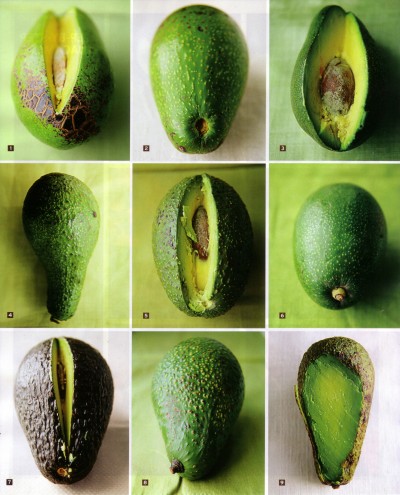
September 2007, Saveur, Avocado Love, Know Your Avocados, p. 84

The most recent Saveur has one of the most erotic fruits on the cover: the avocado (Nguyen, Andrea, “Like Butter,” no. 104, September 2007, pp. 76-87). Am I in doubt? Check out the cover art of the most recent Pearl Jam album.

As I have said before, I tend to obsess on foods. A while back it was guacamole. I was making it every few nights. At an earlier point I tried to search the stores for a packaged guacamole, but that is hopeless. Most of what goes under the label of guacamole is sour cream and onion dip died green, but even the best doesn’t even come close. It’s something that you simply must make yourself. Fortunately for me and my obsessions, while a late teenager my mother — who probably also has a tendency to obsess on foods — went through a phase where she was constantly making a very rustic guacamole, so improvising my own recipe was natural. I have recently achieved a bit of a party reputation for my guacamole — why, I don’t know: it’s about as simple a recipe as you can imagine. The only thing you need to know is how to combine the ingredients so that you don’t over-stir it and end up with too creamy and consistent a guacamole.

My Central and South America hopping brother told me that once while in Mexico he visited an avocado farm. The farm hound would patrol the fields for over-ripe avocados that had fallen from the trees and gobble them down. He reported that under his fur the dog’s skin was slightly green tinted and that he shit guacamole (the lesser known recipe). On the other hand, I have heard that avocados are poison to most domesticated animals, so I don’t know how to reconcile these two stories. On the precautionary principle, Kitty is rather vehemently shooed away from a bowl of the stuff.

Some Other Books that Bush Should Read

The White House press office and has periodically made it known what books the President is reading. On a few occasions even the President himself has staged a mini publicity stunt to show off the same, for instance when he very deliberately paraded around with a copy of Bernard Goldberg’s book Bias to demonstrate his low opinion of the press or Eliot Cohen’s Supreme Command to signal to the military that the administration wasn’t about to be pushed around by a bunch of generals with their dictates of military requirement.

I am currently reading Adam Zamoyski’s Moscow 1812: Napoleon’s Fatal March. Sometimes it’s hard to imagine that a work was not written with an eye to current events. And sometimes they are. Robert Massie has specifically said that he wrote Dreadnought, his book about how the naval arms race between Britain and Germany precipitated the First World War, in part to illustrate the dangers of the Regan nuclear arms buildup.

When I read passages like the following, it is hard not to think that Mr. Zamoyski doesn’t have a certain contemporary swashbuckling world leader in mind. With the La Grande Armée fully ensconced in Moscow, harried by marauding Cossacks, Napoleon contemplates his next move:

Napoleon was far too astute not to realize that his strategy had gone badly wrong, and that Caulaincourt had been right all along. But he did not like to admit it. And he recoiled from the only logical next step, which was to withdraw. He liked neither the idea of retreat, which went against his instincts, nor the implications of such a withdrawal on the political climate in Europe. He also had an extraordinary capacity for making himself believe something just be decreeing it to be true. “In many circumstances, to wish something and believe it were for him one and the same thing,” in the words of General Bourienne. So he hung on, believing that Alexander’s nerve would break or that his own proverbial luck would come up with something.

He had studied the weather charts, which told him that it did not get really cold until the beginning of December, so he did not feel any sense of urgency. What he did not realize, in common with many who do not know those climates, was just how sudden and savage changes of temperature can be, and how temperature is only one factor, which along with wind, water and terrain can turn nature into a viciously powerful opponent.

The unusually fine weather at the beginning of October contributed to his complacency. He teased Caulaincourt, accusing him of peddling stories about the Russian winter invented to “frighten children.” “Caulaincourt thinks he’s frozen already,” he quipped. He kept on saying that it was warmer than Fontainebleau at that time of year, and dismissed suggestions that the army provide itself with gloves and items of warm clothing. …

With every day Napoleon spent in Moscow, the harder it was to leave without loss of face, and the usually decisive Emperor became immobilized by the need to choose between an unappealing range of options on the one hand, and a stubborn belief in his lucky star on the other. He fell into the trap of thinking that by delaying a decision he was leaving his options open. In fact, he only really had one option, and he was reducing the chances of its success with every day he delayed. (pp. 351-352)

For the outcome of this story, one need only consult Charles Minard’s famous chart portraying the destruction of the French Army. Substitute a few terms and this sounds strikingly like the current situation of the United States in the Middle East. For those of you who object to the comparison in the first sentence of the excerpt, “Napoleon was far too astute not to realize that his strategy had gone badly wrong,” I ask, do you really think that CIA director Michael Hayden told the Iraq Study Group that the “instability” in Iraq seems “irreversible” and that he could not “point to any milestone or checkpoint where we can turn this thing around,” (Woodward, Bob, “CIA Said Instability Seemed ‘Irreversible’,” Washington Post, 12 July 2007, p. A1) but that he has been telling the President in his daily briefings that everything is coming up roses? President Bush has been told the situation in Iraq, and in some dark corner of his mind he knows what it is — altogether too often one can see this in his broken, impromptu remarks to the press where his pleading, too strident by half tone seems addressed as much to himself as anyone else in the room. He just doesn’t have the strength of mind — and that is what it takes — to come to terms with the truth.