What Basis the Clinton Myth?

Ezra Klein takes the opportunity of Bill Clinton’s recent poor performance in support of his wife’s faltering campaign to review one of my shibboleths, the unimpressive record he racked up as president (“The Myth of Bill Clinton’s Strategic Genius,” The American Prospect, 17 December 2007):

… it’s worth taking a moment to examine the myth of Clinton’s extraordinary political skills. The 1992 election occurred in context of a deep recession, the post-Soviet Union turn towards domestic policy, and a vicious third party challenge to the sitting Republican. Clinton won, but did not capture a majority.

This was a huge deal for the Democrats, and rightfully so, as they’d been locked out of the White House for 12 years. But it wasn’t the world’s most impressive political feat. By 1994, Clinton had suffered a tremendous defeat on health care reform, passed a deficit reduction act that he was unable to secure a single Republican vote for, attracted Republican support to pass NAFTA, and presided over the loss of 52 Democratic seats in Congress. The next two years were a period of significant retrenchment with some successes, notably the crime bill and, again, the non-traditional priority of “welfare reform.” Clinton did, to be sure, beat Bob Dole, but he failed to capture a majority of the vote. Between 1996 and 2000, the economy roared forward, Clinton managed it ably, pushed through some decent-if-incremental legislation, almost got impeached, and turned his attention to foreign policy work. He exited office a popular president, but not a historic one. His successor — for a variety of reasons — failed to take office, and congressional majorities were reduced from their 1992 peak.

… the remarkable thing about Gingrich wasn’t his eventual fall, but the damage he caused Clinton during his rise. Clinton “won” the personal confrontation, but Gingrich won the ideological showdown, essentially ending a Democratic president’s ability to pursue recognizable progressive priorities for six of his eight years in office.

The purpose of Mr. Klein’s account is to suggest that Bill Clinton is no electoral silver bullet:

Bill Clinton was, to be sure, a very good politician, but that aptitude mainly manifested in getting himself elected. There’s no real evidence that he’s got the same talent for getting other people elected. His tenure did not end with increased Democratic majorities, a Democratic successor, or a vastly expanded social welfare state. The 90s were, to be sure, better for Democrats than the Bush years, but they shouldn’t be blown out of proportion.

I think the sooner the Democratic party gets over its Bill Clinton mythos — and every aspect of it: the deft economic management, the heroic foreign policy, the cleaver triangulation of his opponents, the knack for the pulse of America — the better off it will be.

Democrats Always Looking Over Their Partner’s Shoulder

Matthey Yglesias laments the absence of a second Al Gore candidacy (“The Case for Gore,” TheAtlantic.com, 14 December 2007):

Gore hits the sweet spot of experience and vision in a way that nobody else can. What’s more, a person who’s in a position to be a viable presidential candidate and who believes the things Gore says he believes almost has a duty to run, a duty that I’m sad he hasn’t seen fit to take up.

In 2000 I think a lot of Democrats settled for Gore. He was, for me, the ideal candidate. A bland technocrat is exactly what I want in a president. A book that nags at me constantly is Mismanaging America: The Rise of the Anti-Analytic Presidency by Walter Williams. One blurb of the book reads,

An American president must be a master of two arts: politics and management. According to Willians, no president since Dwight Eisenhower has been a top manager.

I think this is pretty close. I’m not so pessimistic as Mr. Williams. I think there is a line of managerial presidents that includes Eisenhower, arguably Gerald Ford, and George Bush, Sr. A President Gore would have been a part of this lineage: technocratic, competent, hands on, detail oriented, dedicated to getting the small things right, steadfast to the facts of the matter, not necessarily good at the P.R. thing, eschewing the elaborate ideological pronouncement, ultimately a politician, but willing to alienate a key constituency when faced with a tough decision.

I tend to see George Bush, Sr. as a paragon here because he never made things politically difficult for Gorbachev when reveling in Cold War triumphalism might have been domestically expedient and because he went back on his “read my lips” promise when balancing the budget was at stake. In this regard I almost see his professed lack of the “vision thing” as charming; and ultimately all these things cost him the election. He did the right thing even when it conflicted with personal ambition.

For probably the last ten years now I have pretty much figured that my ideal president would expend a significant portion of their political capital on the bland and unrewarding task of rationalizing the budget. After Bill Clinton, I too am an Eisenhower Republican.

When Al Gore was denied the presidency by the Supreme Court in 2000, I think a lot of people imagined him coming back after a period to claim his rightful position, but history doesn’t always work out that way.

A Bipartisan Dupe

One of the reason that I love Paul Krugman so much is that he writes nary a word with which I disagree. Friday’s column (“Played for a Sucker,” The New York Times, 16 November 2007) on Barack Obama’s adoption of Republican “crisis” language regarding Social Security was exactly the sort of rhetoric I would hope for from a vigilant left.

But Mr. Obama’s Social Security mistake was, in fact, exactly what you’d expect from a candidate who promises to transcend partisanship in an age when that’s neither possible nor desirable.

I don’t believe Mr. Obama is a closet privatizer. He is, however, someone who keeps insisting that he can transcend the partisanship of our times — and in this case, that turned him into a sucker.

Mr. Obama wanted a way to distinguish himself from Hillary Clinton — and for Mr. Obama, who has said that the reason “we can’t tackle the big problems that demand solutions” is that “politics has become so bitter and partisan,” joining in the attack on Senator Clinton’s Social Security position must have seemed like a golden opportunity to sound forceful yet bipartisan.

But Social Security isn’t a big problem that demands a solution; it’s a small problem, way down the list of major issues facing America, that has nonetheless become an obsession of Beltway insiders. And on Social Security, as on many other issues, what Washington means by bipartisanship is mainly that everyone should come together to give conservatives what they want.

We all wish that American politics weren’t so bitter and partisan. But if you try to find common ground where none exists — which is the case for many issues today — you end up being played for a fool. And that’s what has just happened to Mr. Obama.

The left should absolutely not lay central New Deal programs — programs for which the opportunity to create may never come again — down on the negotiating table in exchange for some amorphous good will on the part of the right. And Mr. Obama or any other candidate should get that message in no uncertain terms.

Seven years ago, during the 2000 campaign, there was a fairly significant sub-debate about how time spent as a Senator did not do a very good job of prepare a politician for the presidency. The Senate is a collegial atmosphere and owing to the long terms of office, the staggered election cycle and the fact that states can’t be gerrymandered, it is a much more moderate environment than the rough-and-tumble ideological circus sideshow that is the House of Representatives — and really the rest of U.S. politics beyond the hallowed halls of the north wing of the Capitol building.

I would like to think that all Mr. Obama’s happy talk about bipartisanship is just political claptrap designed to appeal to moderate voters who don’t understand what all the partisan bickering is about. But it increasingly seems like real naivety. I would say that nothing in his experience to date has prepared Mr. Obama to fight the kind of partisan wars that he will have to fight to become the president and then more of the same to pass a legislative agenda. And for that reason he should be ruled out at the party’s presidential nominee.

A Revival of the Southern Strategy?

I’m going to venture a prediction. And it’s a pretty easy prediction to make in that it’s based on an unlikely hypothetical and if things branch as I suspect, I’ll never be taken to account for my prediction.

There’s been a lot of twittering on the left about the persistent racism of the Republican party and of the Southern strategy. Rick Perlstein is writing a book about it (tentatively titles Nixonland), Paul Krugman’s column last week was on it (“Politics in Black and White,” The New York Times, 24 September 2007) and the Daily Show really took candidates to task for it last night.

Every time someone goes off on this tangent, I get a little uncomfortable in that it seems like a tired liberal saw that is well into diminishing returns. Surely today’s Republican party has retired all but the last few holdouts and dead-enders. But then it is good to look back at the ol’ red and blue map of election returns by county — the urban archipelagos map — and recall just how rural, white-flight ex-urban and Southern the Republican party remains. And even the younger generation and sophisticates aren’t all that sophisticated. I have a strongly Republican-identified friend who, however much liberals may grate on her, cannot bring herself to make any Republican friends because she finds them such a despicable lot. And I should add that she is a person with a considerable threshold for creepy.

Anyway, my prediction is this: that however latent, in remission, or coded the current Republican racist streak or Southern strategy may be, if Barack Obama gets the Democratic nomination, it is going to come galloping back with a vengeance.

It won’t come out all at once. The racism isn’t knee-jerk. But as the campaign wears on and the truly dire condition in which George W. Bush and Karl Rove have left the Republican party becomes apparent to the Republican nominee, the donor base, the 527s and the pundits, I expect a paroxysm of pseudo- and overt racism to pour forth. The Republican candidate will realize that the American public has soured on whatever affirmative message the Republican party has on offer and that the only way to win is to scare the pants off votes over hypothetical nominee Barack Obama. At that point the campaign will go totally negative — or at least its various minions, toadies and proxies will — the candidate must remain pristine from partisanship. I fully anticipate all those dark murmurs that were heard a while back — that Barack Obama’s middle name is Hussein, that he was educated in a madrassa, that he is a angry black man (could anything be further from the truth?), that he has a chip on his shoulder against white people — to come slithering back out from the dark corners or the mind of red America.

2008: Even the Worst Case Scenario is Rosy!

Clinton vs. Giuliani, Hillary Clinton wins 335 to 203

I’m going to post an electoral map and some bean counting because I know this is one of Kyle’s favorite subjects and I am hoping to tempt him out of his quietude with a delicious helping of red and blue.

Chris Bowers at Open Left has crawled the recent polling data and — all appropriate qualifiers about people not tuned in yet and a lot can happen between now and then — compiled the current outcome of what he thinks is a strong Republican-weak Democrat match-up. In Clinton vs. Giuliani, Hillary Clinton wins 335 to 203. In Clinton vs. Romney it is a Hillary Clinton electoral landslide at 430 to 108.

As Mr. Bowers puts it (“Two General Election Maps,” 23 August 2007),

… it is important to keep in mind that Mitt Romney and Rudy Giuliani are the two frontrunners for the Republican nomination right now, and that Hillary Clinton is supposedly the least electable Democrat of the four early state candidates in double digits. To put it another way, this is supposedly the worst-case scenario for Democrats right now. On top of this, what do you think will happen to either Giuliani or Romney’s numbers when, for nine consecutive months next year (February 6th through Election Day), they are on every media possible, every day, arguing that we don’t need to withdraw any troops from Iraq?

Call me permanently bearish on the Democrats, but it is not only the Republicans who are going to have to endure nine consecutive months of media coverage. What’s going to happen over those nine months is that, nomination in hand, the Republican will tack back towards the center and dissemble and equivocate on the Iraq issue while the Democratic candidate offers elaborate justifications of policy positions, long-winded explanations on the difficulty of carrying out a withdrawal, et cetera until the average voter cannot tell the difference between the two policy positions. Meanwhile, as the above depicted outcome becomes more clearly fixed in the mind of the right-wing machine, they will be driven to ever greater acts of desperation. For instance just yesterday we were reminded that Democrats were at fault for the Cambodian genocide.

Neocons Love Hillary

As if it weren’t enough that business loves Hillary, she’s William Kristol’s top Dem as well. As he tells the Washington Post (Kornblut, Anne E., “Clinton’s Foreign Policy Balancing Act,” 7 August 2007, p. A4):

Obama is becoming the antiwar candidate, and Hillary Clinton is becoming the responsible Democrat who could become commander in chief in a post-9/11 world.

It’s not exactly an endorsement, but as Matthew Yglesias points out (“Clinton Wins Coveted Bill Kristol Endorsement,” The Atlantic OnLine, 7 August 2007), when Bill Kristol says you’re the war candidate, you’re the war candidate.

And if you need still more, at today’s debate she lambasted her opponents for being too open with the electorate and the world about their foreign policy objectives:

Well, I do not believe people running for president should engage in hypotheticals and it may well be that the strategy that we have to pursue on the basis of actionable intelligence — but, remember, we’ve had some real difficult experiences with actionable intelligence — might lead to a certain action. But I think it is a very big mistake to telegraph that, and to destabilize the Musharraf regime which is fighting for its life against the Islamist extremists who are in bed with Al Qaeda and Taliban. And remember: Pakistan has nuclear weapons. The last thing we want is to have Al Qaeda-like followers in charge of Pakistan and having access to nuclear weapons. You can think big, but remember you shouldn’t always say everything you think if you’re running for president, because it has consequences across the world. And we don’t need that right now.

Of course, this sentiment won’t stop Senator Clinton from posturing on trade issues at the expense of Chinese sensitivities — the Chinese being an economically precarious leadership similarly likely to react poorly to too loose a U.S. tongue. And despite the fact that once in office a Hillary Clinton administration — or any other Democratic administration — will immediately revert to the same policy of economic liberalization that the U.S. has pursued toward China for the last 35 years, the campaign will discount future foreign policy damage for a few populist points at home with a clear conscience.

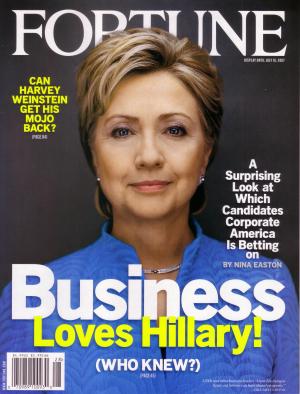
Business Loves Hillary

Business Loves Hillary Clinton, Fortune, 9 July 2007

Fortune reports (Easton, Nina, “Who Business is Betting on,” vol. 156, no. 1, 9 July 2007, pp. 45-52):

One of Hillary Clinton’s most important courtships began early last year, around a formal dinner table at Georgetown’s Four Seasons Hotel. Her targets were Morgan Stanley CEO John Mack and his wife, Christy. Mack was already active politically — but on behalf of Clinton’s political opponents. A Bush “Ranger,” he had raised at least $200,000 for the President’s reelection bid and was one of the most prominent business names on GOP donor lists. At one time his name had circulated as a potential Bush Treasury Secretary.

The conversation that night ranged widely, but always returned to one subject: health-care reform. …

Hillary Clinton was on familiar territory — and managed to charm the couple not only with her “intelligence and educated responses,” as Christy Mack recalls, but also with her one-on-one charisma. “You have these preconceived ideas about people you see in the public eye,” says Christy. “But we were extremely impressed with her ability to connect with every single person. She was an amazing listener, with tremendous warmth.”

The relationship could have ended there — a New York Senator engaging her local constituents. But early this year Clinton upped the ante with a phone call to the Morgan Stanley CEO, asking him to support her presidential bid. When he demurred, she asked for a meeting. Once again — this time over coffee — John and Christy Mack found themselves enticed. When Mack returned to his office, he told Nides he was ready to commit. “John, you can wait, you don’t have to commit yet,” Nides responded. “No,” Mack replied, “early support is better support.” Days later Mack picked up the phone and sealed the deal. Clinton, Nides recalls, “put the time in.”

On the one hand, this bodes well in that some have pointed out that Senator Clinton has nowhere to go but up and when people are exposed to Hillary Clinton in person instead of Hilary Clinton the myth, they are pleasantly surprised. On the other hand, one would really like to know what Senator Clinton could say (or maybe even promise?) to a Bush Ranger — in 2004 nonetheless — about healthcare that would cause him to back her for the presidency.

Cusping on a new Gilded Age, it would perhaps be best to have a candidate that business loathed. But I guess that’s what cusping on a new Gilded Age means: the money men vote first, then the rest of us chose from the slate they have prescreened.