Life in a Northern Town

Matthew Yglesias makes a point about U.S. cities that just hurts (“SoCal Tragedy,” TheAtlantic.com, 7 May 2008):

The thing you really forget about the deplorable land use and development patterns in southern California (and the Soutwest more generally) until you come back out here is how goddamn nice the weather is, a fact that takes the situation out of the realm of farce and into tragedy. You know what a good place to never walk anywhere would be? Boston or Chicago in the winter. Or maybe DC or New York in the summer. That’s some nasty weather to be walking around in.

But LA would be a great place to walk or ride a bike to work all year ’round. But it’s our bad weather belt that has the walkable cities, and our sunny and temperate all the time region that barely has sidewalks.

I have lived more or less my adult life in the Northwest, Seattle, briefly New York and for the last five years, Washington, D.C. I often consider the possibility of moving someplace nice. S., who doesn’t desist in sweater wearing until the temperature hits about 80 degrees, does so more often than me. But as soon as you start considering someplace nicer, you run into this impenetrable wall that everyplace in the sunbelt sucks. I’m not about to live in the old South or Texas for cultural reasons. Miami is physically very beautiful and almost serviceable from the standpoint of urbanism, but is one of the U.S. capitols of superficiality. And the entire Southwest is a wasteland of suburban environmental destruction.

How did this come about that the nicest parts of the country have nothing by way of great, people-friendly cities?

And then I think, even if Los Angeles were physically nice, would you really want to live there? I’m somewhat prone to those theories of cultural determinism based upon the temperate bands of the earth. The sun imposes a certain physicality which is why Los Angeles and Miami are the twin boob job capitols of the country and why, for all its avowed prudery, the old South is a hotbed of sexuality run amok (the counter-argument here is the ancient Mediterranean: both sunny and intellectually vibrant). I have somewhat just resigned myself to being a hunkered-down, rained upon northerner.

Monkey Contributors

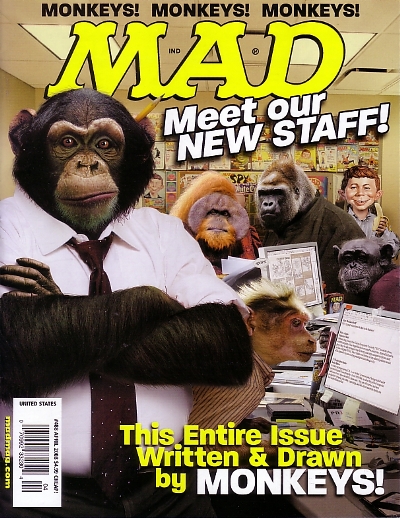
The purpose of switching to a group blog format was to upgrade from my existing two to five posts per week to the sort of high-volume blog that would reward regular refreshing the browser. But alas K. and J. are weak oarsmen. So I’m thinking of a strategy more like that of Mad Magazine:

April 2008 Mad Magazine, monkey editorialship

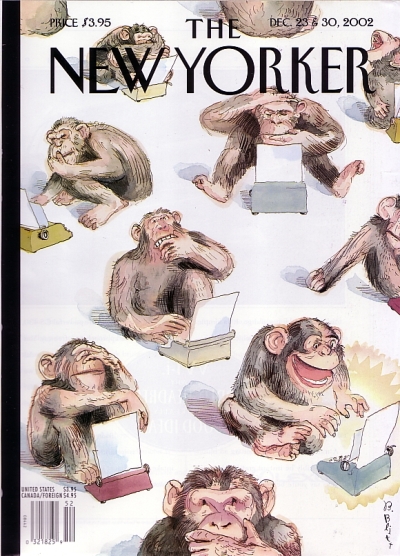
I would hardly be only in the company of Mad. The New Yorker obviously has had similar thoughts:

23 December 2002 New Yorker, the Fiction Issue, chimps on typewriters on the cover

And The New Yorker cover shows that the editorial staff at that magazine is actually thinking through the practicalities of the program. On the other hand, The New Yorker is just involved in a raw numbers game. Mad is trying a strategy of mixing it up.

Back when I worked in IT I actually used to fret that my employer would fire me in favor of a monkey. I’m sure that a chimp could have been at least twice as productive as me when it came to pulling new cables through the suspended ceiling. Perhaps the same would be true of blogging.

Falafel Quest

Pennsylvania working class aren’t the only bitter ones. Matthew Yglesias is bitter as well (“Bitters,” TheAtlantic.com, 13 April 2008):

I’m bitter about the way Meridian Hill Park and the street design in Adams Morgan makes it so difficult to get from my house to the Amsterdam Falafel Shop even though it’d be really close if I could fly.

I hear ya, brother! I live on 18th Street. Amsterdam Falafel is on 18th Street. Were it not for a gigantic gorge jutting out from Rock Creek Park between Irving and Harvard, it would be a straight shot. As it is, 18th doesn’t run through and I have to go a bunch of blocks east, then south, then jog a bunch of blocks back west again. As a result, I go to Amsterdam Falafel a lot less than I would like.

Blogger Karōshi

The New York Times has an article about blogging yourself to death (Richtel, Matt, “In Web World of 24/7 Stress, Writers Blog Till They Drop,” 6 April 2008). The Japanese, for whom this is not a new phenomena, actually have a word for death by overwork: Karōshi.

Matthew Yglesias asks what’s the big deal? (“Death by Blog,” TheAtlantic.com, 6 April 2008). “…[T]o me the most draining times are really those times when I’ve undertaken substantial work on top of the blog.” I, on the other hand, have undertaken a blog on top of substantial work. I’m not a full-time blogger. I have a 40 — okay, more like 50 or 60 — hour a week job. I blog over my lunch break — when I take one — and in the evenings. Often times I feel like I have two jobs. Writing even a few posts is, for me, very time consuming. I get home in the evening and think, “Now it’s time to start my second job.” It frequently takes me a couple of late nights to finish a post and when the end is in sight, I often chase the mirage of finishing until dawn and the horror of birds chirping (Quoth the raven, “Time to get your ass to work”). Back in 2005 I ran a few queries and found that my average post was made between 10:00 at night and 6:00 in the morning (“Hundredth Post: Taking Stock,” smaties (first series), 18 January 2005). I would provide some current stats, but the new blog has a lot more complex a data model than what I developed.

I’m not griping — I’m just riffing. I do it to myself: I’m a wannabe intellectual with a boring day job. I wish I were a writer and I am desperate for a little intellectual exercise. The problem is that by depriving myself of as much sleep as I am, I am incurring as much brain damage as I am engaging in brain stimulation.

And Mom: I turned off comments not to thwart open thread on your concern for my health, but because of a recent rash of comment spam.

Northwest Emergency

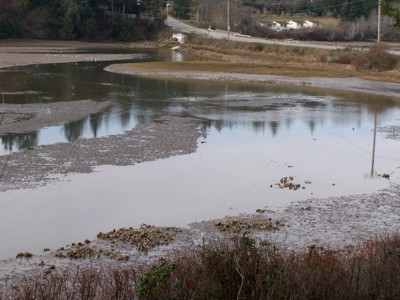
The morning change of the tide, Big Beef Bay, Seabeck, Washington, 6 March 2007, 10:45 AM

I’m on an emergency trip to the Northwest right now because my father is having valve replacement surgery. I’m spending all my time in the hospital this week so posting will be light.

I managed to get away from the hospital long enough for a brief get-together with fellow blogger K. tonight. J. was unavailable as he was stuck home dog-sitting.

Above is a picture of the bay where my parents live. I rushed out the door with the camera just too late to capture two great blue herons beating the tar out of each other with their wings and jumping around like Baryshnikov. Every time I come back I am amazed by how beautiful it is here. I don’t remember being able to see the mountains so exposed and from so many locales as I have noticed this time around. On the other hand, I can’t stand coming back because it’s dismaying how eager everyone in this area seems to be to destroy everything that makes it such a wonderful place. Really what the peninsula could use is fewer such vistas and instead another strip mall.

A few more observations from the trip:

  • On my flight back here I ended up missing a connection so ended up with some extra layovers as part of the reroute. While annoying, the extra legs allowed me to observe more closely the gradation of people from stodgy and formally to kicked and outdoorsy as I traveled from East to West. Judging by the dress and carry-on luggage of the people boarding the plane for the Salt Lake City to Seattle leg, Salt Lake City is like some Los Vegas of the outdoor adventurer.

  • Hillbillies are everywhere. When I was growing up in the Northwest, it seemed like there were the hillbillies and then a bunch of normal suburban people. That must have been some attuned, contextual distinction for which I no longer have the sensitivity. Everybody here seems like a redneck to me now. The urban areas are even populated by the townie brethren of the hillbillies.

  • Bureaucratic language abuse abounds. When my dad had some minor complications that didn’t admit obvious explanation, the anesthesiologist assured us that “unusual events are common the first day of recovery after a surgery.” The hospital garage has a sign over one of the exits that says “Do not enter.” Do you mean do not enter the outside? Wouldn’t that be do not exit? Well they don’t make a do not exit sign. So the do not enter sign will have to do? A sign at the post office reads “Service Animals Only.” So the humans have to wait outside while their animal agents do all their mailing for them?

  • Things are unbelievably cheap around here. I was out to dinner tonight and ordered a cocktail, a glass of wine, salad, an entrée and dessert. I thought that I had gotten totally carried away and was unhappily anticipating the check to be something like the usual $50.00 it would be in D.C. Nope, $23.00. Amazing. That’s what I remember eating out being like — and for a dining experience consistently better than that in D.C. even.

The First Casualties of Gentrification

I suspect that the first real consequences of the gentrification of Columbia Heights are starting to hit Mount Pleasant. I was walking home tonight when I noticed that the Mount Pleasant Super Market was closed with the usual signs up in the windows. A peep through the grates revealed ransacked, bare shelves. My personal favorite grocery store, the Super Save Market has been locked up tight for probably two weeks now, but with no explanation and all the merchandise untouched — suggestive of a landlord locking them out rather than an orderly loosing of the lease.

I have to wonder when the International Progresso Market, Los Primos and the Samber Market are next. All three appear to be just barely hanging on.

The survivor will probably be BestWay which irritates the hell out of me. It’s the biggest of the grocery stores in the neighborhood, but also the most inadequate. First of all, they close way too early. Since the Super Save Market closed I have redirected to BestWay, but am already reminded why the Super Save Market was my favorite. About two thirds of the time that I head over to BestWay I find them closed. And they keep on ratcheting the hours down. It used to be that they closed at 9:00, but the floors were already mopped, the place stinking of whatever foul substance they put in their mop buckets and someone at the door trying to intimidate you from entering at 8:50. So they recently made the closing time 8:50. But everyone has adjusted accordingly. Now the place is mopped and you’re not welcome at 8:40. I frequently don’t even leave the office until 8:30. A grocery store that closes at 8:40 is a store at which I will never shop.

And then there is BestWay’s strange monomania regarding stock. BestWay is the one most like what most people think of when they think grocery store. Most of the stores in Mount Pleasant are weird hodgepodges of products heavily skewed toward the ethnicities of the neighborhood piled on improvised and mismatched shelves in a shop that doesn’t even approach ADA standards. There is a lot of minding your manners, jostling and backing down an isle only wide enough for one. BestWay is large, well stocked and has enough space for people to pass in the isles. But it’s only well-ish stocked. They have most things you would want and offer variety in nearly all product categories, but for some reason never vary the products according to the factors that matter. In the canned vegetable isle they devote a couple of feet on two shelves to tomatoes. That’s quite a lot of tomatoes — as would be expected as people eat a lot of tomatoes. But it’s all a couple of different brands of only 28 oz. cans of whole stewed tomatoes; no 14.5 oz. cans and no diced or sliced. Who makes anything with whole tomatoes? There are like five different brands of catsup — Heinz, Hunts, Del Monte, RichFood, Value Brand — but only in small bottles. But for some reason they carry vinegar in industrial quantities.

As this list may suggest, Mount Pleasant is an over-groceried neighborhood and maybe overdo for a shakeup. It’s a tiny nook of the city with multiple grocery stores in which the norm is huge residential tracts without a grocery store for miles.

I just hope Samber Market isn’t next. It has become my late night fallback now that Super Save Market is closed. It is run by an older Japanese couple and I go there because they are both so overwhelmingly pleasant. They are both very good looking, always dressed like they consider their job at the till to be very serious work, and seemingly happy to see me every time. The man holds up each item as he rings them up and gets a certain look of pride at each one — especially a bottle of wine — like he were serving the community and providing for his family with each sale. Often a boy, I presume their grandson, but maybe their son — they could go either way — is in the store roller-skating laps or climbing the taller shelves way too rambunctiously, but unimpeded by his grandparents.

They must sleep in the stock room on top of pallets of Top Ramen given the expense of living in D.C. Hopefully they’ll survive the winnowing. Hopefully this won’t end up another neighborhood without a grocery store.

Update, 27 January 2008: Yep, it’s confirmed. I walked past the Super Save Market on Friday night and there was a notice up from the D.C. Tenant Court saying that the tenant was in arrears $14,000. They had been making all sorts of upgrades to the store lately and I thought it was because they were finally making a bit of a success of themselves. I guess that it was actually some last ditch gamble to attract more business. The tragedy is that the fancy new shelves probably cost a month’s rent.

Bleak Life Without The Daily Show and The Colbert Report

Since the Daily Show and the Colbert Report have been off the air owing to the writer’s strike, our television has sat black-screened and unwatched. There was a particularly dark bought of HGTV watching somewhere in there resulting in what one of my colleagues referred to as “a wicked TV hangover,” but I have learned that I am more or less a single-show television watcher.

Unfortunately for the cause of the writers strike, but thankfully for myself and for the nation Messrs. Stewart and Colbert are back. An election season is packed full of too much balderdash to do without them.

Apparently they’re back under some mysterious duress. As amends for knuckling under, both of last night’s shows were devoted to a thumb in the eye of their paymasters. They even got a dig in when conceding their return to air back in December (de Moraes, Lisa, “Stewart and Colbert Won’t Stay Out in the Cold,” The Washington Post, 21 December 2007, p. C7):

“We would like to return to work with our writers. If we cannot, we would like to express our ambivalence, but without our writers we are unable to express something as nuanced as ambivalence,” the two men said in a joint statement.

It’s always been a bit of a mystery how much the success of those shows are the genius of Messrs. Stewart and Colbert and how much they relied upon their staffs. Last night was bad news for the writers: Stewart and Colbert are good enough to pull it off on their own.

Pennsylvania in Winter

Pennsylvania farm in winter, Franklin Hill, Montrose, Pennsylvania, 30 December 2007

We just got back from visiting S.’s family in Pennsylvania for the New Year’s weekend and lo, the first post of the year. We did some hiking around the family farm when the cold let up a little yesterday afternoon. It started snowing early in the evening and went hard all night. We spent yesterday morning digging out the cars and clearing the driveway.

The New York Times has an article yesterday on the conflict between advocates for untrammeled nature and off-road vehicle riders (Barringer, Felicity and William Yardley “Surge in Off-Roading Stirs Dust and Debate in West,” 30 December 2007). Someone like David Brooks who advances a scaled down version of red-state, blue-state stereotypes might suggest that this is a case of urban elites looking down their noses at the unsophisticated enthusiasms of the rabble. The article itself tells a much more mixed story.

This is pretty much the way that it is up here in Pennsylvania. The W. family has lived on their hilltop farm for eight generations and in the last few years there has been an invasion exurban types from New Jersey towing trailers of four-wheelers behind their new Ford F150 pickup trucks up to their second country places (I’m not exaggerating here: we passed a few on the way back down as we do on nearly ever trip). None of them have much by way of property — certainly not enough to support their four-wheeling ways — so they crossover onto the W. farm and ride over the hills and dales of its remote corners. The W.s put up no trespassing signs and erect obstructions along trails but a sign doesn’t do much in the face of determination and the riders have gone so far as to bring chainsaws in with them to break up the obstructions that the W.s have built.

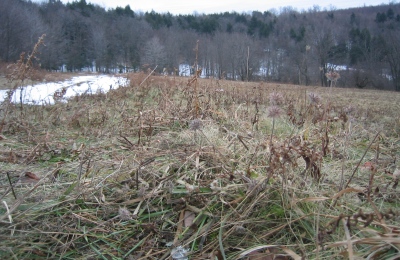
Winter yellow Pennsylvania fields, Franklin Hill, Montrose, Pennsylvania, 30 December 2007

The East with its preponderance of deciduous trees is quite different from the Northwest. The spring is so much more green and the autumns are breathtaking, but during the winter, when the entire countryside is this dull grey of naked branches is a bleak contrast. I have come to think of the winters as insufferably colorless, but while driving around this weekend I noticed for the first time where the color remains. The trees may go but the grasses of the fields remain. It tufts up and is wind-swept so it lays across the fields in waves. It has turned yellow with the season and intermixed with the browns of low withered weeds making the fields a bold yellow-umber color. Everything is damp so it acquires a richness of color and a bit of a glint. The wintry fields are stunningly beautiful.

When I visited Paris it was over New Year’s and as the plane descended towards Charles de Gaulle airport we flew over a number of similar swaths of wintry fields. The color and the coarseness of the grass struck me. I thought at the time that a little exposure to European landscapes would go a long way toward an education in the color pallets of certain European painters. But it now seems to me that similar colors abound in the United States as well. Perhaps it is the combinations or the preponderant colors that is the difference.

Alas, this is another way that rural America is disappearing. It probably used to be that you would drive through this country and it would be nothing but farm fields, working or fallow. But increasingly the tangled yellows of straw and hay or anarchic fallow fields are being replaced by well manicured green suburban lawns. One can really see how anemic and unimaginative the standard suburban lawn is next to the unkempt yellow fields behind a weathered grey split rail fence.

Happy Repeal Day

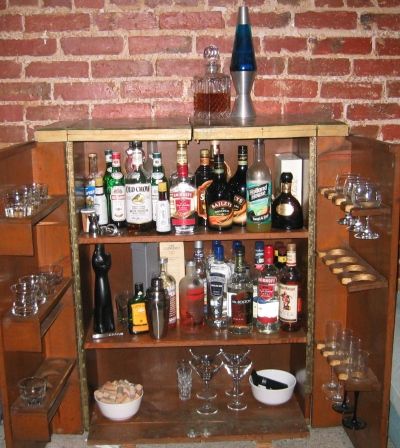
5 December 2007, Repeal Day, my liquor cabinet

Dewars Scotch has the brilliantly targeted (at me and my ilk) advertising campaign of promoting the notion of Repeal Day (Dewars | independent), celebrating the end of prohibition. That’s a holiday I can get behind!

Fittingly Franklin D. Roosevelt, the last president to have been photographed with a cocktail and a cigarette, ran on the repeal of prohibition, signed the Volstead Act legalizing the brewing of beer and presided over the repeal of the Eighteenth Amendment. On 5 December 1933 Utah, of all states, ratified the Twenty-First Amendment to the United States Constitution ending prohibition. Another reason that FDR is one of the best presidents in U.S. history!

It’s snowing out and the bars in D.C. all suck so I will probably be staying in, but while setting the scene for the photograph above, I happily came across a forgotten bottle of now thirteen-year-old Glenlivet single malt scotch: the kind of thing to keep you warm on a winter night. Sorry Dewars, but your promotional failed on me as I will be drinking the competition tonight.

The Magnificent Seven

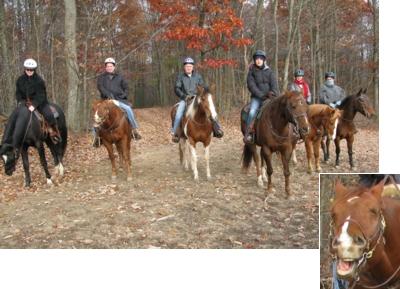
Thanksgiving weekend, 2007, Pleasant Valley Ranch, Pennsylvania, riding horses

(six in picture, seventh behind camera)

S. and I spent the Thanksgiving weekend with the usual crew of regional friends, one toddler, three dogs a cat and an Aussie, this time in the Poconos. The stuffing wars between S. and I brewed on into another season (I make mine with thyme and raisins, she makes a more stripped down version). I tried to supplement my usual entry with an experimental roast fall vegetable stuffing, but owing to insufficient time-management on my part had to be turned over to another cook to be circumscribed into merely roast vegetables, sans cornbread.

The day after Thanksgiving we went on a day hike. We ended up driving all over creation trying to locate a trail where we wouldn’t be imperiled by the stray slings and arrows of hunters. After driving past a number of trailheads, we arrived upon a national park, figuring that there wouldn’t be any hunters allowed. We parked and as we were headed for the trailhead, two young men in full camouflage, one toting a bow and arrows, the other a rifle came off the trail and towards us. This put a pall on our hiking party and we stopped them for questioning. They explained that it was hunting to the right, no hunting to the left, and that the hunters would probably have hiked quite a ways off the trail anyway. So we decided to proceed. The hutch at the trailhead greeted us with a litany of yellow warning postings. “Warning: Hunting season in effect.” “Warning: Beware of Bears,” and all the usual instructions on what to do if attacked by a bear. The next one was a bonus danger: “Warning: Venture off the marked trail at your own risk. This park is a former military base and may contain unexploded ordinance.” But the real kicker was a homemade bulletin with the row of tear-offs down one side listing the contact information for the nearest hospital and driving directions to get there. And two of the tear-offs had already been taken.

On Saturday we went horseback riding at Pleasant Valley Ranch. I don’t like horses and the only time I have ever ridden one was in probably fourth grade when a classmate and her mother rode their horses over to my parents house. I was boosted up into the saddle, wrapped my arms around the waste of my classmate and she rode me one lap up and down the dirt road off of which my parents live.

Under most circumstances I would have been much less than enthusiastic about the prospect of riding horses, but as I am presently reading quite a bit of Nineteenth Century military and diplomatic history and as horsemanship plays a significant part in this tale and is major component of martial virtue in the period, I though I should get a visceral sense of it. The ranch is twenty-something acres and we rode through wooded hollows, over grassy hills and through recently harvested corn fields. The picture above is taken as we came out of a wood at the crest of a hill overlooking a valley and a ridge, along which ran a portion of the Appalachian Trail (please note the humorous expression on the face of my horse, Bogie, inset).

As horses’ hooves rustled through the fallen leaves along the trails, I tried to imagine navigating the strange and uncharted byways of sparsely populated preindustrial Europe. I tried to imagine what it would be like to ride from Paris to Moscow in a column of 600,000 in the summer of 1812, happy and unaware. It was plenty cold out on Saturday, but I tried also to imagine what it would be like to be about as well dressed as I was this day, but in twenty-degree-below-zero weather on the retreat from Moscow. Where the road was boggy, I tried to imagine what it would be like for a team to pull a cannon through the mud.

My inspiration here is Adam Zamoyski’s gruesome book, Moscow 1812: Napoleon’s Fatal March. In a section of the book where he ponders the factors that determined who survived and who perished, Mr. Zamoyski proposes a number of possibilities. At the heading of one subsection of illustrative vignettes, he proposes, “Devotion to another could be a life-saver.” It is a misleading introduction as most of what follows are actually stories about how people died together. The horses are the subject of some of the most brutal passages in Mr. Zamoyski’s book, but of the devotion between soldier and horse he says,

Sergent Bourgogne tells of his friend Melet, a dragoon of the Guard. Melet was devoted to his horse, Cadet, with which he had been through several campaigns, in Spain, Austria and Prussia, and was determined to get it back to France with him. He always went in search of food for Cadet before thinking of himself, and when it became impossible to find any forage at all along the line of retreat of the Grand Armée he went in search of it among the Russians, donning the coat and helmet of a Russian dragoon he had killed in order to get past their pickets. Once inside the enemy’s encampment he would help himself to enough hay and oats for a few days and then make his escape. Sometimes he was discovered, but he always got away, and he did return to France with Cadet. A Bavarian Chevau-Léger whose darling mare Lisette fell through the ice of a bog outside Krasny and could not get out simply lay down to die beside her. (p. 491)

It was just a little two hour ride around the lot, but by the time the horses started to anticipate the end of the road I was fretting that it was over so soon. If you are looking to do something equine Pleasant Valley Ranch is a great experience. You couldn’t ask for a more easygoing, intelligent and attentive host.