ABM

In the wake of the U.S.-Russia dustup over placement of an ABM interceptor site there has been a raft of articles on the U.S. missile shield. The October 2007 issue of Arms Control Today devotes the cover and six articles to it. Matthew Yglesias (“Preemption, 12 October 2007) calls his readers’ attention to a long story in Rolling Stone on the subject (Hitt, Jack, “The Shield,” Issue 1036, 4 October 2007).

I think that Mr. Yglesias is correct to say that the real purpose of ABM is “to facilitate American first strikes.” That the U.S. seeks such a capacity is the conclusion of a RAND report (Buchan, Glen C., et. al., Future Roles of U.S. Nuclear Forces: Implications for U.S. Strategy, Santa Monica, California: RAND, 2003, see p. 61) and Keir Lieber and Daryl Press suggest (“The End of MAD: The Nuclear Dimension of U.S. Primacy,” International Security, vol. 30, No. 4, Spring 2006, pp. 7-44, see p. 28) that in such a scheme, mop-up of a small number of surviving missiles launched after a disarming counterforce strike might be a job for which an ABM system of limited capability might be adequately suited.

But this isn’t the whole of the story: there are three reasons that the right has in the past and continues today to be so in favor of an anti-ballistic missile system.

  1. More fundamental than anything else is the American cultural reason for the fervor for ABM on the right. The culturally Scotch-Irish descended, Jacksonian segment of the United States subscribes to a very specific notion of warfare and the law of nations. War is to be fought all out with no restraint. Victory resulting in complete submission of the opponent is the objective. It is retributive in its notion of justice and particularistic rather than universalizing and legalistic in its reasoning. It is a mentality that never made the leap to the counterintuitive reasoning of the nuclear age. Its members have never understood limited war or restraint in warfare. Hence the angst over Vietnam, the use of torture in Iraq and opposition to all forms of arms control.

    The basis of arms control in the 60s and 70s was the gradual acceptance by nuclear strategists of MAD and its institutionalization in the Anti-Ballistic Missile Treaty of 1972. That nuclear powers would intentionally remain vulnerable to attack was the linchpin in stabilizing the nuclear arms race, but this flew in the face of the Jacksonian notion of war. Conspiring with one’s enemies to limit one’s capabilities and limit the uncontainable violence of war didn’t fit their paradigm and ever since they have been raging to tear down the entire structure. The intense interest in deploying an anti-ballistic missile system has had less to do with pragmatic considerations of national security than with the ideological struggle between two strategic paradigms. No policy debate would be so intense and fought out over generations of strategists and politicians were it just a weapons system at stake. The aim of moving to deploy an ABM system so urgently — even before it has been adequately demonstrated to work — is specifically to destroy the existing arms control regime and international system more generally in favor of one more in line with Jacksonian notions.

    This is why opponents of ABM have done so much to pillor Ronald Reagan, the id of 1970s and 80s America, and why the label “star wars,” with its invocation of psycho-cultural tropes, was so effective. The whole debate about ABM has taken place where strategic reasoning leaves off and social-psychology picks up.

  2. Hedging one’s opposition to ABM on technical infeasibility is probably a bad option. First, Americans, with their infinite faith in technology and can-do attitude won’t buy it. Second, at some point a system of at least some rudimentary capability will probably be up and running. A review of the history of nearly every weapon today touted as a miracle system shows that at some point in its development it was widely considered a boondoggle that would never work.

    The Patriot Missile is a good example here. During development in the late 1970s there was endless harping that the technical hurdles were insurmountable and that it would never work. The first battery was deployed in 1984 as an anti-aircraft weapon, but it was designed to be a modular system and underwent a number of major and minor upgrades, including the 1988 upgrade that gave it the anti-ballistic missile capability for which it is so well known today. In the 1991 Gulf War CNN footage of Patriot missiles rising to destroy incoming Scuds over Israel and Saudi Arabia are some of the most memorable images of the war. Subsequent studies have indicated that the success rate of the Patriot was significantly lower than initially reported, but additional upgrades throughout the 1990s have further refined the performance of the weapon. In the invasion of Iraq the weapon misidentified and shot down two allied aircraft, but it is hardly the only system to have malfunctioned resulting in friendly-fire deaths. It is presently undergoing an upgrade that is nearly a complete system redesign and will significantly enhance performance in nearly every aspect. The important point is that it managed to overcome its technical hurdles, with significant progress being made post-deployment and has undergone a number of modifications that have pushed a thirty year old system well beyond its initial specifications. A similar story could be told for the Tomahawk cruise missile or the B-2 stealth bomber.

  3. As Senator Lyndon Johnson argued to liberal skeptics who thought the 1957 civil rights bill didn’t go far enough, it was more important that a bill get passed than any particular content of the bill. Or as Senator Johnson put it, “Once you break the virginity, it’ll be easier next time.” Senator Edward Kennedy has offered a similar defense of his votes for micro-initiative healthcare programs or No Child Left Behind. If a comprehensive universal healthcare bill is unpassable, than pass it in a million little pieces. Or, it is more important to get Congress to agree in principle on federal education spending. The program can later be reengineered with amendments.

    One of the notable features of the post Newt Gingrich / George W. Bush right is the degree to which they have learned to use the very things they most hate about government to their advantage. One is that a budget line-item never dies. All that was necessary was to fund ABM once, then there would be interest groups, a bureaucracy, a scientific community, a lobby and the fundamental human laziness of just carrying a line-item forward. The program would then live in perpetuity.

    Combine this with number two, that the technological problems can be ironed out in the field with enough money, and the important point is to get systems in place. The pressures of real-world operability plus the bureaucratic juggernaut will force a system into existence. The arguments that Mr. Hitt in the Rolling Stone piece thinks his strongest are, at this high-level, no argument at all. You really have to dig down into the nitty-gritty — which he does not do — before such arguments start to have any impact. In this scenario, a few negative GAO reports are no threat. In fact, they could shame politicians to throw good money after bad, lest failure show their previous votes in a new light. In fact, I’ll wager that if the Democrats capture Congress and the White House in 2008, the ABM juggernaut just keeps rolling on unabated.

The real problem with an anti-ballistic missile system is that it is a Maginot Line. This is the case for three reasons.

  1. ICBM counter-measures and ABM system requirements don’t scale at the same rate so would-be attackers can defeat ABM — or at least confound it to the point where a defender could not factor it into their strategic considerations with any reliability — much more easily and affordably than defenders can adapt. And being on the right side of a scalability calculation is how one wins a strategic competition.

    If the technical countermeasures aren’t enough, it’s worth noting that the calculation of an ABM system is that its OODA loop is inside that of an ICMB flight time. As terrifyingly short as ICBM flight times are, they are long enough compared to modern C3I. To defeat ABM, all one has to do is compress ballistic missile flight time to less than the OODA of ABM. The 25 minutes from Asia to the U.S. is a relatively long time, but park a missile submarine loaded with intermediate-range ballistic missiles (IRBMs) a few hundred miles off the coast and now you are talking about flight times of more like five minutes. Many IRBMs are suborbital so even if detected and reacted to, there just might not be enough air under a warhead for a ground-based interceptor to work its magic.

    Reaction time of ABM could be shortened too, with the first C of C3I — Command — being the lowest hanging fruit. But automate the decision-making component and SkyNet goes live.

    All of these calculations explain why the Chinese are spending so heavily on SSBNs (Lewis, Jeffrey, “Two More Chinese Boomers?,” Arms Control Wonk, 4 October 2007) as well as why the United States continues to turn out attack submarines ($2.7 billion for one Virginia class submarine in the FY 2008 budget) nearly 20 years after the end of the Cold War and without a single navy peer competitor prowing the seas.

  2. Once it becomes clear that ballistic missiles are under threat, states will quickly realize that the future is in cruise missiles.

    Having watched a number of U.S. air power attacks on CNN, Americans think that cruise missiles are an exclusive U.S. technology. While, say, the U.S. Tomahawk cruise missile is an extremely sophisticated weapon, cruise missiles are not beyond the reach of less capable powers. The German V-1 “flying bomb”, first flown in 1944, was essentially a cruise missile. The United States deployed its first cruise missile, the problem-prone Snark, in 1961 and initially development of the cruise missile was considerably ahead of that of the ICBM. The Europeans have the Storm Shadow. During the invasion of Iraq, Saddam Hussein attacked Kuwait with a Chinese-made Silkworm cruise missile, first deployed in the early 1980s. Proliferation of cruise missiles is proceeding apace and the technology is not so sophisticated as to be intercepted by export control regimes. Hell, the flight control system of a Tomahawk runs on an 8086 processor. And it’s not even manufactured by Intel anymore. The design has been licensed to a bunch of low-end Asian chip fabricators.

    Cruise missiles fly low and under radar detection systems, are capable of maneuver and because they don’t follow set, easily calculable trajectories like ICBMs, are not subject to easy intercept. Cruise missiles usually have shorter ranges, so we are potentially back talking about anti-submarine warfare again.

  3. Then, of course, there is the most radical delivery system. If I were a terrorist or rogue state plotting to get a weapon of mass destruction to a U.S. city, I would just FedEx it.

    As has been fairly well observed, modern terrorism and to an increasing extent, modern war in general, is parasitic on the very highways and byways of globalization. There is no killer app here that can solve the problem. This is more labor-intensive problem demanding a myriad of heterogeneous and creative operations.

It would seem to me that given the scalability issue covered in number one, ABM is a grand-strategic looser. Much more security per dollar could be had through the tried and true means of anti-proliferation, traditional deterrence, counterforce, anti-submarine warfare and the newer, but relatively affordable area of homeland security.
The Stable North of Iraq

Things may be a disaster between the Shi’ia and the Sunnis in the south of Iraq, but at least the Kurdish north is stabilized. Think again (Traynor, Ian, “Upsurge in Kurdish Attacks Raises Pressure on Turkish Prime Minister to Order Iraq Invasion,” The Guardian, 9 October 2007):

Turkey’s prime minister, Recep Tayyip Erdogan, came under intense pressure last night to order an invasion of northern Iraq following the deadliest attacks for over a decade on the Turkish military and civilians by separatist Kurdish guerrillas. Mr Erdogan, who has resisted demands from the Turkish armed forces for the past six months for a green light to cross the border.

Mr Erdogan, who has resisted demands from the Turkish armed forces for the past six months for a green light to cross the border into Iraqi Kurdistan, where the guerrillas are based, called an emergency meeting of national security chiefs to ponder their options in the crisis, a session that some said was tantamount to a war council.

A Turkish incursion is fiercely opposed by Washington since it would immensely complicate the US campaign in Iraq and destabilise the only part of Iraq that functions, the Kurdish-controlled north.

And Turkey isn’t the only country with a Kurdish problem. Iran has a Sunni Kurdish population in its northwestern region with which it has engaged in numerous clashes. Iran is already operating in Iraq in support of the Shi’ia and both Iran and Turkey have conducted simultaneous attacks on Kurdish rebels and a few cross-border artillery attacks.

I would say that the notion advocated by Democrats of drawing down U.S. forces in Iraq to maybe 50,000 massed primarily in the Kurdish north is no solution.

Iraq and Vietnam; Civil Wars and Asymmetric Conflict

Someone at some point should drive home to the right that Iraq and Vietnam are not some apparition or anomaly requiring exceptional explanation — namely the Dolchstoßlegende — but in fact the historical trend.

Our historical-materialist problems in Iraq are multifaceted. Iraq is a combination of two pernicious trends: one relating to civil wars and one relating to asymmetric conflict.

First, on the issue of civil wars, they are by nature long, intractable and fought to the bitter, bloody end. The Los Angeles Times had the good sense to have Barbara F. Walter, author of the study, Committing to Peace: The Successful Settlement of Civil Wars (2002), write a brief summary of her survey of civil wars and the likely meaning for Iraq (Walter, Barbara F., “You Can’t Win With Civil Wars,” Los Angeles Times, 2 October 2007):

The approximately 125 civil wars — conflicts involving a government and rebels that produce at least 1,000 battle deaths — since 1945 tell us several things: The civil war in Iraq will drag on for many more years; it will end in a decisive victory for either the Shiites or the Sunnis, not in a compromise settlement; and the weaker side will never sign a settlement or lay down its arms because it has no way to enforce the terms.

Civil wars don’t end quickly. The average length of all civil wars since 1945 is 10 years. Conflicts in Burma, Angola, India, the Philippines, Chad and Colombia have lasted more than 30 years. Wars in Afghanistan, Cambodia, Lebanon, Sudan and Peru have lasted more than 15 years. Even Iraq’s previous civil war, fought against the Kurds, lasted 14 years.

This suggests that, historically speaking, Iraq’s current civil war could be in its early stages, with nothing to suggest that it will be a short, easy war.

Another lesson from history is that the greater the number of factions involved in a civil war, the longer it is likely to persist. Iraq simply has too many factions, with too much outside support, to come to a compromise settlement now. Not only is there no Shiite or Sunni who can speak for all of his side’s factions, but the parliament seems incapable of stopping the violence between these groups.

Civil wars rarely end in negotiated settlements. In research for a book on the topic, I found that 76% of civil wars between 1945 and 2005 ended only after one side had defeated all others. Only 24% ended in some form of negotiated solution. This suggests that the war in Iraq will not end at the bargaining table but on the battlefield.

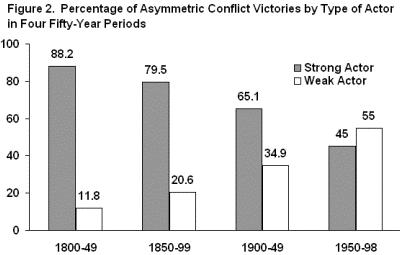
Second, on the issue of asymmetric conflict, the trend over the last two centuries is toward small powers defeating larger ones, to the point where in the latter half of the Twentieth Century, small powers actually defeat large powers more often than not. Below is figure 2 from Ivan Arreguín-Toft, “How the Weak Win Wars: A Theory of Asymmetric Conlict,” (International Security, vol. 26, no. 1, Summer 2001, pp. 93–128).

Arreguín-Toft, Ivan, "How the Weak Win Wars: A Theory of Asymmetric Conlict," International Security, vol. 26, no. 1, Summer 2001, pp. 93–128, Figure 2: Percentage of Asymmetric Conflict Victories by Type of Actor in Four Fifty-Year Periods

Given these two trends, the deck was stacked against the U.S., even with the greatest effort, but since it was undertaken by the Solomon Grundy administration (Wikipedia | Sean Baby) we never stood a chance. They know how to smash and that’s about it.

Neither of these two observations are new: both trends were generally known at the time of the invasion of Iraq — Ms. Walter’s book is from 2002 and Mr. Arreguín-Toft’s article is from 2001 and neither were breaking new ground. Five year on, it is now completely apparent outside of administration propagandists that the key strategic judgment with respect to Iraq was not how many soldiers in the initial invasion, or how many in the subsequent occupation, or whether to intervene in the looting, or to disband the Iraqi army, or seasoned experts versus right-wing sycophants to staff the CPA, or any of the many, many other mistakes, but whether to go into Iraq or not in the first place. Barring sufficient historical awareness here, at least the administration should have known and acted like the odds were not in favor of success. Instead we got the fast-talker’s sales pitch.

And as the Dolchstoßlegende crowd now attempts to rewrite the history of the Iraq debacle a la the Vietnam War version thereof, it should be born in mind that that war was part and parcel of these trends.

A Revival of the Southern Strategy?

I’m going to venture a prediction. And it’s a pretty easy prediction to make in that it’s based on an unlikely hypothetical and if things branch as I suspect, I’ll never be taken to account for my prediction.

There’s been a lot of twittering on the left about the persistent racism of the Republican party and of the Southern strategy. Rick Perlstein is writing a book about it (tentatively titles Nixonland), Paul Krugman’s column last week was on it (“Politics in Black and White,” The New York Times, 24 September 2007) and the Daily Show really took candidates to task for it last night.

Every time someone goes off on this tangent, I get a little uncomfortable in that it seems like a tired liberal saw that is well into diminishing returns. Surely today’s Republican party has retired all but the last few holdouts and dead-enders. But then it is good to look back at the ol’ red and blue map of election returns by county — the urban archipelagos map — and recall just how rural, white-flight ex-urban and Southern the Republican party remains. And even the younger generation and sophisticates aren’t all that sophisticated. I have a strongly Republican-identified friend who, however much liberals may grate on her, cannot bring herself to make any Republican friends because she finds them such a despicable lot. And I should add that she is a person with a considerable threshold for creepy.

Anyway, my prediction is this: that however latent, in remission, or coded the current Republican racist streak or Southern strategy may be, if Barack Obama gets the Democratic nomination, it is going to come galloping back with a vengeance.

It won’t come out all at once. The racism isn’t knee-jerk. But as the campaign wears on and the truly dire condition in which George W. Bush and Karl Rove have left the Republican party becomes apparent to the Republican nominee, the donor base, the 527s and the pundits, I expect a paroxysm of pseudo- and overt racism to pour forth. The Republican candidate will realize that the American public has soured on whatever affirmative message the Republican party has on offer and that the only way to win is to scare the pants off votes over hypothetical nominee Barack Obama. At that point the campaign will go totally negative — or at least its various minions, toadies and proxies will — the candidate must remain pristine from partisanship. I fully anticipate all those dark murmurs that were heard a while back — that Barack Obama’s middle name is Hussein, that he was educated in a madrassa, that he is a angry black man (could anything be further from the truth?), that he has a chip on his shoulder against white people — to come slithering back out from the dark corners or the mind of red America.

Syria Gets the Osirak Treatment?

Also in nuclear news, despite some pretty severe smack-downs from some prominent names in the arms control community, Glenn Kessler and the Washington Post are apparently sticking by their story that Israel bombed a Syrian nuclear installation on 6 September 2007 (“Israel, U.S. Shared Data On Suspected Nuclear Site,” 21 September 2007, p. A1).

Joseph Cirincione, coauthor of the widely consulted reference, Deadly Arsenals: Nuclear, Biological and Chemical Threats, calls this story “nonsense” (“North Korea-Syria Nuclear Ties: Déjà Vu All Over Again?,” Foreign Policy, Passport, 14 September 2007) and Jeffrey Lewis of Arms Control Wonk goes so far as to call it “bullshit” (“Did Israel Strike a Syrian Nuclear Facility?, 16 September 2007). Mr. Cirincione writes and Mr. Lewis excerpts approvingly:

The Washington Post story should have been headlined “White House Officials Try to Push North Korea-Syria Connection.” This is a political story, not a threat story. The mainstream media seems to have learned nothing from the run-up to war in Iraq. It is a sad commentary on how selective leaks from administration officials who have repeatedly misled the press are still treated as if they were absolute truth. Once again, this appears to be the work of a small group of officials leaking cherry-picked, unvetted “intelligence” to key reporters in order to promote a preexisting political agenda.

This is definitely the administration that has cried wolf too many times, but the Washington Post article seems pretty heavily sourced. And I don’t believe that Syria is an Israeli bombing range where the IDF just flies out for practice missions. If they went in, they must have had some pretty serious concerns. I’m going to need a lot more than unnamed Bush officials and bluster before passing judgment on this story.

A Bent Spear

The Washington Post put a major story about the six nuclear armed cruise missiles unwittingly flown across the country on the cover of the weekend edition (Pincus, Walter and Joby Warrick, “The Saga of a Bent Spear,” 23 September 2007, p. A1). Details on the exact point of failure remain under wraps, but it sounds like an instance of a single failure leading to a chain of subsequent failures.

The article goes on to point out that this is just the final, high-profile outcome of a longstanding, but not yet newsworthy problem:

A secret 1998 history of the Air Combat Command warned of “diminished attention for even ‘the minimum standards’ of nuclear weapons’ maintenance, support and security” once such arms became less vital, according to a declassified copy obtained by Hans Kristensen, director of the Federation of American Scientists’ nuclear information project.

The Air Force’s inspector general in 2003 found that half of the “nuclear surety” inspections conducted that year resulted in failing grades — the worst performance since inspections of weapons-handling began. Minot’s 5th Bomb Wing was among the units that failed, and the Louisiana-based 2nd Bomb Wing at Barksdale garnered an unsatisfactory rating in 2005.

Both units passed subsequent nuclear inspections, and Minot was given high marks in a 2006 inspection. The 2003 report on the 5th Bomb Wing attributed its poor performance to the demands of supporting combat operations in Iraq and Afghanistan. Wartime stresses had “resulted in a lack of time to focus and practice nuclear operations,” the report stated.

It’s worth noting that it’s not just the Army that is being degraded by the excess demands of the administration’s war in Iraq.

Pink Slips All Around — Banishment for Maureen Dowd

So it’s great that The New York Times Select wall has come down. I always told myself that if The New York Times went subscription, I would subscribe. It’s too important to do without. But instead of making such a cut-and-dry situation, they only made part of their content subscription, so I didn’t know what to do. I wanted to read Paul Krugman, but I could buy the paper off the stand for $2.00 per week, or $8.00 per month — $1.00 more than the Select subscription rate. The extra $1.00 was totally worth it to not be exposed to the rest of The New York Times’s lackluster editorial page. As much as I wanted the ease of access to Paul Krugman, I just couldn’t bring myself to pay for the rest of those dismal nobodies.

How is it that “the paper of record” ended up with such a weak stable? If I were in charge, I would keep Krugman, Brooks and Friedman and dump the rest in favor of a real feisty debate — not the thin gruel they are currently serving up. That would leave six slots to fill. I would pick maybe two real devotees each, right and left and two people rightish and leftish, but unorthodox and hard to pin down. The amazing thing is that such a bunch of mediocrits have the megaphone of The New York Times editorial page when so many amazing talents are backbenched at lesser read magazines like The Progressive, The American Conservative et cetera. Time for some promotions.

On the right I’d get someone smart — not a hack — who can occasionally refrain from reworking party talking points. Say Max Boot or David Frum. For the two on the left I would definitely go with Barbara Ehrenreich. She filled in for Thomas Friedman for a few weeks once and it was great and she would help to make up for the shameful lack of women on the page. Then maybe someone like Rick Pearlstein, Thomas Frank or Jonathan Chait. For the hard to pin down I would go with someone like Andrew Sullivan, Christopher Hitchens, Michael Lind or Virginia Postrel.

Check that, I’d fire Thomas Friedman too and replace him with someone similar, but less Howdy Doody. Maybe Fareed Zakaria if he could be lured away from his already pretty sweet post at Newsweek or Andrew Bacevich — he could double as the hard to pin down as well.

More important than anything else is that is that Maureen Dowd be forced back behind some — any — kind of wall. She’s like a Ritalin sedated cross between Bertie Wooster’s aunt Dahlia and Carrie Bradshaw. Does the left really need its own Peggy Noonan? And yet has anyone ever done so much damage to the left, irregardless of which way she turns her poison pen? Her petty rages against the left are the purest breed of the once established, insurmountable standard narratives that capture media coverage and yet her juvenile sprite-bitch screeds against the right are frame-ready examples of the right-wing character of the left. And I swear, no one is working so relentlessly to undermine the feminist cause as Dowd with her preening, prissy socialite stylings. When I read her column I need to remind myself that she is a freak and that women are in fact capable of serious thought. Do you know that she actually won a Pulitzer? What can that possibly mean?

I see that her current column is already the most e-mailed article on the site. She could be ignored as a writer more suited to Entertainment Tonight were this not the ase twice a week. It’s enough to make me think that Ann Coulter is on to something with her descriptions of peevish, smug, small-minded Upper West Siders.

Enthusiasts, Eccentrics and the Unamused

Howard, Manny, "My Empire of Dirt," New York Magazine, 17 September 2007, pp. 22-29 & 107-108

From the Hell Is Other People Files comes this great cover story from last week’s New York Magazine about a man who decided to take the eat local movement to the next step and tried to eat only out of his own back yard … in Brooklyn. On the cover, the story is billed as “Green 1/55th of an Acre,” though inside the title is “My Empire of Dirt,” (Manny Howard, 17 September 2007, pp. 22-29 & 107-108). A significant subplot of the story is just how much this little venture pissed off his wife. Mr. Howard recounts the following story:

Then came the last straw. The following afternoon, Caleb and I constructed most of a high-rise chicken coop in a few hours. We decided on a vertical design filled with ramps so that it would take up a minimum of the garden’s square footage (another concession to our urban setting). We equipped it with wheels and tracks so the poop could be removed from under it and the coop rolled back into place. The work was going well. At about 5:30 p.m., Caleb scrubbed up and got on his bike in order to get home in time to tidy up and attend his bartending class. At 6:30, I was putting the finishing touches on the rig. Inspired by the coop design in Nick Park’s animated film Chicken Run, I was using the table saw to mill eight-inch plywood into strips to make footholds for the entrance ramp when the blade of the saw tagged my right pinkie, destroying the second knuckle. Parts of my finger were left on the saw and on the ground.

I pried my cell phone out of my work pants using my left hand and, holding my right hand above my head, called Josh, a childhood friend who is now a firefighter and, more to the point, lives around the corner. He ran over immediately and field-dressed the mangled wound while I stood there scared—not so much of the wound, which I figured was not going to kill me, but of Lisa, who probably would. I expected her to come through the door with the kids at any moment. After another long day at the office, this would be quite a scene for her to stumble into.

Deciding not to take me to an emergency room, where we’d get stuck at the end of a long queue, Josh located a hand surgeon named Danny Fong on Canal Street, and he agreed to see me and my pinkie immediately. But before we could get out the door, Lisa turned up with Heath and Jake. Before even a hello, I said, as casually as I could muster, “Hon, I’ve banged my finger and I need to go to the doctor.”

“How?” she asked. “How bad?”

“Not too bad,” I lied. Then I came clean: “With the table saw.”

She screamed in anguished frustration. She couldn’t just resent me for my silly folly; now that I’d maimed myself in the process, she had to feel sympathy too.

Behind every enthusiast or eccentric stands a spouse decidedly less than amused, doing their part to reign in these outliers of spirit. In some ways we all support one another, but in demanding support in return, we all collude in deadening each other.

Disparaging Comparisons Between Washington, D.C. and New York

16 September 2007, the Financial District from the Brooklyn-Queens Expressway

Every visit I make to New York is a painful reminder what a grim and slender existence one leads living in Washington, D.C. For some time now two large comparisons have been part of my usual refrain.

  • The people in New York are so much more interesting and varied than in D.C. In Washington, D.C. it seems as if there is one perfect model and everyone is judged according to how closely they can approximate that one right way to be. To be fashionable in D.C. is about conformity. In New York everyone is struggling to differentiate themselves and people are judged by how unique they are. Every aspect of personae and identity is part of the pallet (though beyond one’s creative control, most unusual or inscrutable combination of ethnic background is in play).

  • People talk about a New York minute: everything in New York is so fast paced. But when I’m in New York I feel like I may as well be in Paris. New Yorkers understand joie de vivre. They do it in enough ways that it would be difficult to catalog. People take time to enjoy themselves. Everywhere you go there are little cafés where people are having a leisurely meal and talking with a friend or watching the crowds pass. Kitchens are small so food is most commonly very basic, focusing on quality of ingredients rather than labor in preparation. People lavish a lot of attention on their animals and are almost universally excited about the pets of others. The city may be gigantic, but the neighborhoods are small and everywhere you go there are meetings, planned and accidental and people talking. Everyone has an avocation to which they are very devoted.

A few other observations about New York and D.C.:

  • New York is a city with a staggering number of restaurants. On Saturday night S. and I were out wandering and decided that we wanted some Italian food. We simply wandered, confident that in a short time we would stumble upon exactly what we wanted. And in a few blocks we came to a tiny Italian place with tile floors, dark walls, little tables, a cramped bar half-way back surrounded by about a dozen older male waiters in white shirts and black ties running in every direction. The food was unpretentious, but quality. There are probably so many restaurants like that in New York than one couldn’t locate them all without the aid of technology. In Washington, D.C. there are maybe three or four such restaurants and they may be a dying breed (I’m thinking Giovanni’s Trattu on Jefferson Place or Trattoria Italiano in Woodly Park). Probably just the number of new restaurants that open and old restaurants that go out of business in New York exceeds the total number or restaurants in the entire District of Columbia.

  • While I was away for the weekend, Matthew Yglesias made an exuberant post about a new place in town serving late night breakfast (“Late Night Late Night Breakfast Blogging,” 16 September 2007). This is indeed a very big deal in D.C. To date, just about the only place in the city where breakfast was available at any time other than breakfast time was The Dinner. In fact, just about the only place that anything was available late — or at least later than the post-last-call places on bar rows — was again, The Dinner. This is unbelievable in a major city. In New York, as is well known, the opening or closing of such a place is a nonevent, so common are such places. And in New York they all deliver with a $5.00 minimum order. In D.C. the standard minimum for delivery is $20.00.

  • Both New York and Washington, D.C. are noisy cities. I find that increasingly I like the noise of New York. It is the noise of life and work: delivery trucks dropping things off, garbage trucks taking things away, crowds of people. In Washington, D.C. the noise is that of the delusions of the national security state: police sirens, emergency vehicles rushing around from one nonevent to the next, convoys for VIPs.

  • It’s amusing the degree to which New Yorkers match their city. New York is crumbling and second hand. So are a surprising number of its residents.

  • For months now I have been wanting to get to Mark Israel’s Doughnut Plant. Their signature, the Tres Leche, is indeed one dope-ass doughnut! When I walked up, there was a “back in five minutes” sign up in the window and a small crowd gathered around outside waiting. The store is completely inauspicious, consisting of just a little counter and a window back to the kitchen and some storage overflow, but if you find yourself in the Lower East Side it is definitely worth a jaunt.

September 11th

In the days after 11 September 2001, as the disbelief and shock began to subside in favor of a sense of what had happened and what came next, CNN uncovered an old documentary, Building the World Trade Center, made by the New York Port Authority and aired it’s entire twenty minutes. I was lucky to catch it and it has since become a favorite piece of film for me. The first ten minutes of the video are an interesting, if stylistically dated, discussion of some of the features of the site and novel construction techniques and design features employed in the building. What makes me return to the film again and again is that at about time 10:05 — on the factual tidbit that after the foundational structures were in place construction proceeded according to a formula at the rate of about three floors every ten days — the film switches from informative documentary to whimsical art film. Set to Johann Strauss, Jr.’s Vianna Blood is an uninterrupted five minute dance of building rising. Watch a crane operator rotate a huge section of sheet metal at 12:25-12:36, the pan around the partly completed towers at 13:44-14:00 or the documentary makers themselves at 14:20-14:25 — it could be Stanly Kubrick. It’s a wonderful little paean to labor and ingenuity and capitalism.