Apollo 11

At 20:18 UTC / 4:18 PM Eastern time, Lunar Moduel Eagle landed on the surface of the moon. Six hours of checking over instrumentation, preparations and suiting up ensued. At 02:56 UTC / 10:56 PM Eastern time, forty years ago, Neil Armstrong climbed down the ladder of the Lunar Module and became the first human to walk on the surface of a planet other than the one on which he originated.

The clichéd original “Yes we can” refrain aside, I often reflect on the fact that humans have been to the Moon and find that I can hardly believe it. And we did it forty years ago. It’s a feat I would be hard pressed to imagine we could do today, and yet we did it forty years ago!

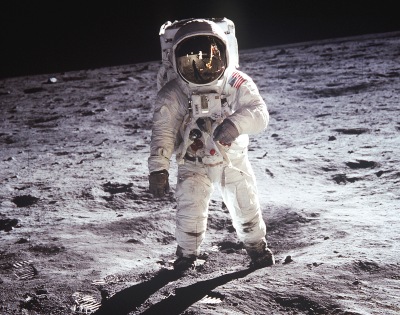
This is a picture of a human walking on another planet:

20 July 1969, Buzz Aldrin walking on the Moon

This is a man in the second half of the Twentieth Century.

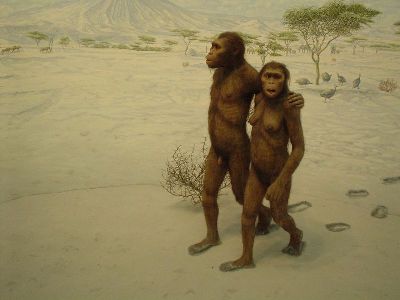
Three and a half million years earlier, humans looked more like this:

Australopithecus afarensis depicted in the Laetoli footprints diorama at the Natural History Museum, New York

This, a hairless ape, set out to explore the universe forty years ago.

This is a picture of a lander vehicle and an interplanetary vehicle conducting docking maneuvers in orbit around another planet (the Earth can be seen 384,403 km away in the distance):

21 July 1969, Lunar Module Eagle as seen from Command Module Columbia

We have actually constructed vehicles for the purpose of flying to other planets, and other vehicles for landing, and those vehicles have done so, and conducted maneuvers in orbit around another planet. There are people among us who know how to do this: engineers who can design and construct the vehicles, physics who can plot the course and lay out a mission plan, people capable of piloting the ships. It’s hard to believe.

That it has been forty years since we have done such a thing seems like a bit of a fall. What must it be like to be one of these people, a relic of the future?

Our Odyssey

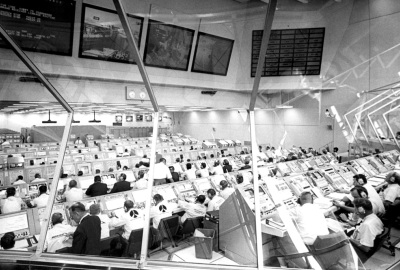
Countdown to launch of Apollo 11, Firing Room 1, Kennedy Space Flight Center, 16 July 1969

NASA is currently streaming the complete mission recording of Apollo 11 in real time in recognition of the 40th anniversary of the first manned Moon landing.

It feels appropriate to listen to an Apollo 11 cycle, so to speak. This is a performance of an incredible history and a true adventure. This is our Odyssey. The Iliad and the Odyssey were typically performed over three nights. Apollo 11 was four days from launch to touchdown on the Moon (16-20 July 1969; splashdown back on Earth 24 July). John F. Kennedy, Wernher von Braun, Neil Armstrong are our Homer, Agamemnon, Akhilleus and Priam.

I have heard it explained that part of the reason that Joyce’s Ulysses is such a pastiche is that he was trying to cram all the language of Dublin into a single work. Similarly, this week I was talking with some people about the way that David Foster Wallace appropriated the languages of commercial communication, technical writing, bureaucratic memoranda or the casual writing of e-mail to the purpose of literature. The language of our Odyssey is not Dublin bar talk, lyrical poetry or bard’s tale, but bureaucratese, engineering-speak: gage readings, mission book codes, equipment test reports, pre-burn checklists. Instead of the lyre and drum, we have the harmonics of white noise — a combination of the cosmic background radiation and electromagnetic interference of the communication and recording gear itself — and the synthetic electronic beeps of computers.

The Last Trace of 1968

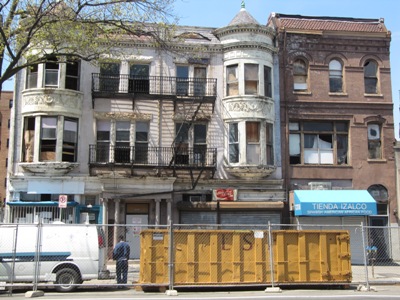
The last of the 1968 Martin Luther King, Jr. assassination riot damage, 14th Street NW, between N Street and Rhode Island NW, 24 April 2009

When I first moved to D.C. in 2003 I set out to explore. My aunt had told me that it was unwise to go east of 16th Street but I did anyway. I remember walking up 14th Street NW toward U Street and it being obviously a neighborhood in transition. There were a few new places, but much remained burned out and deserted. The middle class people who were there were the homosexual vanguard of gentrification.

I simply thought of it as the usual urban decay and renewal, but it turns out that 14th Street had something unique about its desolation. Here’s the AIA Guide to the Architecture of Washington, D.C. (Baltimore, Maryland: Johns Hopkins University Press, Fourth Edition, 2006):

The Logan Circle / Shaw area declined gradually until 1968, when a series of riots in the wake of the assassination of Martin Luther King, Jr. dealt a devastating blow. Angry mobs set fire to businesses that refused to close in mourning of the slain civil rights leader, and the physical and psychological scares of that tragic period are still evident in various corners of the neighborhoods. (p. 268)

Fourteenth Street wasn’t just any urban decay, but was where some of the most notable of the rioting and arson had occurred in 1968. The damage to the buildings that I was witnessing was the damage that had been done then and the area was only now, 35 years later, starting to be repaired. The scars were those rent in anger over the assassination of Martin Luther King, Jr.

I have lived in Washington, D.C. for six years now and during that time the 14th Street corridor has gentrified significantly and the street of which it would be unwise to go east has moved significantly further eastward. At this point 14th Street is more or less a continuously nice street from the Mall all the way up to Columbia Heights and on to … I don’t know where … probably where 14th Street terminates at Iowa Avenue out in the early generation suburbs (I’ve commented previously on the transformation of 14th Street at Columbia Heights here: “The Future of Columbia Heights,” 25 February 2007). The last remnants of the 1968 riots is the block between N Street and Rhode Island NW (pictured above) and now even it is being refurbished. When they are done there, the last physical remnant of the 1968 anger will finally have been erased.

In a city of monuments, I almost feel as if they should leave it as a monument to the end of an era, to a bad year, to a time when the populace wouldn’t take it, when misdeeds were met in kind and to the city that was. Cities need to change, but they need to show their history as well. When this refurbishment is complete, the District of Columbia will have gained a few thousand more square feet of places to go and to live and a few thousand dollars more in rent and taxes, and a neighborhood blight will have been eliminated, but the record of 1968 in our everyday, non-nostalgic, non-consciously historical lives will be gone.

Freedom Safely Delivered to Future Generations

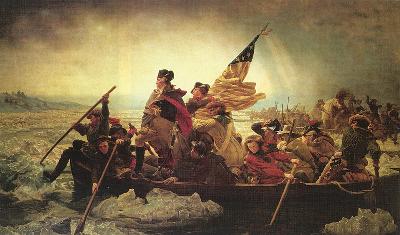
Emanuel Leutze, Washington Crossing the Delaware, 1851, Metropolitan Museum of Art, New York City

Listening to President Obama’s Inaugural Address with the variable sound quality on the Mall, I thought it was okay. An inaugural address should be more high principle and values than policy specifics and argumentation. Does the President know that he has a State of the Union Address in like 20 days? Save all of the detail and proposals and the laundry lists for then. And there was a too much of the boilerplate political rhetoric about our children and the future and freedom, et cetera.

But on a second listening, the rhetoric remains a little too detailed, but the overarching structure of the Address stands out to me, and within their context, a few lines become brilliant. The Address is constructed as a meditation on Emanuel Leutze’s 1851 painting, Washington Crossing the Delaware (above; higher resolution version here).

As SLOG’s reporter onsite Christopher Frizzelle points out (“A Review of the Speech from the Third Row,” 20 January 2009), the Address is bookended by images of storms and ice. The new President starts by saying,

The words [of the oath] have been spoken during rising tides of prosperity and the still waters of peace. Yet, every so often the oath is taken amidst gathering clouds and raging storms.

And ends with similar imagry:

… in this winter of our hardship … let us brave once more the icy currents, and endure what storms may come

Mr. Frizzelle characterizes it thus:

He is doing there what poets, namely the Romantic poets, used to do better than anyone — expressing the emotional / psychological plane of reality in terms of weather, pastoral phenomena, landscape.

The coda of the speech, the closing invocation of ice and storms, is a description of one of the darker moments during the Revolutionary War. In July of 1776 the British had landed on Staten Island and for the remainder of the year dealt a string of defeats to the Continental Army, capturing New York City, driving the Continental Army into retreat up Manhattan, across New Jersey and across the Delaware river into Pennsylvania. Washington’s army had been reduced from 19,000 to 5,000 and the Continental Congress abandoned Philadelphia anticipating British capture when the campaign season resumed in spring. It was, as President Obama described it, “a moment when the outcome of our revolution was most in doubt.”

The Continental Army encamped at McKonkey’s Ferry, Pennsylvania where General George Washington plotted a surprise attack back across the Delaware River. It was an especially unconventional move as the British had assumed the campaigning season over and established winter quarters. As President Obama relates, prior to the Christmas night crossing of the Delaware River General Washington ordered that a reading be made amidst the soldiers. The words are not General Washington’s, but those of Thomas Paine. Mr. Paine had been traveling with the Continental Army and his pamphlet, The American Crisis had just been published. It was this from that General Washington judged that the night’s inspiration would be drawn. The line that President Obama quoted from Paine is this:

Let it be told to the future world that in the depth of winter, when nothing but hope and virtue could survive, that the city and the country, alarmed at one common danger, came forth to meet it.

The victory won at the Battle of Trenton resulted in a turn away from the flagging morale of the Continental Army. When the British attempted to retake Trenton on 3 January 1777, they were outmaneuvered and quite nearly driven out of New Jersey.

The central arc of President Obama’s speech, set between the two snows and storms, reflects Thomas Paine’s image of “the depth of winter, when nothing but hope and virtue could survive.” Since it’s Barack Obama, the hope part goes without saying at this point, no? So the body of the speech addresses itself to the virtues by which the country will meet our “common danger.” Here I would like to make a list of examples, but the surprising thing about rereading this speech is how his description of the various virtues defies a simple list. They are often painted in contrasts, or without directly saying their name. I think something like constancy is a good example. “We are the keepers of this legacy.” “… the fallen heroes who lie in Arlington whisper through the ages.” For an obvious example, he says,

Our challenges may be new, the instruments with which we meet them may be new, but those values upon which our success depends, honesty and hard work, courage and fair play, tolerance and curiosity, loyalty and patriotism — these things are old.

Even when listing other values, constancy — “these things are old” — underlies them all. One of the best parts of the speech for me, especially as a leftist, was the President’s paean to workers, especially “men and women obscure in their labor.”

Among all these virtues, one receives particular recognition: unity, self-sacrifice, the common good, the gaze toward something greater than one’s self. “[Our predecessors] saw America as bigger than the sum of our individual ambitions; greater than all the differences of birth or wealth or faction.” “We will build the roads and bridges, the electric grids and digital lines that feed our commerce and bind us together.” The cynics have forgotten “… what free men and women can achieve when imagination is joined to common purpose …” “… more united, we cannot help but believe … that the lines of tribe shall soon dissolve …”

Look again now at Mr. Leutze’s painting. It’s most outstanding characteristics are an imposing river of ice between the Continental Army and the New Jersey shore, a tumult of citizen soldiers raging in boats and on the near shore. In the midst of this chaos and struggle rises the figure of General Washington, unperturbed, resolute, beyond the fray, his face fixed on distant goals and illuminated by the bursting sky.

Then study the crew of the boat. It is a microcosm of the colonies. The two oarsmen in the bow of the boat are a Scotch (note the Scottish bonnet) and an African American. There are two farmers in broad-brimmed hats toward the back. The man at the stern of the boat is quite possibly a Native American (note the satchel). There is an androgynous rower in red who is perhaps supposed to be suggestive of women. “… our patchwork heritage is our strength.”

Return now to President Obama’s Address. In this winter of adversity what persists are our virtues, above all unity. The icy currents of the bookends of the speech are the Delaware River, the middle arc of the virtues of the nation are the boat with its diverse crew of rebel irregulars. And consider the last line of the Address, “… with eyes fixed on the horizon and God’s grace upon us, we carried forth that great gift of freedom and delivered it safely to future generations.” It is a description of General Washington, father and symbol of the nation, rising out of the clamor of peoples — out of many, one — illuminated, gazing toward the future of freedom safely delivered over to the other side.

I’m not exactly a nationalist or a collectivist. I’m not so hot on all the unity talk. I more prefer an individualist, contending interest groups theory of politics. We are most markedly not one people and to say otherwise is the propaganda of an agenda. But if you dig Romanticist nationalism, then President Obama in his Inaugural Address is your artist-president, poet-in-chief.

The Grand Historical Narrative of Postmodernism

When people think of postmodernism in philosophy, they usually have in mind a pretty specific list of thinkers such as Claude Lévi-Strauss, Jacques Lacan, Michel Foucault, Jacques Derrida, Jean-François Lyotard and a number of lesser lights among the French post-structuralists. But I am thinking of an alternate trajectory where the key figures would be Oswald Spengler and Martin Heidegger (Heidegger is at least a bridge figure in any version of postmodernism). In the grand historical narrative spun by these two, there is a founding period of the Western intellectual tradition where a series of conceptualizations dramatically circumscribed the realm of possible future development, determined the course of the developments that would occur and cut us off from other potential futures. For Heidegger it was the impressing of ουσια with the form of λογος in the metaphysics of Aristotle. The remainder of the Western tradition has unfolded within the confines of this original conception.

A point made by Spengler in The Decline of the West but similarly prominently by Harold Bloom in The Anxiety of Influence is that such an original conceptualization has only a limited potential. It is a potential of sufficient abundance as to play out over the course of millennia. Nevertheless, some time in the midst of the Long Nineteenth Century the Western tradition hit its pinnacle and has now entered, in Spengler’s terms, the autumn of its life. Either at some point in the recent past, or at some point in the imminent future the West will have exhausted itself. The parlor game is in arguing for various watershed events: the death of god, the First World War, “on or about December 1910” (Virgina Woolf).

In its negative mode, postmodernism is that attempt to clear away the debris of the wreckage of the West (Heidegger’s Destruktion or Abbau, Derrida’s deconstruction). In its affirmative mode, it is the attempt to get behind that original conceptualization, revisit that original openness to that unbounded potentiality of ουσια and to refound the Western intellectual tradition — or something more cosmopolitan still — on that basis. Hence the interest in Heidegger with the pre-Socratics, with Parmenides and Heraclitus.

I have lived in sympathy with similar such ideas for some time now in that my trajectory out of natural science into philosophy started with my first encounter with Thomas Kuhn in the May 1991 issue of Scientific American (Horgan, John, “Profile: Reluctant Revolutionary“). In Kuhn I was introduced to the notion of a domain formed by an original act of genus insight (a paradigm), but with only a limited potential, eventually to be exhausted and superseded by subsequent reconceptualization of the field.

I suspect that one of the causes of the structure of scientific inquiry as Kuhn describes is that the object of scientific inquiry is, at least phenomenologically, a moving target. A theory is derived within a certain horizon of experience, but just as quickly as a theory is promulgated, human experience moves on. The scope of human experience expands as our capabilities — for perception, for measure, for experiencing extremes of the natural world — increase. Consider that when Albert Einstein published the special and general theories of relativity people had no idea that stars were clumped into galaxies. They thought that the milky way was just one slightly more dense region of stars in a universe that consisted of an essentially homogenous, endless expanse of stars. They had identified some unusual, diffuse light patches that were referred to as nebula, but they had not realized that these nebulae were each entire galaxies of their own, tremendously distant, and that the local cluster striping our sky was the galaxy containing our sun, as viewed from the inside. And no one realized that the universe was expanding. They imagined that the spread of starts was static. Einstein — in what he later called the greatest error of his professional life — contrived his equations of relativity to so predict a static universe, whereas they had originally predicted one either expanding or contracting.

Notice that if one were to accept these ideas above, the intellectual scheme with which we would be faced would be one of cycles within cycles of superior and subordinate ideas, e.g. the Newtonian and Einsteinian and quantum mechanical scientific revolutions all take place within the horizon of ουσια qua λογος.

This is a romantic series of ideas, that a primordial act of genius is capable of radically redirecting the course of history. Of course postmodernists reject such totalizing abstractions as “Western civilization,” “the Western intellectual tradition,” and “the West” as well as the practice of constructing such grand historical narratives as the one I have sketched above. But there it is. I think that postmodernist thought is riddled with tensions, especially between its macro structure and micro tactics.

Note on a Leftist Apologia for Military Studies

I’m a leftist, though sufficiently idiosyncratic of one that many others so identifying look askance at such a claim on my part. One factor in my intellectual homelessness is that one of my primary concerns is the martial.

America abounds in the sort of gear head who revels in military tech divorced of any consideration of the context in which it came to be, or the kind of person who believes in honor and thrills at tales of gory sacrifice. The entire business model of the History Channel is built around bring together these people with endless re-edits of stock footage of the Second and Vietnam wars. I am not a person who so thrills. At this point, I intend to devote myself to issues military, but if I could turn my life into something greater than a few thousand calorie-a-day contribution to the heat death of the universe, it would be the first principle of the Charter of the United Nations, “to save succeeding generations from the scourge of war.”

But the question remains, why the obsession with war? Why the minutia and the machines and the faux generalship?

The left has eschewed any consideration of the nuts and bolts of military issues in favor of wholesale condemnation, no further consideration required. The outcome of this position is that having nothing to say that resonates with voters is an abdication to the military thoughts of less scrupulous elements of the polity. In the hurly-burly of politics, time is the most scarce commodity. Having a plan at the ready when the moment strikes is the better part of victory in politics. And in those last three principles, operative to the determent of the left, can be found the whole explanation for the present imbroglio of the United States in the Middle East.

To effectively shunt war aside, the left must possess a minimum of military credibility. We must be able to deal with war in its own terms.

I think there is a Hegelian unfolding of the world spirit in the political-military happenings of the world where there is no around, only through (the truth of the flower is as much in the bud as the blossom). War will not halt, it can only be dampened. It is not merely enough to condemn nuclear weapons. It will be a varied and arduous road between world-ending arsenals and total disarmament. It is a road that must be plotted in detail, traversed along the whole of its track. There is no substitute for the compromising and half-measures of disarmament. To hate and fear something so much, one must also love it, revel and writhe in it.

Most consider strategy and military studies an entirely instrumental practice, whether pursued for the ends of national power, or for the excise of war as a scourge of humanity. I think there is more to it than that. There is something, many things, profound in war and violence.

In so far as society and its precepts are not optional, there is a continuity between force and violence and civilization. War is everywhere, even amidst peace. War is the substrate of peace. War is natural and peace an artifice.

What has me thinking in this direction is the excerpting by James Marcus (“Turning a Page,” History News Network, 5 November 2008) of a few lines from Tobias Wolff’s In Pharaoh’s Army: Memories of the Lost War:

It’s the close call you have to keep escaping from, the unending doubt that you have a right to your own life. It’s the corruption suffered by everyone who lives on, that henceforth they must wonder at the reason, and probe its justice.

Our thoughts on morality and justice, taken amidst the consolations of society, are pat and facile, so unfamiliar with the whole gamut of relevant circumstances of life are the majority of us. It is only from this side of the wall separating civilization from nature that someone could assert something so stupid as a right to life. Forces of the universe assert otherwise. Very few of us have been caused to fundamentally doubt this. And not merely to doubt in the abstract, but in the concrete of concrete: do I have a right to my life?

In the martial is more than machines and terrain and maneuver. There is a weltanschauung to be found there. It ought to be explicated.

The Perspective of the World, 2008

The recent, dramatic drops in the Dow Jones Industrial Average command attention, but they are foam. The real currents of the current crisis are mostly hidden from public view. Some journalists are burning a lot of shoe leather to bring that story to light, but I imagine that much of it will remain obscured from history to all but the actors themselves.

And so Fernand Braudel in Civilization and Capitalism, 15th-18th Century, Volume I: The Structures of Everyday Life: The Limits of the Possible (trans. Siân Reynolds, New York: Harper & Row Publishers, 1981):

On the other hand, looking up instead of down from the vast plane of the market economy, one finds that active social hierarchies were constructed on top of it: they could manipulate exchange to their advantage and disturb the established order. In their desire to do so — which was not always consciously expressed — they created anomalies, ‘zones of turbulence’ and conducted their affairs in a very individual way. At this exalted level, a few wealthy merchants in eighteenth-century Amsterdam or sixteenth-century Genoa could throw whole sectors of the European or even world economy into confusion, from a distance. Certain groups of privileged actors were engaged in circuits and calculations that ordinary people knew nothing of. Foreign exchange for example, which was tied to distant trade movements and to the complicated arrangements for credit, was a sophisticated art, open only to a few initiates at most. To me, this second shadowy zone, hovering above the sunlit world of the market economy and constituting its upper limit so to speak, represents the favored domain of capitalism, as we shall see. Without this zone, capitalism is unthinkable: this is where it takes up residence and prospers. (p. 24)

The New York Times last Thursday (Nocera, Joe, et. al., “As Credit Crisis Spiraled, Alarm Led to Action,” 2 October 2008, p. A1):

This is what a credit crisis looks like. It’s not like a stock market crisis, where the scary plunge of stocks is obvious to all. The credit crisis has played out in places most people can’t see. It’s banks refusing to lend to other banks — even though that is one of the most essential functions of the banking system. It’s a loss of confidence in seemingly healthy institutions like Morgan Stanley and Goldman — both of which reported profits even as the pressure was mounting. It is panicked hedge funds pulling out cash. It is frightened investors protecting themselves by buying credit-default swaps — a financial insurance policy against potential bankruptcy — at prices 30 times what they normally would pay.

It was this 36-hour period two weeks ago — from the morning of Wednesday, Sept. 17, to the afternoon of Thursday, Sept. 18 — that spooked policy makers by opening fissures in the worldwide financial system.

Anomalies, zones of turbulence, fissures: call them what you will.

Nixon and the Conservative Ascendancy

With the completion of his forthcoming Nixonland: The Rise of a President and the Fracturing of America, Rick Perlstein (personal | blog) has really outdone himself. Before the Storm: Barry Goldwater and the Unmaking of the American Consensus was a mere 671 pages long. Nixonland will be in tomb-territory at just short of 900 and it sounds like it is approaching a grand theory of contemporary American politics level of analysis.

Not being a member of the advanced copy, galley proof gravy train, I am relying on Ross Douthat’s very interesting review in the current Atlantic (“E Pluribus Nixon,” vol. 301, no. 4, May 2008, pp.83-86). He has a lot to say but his last few column inches sum up are the chewiest morsels:

And yet one doesn’t have to excuse Nixon’s many sins to wonder whether his mix of ruthlessness, self-interest and low cunning might have been preferable to some of the alternatives on offer. … It was a political moment when the old order could no longer govern, and the new order wasn’t ready. The kids who screamed for Goldwater and McGovern would grow up to be responsible Reaganites and Clintonians, but back then they had only idealism, not experience, and Nixonland is an 800-page testament to the dangers of idealism run amok.

In this climate, the voters didn’t choose Nixon over some neoconservative or neoliberal FDR; no such figure was available. They chose Nixon over an exhausted establishment on the one hand — nobody seems more hapless in Nixonland that figures like Hubert Humphrey and Nelson Rockefeller — and the fantasy politics of left and right on the other. They chose Nixon over the abyss.

Perlstein sometimes seems to suggest that Nixon was the abyss, and that by choosing him we vanished into it. But this misunderstands contemporary America, and it misunderstands Dick Nixon. A cynic in an age of zeal, a politician without principle at a moment that valued ideological purity above all, he was too small a man to threaten the republic. His corruptions were too petty; his schemes too penny-ante; and his spirit too cowardly, too self-interested, too venal to make him truly dangerous. And he was a bridge, thank God, to better times. Could America have done better? Perhaps. But on the evidence of Nixonland, we could have done far worse as well.

In a certain sense I imagine this as of a piece with Sean Wilentz’s also forthcoming The Age of Reagan: A History, 1974-2008, which incidentally picks up where Mr. Perlstein’s story leaves off. Both books seem important analyses of the most outstanding fact of the present political era: the ascendancy of the right. But are there really any structural forces at play here? Nixon’s victory owes as much to contingency as to any deep forces of the American psyche. Consider how differently events could have played out had Sirhan Sirhan’s aim been a little off. Nixon would have disappeared into history as merely a McCarthyite coat-tail rider, Vice President and two-time Republican also-ran. Reagan killed Carter in the electoral college, but he only won 50.7 percent of the popular vote. If Paul Volcker had been less bold as Federal Reserve Chairman and the Sea Stallion been a more reliable helicopter, perhaps Carter would have been a two-term president.

This passage may be too sweeping to be a useful analysis. Perhaps I post it more for reason of appreciating its tone than its incisiveness. Ringing speeches by American politicians aside, I think that often the best thing about modern liberalism is that it minimizes the damage of human perfidy rather than serving as a forum for the realization of “our potential.” And that is about the best for which we can practically hope.

My inclination is to lump those who see Nixon and his coconspirators as a catastrophe as the other side of the same coin with the fascist sympathizers of the 1930s a lá Carl Schmitt and that strain of neoconservatism that persists today — the Straussian strain — who worry that democracy isn’t a system of governance up to the challenges or that it will fare poorly in the competition of international politics against stronger state types. The robustness and fault-tolerance of liberalism is consistently underestimated. A couple of teapot totalitarians, domestic or international, will hardly spell the end for our way of life. As a political-philosophical conservative and a liberal, I don’t have exalted hopes for democracy, but neither do I see it as really imperiled by either its mediocrity or its excesses.

But then I think again and wonder if I have castigated too quickly, and it is confidence, not fret that is misplaced. A wayward politician every few election cycles is one thing, but an assault sustained over a prolonged period may be something else. The thing that makes U.S. liberalism robust is that politics is founded in the fundamental life of the people and in the United States there is a long tradition — stretching back to our British cultural antecedents — amenable to such a system of government. But such characteristics aren’t our only ones. A militarism, paranoia, religious absolutism and that old saw whose penetrating insight has been dulled from having become a cliché, the sense of manifest destiny are as much a part of the American character as the democratic ideal and each can serve as a basis for an attack on the latter. Under the relentless pressures of the military-industrial complex and its attendant right-wing tendencies, has the U.S. character has started to distort? Perhaps the democratic ideal was something that could only flourish under the conditions of splendid isolation (the name for the British version of the same; out name, “divine providence,” obscures the geopolitical reality in a haze of latter-day theology). I believe that the remove of the United States from the corrupting necessities of realpolitik was a part of the original formulation of the notion of “the city on the hill.” Could it be that the democratic ideal is simply not something that can survive into the age of the ICBM and jet aircraft? In this sense, perhaps what makes Nixon unique is his excessive focus on foreign policy, to such a detriment to domestic issues, that his domestic program became but a withered appendage to foreign policy ends, hardly the place to invest precious principles.

The Final French First World War Veteran

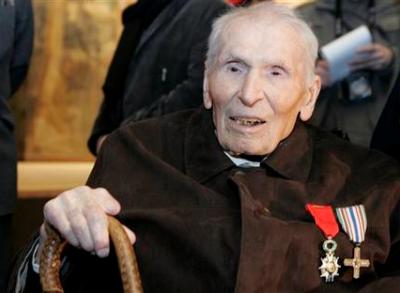
Lazare Ponticelli, the last French veteran of the First World War

The obituary this week in The Economist is Lazare Ponticelli, the last French veteran of the First World War. He was born in Italy on 7 December 1897 and enlisted in the French army at the age of 16. He died on 12 March 2008, age 110. The Economist chooses the theme of memory and — strangely more significant — the forgotten for its elegy (“Obituary: Lazare Ponticelli,” 19 March 2008):

Mr. Ponticelli wanted none of that: no procession, no racket, pas de tapage important. He was grateful for his belated Légion d’Honneur, which he kept with his other medals in a shoe-box. But he was keenly aware that he drew such attention only because he was the last.

What had become of the others? The stretcher-bearers in the Argonne, for example, who had told him they didn’t dare leave the trench for fear of German fire. The man he had heard from no-man’s land, caught in the barbed wire and with his leg severed, screaming to be rescued, until Mr. Ponticelli ran out to him with wire-cutters and dragged him back to the lines. The German soldier he tripped over in the dark, already wounded and expecting to be killed, who mutely held up his fingers to show him that he had two children. The comrades who helped him, because he could not read or write, to keep in touch by letter with the milkmaid he had met before the war. Or the four colleagues who held him down when, after the battle of Pal Piccolo, the army surgeon gouged out of his cheek a piece of shrapnel already lodged in gangrene.

With each new round of shelling, he said, they all expected the worst. They would reassure each other by saying, “If I die, you’ll remember me, won’t you?” Mr. Ponticelli felt he had a duty to try, but struggled. These were mes camarades, les gars, un type: faces, not names. And as he faded, even those faces lost their last hold on the living.

Increasingly, however, people wanted to talk to him about the war. He always courteously obliged them, though by the end his thin, scratchy voice came out in gasps. It was as important to him as it was to them to underscore the horror and futility of it. More than anything, he was appalled that he had been made to fire on people he didn’t know and to whom he, too, was a stranger. These were fathers of children. He had no quarrel with them. C’est complètement idiot la guerre. His Italian Alpine regiment had once stopped firing for three weeks on the Austrians, whose language many of them spoke; they had swapped loaves of bread for tobacco and taken pictures of each other. To the end of his life, Mr. Ponticelli showed no interest in labelling anyone his enemy. He said he did not understand why on earth he, or they, had been fighting.

On March 17th he had his wish, or most of it: a state funeral for all the poilus at Les Invalides, and then a simple family burial. The government badly wanted this last foot-soldier to be memorialised; but he preferred to be uncelebrated and ordinary, even in some sense forgotten, and thus the more symbolic of all the rest.

The passing of the last French veteran of the First World War is most significant in that the French are considered the most outstanding participant, as both victim and hero, of that war, perhaps the most outstanding war in modern history. As the New York Times obituary notes (Martin, Douglas, “Lazare Ponticelli, France’s Last Veteran of World War I, Is Dead at 110,” 13 March 2008), the passing of the last German veteran of the war, Erich Kästner, on 1 January 2008 went unobserved. There is no honor in villainy, even when it’s as inadvertent as the corresponding heroism.

Americans like to ridicule the French for their recent military fortunes. “Cheese-eating surrender monkeys” is the phrase. It’s always easy for the young to get the better of the old. By the time the First World War came about, France was a country in the full of relative decline. By the time it faced the blitzkrieg, it was a nation exhausted.

Perhaps it was easy too for the United States to roll Germany because by the time we showed up on the scene French and German casualties had already passed a million on each side. Total U.S. casualties in that war were 117,000 — less than were killed among the French in some single running battles. The French suffered 161,000 killed between February and December 1916 at the Battle of Verdun; 50,000 killed in action between July and November 1916 during the Somme offensive; and 95,000 casualties (killed and wounded) between July and August at the Second Battle of the Marne.

When you consider that in the Twentieth Century France sustained 2,262,000 killed blunting the German onslaught, compared to 409,000 for the United States — a fifth the French number — our boasts seem pretty hollow. G.I. Joe looks a little Johnny Come Lately. We installed the keystone and take credit for the entire arc. But the big wheel keeps on turning and the United States is no longer a young country. Our day to be elbowed aside by a young upstart is in the works already and our dotage will be similarly unhonored by youth.

A Sound That Calls People From Afar

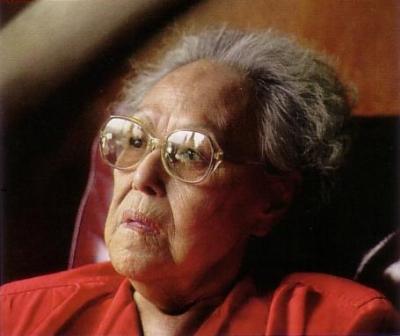
Marie Smith, or Udachkuqax*a'a'ch, "a sound that calls people from afar", died 21 January 2008

Marie Smith, or Udachkuqax*a’a’ch, “a sound that calls people from afar” as she was named in her native language, died on 21 January 2008, aged 89. Born 14 May 1918 in Cordova, Alaska, she was the last living person who spoke the Eyak language, a Native American language of south-central Alaska.

I work for a language services company and while stories such as this mean that the company’s job gets a little easier, many of the people who comprise the company have a heightened awareness of language and the impending extinction of many of the world’s languages. It is an issue of concern and I think a certain pathos.

The Economist reports (Obituary: Marie Smith,” 7 February 2008):

This universe of words and observations was already fading when Marie was young. In 1933 there were 38 Eyak-speakers left, and white people with their grim faces and intrusive microphones, as they always appeared to her, were already coming to sweep up the remnants of the language. At home her mother donned a kushsl, or apron, to make cakes in an ‘isxah, or round mixing bowl; but at school “barbarous” Eyak was forbidden. It went unheard, too, in the salmon factory where Marie worked after fourth grade, canning in industrial quantities the noble fish her people had hunted with respect, naming not only every part of it but the separate stems and shoots of the red salmonberries they ate with the dried roe.

As the spoken language died, so did the stories of tricky Creator-Raven and the magical loon, of giant animals and tiny homunculi with fish-spears no bigger than a matchstick. People forgot why “hat” was the same word as “hammer”, or why the word for a leaf, kultahl, was also the word for a feather, as though deciduous trees and birds shared one organic life. They lost the sense that lumped apples, beads and pills together as round, foreign, possibly deceiving things. They neglected the taboo that kept fish and animals separate, and would not let fish-skin and animal hide be sewn in the same coat; and they could not remember exactly why they built little wooden huts over gravestones, as if to give more comfortable shelter to the dead.

Mrs Smith herself seemed cavalier about the language for a time. She married a white Oregonian, William Smith, and brought up nine children, telling them odd Eyak words but finding they were not interested. Eyak became a language for talking to herself, or to God. Only when her last surviving older sister died, in the 1990s, did she realise that she was the last of the line. From that moment she became an activist, a tiny figure with a determined jaw and a colourful beaded hat, campaigning to stop clear-cutting in the forest (where Eyak split-log lodges decayed among the blueberries) and to get Eyak bones decently buried. She was the chief of her nation, as well as its only full-blooded member.

The Economist is right to point out that much more than just a language dies with its last speaker. An epistemology, a worldview, a critical bearer of the history of a people is lost to time as well.

In a favorite book, William Gibson’s Idoru, one of the main characters is named, in a misplaced developing world commodity fetish, Chia Pet McKenzie. I thought that was a little bit much, but the Economist also reports of Mrs. Smith that,

…she smoked too much, coughing her way through interviews in a room full of statuettes of the Pillsbury Doughboy, in which she said her spirit would live when she was dead.

Maybe Mr. Gibson wasn’t so far out on a limb after all. I sure hope one of those Pillsbury Doughboy statuettes ends up in the National Museum of the American Indian.