Frenetic Fojol Cusping on Celebrity

It’s been a big couple of days for the Fojol Brothers. Thursday was their weekday lunch debut and they were back again on Friday (I parenthetically hedged, though they said right there in their tweet that it was their first weekday daytime appearance).

Fojol Brothers, Lamont Park, Mount Pleasant, 19 July 2009

Today they were in my neighborhood on the corner of Lamont Park in Mount Pleasant. And it was quite a show. There are two new Fojol sisters, Mewshah and Bhujaja. The AcroFiends were there, just to eat though, Peter / Kipoto, girlfriend in tow, was there out of costume as it was supposed to be his day off from Fojol.

Kahn, Howie, "Keep On Food Truckin'," GQ, August 2009, p. 34

On Thursday they told me that they were getting profiled in GQ. On Friday Justin / Dingo had the issue with him and they got the introductory page to a whole piece on food carts in various cities.

Seattle's Maximus Minimus pig truck

As is often the case with such articles, it’s somewhat arbitrary in selection. For instance, I have no idea how GQ could have missed Seattle’s mind-bogglingly tricked out Maximus Minimus (website | twitter).

After wrapping up in Mount Pleasant today, the Fojol Brothers tweet that they will be at Eastern Market all day tomorrow.

Our Odyssey

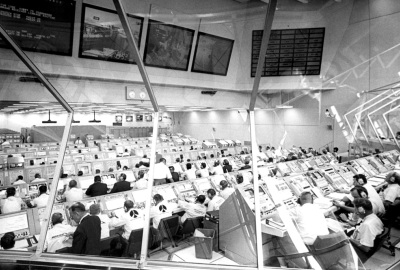
Countdown to launch of Apollo 11, Firing Room 1, Kennedy Space Flight Center, 16 July 1969

NASA is currently streaming the complete mission recording of Apollo 11 in real time in recognition of the 40th anniversary of the first manned Moon landing.

It feels appropriate to listen to an Apollo 11 cycle, so to speak. This is a performance of an incredible history and a true adventure. This is our Odyssey. The Iliad and the Odyssey were typically performed over three nights. Apollo 11 was four days from launch to touchdown on the Moon (16-20 July 1969; splashdown back on Earth 24 July). John F. Kennedy, Wernher von Braun, Neil Armstrong are our Homer, Agamemnon, Akhilleus and Priam.

I have heard it explained that part of the reason that Joyce’s Ulysses is such a pastiche is that he was trying to cram all the language of Dublin into a single work. Similarly, this week I was talking with some people about the way that David Foster Wallace appropriated the languages of commercial communication, technical writing, bureaucratic memoranda or the casual writing of e-mail to the purpose of literature. The language of our Odyssey is not Dublin bar talk, lyrical poetry or bard’s tale, but bureaucratese, engineering-speak: gage readings, mission book codes, equipment test reports, pre-burn checklists. Instead of the lyre and drum, we have the harmonics of white noise — a combination of the cosmic background radiation and electromagnetic interference of the communication and recording gear itself — and the synthetic electronic beeps of computers.

Fojol Do Lunch

Fojol Brother Peter Korbel, weekday lunch in front of the IMF building, 16 July 2009

Fojol Brothers had their first (at least since I’ve been following them) weekday lunch. They parked at the corner of 19th and Pennsylvania Avenue, at Edward R. Murrow Park in front of the IMF building, necessitating a bit of a hike on my part, but always worth it.

While ordering, Peter (above) told me that a picture of me was included in their write-up in Brightest Young Things (Nicholson, Alex and Dakota Fine, “Hitting the Streets With: Fojol Brothers of Merlinida,”, 13 July 2009). This is not a surprise since they asked if I would pose for a food shot. I’m the guy in the bike helmet in the first large photo. Oddly enough this was my first time catching the Fojol Brothers. In the photograph accompanying my first post on the Fojol Brothers, I think that the guy in the foreground turning around to look back is Dakota Fine, the photographer for the Brightest Young Things piece.

I think that the Fojol Brothers have so far been limited to nights and weekends by their other commitments. I hope this is an indication that things are viable enough where they’re going to be doing it a lot more.

The Internet is Still Very, Very New

The Stranger “reviews” twitter and makes the obvious, though necessary point (Constant, Paul, “Paul Constant Reviews Twitter,” The Stranger, 30 June 2009):

So I’m going to say something that might strike you as weird and naive, but it’s true. Listen: The internet is still very, very new.

Most people haven’t even been on the internet for 10 years yet. Ten years! Every technology is lawless frontier after just 10 years.

Television was still radio with scenery 10 years after its inception. People pointed, awestruck, at planes 10 years after Kittyhawk.

We’re just learning what the internet can do, and we’ll learn a lot more once children born today grow up with today’s internet.

For the first three years of twitter, it was easy to lampoon the service as the ultimate medium for whining about first world problems. But then the Iranian election happened and overnight it became a tool for unleashing social transformation and the indispensable news medium. The Internet is still new. Many potential services lay as yet unimplemented. Many will at first seem trivial or demeaning of this or that high value (“Is Google making us stupid?”). They will seem so until the moment when they transform into something utterly other than their original intention, specification, design.

Good point aside, can we have no more articles about twitter written entirely of 140 character paragraphs. It was cute at first, but now it’s just very gimmicky. It was worth it once for the style of the thing, but now to do so only detracts from your larger point. The 140 character message has its place and it is not the short-form essay.

On the Whistle-Stop Tour the Action is at the Caboose

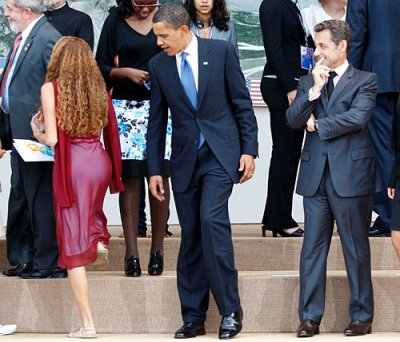
As I posted again and again and again on the bizarre and sublimated love affair of Condoleezza Rice and George W. Bush, Jr., and in the interest of being fair and balanced, and because I’m a prurient ass hole, I have no choice but to post on this photo:

G8 Summit, President Obama and Brazilian Junior Delegate Mayora Taveres, 10 July 2009

Forget about all that stuff about how photos lie and what the video shows. Liberals need to offer a full-throated defense of the President in this situation. So, in the President’s defense, I offer that that is a hot piece of ass! And this is not just any piece of ass we are talking about here: this is Brazilian ass. I mean, a piece of Argentinean ass was enough to suck out the brain of Mark Sanford, leaving him a drooling, misty-eyed, blubbering microcephalic. So long as President Obama refrains from inflicting upon us tales of a fuchsia dress circa 2014, whatever (could “junior delegates” be the new interns?).

More impressive than President Obama is that dastardly, self-satisfied look on the face of President Nicolas Sarkozy, European Mephistopheles standing next to the virtuous, but naïve — especially in the mechanics of love — American, pleased with his handy bit of work in tempting the America naïf with the fruits of colonial adolescence. I don’t think President Sarkozy is so much admiring this Brazilian can, as looking at President Obama, enjoying a moment of male recognition, reveling in the fall of one of his fellows.

How do you pick a title for a post like this. I don’t know which political-strategic-cum-sexual pun to go with: interceptor missiles, emissions, some play on G8, what?

Knowledge is a Network

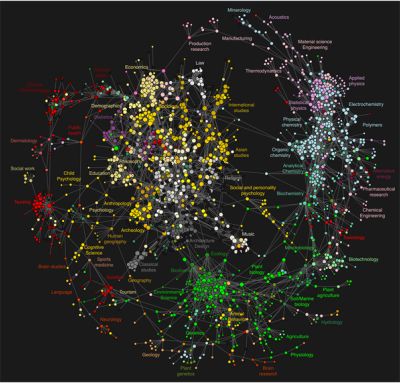
Bollen, Johan, et al., Clickstream Data Yields High-Resolution Maps of Science, Public Library of Science One

Knowledge is a network phenomenon. Only primitive knowledge consists of non-systematized catalogues of facts. System is the highest state of knowledge. Right now the system of our knowledge might be said to be clumpy, with well developed disciplines, but tenuous connections between them. Knowledge is still subject to cluster analysis. The apogee of knowledge will be a system of complete propositional consistency.

I present here a selection of discussions of the network nature of knowledge:

Kevin Kelly (“The Fifth and Sixth Discontinuity,” The Technium, 15 June 2009):

We casually talk about the “discovery of America” in 1492, or the “discovery of gorillas” in 1856, or the “discovery of vaccines” in 1796. Yet vaccines, gorillas and America were not unknown before their “discovery.” Native peoples had been living in the Americas for 10,000 years before Columbus arrived and they had explored the continent far better than any European ever could. Certain West African tribes were intimately familiar the gorilla, and many more primate species yet to be “discovered.” Dairy farmers had long been aware of the protective power of vaccines that related diseases offered, although they did not have a name for it. The same argument can be made about whole libraries worth of knowledge — herbal wisdom, traditional practices, spiritual insights — that are “discovered” by the educated but only after having been long known by native and folk peoples. These supposed “discoveries” seems imperialistic and condescending, and often are.

Yet there is one legitimate way in which we can claim that Columbus discovered America, and the French-American explorer Paul du Chaillu discovered gorillas, and Edward Jenner discovered vaccines. They “discovered” previously locally known knowledge by adding it to the growing pool of structured global knowledge. Nowadays we would call that accumulating structured knowledge science. Until du Chaillu’s adventures in Gabon any knowledge about gorillas was extremely parochial; the local tribes’ vast natural knowledge about these primates was not integrated into all that science knew about all other animals. Information about “gorillas” remained outside of the structured known. In fact, until zoologists got their hands on Paul du Chaillu’s specimens, gorillas were scientifically considered to be a mythical creature similar to Big Foot, seen only by uneducated, gullible natives. Du Chaillu’s “discovery” was actually science’s discovery. The meager anatomical information contained in the killed animals was fitted into the vetted system of zoology. Once their existence was “known,” essential information about the gorilla’s behavior and natural history could be annexed. In the same way, local farmers’ knowledge about how cowpox could inoculate against small pox remained local knowledge and was not connected to the rest of what was known about medicine. The remedy therefore remained isolated. When Jenner “discovered” the effect, he took what was known locally, and linked its effect into to medical theory and all the little science knew of infection and germs. He did not so much “discover” vaccines as much as he “linked in” vaccines. Likewise America. Columbus’s encounter put America on the map of the globe, linking it to the rest of the known world, integrating its own inherent body of knowledge into the slowly accumulating, unified body of verified knowledge. Columbus joined two large continents of knowledge into a growing global consilience.

The reason science absorbs local knowledge and not the other way around is because science is a machine we have invented to connect information. It is built to integrate new knowledge with the web of the old. If a new insight is presented with too many “facts” that don’t fit into what is already known, then the new knowledge is rejected until those facts can be explained. A new theory does not need to have every unexpected detail explained (and rarely does) but it must be woven to some satisfaction into the established order. Every strand of conjecture, assumption, observation is subject to scrutiny, testing, skepticism and verification. Piece by piece consilience is built.

Pierre Bayard (How to Talk About Books You Haven’t Read [New York: Bloomsbury, 2007]):

As cultivated people know (and, to their misfortune, uncultivated people do not), culture is above all a matter of orientation. Being cultivated is a matter not of having read any book in particular, but of being able to find your bearings within books as a system, which requires you to know that they form a system and to be able to locate each element in relation to the others. …

Most statements about a book are not about the book itself, despite appearances, but about the larger set of books on which our culture depends at that moment. It is that set, which I shall henceforth refer to as the collective library, that truly matters, since it is our mastery of this collective library that is at stake in all discussions about books. But this mastery is a command of relations, not of any book in isolation …

The idea of overall perspective has implications for more than just situating a book within the collective library; it is equally relevant to the task of situating each passage within a book. (pgs. 10-11, 12, 14)

And I might add that it is not only passages within a book, but passages between books. Books, passages, paragraphs, et cetera are all stand-ins for or not-quite-there-yet stabs at the notion of memes. It is the relation of memes that is critical and books or passages therefrom are proxies or meme carriers. A book is a bundle of memes. And those memes bear a certain set of relations to all the other memes bundled in all the other books (or magazines, memos, blog posts, radio broadcasts, conversations, thoughts, or any of the other carriers of memes).

This brings us to the ur-theory of them all, W.V.O. Quine’s thumb-nail sketch epistemology from “Two Dogmas of Empiricism,” (The Philosophical Review vol. 60, 1951, pp. 20-43; Reprinted in From a Logical Point of View [Cambridge, Mass.: Harvard University Press, 1953; second, revised, edition 1961]):

The totality of our so-called knowledge or beliefs, from the most casual matters of geography and history to the profoundest laws of atomic physics or even of pure mathematics and logic, is a man-made fabric which impinges on experience only along the edges. Or, to change the figure, total science is like a field of force whose boundary conditions are experience. A conflict with experience at the periphery occasions readjustments in the interior of the field. Truth values have to be redistributed over some of our statements. Reevaluation of some statements entails re-evaluation of others, because of their logical interconnections — the logical laws being in turn simply certain further statements of the system, certain further elements of the field. Having reevaluated one statement we must reevaluate some others, whether they be statements logically connected with the first or whether they be the statements of logical connections themselves. But the total field is so undetermined by its boundary conditions, experience, that there is much latitude of choice as to what statements to reevaluate in the light of any single contrary experience. No particular experiences are linked with any particular statements in the interior of the field, except indirectly through considerations of equilibrium affecting the field as a whole.

If this view is right, it is misleading to speak of the empirical content of an individual statement — especially if it be a statement at all remote from the experiential periphery of the field. Furthermore it becomes folly to seek a boundary between synthetic statements, which hold contingently on experience, and analytic statements which hold come what may. Any statement can be held true come what may, if we make drastic enough adjustments elsewhere in the system. Even a statement very close to the periphery can be held true in the face of recalcitrant experience by pleading hallucination or by amending certain statements of the kind called logical laws. Conversely, by the same token, no statement is immune to revision. Revision even of the logical law of the excluded middle has been proposed as a means of simplifying quantum mechanics; and what difference is there in principle between such a shift and the shift whereby Kepler superseded Ptolemy, or Einstein Newton, or Darwin Aristotle?

For vividness I have been speaking in terms of varying distances from a sensory periphery. Let me try now to clarify this notion without metaphor. Certain statements, though about physical objects and not sense experience, seem peculiarly germane to sense experience — and in a selective way: some statements to some experiences, others to others. Such statements, especially germane to particular experiences, I picture as near the periphery. But in this relation of “germaneness” I envisage nothing more than a loose association reflecting the relative likelihood, in practice, of our choosing one statement rather than another for revision in the event of recalcitrant experience. For example, we can imagine recalcitrant experiences to which we would surely be inclined to accommodate our system by reevaluating just the statement that there are brick houses on Elm Street, together with related statements on the same topic. We can imagine other recalcitrant experiences to which we would be inclined to accommodate our system by reevaluating just the statement that there are no centaurs, along with kindred statements. A recalcitrant experience can, I have already urged, be accommodated by any of various alternative reevaluations in various alternative quarters of the total system; but, in the cases which we are now imagining, our natural tendency to disturb the total system as little as possible would lead us to focus our revisions upon these specific statements concerning brick houses or centaurs. These statements are felt, therefore, to have a sharper empirical reference than highly theoretical statements of physics or logic or ontology. The latter statements may be thought of as relatively centrally located within the total network, meaning merely that little preferential connection with any particular sense data obtrudes itself.

As an empiricist I continue to think of the conceptual scheme of science as a tool, ultimately, for predicting future experience in the light of past experience. Physical objects are conceptually imported into the situation as convenient intermediaries — not by definition in terms of experience, but simply as irreducible posits comparable, epistemologically, to the gods of Homer. Let me interject that for my part I do, qua lay physicist, believe in physical objects and not in Homer’s gods; and I consider it a scientific error to believe otherwise. But in point of epistemological footing the physical objects and the gods differ only in degree and not in kind. Both sorts of entities enter our conception only as cultural posits. The myth of physical objects is epistemologically superior to most in that it has proved more efficacious than other myths as a device for working a manageable structure into the flux of experience.

Image from Bollen, Johan, Herbert Van de Sompel, Aric Hagberg, Luis Bettencourt, Ryan Chute, et al., “Clickstream Data Yields High-Resolution Maps of Science,” Public Library of Science One, vol. 4, no. 3, March 2009, e4803, doi:10.1371/journal.pone.0004803. See article for a larger version.


David Foster Wallace and Allen Ginsberg

There’s this big challenge amid Infinite Summer to try to characterize David Foster Wallace by ostension, or to try to best capture his project comparatively, preferably in twos. For instance, Paul Melancon tweets (1 July 2009), rather cleverly, I think, that David Foster Wallace is “like Proust and Philip K. Dick’s love-child.” The thing that I keep on thinking about as I read Infinite Jest is stanzas 14-19 from Allen Ginsberg’s Howl:

who chained themselves to subways for the endless ride from Battery to holy Bronx on benzedrine until the noise of wheels and children brought them down shuddering mouth-wracked and battered bleak of brain all drained of brilliance in the drear light of Zoo,

who sank all night in submarine light of Bickford’s floated out and sat through the stale beer after noon in desolate Fugazzi’s, listening to the crack of doom on the hydrogen jukebox,

who talked continuously seventy hours from park to pad to bar to Bellevue to museum to the Brooklyn Bridge,

lost battalion of platonic conversationalists jumping down the stoops off fire escapes off windowsills off Empire State out of the moon,

yacketayakking screaming vomiting whispering facts and memories and anecdotes and eyeball kicks and shocks of hospitals and jails and wars,

whole intellects disgorged in total recall for seven days and nights with brilliant eyes, meat for the Synagogue cast on the pavement,

Of course Ginsberg is about as New York as they come (come on, make Newark and other territories west of the Hudson boroughs already), whereas David Foster Wallace is Illinois corn fields. Still, the whole passage is all David Foster Wallace: the madness, the drugs, the intellectual nomadism, the schizoid schemata, the words, words, words. But the line that describes Infinite Jest to me more than any other is “whole intellects disgorged in total recall.” So far I am reading Infinite Jest after Annie Lowrey (“Inaugural Infinite Post,” A Supposedly Fun Blog, 29 June 2009): “It reads a bit like novel-as-mental-upload.” Infinite Jest is a 1,000-page brain dump of a man deeply in the throes of depression.

Ultimately the best comparison is that the first line of the poem is “I saw the best minds of my generation destroyed by madness …” Could there be anything more fitting to David Foster Wallace? I stopped at “destroyed by madness”, but the temptation to continue quoting (“starving hysterical naked, dragging themselves through the negro streets at dawn looking for an angry fix, angelheaded hipsters …”) is hard to resist.

The thing about Ginsberg is that he’s telling a gigantic inside joke of a grand circle — the Beats — comparable to earlier such groups: the Vienna Circle, Bloomsbury, the Algonquin Roundtable, Partisan Review, et cetera. For all of its counter-culture, there’s still something — or maybe only something in retrospect — élite about Howl. Infinite Jest is very inside-jokey too, or “highly colloquial,” as David Foster characterizes the Wallace family penchant for language in footnote three of “Tense Present” (“Democracy, English, and the Wars Over Usage,” Harper’s, April 2001, pp. 39-58). Infinite Jest may be formally avant garde, but its content is a bunch of anonymous nobodies. There’s a proletariat spirit to David Foster Wallace that Ginsberg aimed for, and perhaps hit in his time, but that has since rubbed off.

Update, 15 July 2009: Compare:

‘E.T.A.’s best minds on the problem. Whole thesauruses digested, analyzed.’ (Infinite Jest, p. 101)

It’s also worth nothing that after the sections waxing fantastic about tennis, Infinite Jest seems a lot less proletariat. But maybe that’s just me: I almost can’t walk past a tennis court without making a snide remark.

My Unconscious is Earnest; It’s Only My Ego That’s Nihilist

David Foster Wallace is already starting to get inside my head (I’m reading Infinite Jest as part of the Infinite Summer project). Last night I had a dream that S. and I were moving to a new place, an old facility building that had been converted into residential dwelling, located on a sparsely built, wooded former campus of some sort (E.T.A.?) on Lake Washington in Seattle. The current resident of the unit was David Foster Wallace and according to whatever dream logic was in effect, we were moving in a few days before he was moving out (it was revealed later in the dream — because you discover your dream personae as you discover those of other people — that the occupant prior to us of the place from which we were moving was also David Foster Wallace). We engaged in a series of joint activities in the period of our overlap, one of which included sitting together around a large table with a lot of simply cut, craftsman-type ornamentation as we painted it. Mr. Wallace was telling us how good these sorts of communal art works are when in a moment of cynical snark, of which I am want — at least dreamworld Donald is accurate in this respect — I insisted, “Yeah, but this sort of artistic self-indulgence is just a few steps removed from scrawling inscrutable messages on the wall in your own feces.” At which Mr. Wallace treated me to a considerable upbraiding regarding the failings of my detached, ironic stance. I struggled to defend my position of cynicism, but only flailed rather impishly in the face of his well reasoned criticisms. The argument, and my failings, continued through an afternoon’s shoreline scrub brush walk.

I know, I know, blogging your dreams! Is there anything more boring than other peoples’ dreams? It’s bad enough to have to hear about them while struggling for bathroom sink time in the morning; then to go and blog about them! I’ve tried to keep it brief, only to serve as an example of how quickly (I’m only on like page 50) and in what ways David Foster Wallace is getting in my head in a way that no novel has in a long time.

The Mullahs Killed Michael Jackson

[Editor’s Warning: elitist liberal moralizing to follow]

Dan Savage:

The Iranian regime has accused the CIA of killing Neda in order to win sympathy for the protesters and create disorder in Iran. I accuse the Iranian regime of killing Michael Jackson to end all coverage of the protests in Iran on CNN, Fox News, MSNBC, ABC, CBS, and NBC.

(“The Mullahs Killed Michael Jackson,” SLOG, The Stranger, 25 June 2009)

It’s unfortunate that the public and the media are so transfixed by the solipsistic, bread-and-circus phantasmagoria. Entertainment trumps world history every time.

When Realpolitik and Principle Converge

Apropos my two previous posts about keeping non-proliferation goals in the mix with democracy permotion, Matthew Yglesias spells out the logic for why this is probably not tenable (“Engagement With a Post-Crackdown Iran,” Think Progress, 23 June 2009):

The hope behind an engagement strategy was that the Supreme Leader might be inclined to side with the more pragmatic actors inside the system — guys like former president Rafsanjani and former prime minister Mousavi. With those people, and most of the Iranian elites of their ilk, now in open opposition to the regime, any crackdown would almost by definition entail the sidelining of the people who might be interested in a deal. Iran would essentially be in the hands of the most hardline figures, people who just don’t seem interested in improving relations with other countries. Under the circumstances, the whole subject of American engagement may well wind up being moot.

So maybe the realpolitik and the principled position have converged here. All-in with the dissidents may be the only option that can produce progress on the nuclear issue at this point.