The Transition from Idealism to Power

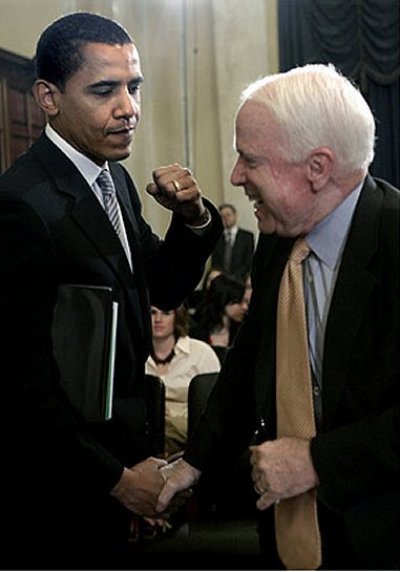
For all the idealism and slogans of the campaign trail, what I see in the moves of the last few days — in the selection of Rahm Emanuel as his chief of staff, in his politicianly reticence at Friday’s press conference, in his meeting with Senator McCain — is a man making preparations for the actuality of governance, of the exercise of power, of making the necessary compromises between idealism and the hard reality of the achievable.

Along similar lines, here’s Ezra Klein (“Legislator-in-Chief,” TAPPED, 16 November 2008):

… the success of Obama’s presidency is dependent on his ability to navigate an increasingly dysfunctional Congress, and that the ability to pass bills through the institution requires pretty fair knowledge of how it works and pretty good relationships with the key players. Clinton didn’t have that. He entered office and showed very little respect for congressional expertise, surrounding himself with trusted associates from Arkansas and young hotshots from his campaign. Obama is not making the same mistake.

I’m essentially pro-establishment. All that hoary stuff of Sarah Palin on the campaign trail about shaking up Washington and the evils of Washington insiders is just junk pander to an ignorant public. Washington, D.C. — any center of power — is a complex place. Knowledge of the workings of Congress, of the bureaucracy, of all the hangers-on, especially the unofficial, undocumented byways, counts.

A point that S. made this weekend is that there is a difference between being an advocate and being a policy maker in a position of power. Al Gore has said that he feels he can best advance his agenda from outside of government and that may sound like something that someone in his position just says. But Mr. Gore can adopt an uncompromising position that the United States should be completely off of fossil fuels within ten years. And President-elect Obama has embraced that position on the campaign trail. But here is the contrast of actual governance. President Obama will probably pursue a more mixed agenda on energy and climate change because he has to make policy of principle and that will involve grabbing at what can be had in the current political environment, bringing in fence-sitters and even some opponents to a comprehensive, compromise package.

I would say that so far President-elect Obama is looking pretty shrewd and his choices are already giving me confidence.
The Current Climate

The Onion’s post-election analysis (“Nation Finally Shitty Enough To Make Social Progress,” Issue 44-45, 5 November 2008):

Carrying a majority of the popular vote, Obama did especially well among women and young voters, who polls showed were particularly sensitive to the current climate of everything being fucked. Another contributing factor to Obama’s victory, political experts said, may have been the growing number of Americans who, faced with the complete collapse of their country, were at last able to abandon their preconceptions and cast their vote for a progressive African-American.

Citizens with eyes, ears, and the ability to wake up and realize what truly matters in the end are also believed to have played a crucial role in Tuesday’s election.

Deliver Me From These Awful Debates

I’m the kind of person who gets wound up over the State of the Union Address like it were the Super Bowl, but both these debates bored the life out of me. I was looking at the clock and whishing for it to be over. I blame it on the Senate: it’s too insular a world. When Senator McCain said that he had written a letter to the Treasury Secretary that Senator Obama had not signed, that he whishes we could see that letter, I was one impressed customer. You wrote a letter. I’ll bet the Treasury Secretary wound up the entire department and wrote one back. God! If the next president would just write a letter to Wall Street or to Mahmoud Ahmadinejad, I’ll bet they would write letters back too.

And John McCain’s jokes were such insufferable stinkers. His stilted humor is the perfect analog to his person. And what was up with that bizarre attack on Tom Brokaw?

And where is the Barack Obama of the prepared statements? Take away rehearsal and he’s just another quibbling, rambling Senator lost in the shuffle. In the last debate when he stammered for what seemed like two or three minutes trying to get out the name of that thing we did with those other countries about those big bombs I couldn’t believe it. “The Nuclear … uh … uh … Proliferation … uh … Agreement.” It’s a treaty. What’s so hard about that?

Tom Brokaw was a dud of a moderator. Where the hell did he dig up that completely arbitrary non sequitur about holding Congress to a two year deadline to reform Social Security? Why not the proverbial first hundred days?

People who say that one candidate or the other won are either spin-meisters or possessed of higher levels of discernment than me. I think that these debates are completely inconsequential for the outcome a month from now.

The Democrats Reborn?

I’m trying to keep up my jaundiced eye here, but I feel like tonight I have seen a Democratic party unlike any I have seen before in my lifetime. Walter Mondale was perhaps the last of the old guard still to possess some fight, but after that, not Dukakis, or Clinton, or Al Gore or John Kerry. They all seemed too timid, too poll tested, too cowed. First last night in Joe Biden’s speech and then again tonight in Barack Obama’s I heard a Democratic party unbowed, spirited, confident.

Senator Biden’s introduction by his son and his own discussion of his family was surprisingly emotional and seemingly so for everyone involved. His speech was the version of values that Democrats should be putting forward, it was tough on foreign policy, and unlike Democrats for the last eight years, effortlessly sincere, uncontrived. As Matthew Yglesias pointed out (“It’s Biden,” ThinkProgress, 23 August 2008), the selection of Biden for VP “signals as desire to take the argument to John McCain on national security policy” and deliver to voters “a full-spectrum debate about the issues facing the country rather than a positional battle in which one party talks about the economy and the other talks about national security.” In Joseph Biden I think I first, finally saw a different, rejuvenated Democrats.

The same was true for Barack Obama’s speech tonight. His cadence was off in places, but it was defiant, pugilistic and signaled to me that the Senator has absorbed all the right lessons about the campaign. I think many of the myths that have plagued the Senator as well as the party at large for the last few weeks have been definitively left behind after tonight. It showed some of the populism that worked so well for Al Gore in the final weeks of the 2000 election. My favorite part, like with Senator Biden, was when Senator Obama took the foreign policy issue by the horns:

You don’t defeat — you don’t defeat a terrorist network that operates in 80 countries by occupying Iraq. You don’t protect Israel and deter Iran just by talking tough in Washington. You can’t truly stand up for Georgia when you’ve strained our oldest alliances.

If John McCain wants to follow George Bush with more tough talk and bad strategy, that is his choice, but that is not the change that America needs.

If Chris Matthews waxing rapturous is any indication, then he achieved everything he needed to do. After Chris Matthews, what more can you ask for? Who knows, maybe even Maureen Dowd will write a positive review. I think McCain’s speech a week from now will look pretty wooden in comparison.

My only concern is as, I think it was Patrick Buchanan said last night, after a week of the Republicans ripping into Senator Obama next week, the Democrats may regret going so easy on Senator McCain. Alternately, Democrats may finally have learned that you have to run your negative stuff stealth.

Bush’s Götzen-Dämmerung; Obama’s Revaluation of All Values

This does even more for me than Hillary Clinton’s drinking habits:

Obama himself went through a period of “devouring” the work of Nietzsche while living in New York. It’s difficult to say what Obama might have absorbed from the German philosopher, mostly because Nietzsche himself is so hard to pin down, but one of Obama’s favorite instructors at Occidental told Mendell that anyone who immersed themselves in his thought would learn “to call everything into question.”

(Miller, Laura, “Barack by the Books,” Salon.com, 7 July 2008)

New York and Nietzsche! Could it be any more élitist? It kinda makes ya see the theme of change in a different light. As Nietzsche said, “… only beginning with me are there hopes again” (Ecce Homo, “Why I am a Destiny,” §1, trans. Walter Kaufmann, 1976).

The Central Question Regarding Barack Obama

Paul Krugman opens Monday’s editorial asking the central question for the left about Barack Obama (“The Obama Agenda,” The New York Times, 30 June 2008):

It’s feeling a lot like 1992 right now. It’s also feeling a lot like 1980. But which parallel is closer? Is Barack Obama going to be a Ronald Reagan of the left, a president who fundamentally changes the country’s direction? Or will he be just another Bill Clinton?

Oddly enough, I found myself a supporter of Hillary Clinton in the primaries because I suspect the latter. Perhaps that was a little naive as I also suspect that Senator Clinton is fundamentally and genuinely conservative politically and personally.

No one can fight every battle and not every battle should be fought in the most direct manner. One must marshal one’s resources for the critical moment, and more times than not maneuver is superior to grabbing the bull by the horns. I presume that Senator Obama recognizes two things: first he has to get into the White House before he can do anything else and once there he will only be able to accomplish a small number of his objectives so he needs to dispense with the lesser objectives and focus on the really important ones.

For instance, voting for the FISA bill last week was, I presume, tactical. It takes that accusation off the table for the duration of the campaign. Everyone runs a stealth campaign anymore. You’ve got to avoid at all costs doing anything that could be used to provoke the middling mind of the independent voter. Once in the White House, then he will really be in a position to address the problems of the FISA program. Again, first win the election, then come the reforms. Would losing to John McCain serve the cause of FISA reform?

Presidents can only have limited power and limited time to accomplish their agenda. Senator Obama has to be eyeing that Oval Office desk and thinking Economy, Budget, Healthcare, Iraq, Afghanistan, War on Terrorism and everything else will just have to take the back seat.

At least this is the story I am feeding myself to assuage my severe doubts that this will be another eight years of cowed liberalism. Senator Obama is giving us plenty of reason to believe otherwise.

Playing Into bin Laden’s Hands

Last week President Bush (remember him?) took his message somewhere that people might listen without creating a media spectacle, the Israeli Knesset, where he made his now infamous, implicit criticism of Barack Obama (“President Bush Addresses Members of the Knesset,” The Knesset, Jerusalem, Israel, 15 May 2008):

Some seem to believe that we should negotiate with the terrorists and radicals, as if some ingenious argument will persuade them they have been wrong all along. We have heard this foolish delusion before. As Nazi tanks crossed into Poland in 1939, an American senator declared: “Lord, if I could only have talked to Hitler, all this might have been avoided.” We have an obligation to call this what it is — the false comfort of appeasement, which has been repeatedly discredited by history.

Yes, yes, appeasement has been discredited, except in all those other instances where its opposite, belligerence or intransigence has been discredited too (“The Contradictory Lessons of the Twentieth Century, smarties, 28 August 2004). The fact is that there is no diplomatic panacea — firm resolve always works — and what is required is that ever so subtle virtue, judgment, exactly what this administration has been lacking.

This all reminds me of the passage from Ron Suskind’s The One Percent Doctrine in which he describes the assessment of the CIA as to the meaning of Osama bin Laden’s 29 October 2004 statement , made just days before the 2004 presidential election:

Inside of the CIA, of course, the analysis moved on a different track. They had spent years, as had a similar bin Laden unit at FBI, parsing each expressed word of the al Qaeda leader and his deputy, Zawahiri. What they’d learned over nearly a decade is that bin Laden speaks only for strategic reasons — and those reasons are debated with often startling depth inside the organization’s leadership. …

Today’s conclusion: bin Laden’s message was clearly designed to assist the President’s reelection.

At the five o’clock meeting, once various reports on latest threats were delivered, John McLaughten opened the issue with the consensus view: “Bin Laden certainly did a nice favor today for the President.” (p. 335-336)

The fact is that the policies of President Bush and his administration have been an irreplaceable gift to al Qaeda. As Osama bin Laden himself said in the afore mentioned statement,

[It is] easy for us to provoke and bait this administration. All that we have to do is to send two mujahedeen to the furthest point east to raise a piece of cloth on which is written al Qaeda, in order to make generals race there to cause America to suffer human, economic and political losses without their achieving anything of note …

Osama bin Laden essentially told the world that he loves George Bush for playing right into al Qaeda’s hands.

Barack Obama and the left more generally have responded to the President’s implicit criticism, but it’s been entirely meta. It’s beyond the bounds of fair politics, the President shouldn’t make such criticisms while abroad, etc. The left should deal squarely with this issue. Appeasement — were it even true — would be one thing, but George Bush is America’s gift to Osama bin Laden. Senator Obama is not bin Laden’s candidate: George W. Bush is. For seven years now the West has danced to bin Laden’s tune. On 20 January 2009 that ends.

Ouch! 2008 as 1972

Among all the other things they’ve lost, at least The Economist hasn’t lost their edge. In review of Rick Perlstein’s new book, Nixonland, they have the following to say about the present election season (“The Fuel of Power,” vol. 387, no. 8579, 10 May 2008, pp. 93-94):

It is hard, in the current political season, to read this book without hearing the sound of history rhyming, to paraphrase Mark Twain. George McGovern’s promise of “post-partisanship” galvanised America’s youth. He trumpeted his opposition to the Vietnam war under the slogan of “right from the start”. He went on to suffer one of the biggest defeats in the general election in American history. “Dirty politics confused him,” Hunter S. Thompson sighed. Nixon chose “experience counts” as his campaign slogan in 1960 and boasted that he had spent “a lifetime getting ready”. He made up for his lack of personal charm by an almost deranged relentlessness. But this week’s result suggests that these are only half-rhymes at best: Barack Obama has already met his Richard Nixon and slain her.

The entire media establishment this week is touting the demise of the Clinton campaign, and the whole thing has been rather unseemly for Senator Clinton, but no one says it in quite such a wince-inducing fashion as The Economist.