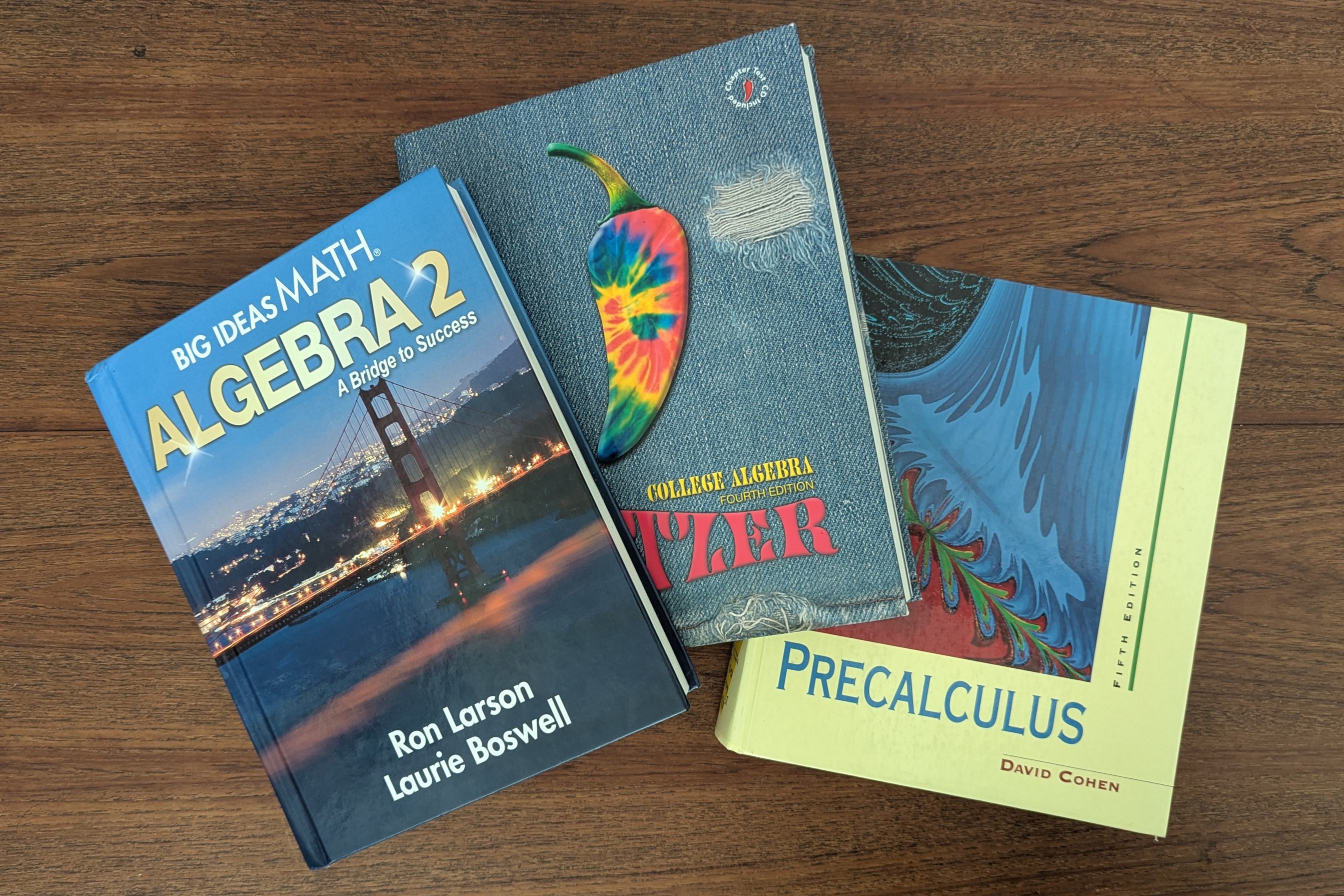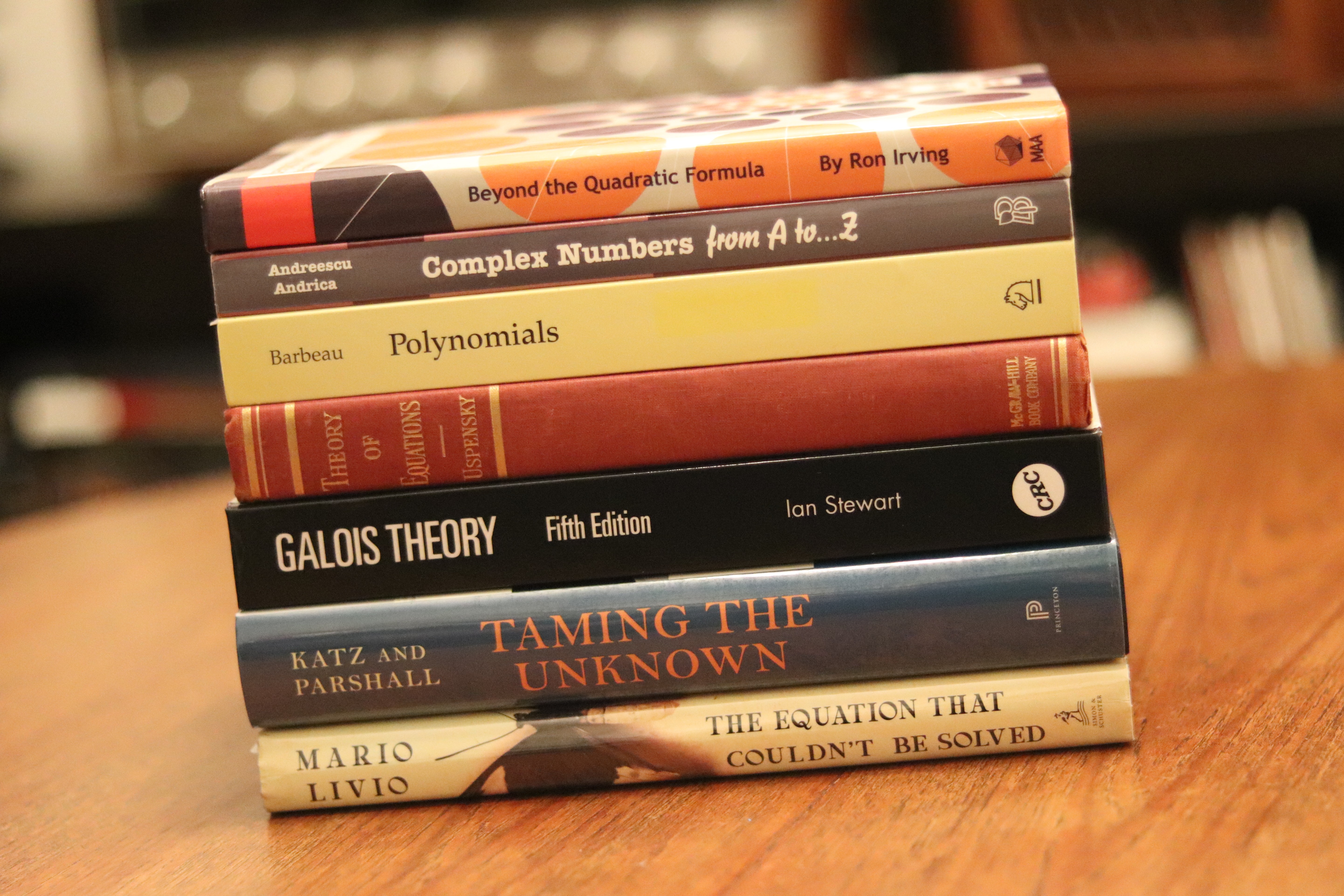
I know like two people in the world care about my pretensions, but (as much for me) here is a math study program update: I still have a long row to hoe before I am done with my textbooks on algebra and pre-calculus. I am actually pretty unhappy with how slow I am going. But I feel like I am at least over the hump of regaining lost understanding. But this far in, I have had three thoughts: (1) I am really enjoying polynomials; and (2) while I have done okay with these textbooks, I feel like what I have gained so far is merely a grab-bag of a few dozen tricks, not understanding; (3) since polynomials was once one of the primary areas that drove mathematicians crazy for literally hundreds of years, and solving its problems was the origin of group theory and abstract algebra, I feel like I should not treat this as merely on-the-way to calculus, but should spend a little time engaging with the subject of polynomials on its own. So I have gathered together this little pile of books for a study program on polynomials. They are:
- Irving, Ronald S., Beyond the Quadratic Formula (Mathematical Association of America, 2013)
- Andreescu, Titu and Dorin Andrica, Complex Numbers from A to … ℤ (Birkhäuser, 2005)
- Barbeau, E.J., Polynomials (Springer, 2003)
- Uspensky, J. V., Theory of Equations (McGraw Hill, 1948)
- Stewart, Ian, Galois Theory (Chapman and Hall, 5th Edition, 2022)
- Katz, Victor J. and Karen Hunger Parshall, Taming the Unknown: A History of Algebra from Antiquity to the Early Twentieth Century (Princeton University Press, 2014)
- Livio, Mario, The Equation That Couldn’t Be Solved: How Mathematical Genius Discovered the Language of Symmetry (Simon & Schuster, 2005)
Some brief notes on these books:
- The first five are mathematics books proper, and the last two are histories of mathematics.
- All of these books either claim in their introductions, or have been assessed by reviewers, to be at the level of an ambitious high school student.
- I think I am considering Barbeau’s Polynomials to be my primary text, with Irving’s Beyond the Quadratic Formula as a supporting text.
- Uspensky’s Theory of Equations is here for antiquarian interest (theory of equations is what the study of polynomials used to be called). Older books tend to have very different problems and I want to see how people used to think about polynomials.
- I dipped a little bit into Uspensky’s book when I first got it and quickly found myself overwhelmed by issues of complex (imaginary) numbers, so added Andreescu and Andrica’s Complex Numbers from A to … ℤ to my study program as a preliminary.
- Stewart’s Galois Theory will take me from the core study of polynomials, up through the beginning of abstract algebra. Again, I have read that Stewart’s book is so measured and stepwise, that even an intermediate reader can follow his presentation.
- Katz and Parshall’s book is a complete history of algebra, from cuneiform tablets to modern abstract algebra. Livio’s book focuses on the quandary of the quintic equation (a polynomial of degree 5) and, the two geniuses of Niels Henrik Abel and Évariste Galois, and the advent of group theory and abstract algebra.
Of course there is the whack-a-mole problem of prerequisites. One of those is already addressed by the book on complex numbers. But complex numbers at least seem core to polynomials. My real problem is that all of these books include in almost every one of their problem sets, questions asking you to prove this or that theorem. And being the completist that I am, I am not about to skip a whole class of problem. And besides, proofs seem integral to the depth of understanding I seek. It had been my intention to put off learning the techniques of proofs until somewhere in the midst of calculus. But I guess after my basic algebra books, I will work through a book or two on proofs before proceeding to this program.
I shouldn’t be disappointed. A significant motivation for this project has been the stature a certain collection of books hold in my mind. And one of those books, I book a spend a long time wondering over on a particularly memorable day spent in the University of Washington book store, with its amazing collection of math books (oh, to be able to go back), is Chartrand, Polimeni and Zhang’s Mathematical Proofs: A Transition to Advanced Mathematics (2nd ed., Pearson, 2007). I don’t even know if it is a good book on proofs. I just know that it has loomed in my imagination for 30 years. I am going on vacation next week and it is coming as one of my vacation books.