The Committee to Save the World, Ten Years On

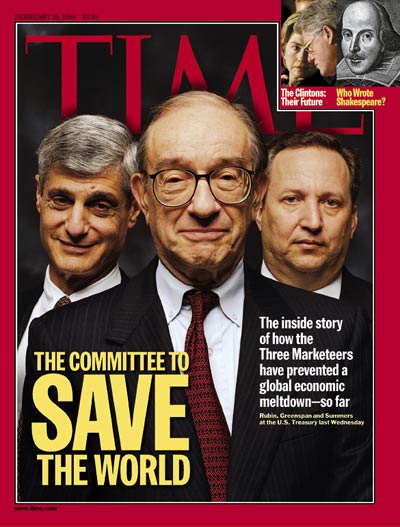
The Committee to Save the World, Time Magazine, 15 February 1999

It’s mostly consigned to the past, but it increasingly seems to me that the Asian financial crisis of 1997-98 and the attendant reaction of U.S. economic policy makers was the watershed economic event of the present era. The economic handlers of the time, most outstandingly Alan Greenspan, Robert Rubin and Lawrence Summers came as close to the rank of heros as economic policy makers are allowed (“the committee to save the world” in Time Magazine’s famous formulation). During the period 2 July 1997 through 23 September 1998 — the floating of the Thai baht to the deal to bail out Long Term Capitol Management — the Federal Reserve held rates steady at 5.5 percent, then in September, October and November made a succession of impressively restrained off-committee 25 basis point rate cuts. The firebreak held and the U.S. economy got another 24 months of economic growth, crossing the line to become the longest uninterrupted economic expansion in U.S. history in February of 2000. On such a basis is the formidable reputation of Alan Greenspan built.

But the unenunciated strategy of Greenspan, et. al. during this period was to stave off the spreading crisis by converting the vast and voracious American body of consumers into the buyer of last resort for the world. The countries in crisis would be propped up through IMF aid packages, but also through the newly enhanced competitiveness of their goods on the U.S. market. This was accomplished through the aforementioned interest rate cuts, but also at Treasury through the strong dollar policy.
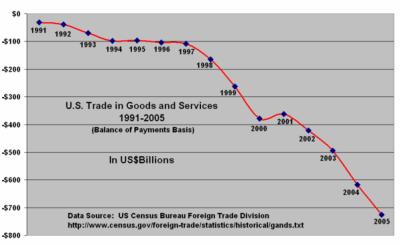
U.S. trade deficit, 1991-2005

Source: Wikipedia; U.S. Census Bureau, Foreign Trade Division

The broadest mechanism by which interest rates work is through home mortgages. As interest rates decline they set off a wave of home loan refinancing, liberating spending previously sunk into housing costs. That combined with the (psychological) wealth effect of the stock market and a historic credit binge came together in the person of the American consumer to pull the world back from the brink. A glance at the above graph of the trade deficit shows that 1997 was the inflection point.

In so far as the way that the U.S. opted to combat the global spread of the anticipated “Asian contagion” was to transform the U.S. consumer into the buyer of last resort through loose credit, the collapse of the housing market bubble is the continuation of, or the knock-on effects of the Asian financial crisis of 1997-98. It could only be postponed, not avoided; transformed, not stopped. Old wine in new bottles.

It was fairly apparent to most observers during the late 1990s and 2000s that the Federal Reserve was struggling to stave off a crisis and did the best that it could, but was merely kicking the can down the road. There was plenty of commentary at the time that the Fed was merely letting pressure off one bubble by inflating another. And inside the Fed they were fully aware that this was what they were doing, but they had to deal with the crisis at hand and figured that they would cross the bridge of the iatrogenic consequences of their policies when they came to them.

In this sense the ultimate cause of the present economic crisis is a structural imbalance in the world economy that has a tendency to generate crises. One portion of the world, the developing, produces without consuming and as a result experiences a glut of savings. The other, the U.S., consumes by borrowing the surplus savings of that other portion of the world. Witness the current account deficit of the United States with China and the strategic fallout thereof. The problem is political-economic in nature and the ultimate solution lies in the realm of politics, not behind the scenes financial wizardry.

A Broad View of What Constitutes a Bank

In today’s column Paul Krugman (“It’s a Miserable Life,” The New York Times, 20 August 2007) points out an interesting aspect of the current financial crisis:

The key to understanding what’s happening is taking a broad view of what constitutes a bank. From an economic perspective, a bank is any institution that offers people liquidity — the ability to convert their assets into cash on short notice — while still using their money to make long-term investments.

Consider the case of KKR Financial Holdings, an affiliate of Kohlberg Kravis Roberts, a powerhouse Wall Street operator. KKR Financial raises money by issuing asset-backed commercial paper — a claim that’s sort of like a short-term C.D., used by large investors to temporarily park funds — and invests most of this money in longer-term assets. So the company is acting as a kind of bank, one that offers a higher interest rate than ordinary banks pay their clients.

It sounds like a great deal — except that last week KKR Financial announced that it was seeking to delay $5 billion in repayments. That’s the equivalent of a bank closing its doors because it’s running out of cash.

The problems at KKR Financial are part of a broader picture in which many investors, spooked by the problems in the mortgage market, have been pulling their money out of institutions that use short-term borrowing to finance long-term investments. These institutions aren’t called banks, but in economic terms what’s been happening amounts to a burgeoning banking panic.

Mr. Krugman points out that while the banking industry narrowly defined is well regulated — that is, both brought under law and made more uniform and predictable — by a host of institutions — the FDIC, the Federal Reserve, various banking laws, the Basil accords, et cetera — these other bank-like institutions are not similarly covered. Hence, the Fed can modify its rates all it wants and the FDIC may offer insurance, but these don’t effect the pricing of asset backed securities or the willingness of investors to purchase commercial paper in anything like the way that they effect regular banking.

Just as the financial sector innovates, so regulation and governing institutions should innovate as well. Unfortunately the sort of consensus that produces institutions like the Federal Reserve or the FDIC come only out of major crises — not the sort at which we are currently looking. For that, the financial system will have to build up a lot more pressure.

Public Financial Institutions

Thomas Barnett is conservative leaning and — ironically enough — is one of those intellectuals who is stupid in exactly the way that conservatives predict intellectuals to be: he tends to trip over his own intelligence. A perfect example is his completely incoherent take on the recent, sudden burst of the housing bubble (“Nice analysis of the sub-prime ‘crisis’,” 13 August 2007):

The only crisis I see coming out of the subprime shenanigans (such new tricks to fleece people will always be with us) would involve governments assuming they should bail out all those hedge funds that long dabbled in this stuff. O’Driscoll makes a great comparison to the S&L crisis of years ago: so long as financial institutions assumed the FDIC bailout was coming, they’d pawn off the risk to the government instead of effectively discounting it themselves.

Really? The only crisis he sees is moral hazard? So we’re courting moral hazard toward no specific end?

Government intervention isn’t bailing out “all those hedge funds”: it is protecting the rest of us — not necessary culpable in the “shenanigans,” but still subject to the consequences thereof — from spreading economic misery. To suggest that this same old moral hazard argument that economic conservatives have been making since 1913 is somehow penetrating analysis of our present day woes is completely retrograde. Moral hazard is real, but people with less pronounced agendas have a lot more interesting things to say about the subject than that in the face of it we should do nothing.

The FDIC, the Federal Reserve, the SEC, punitive, but stabilizing taxes, transparency laws, etc. were created specifically because “foolish” investors engaging in “shenanigans” could be found well before any of these public sector economic institutions ever existed; and further, to protect non-privileged investors who did everything by the book from said “shenanigans” — in other words, to prevent the spread of irrationality. Once a critical mass of people begin to act irrationally — e.g. in a financial panic — rationality flips and the irrational becomes the rational thing to do.

And as if this wasn’t disconnected enough, then there’s this parenthetical aside:

(since finance is–to a large part–a young man’s game, the bulk of the front-line players tends to age out every dozen years or so, which pretty much guarantees you new forms of shenanigans with the same regular frequency)

It’s all fine and good to use pejoratives such as “shenanigans” and “foolish” — as Mr. Barnett does — to describe less than perfectly rational market actors who continue to fall for plaid-out investment schemes such as the housing bubble long after their true nature has become more than apparent, but if less than perfectly rational behavior is in fact systematic, as Mr. Barnette suggests with this theory, then what’s the point of moralizing about it? Systematic problems should be dealt with through systematic solutions — and not systematic solutions that entail mass suffering for all of society.

The Federal Reserve and Mortgage Backed Securities II

So it turns out that what was unusual about the Friday open market operations of Federal Reserve was even more narrowly technical still. The Federal Reserve always accepts mortgage backed securities as collateral, but usually issues loans backed by this sort of collateral at a less favorable rate. What was unusual on Friday was that the Federal Reserve issues all loans at the most favorable rate, no matter the collateral.

Kevin Drum passes along an e-mail from Stephen Spear, a professor of economics at Carnegie Mellon University, in which the Professor relates a conversation with a Federal Reserve colleague about the operation (“Friday’s Liquidity Event,” Political Animal, The Washington Monthly, 12 August 2007):

Here’s what I’ve been told by a colleague at the Fed:

First a minor point: Most of the open market operations that the Fed does (including Friday’s) are short-term collateralized loans and not outright purchases of securities. Friday’s loans were all overnight (well, over the weekend, actually, maturing on Monday). So the Fed is technically not buying anything; it’s been making short-term loans of cash against collateral.

The Fed accepts three categories of collateral for these loans. One is Treasury securities, another is other government agency securities, and the third is mortgage-backed securities that are federally guaranteed. Because they are federally guaranteed, the mortgage-backed securities the Fed accepts are (obviously) the very best.

Typically the interest rate on these short-term loans varies slightly depending on the type of collateral offered by the borrower. Treasuries get the lowest rate; mortgage-backed securities the highest. (The details of the last 25 OMOs, including the rates for each type of security, are available here.)

What was unusual about Friday (other than the size of the operation) is that the Fed announced it would lend against all three types of collateral at the same rate.

To quote my Fed colleague on this: “I’m not sure why we did this. I think the idea was that given the size of the operation we did not want to risk disrupting the Treasuries markets, but there may have been other motivations. The expectation was that borrowers would primarily use mortgage-backed securities, since these have the lowest opportunity cost to the borrower.”

On the web page above, you will see that for Friday’s operations, under collateral type it just says “mortgage-backed.” What this means is that mortgage-backed securities or any better securities were allowed as collateral — in other words, all three types were acceptable. Apparently, the media misinterpreted this as saying that the Fed was only accepting mortgage-backed securities, which led to the headlines about the Fed buying these things up.

So, the bottom line is that the Fed’s actions on Friday were unusual, but not tremendously so. It did three OMOs instead of the usual one. The quantity of reserves lent out was larger than normal, and the way collateral was handled was slightly unusual. But the general operating procedure, including the type of collateral accepted, was completely standard. It would seem that the media is trying to make the story a lot more sensational than it truly is.

Given the extraordinary amounts of money here along with tweaks to the usual policy, obviously the Federal Reserve sees a problem requiring extra-ordinary measures, but obviously not the panic initially reported by the press.

The Federal Reserve Does Not Buy Mortgage-Backed Securities

When I saw the following story in the New York Times on Friday (Peters, Jeremy W. and Wayne Arnold, “Stocks Are Volatile After Global Sell-Off,” 10 August 2007) I fucking freaked:

The E.C.B. injected another 61 billion euros ($84 billion) into the banking system, after providing 95 billion euros the day before. The Federal Reserve today added $19 billion to the system through the purchase of mortgage-backed securities, then another $19 billion in three-day repurchase agreements. The Fed added $24 billion on Thursday.

It’s not the amounts of money that are unusual. Yes, this indicates a fairly aggressive attempt to preserve liquidity in financial markets and it is definitely earning the headlines it is getting in The Financial Times and The Wall Street Journal. But that the Federal Reserve might engage in the direct purchase of $19 billion worth of mortgage-backed securities would indicate a real problem and the adoption of extraordinary, panic measures on the part of the Federal Reserve. On Friday I was thinking how I might reinvest my 401k into gold doubloons.

Thankfully, on Saturday Dean Baker pointed out (“The Fed Does Not Buy Mortgage-Backed Securities!!!!!!,” Beat the Press, 11 August 2007) that this was just incompetence on the part of the economic reporting at The New York Times and The Washington Post (who also reported the story). That what really happed was that the Federal Reserve made a more routine loan through the discount window and accepted the $19 billion in mortgage-backed securities as collateral for the loan.

While you’re there, his post (“Tell The Post: The Problem Isn’t Subprime,” Press, 11 August 2007) pointing out that the cause of our current financial woes is not the subrime market (dirty, irresponsible poor people) is a useful reminder. The real problem is the bursting of the housing bubble more generally. The subprime market is just the first place it’s really being felt.