Solomon Grundy Versus the Hulk: Battle of Metaphors

Kevin Drum agrees that the proper reference to go with regarding the Bush administration is stupid violent comic book characters. Regarding their policy toward poppy growing in Afghanistan, he explains as such (“Bush and the 60s,” Political Animal, Washington Monthly, 7 October 2007):

So: hippies bad. Hate hippies. Drug culture bad. Hate drug culture. Drugs come from poppies. Poppies come from Afghanistan. Hulk smash.

I went with Solomon Grundy instead of the Hulk (“Iraq and Vietnam; Civil Wars and Asymmetric Conflict,” 5 October 2007). When I think <man who declares himself in the third person> + <planned violent act>, it’s Solomon Grundy who comes to mind with me. Solomon Grundy is a little more down-stream a villain and if I had thought about it, the Hulk would have been better, especially with George Bush being mild-mannered Bruce Banner at the presidential podium and obviously a raving, retarded lunatic behind the closed doors of the White House.

Iraq and Vietnam; Civil Wars and Asymmetric Conflict

Someone at some point should drive home to the right that Iraq and Vietnam are not some apparition or anomaly requiring exceptional explanation — namely the Dolchstoßlegende — but in fact the historical trend.

Our historical-materialist problems in Iraq are multifaceted. Iraq is a combination of two pernicious trends: one relating to civil wars and one relating to asymmetric conflict.

First, on the issue of civil wars, they are by nature long, intractable and fought to the bitter, bloody end. The Los Angeles Times had the good sense to have Barbara F. Walter, author of the study, Committing to Peace: The Successful Settlement of Civil Wars (2002), write a brief summary of her survey of civil wars and the likely meaning for Iraq (Walter, Barbara F., “You Can’t Win With Civil Wars,” Los Angeles Times, 2 October 2007):

The approximately 125 civil wars — conflicts involving a government and rebels that produce at least 1,000 battle deaths — since 1945 tell us several things: The civil war in Iraq will drag on for many more years; it will end in a decisive victory for either the Shiites or the Sunnis, not in a compromise settlement; and the weaker side will never sign a settlement or lay down its arms because it has no way to enforce the terms.

Civil wars don’t end quickly. The average length of all civil wars since 1945 is 10 years. Conflicts in Burma, Angola, India, the Philippines, Chad and Colombia have lasted more than 30 years. Wars in Afghanistan, Cambodia, Lebanon, Sudan and Peru have lasted more than 15 years. Even Iraq’s previous civil war, fought against the Kurds, lasted 14 years.

This suggests that, historically speaking, Iraq’s current civil war could be in its early stages, with nothing to suggest that it will be a short, easy war.

Another lesson from history is that the greater the number of factions involved in a civil war, the longer it is likely to persist. Iraq simply has too many factions, with too much outside support, to come to a compromise settlement now. Not only is there no Shiite or Sunni who can speak for all of his side’s factions, but the parliament seems incapable of stopping the violence between these groups.

Civil wars rarely end in negotiated settlements. In research for a book on the topic, I found that 76% of civil wars between 1945 and 2005 ended only after one side had defeated all others. Only 24% ended in some form of negotiated solution. This suggests that the war in Iraq will not end at the bargaining table but on the battlefield.

Second, on the issue of asymmetric conflict, the trend over the last two centuries is toward small powers defeating larger ones, to the point where in the latter half of the Twentieth Century, small powers actually defeat large powers more often than not. Below is figure 2 from Ivan Arreguín-Toft, “How the Weak Win Wars: A Theory of Asymmetric Conlict,” (International Security, vol. 26, no. 1, Summer 2001, pp. 93–128).
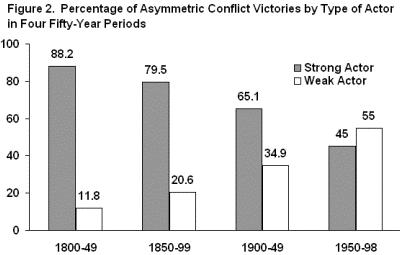
Arreguín-Toft, Ivan, "How the Weak Win Wars: A Theory of Asymmetric Conlict," International Security, vol. 26, no. 1, Summer 2001, pp. 93–128, Figure 2: Percentage of Asymmetric Conflict Victories by Type of Actor in Four Fifty-Year Periods

Given these two trends, the deck was stacked against the U.S., even with the greatest effort, but since it was undertaken by the Solomon Grundy administration (Wikipedia | Sean Baby) we never stood a chance. They know how to smash and that’s about it.

Neither of these two observations are new: both trends were generally known at the time of the invasion of Iraq — Ms. Walter’s book is from 2002 and Mr. Arreguín-Toft’s article is from 2001 and neither were breaking new ground. Five year on, it is now completely apparent outside of administration propagandists that the key strategic judgment with respect to Iraq was not how many soldiers in the initial invasion, or how many in the subsequent occupation, or whether to intervene in the looting, or to disband the Iraqi army, or seasoned experts versus right-wing sycophants to staff the CPA, or any of the many, many other mistakes, but whether to go into Iraq or not in the first place. Barring sufficient historical awareness here, at least the administration should have known and acted like the odds were not in favor of success. Instead we got the fast-talker’s sales pitch.

And as the Dolchstoßlegende crowd now attempts to rewrite the history of the Iraq debacle a la the Vietnam War version thereof, it should be born in mind that that war was part and parcel of these trends.

Lives Better Than Yours

  1. Lauren Weedman, who wrote for The Daily Show for a brief period, recounts her experience (“I Am So Funny,” The Stranger, vol. 17, no. 3, 26 September 2007):

    Stephanie suddenly looks sad.

    “I’m sorry I’m not laughing — it just takes a lot to make me laugh. It has to be like, hilarious, to make me laugh. I’m sure you’re really funny, but I’d just be careful with the ‘trying to be funny’ thing. Everyone has a really low tolerance for that around here. So, anyway, welcome!”

    Ya gotta imagine the competition around that office to be funny is pretty damn steep. I’ll bet none of the staff needs help working on their obliques at the gym.

  2. When an editor requested some modifications to a piece on a fantasy sexual encounter to make it seem more attainable to the average person, Audacia Ray replies (“My Naughty Adventures in Print,” Waking Vixen, 2 October 2007),

    Well, I do have to say that there’s probably not a lot about my life that is attainable to the average person …

    That’s a pretty heady boast, but her blog bears it out. The resultant article is here (“I Want…Double Penetration,” Time Out New York, no. 627, 4 October 2007) and not safe for work.

A Revival of the Southern Strategy?

I’m going to venture a prediction. And it’s a pretty easy prediction to make in that it’s based on an unlikely hypothetical and if things branch as I suspect, I’ll never be taken to account for my prediction.

There’s been a lot of twittering on the left about the persistent racism of the Republican party and of the Southern strategy. Rick Perlstein is writing a book about it (tentatively titles Nixonland), Paul Krugman’s column last week was on it (“Politics in Black and White,” The New York Times, 24 September 2007) and the Daily Show really took candidates to task for it last night.

Every time someone goes off on this tangent, I get a little uncomfortable in that it seems like a tired liberal saw that is well into diminishing returns. Surely today’s Republican party has retired all but the last few holdouts and dead-enders. But then it is good to look back at the ol’ red and blue map of election returns by county — the urban archipelagos map — and recall just how rural, white-flight ex-urban and Southern the Republican party remains. And even the younger generation and sophisticates aren’t all that sophisticated. I have a strongly Republican-identified friend who, however much liberals may grate on her, cannot bring herself to make any Republican friends because she finds them such a despicable lot. And I should add that she is a person with a considerable threshold for creepy.

Anyway, my prediction is this: that however latent, in remission, or coded the current Republican racist streak or Southern strategy may be, if Barack Obama gets the Democratic nomination, it is going to come galloping back with a vengeance.

It won’t come out all at once. The racism isn’t knee-jerk. But as the campaign wears on and the truly dire condition in which George W. Bush and Karl Rove have left the Republican party becomes apparent to the Republican nominee, the donor base, the 527s and the pundits, I expect a paroxysm of pseudo- and overt racism to pour forth. The Republican candidate will realize that the American public has soured on whatever affirmative message the Republican party has on offer and that the only way to win is to scare the pants off votes over hypothetical nominee Barack Obama. At that point the campaign will go totally negative — or at least its various minions, toadies and proxies will — the candidate must remain pristine from partisanship. I fully anticipate all those dark murmurs that were heard a while back — that Barack Obama’s middle name is Hussein, that he was educated in a madrassa, that he is a angry black man (could anything be further from the truth?), that he has a chip on his shoulder against white people — to come slithering back out from the dark corners or the mind of red America.

Billy Jeff Clinton

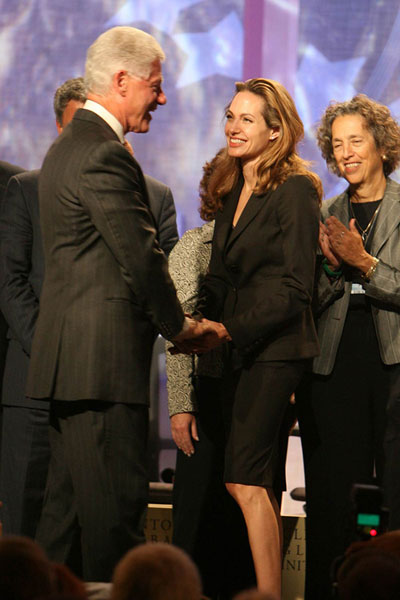
Bill Clinton and Angelina Jolie at the launch of the Clinton Global Initiative

I know he’s Brad Pitt and all and is probably pretty secure in that, but I wouldn’t let Angelina Jolie anywhere near Bill Clinton if I were him. Ms. Jolie has lost a lot of weight lately, but she is totally the ol’ hound dog’s type. And Ms. Jolie was married to Billy Bob Thorton so we know she has a high tolerance for dried up, grey old guys and vulgar male pantings in that dopy Southern accent.

Moral Hazard and Optimization

Lawrence Summers has an editorial in yesterday’s Financial Times arguing against excess concern with moral hazard (“Beware the Moral Hazard Fundamentalists,” 24 September 2007, p. 11). It is a well deserved and long overdue point. Whenever an economic crisis looms, the usual suspects trot out all the laissez faire tut-tuting. It was probably a day or two after the major news stories about the most recent central bank interventions that The Wall Street Journal editorial page started in with the boiler plate about how a few routine government interventions today spelled cataclysm of serfdom down the road. Mr. Summers’s editorial or others like it should be kept at the ready at more responsible economic editorial boards around the country.

I’m going to refrain from reposting Mr. Summers’s analysis because it is long, but it is worth reading at the link. It is worth noting that Mr. Summers doesn’t split hairs about the significance of his argument though.

Moral hazard fundamentalists misunderstand the insurance analogy, fail to recognise the special features of public actions to maintain confidence in the financial sector and conflate what are in fact quite different policy issues. As a consequence, their proposed policies, if followed, would reduce the efficiency of the financial sector in normal times, exacerbate financial crises and increase economic instability.

Mr. Summers’s three points of contention all argue that moral hazard, as its soothsayers characterize it, does not in fact obtain. I’m not an economist, but I’m going to go further and suggest that even if it did, under sufficiently dire circumstances, we still shouldn’t concern ourselves too much with it.

The economy isn’t a system that admits a state of perfect tune, but instead of optimization. Many factors trade off and the object is a state of affairs where maximum benefit is derived from a given factor without the deleterious effects of said factor overwhelming the positive. The Philips curve or patent protection are good examples, but others abound. It’s part of the power of economic-like thinking. And the economy is dynamic: the advantageousness or deleteriousness of a certain ratio of factors may change with time, or in relation to a third factor. For instance, central banks may have an easier time controlling inflation and may be able to do so at lower rates of interest when governments balance their budgets.

Given a dynamic balance of harms and advantages, moral hazard is a factor like any other. Moral hazard trades off with other objectives. Like the present, the most common example that people point to where it trades off is with capitol liquidity. Mr. Summers compiles a good list of examples of so objected government programs to preserve liquidity.

Moral hazard is indeed something to be minimized when times are good, it’s affordable, and its harms relatively troubling compared to the mix of harms on the horizon. But it is a goal to be relaxed when its attainment becomes extremely costly in the face of our other goals.

Think of it like this. Not spilling hot coffee in out lap is one of our objectives and under most circumstances it’s a pretty affordable one. On the go, you may have to drink from one of those sippy-cups and lean into a swig as an extra precaution, but still pretty easy. When suddenly an oncoming car swerves mid-coffee-sip into your lane, the equation shifts and the time, attention and dexterity to maneuver the coffee cup into your car’s dashboard cup holder becomes unaffordable. In order to achieve some of your other goals, you may forgo the no-hot-coffee-in-lap objective and just drop the damn cup to get the second hand on the steering wheel in a timely fashion.

When faced with a potential economic crisis, a little moral hazard may be an acceptable sacrifice. So long as the government preserves an element of roulette and just deserts in who survives and who perishes in a crisis and cultivates a reputation of preferred laissez faire — or at least an adequate amount of uncertainty about where and when it will intervene — then economic actors will remain sufficiently terrified about the future as to plan accordingly.

Syria Gets the Osirak Treatment?

Also in nuclear news, despite some pretty severe smack-downs from some prominent names in the arms control community, Glenn Kessler and the Washington Post are apparently sticking by their story that Israel bombed a Syrian nuclear installation on 6 September 2007 (“Israel, U.S. Shared Data On Suspected Nuclear Site,” 21 September 2007, p. A1).

Joseph Cirincione, coauthor of the widely consulted reference, Deadly Arsenals: Nuclear, Biological and Chemical Threats, calls this story “nonsense” (“North Korea-Syria Nuclear Ties: Déjà Vu All Over Again?,” Foreign Policy, Passport, 14 September 2007) and Jeffrey Lewis of Arms Control Wonk goes so far as to call it “bullshit” (“Did Israel Strike a Syrian Nuclear Facility?, 16 September 2007). Mr. Cirincione writes and Mr. Lewis excerpts approvingly:

The Washington Post story should have been headlined “White House Officials Try to Push North Korea-Syria Connection.” This is a political story, not a threat story. The mainstream media seems to have learned nothing from the run-up to war in Iraq. It is a sad commentary on how selective leaks from administration officials who have repeatedly misled the press are still treated as if they were absolute truth. Once again, this appears to be the work of a small group of officials leaking cherry-picked, unvetted “intelligence” to key reporters in order to promote a preexisting political agenda.

This is definitely the administration that has cried wolf too many times, but the Washington Post article seems pretty heavily sourced. And I don’t believe that Syria is an Israeli bombing range where the IDF just flies out for practice missions. If they went in, they must have had some pretty serious concerns. I’m going to need a lot more than unnamed Bush officials and bluster before passing judgment on this story.

A Bent Spear

The Washington Post put a major story about the six nuclear armed cruise missiles unwittingly flown across the country on the cover of the weekend edition (Pincus, Walter and Joby Warrick, “The Saga of a Bent Spear,” 23 September 2007, p. A1). Details on the exact point of failure remain under wraps, but it sounds like an instance of a single failure leading to a chain of subsequent failures.

The article goes on to point out that this is just the final, high-profile outcome of a longstanding, but not yet newsworthy problem:

A secret 1998 history of the Air Combat Command warned of “diminished attention for even ‘the minimum standards’ of nuclear weapons’ maintenance, support and security” once such arms became less vital, according to a declassified copy obtained by Hans Kristensen, director of the Federation of American Scientists’ nuclear information project.

The Air Force’s inspector general in 2003 found that half of the “nuclear surety” inspections conducted that year resulted in failing grades — the worst performance since inspections of weapons-handling began. Minot’s 5th Bomb Wing was among the units that failed, and the Louisiana-based 2nd Bomb Wing at Barksdale garnered an unsatisfactory rating in 2005.

Both units passed subsequent nuclear inspections, and Minot was given high marks in a 2006 inspection. The 2003 report on the 5th Bomb Wing attributed its poor performance to the demands of supporting combat operations in Iraq and Afghanistan. Wartime stresses had “resulted in a lack of time to focus and practice nuclear operations,” the report stated.

It’s worth noting that it’s not just the Army that is being degraded by the excess demands of the administration’s war in Iraq.

More Liberals Who Love Guns

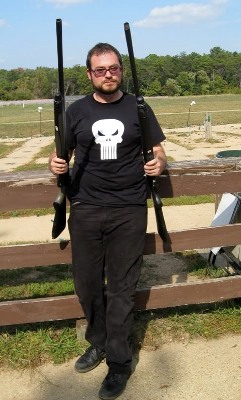
22 September 2007, Matthew Yglesias as The Punisher

John isn’t the only liberal who likes guns. Here’s Matthew Yglesias and Ezra Klein. And Yglesias is doing it with style!

I imagine John a lot more Eddie Bauer, whether it’s out fly fishing or carrying his concealed piece. With a cable-knit sweater and mock turtleneck you can’t very effectively wear one of those cool strappy holsters that situate your gun high under the arm (there’s probably a lesser-known leather-man fetish around these holsters), but the ankle holster is pretty cool too. It results in some awesome crouched action poses. Or maybe John has two sawed-off shotguns rigged up his sleeves a lá John Conner in the first Terminator film.

A Puff of Wig Glue and Couture

When Violet Blue posted that she had been invited to appear on the Tyra Banks Show to talk about women and pornography, I thought that maybe there was a dollop of intelligence to be found somewhere in the daytime television world, that maybe there was something slightly enlightened about Tyra Banks (she did tell reporters to “Kiss my fat ass” when the usual rags had run some stories about how she may have put on some weight). Well, Ms. Blue has the post-taping report up (“Tyra Banks Show — *Not* America’s Next Top Blogger,” Open Source Sex, 20 September 2007) and it sounds like daytime television remains the wasteland of small-mindedness and petty sadism that I remember it.