Anti-Humanist Architecture

I like Charles Mudede, I think he’s a pretty unique guy, but comments like this (“La Defense,” SLOG, The Stranger, 15 July 2008) make my fantasies of an architecture holocaust all the more vivid:

We see that the best buildings have in their design no humans in mind. All the better if the work is alien, monstrous, indifferent–anything more other than what we are already. A work that strives for the inhuman strives to be closer to the truth, which consistently turns out to be inhuman.

That’s all fine and good, but for the rest of us, we thought we were going shopping, commuting, trying to renew some government mandated piece of documentation, when in addition to all the rest of the litany of the day’s petty insults, we have to have an encounter with the monstrous truth as well. One may have thought that alien and indifferent were good for avant guard philosophy books, but apparently they’re a good arrangement for the DMV flagship office too. Thank you, architecture.

Bush’s Götzen-Dämmerung; Obama’s Revaluation of All Values

This does even more for me than Hillary Clinton’s drinking habits:

Obama himself went through a period of “devouring” the work of Nietzsche while living in New York. It’s difficult to say what Obama might have absorbed from the German philosopher, mostly because Nietzsche himself is so hard to pin down, but one of Obama’s favorite instructors at Occidental told Mendell that anyone who immersed themselves in his thought would learn “to call everything into question.”

(Miller, Laura, “Barack by the Books,” Salon.com, 7 July 2008)

New York and Nietzsche! Could it be any more élitist? It kinda makes ya see the theme of change in a different light. As Nietzsche said, “… only beginning with me are there hopes again” (Ecce Homo, “Why I am a Destiny,” §1, trans. Walter Kaufmann, 1976).

The Squirrel Path of Naigedajo

Koike, Kazuo and Goseki Kojima, Lone Wolf and Cub, issue 3, The Gateless Barrier, July 1987, p. 39

Before I leave the issue of animals, I guess one more observation.

Our cat is an indoor cat and I like to torment him by enticing the squirrels into the backyard. I leave a trail of nuts along the top of the fence and the cat sits in the window despairing to bury his fangs into the throats of one of those rodents. And for their part, the squirrels love it. They dance and cavort outside the window, just inches from the cat. But there’s more to it than nabbing the nuts with impunity. The squirrels seem to revel in braving death. They will take up position on the fence and lock themselves into some mental faceoff with the cat, the most ready human analog that comes to mind is the contest of will between pitcher and batter in a baseball game (only with death on the line). They stair intently at each other. After a period of fixed stillness, they both begin to twitch their tails in some sort of converging harmonic. There’s this elaborate dance — a dance of death, if you will.

What is surprising to me is the utter level of clumsiness that seems to be effective for a predator. A predator doesn’t have to get the drop on their prey. Frequently enough, prey spot predator and seem to have some sort of prey behavior where they recognize and accept their prey destiny. It’s enough to make me believe in the Inuit practice of killing only the whale that an elder has confirmed has given itself willingly to the village. It’s like Freud’s death drive already present in some common ancestor.

Alternately, last week S. and I were sitting in the back yard and a regular outdoor cat who works a circuit up and down the alley of our block made a stop at our place. The nuts were out and so were the squirrels and I braced myself to intervene to save one of the creatures that I had enticed into harm’s way. The cat leapt up to the fencerail. The squirrels scattered, except one who stood his ground less than a foot away from the cat. This is a tough, gristly, street-smart black cat. He was prone for the kill. We could see the tension for the pounce build in his body. But this squirrel didn’t back down. They stared at each other and both did the tail routine. But after a few minutes of this psychic altercation, the cat relaxed into a submissive position. The squirrel won the faceoff through some means entirely invisible.

I acquired all of my knowledge of Zen Buddhism, Bushido and Kendo as a pre-teen through an intense study of Lone Wolf and Cub comics. And intense study is how I would characterize my interest in these books. To this day I still find occasion to break out some concept or bit of wisdom gleaned back then. In issue three of this most conceptual story, Itto Ogami is hired by town politicians to assassinate a local radical Buddhist priest who is militating for the peasants. When he finds that he cannot deliver the killing blow, the monk counsels Mr. Ogami on why he cannot:

That which is not … cannot be slain. You cannot kill me for I am a leaf of Naigedajo. Forget the self and unite with Mu, Nothingness.

To kill a man, you must first project the aura of death. Your opponent reciprocates, projecting his aura of death — or perhaps an aura of fear. Thus united can you wield the sword. This is Mu. But if no aura opposes yours … that which you project rebounds upon you. It is impossible to make such a cut. If you force yourself, you yourself will be cut.

Like Sensei Splinter, I think that squirrel must walk the gateless path of Naigedajo.

Back on Assignment; the Menagerie

13 July 2008, Pennsylvania menagerie

No posting for the past week because I spent the last few day in Pennsylvania with S. visiting her family.

There’s lots of nature up there, in lots of different states. We saw two grey down-covered baby birds in a low nest. They extended their gangly necks and waived their open beaks when they sensed our presence. We stopped in the road for a gaggle of baby wild turkeys in tow behind both their parents. I nearly stepped on a fog who decided that laying low until the last minute was the best strategy. I saw just about the biggest frog I’ve ever seen while walking a lap around a pond. One of S.’s parents cats, George, scared the shit out of me when he came galloping up while I crossed the yard in the middle of the night. He turned out to be just a cat, but when I heard his feet in the dark I didn’t know if he was a coyote or what. The deer are so prevalent that they aren’t even worth mentioning. Except maybe the one we saw cross the lawn of a notably manic hunter neighbor. We marveled that it managed to get that close to his house without getting blasted, but it turns out that for some reason he has taken favor on this one and has tamed it.

And where does one even start with the bugs? The most unusual black and white moth, more like a church window than a moth, tried to hide in a basket full of shells in the W. house. At a dinner over at the maternal grandparent’s house, a moth so big that it was mistaken at first for a bat, got trapped between the house and the bug net. Along a creek — what most people would call a drainage ditch, but from the environs was obviously a fairly important part of the area — something that looked and flied like a dragonfly but with colored butterfly-like wings flittered.

I plucked two beetles off a bush. They clung to the leaves in large numbers. They had a characteristic way of spreading their legs out that seemed designed to dissipate heat. Once in my hand, one pulled its legs in and curled up into a ball. The other ran across my palm, grabbed the other, rolled her into position and, to my surprise, mounted her and began to copulate. Part of me was disgusted to have these bugs fucking in my hand, but the other part of me was fascinated! I have read Olivia Judson’s post on paleontological sexology and all the different animal genitalia (“A Tyrannical Romance,” The Wild Side, The New York Times, 12 February 2008) and was thrilled at the prospect of conducting field observations. Their spurred feet dug into the ridges of my fingerprint so that dislodging them would actually be somewhat of a chore. He deployed from his abdomen a maroon colored device like my mind’s eye imagines the weapon of the second murder from the film Seven. He jabbed it into her abdomen and I could actually the proboscis pumping her full of semen. He took a couple of minutes, finished, retracted, and commences some sort of post-coitus ritual, running his previously confining appendages all over her. During coitus she had folded her antennae, like the rest of her appendages, in to some ultra-sleek shape, but now she relaxed them out and they began to twiddle as in a more active state. It’s amazing how much the forms of human copulation resemble those of the rest of the animals, all the way down the hierarchy. It was time to move on for the humans so I ditched these two randy bastards to perhaps another mate for her (all nature is slutty) or perhaps gestation time. It was a rare opportunity to observe something totally wild.

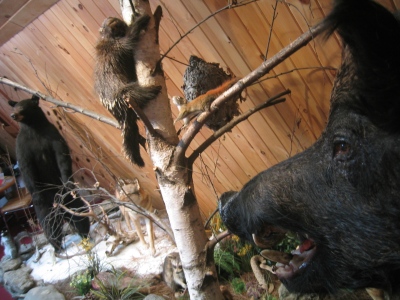
The think about America’s rural areas is that there is a lot more interesting wildlife engaged in natural-type stuff, instead of obsessing over the contents of our trashcans like all the animals in the city. Unfortunately, rural people think that the best way to enjoy nature is to destroy it, in that a significant portion of the animals that you encounter are various states of dead. A significant portion are roadkill. The weekend revolved around a giant country picnic that entailed a lot of barbequed cow, two deep-fried turkeys, lots of hunters and their hunting paraphernalia. The picnic was hosted on the grounds of an avid hunter who took us on a tour of his above-garage bar and game room. His game room included a real menagerie of dead and stuffed animals, skulls and antlers. S.’s brother (a meat-eater) commented that the place was like the sanctum of a psychopathic killer. One could imagine a Jeffrey Dahmer or someone similarly collecting and posing their human victims.

On the way home, we drove part of the way down Route 11 to avoid construction on I-81. Route 11 runs along a river and we passed a gigantic turtle in the middle of the road — and I mean gigantic! He was probably three feet tall and 60 pounds. Instead of the usual stubby little tail that most turtles have, he had this long, spike-rowed tail like a dinosaur. But he was a turtle in the middle of the road. Prospects: bad. He looked like he knew how bad they were, but had no choice but to cross the road. I though of insisting that we turn around and help him, but what would have happened? Maybe both of us would have been done in together. I can see the headlines the next day: “Man and Turtle Killed in Accident on Route 11.” Or for all I know he was a species of snapper and the fucker would have turned around and bite me and I would have had to chop off his head to get him to let go. It’s sad to think that a probably 60 year old specimen of a species millions of years old was killed by a redneck on a potato-chip run. Animals possess a dignity that humans ought not violate for their petty purposes.

Anyway, enough with the animals and the rednecks and my weekend. It’s back to the tussle.

The Central Question Regarding Barack Obama

Paul Krugman opens Monday’s editorial asking the central question for the left about Barack Obama (“The Obama Agenda,” The New York Times, 30 June 2008):

It’s feeling a lot like 1992 right now. It’s also feeling a lot like 1980. But which parallel is closer? Is Barack Obama going to be a Ronald Reagan of the left, a president who fundamentally changes the country’s direction? Or will he be just another Bill Clinton?

Oddly enough, I found myself a supporter of Hillary Clinton in the primaries because I suspect the latter. Perhaps that was a little naive as I also suspect that Senator Clinton is fundamentally and genuinely conservative politically and personally.

No one can fight every battle and not every battle should be fought in the most direct manner. One must marshal one’s resources for the critical moment, and more times than not maneuver is superior to grabbing the bull by the horns. I presume that Senator Obama recognizes two things: first he has to get into the White House before he can do anything else and once there he will only be able to accomplish a small number of his objectives so he needs to dispense with the lesser objectives and focus on the really important ones.

For instance, voting for the FISA bill last week was, I presume, tactical. It takes that accusation off the table for the duration of the campaign. Everyone runs a stealth campaign anymore. You’ve got to avoid at all costs doing anything that could be used to provoke the middling mind of the independent voter. Once in the White House, then he will really be in a position to address the problems of the FISA program. Again, first win the election, then come the reforms. Would losing to John McCain serve the cause of FISA reform?

Presidents can only have limited power and limited time to accomplish their agenda. Senator Obama has to be eyeing that Oval Office desk and thinking Economy, Budget, Healthcare, Iraq, Afghanistan, War on Terrorism and everything else will just have to take the back seat.

At least this is the story I am feeding myself to assuage my severe doubts that this will be another eight years of cowed liberalism. Senator Obama is giving us plenty of reason to believe otherwise.

The Most Terrible Power of All Concentrated in One Man

In response to a reader question, Matthew Yglesias says that if President Bush so decides, there is nothing anyone can do to prevent air strikes against Iran (“By Request: What if Bush Bombs Iran?,” TheAtlantic.com, 1 July 2008):

… if Bush orders air strikes against Iranian targets, nobody can stop him. A plain reading of the text of the U.S. Constitution would seem to suggest that it would be unconstitutional for the military to follow any such order absent a declaration of war or some other form of congressional authorization. But the settled precedent, ratified by key Democratic Party leaders as recently as the bombing of Serbia during the Kosovo crisis, is that no such authorization is necessary. I’m not happy with this situation and think it’s crazy that we as a country have moved away from the constitutional procedure, but the cat’s been out of the bag for a while now and if Bush wants to bomb Iran Bush will bomb Iran.

Democracy is based in part on a notion of the wisdom of crowds — or in the negative formulation, it is based on the recognition of the perfidy of powerful men. It is terrifying to think that when it comes to the most fateful questions facing a nation — the most terrible expenditure of the nations resources a country might undertake, one that throws the very survival of the country into the pot, one capable of completely remaking the social order of a people — we have abdicated that power to a single man.

On the right there is this constant carping about the founders’ intent, originalism, strict constitutionalists and activist judges, but when it comes to this issue, perhaps the most gross violation of the founders’ intent and the plain language of the Constitution, Republicans are complete subscribers to the cult of the great leader — at least until that power passes to a Democratic president, that is.

This is one of the reasons that I like The American Conservative. They actually see this situation for the massive threat to American liberties and the American way of life that it is.

Some future president, less ambitious, more moderating, ought return to the traditional confines of the office and forfeit this unofficial power. And a Congress more attune to it’s Constitutional duty than to it’s party platform ought to reassert this prerogative by threatening impeachment to any president who dares usurp it.

The Thinking Cap

Scientific American has an article on how the mind-machine interface is about to go commercial with a wearable EEG game controller that reads your mind (Sergo, Peter, “Head Games: Video Controller Taps into Brain Waves,” 14 April 2008). How’d they do it? Exactly the way the people at Wired would imagine. Rather than developing a series of hard-won determinate correlations between identified brain waves and intentions they just brute forced it. They recorded a gigantic quantity of sample data and processed it using a cloud computer to find the patterns:

Emotiv solved this brain-computer interface problem with the help of a multidisciplinary team that included neuroscientists, who understood the brain at a systems level (rather than individual cells), and computer engineers with a knack for machine learning and pattern recognition. Over the last four years, the company has conducted thousands of EEG recordings on hundreds of volunteers — not all gamers — as they experienced virtual scenarios that elicited various emotions, facial expressions and cognitive demands. The aim was to find a revealing brain activity that many people shared — a needle in a haystack of frenzied signals. Now, the EPOC allows users to fine-tune settings that allow it to pick up on even the subtlest of smirks.

When building these algorithms commenced two years ago, it had taken up to 72 hours for a bank of powerful computers to run through a mere 10 seconds of individual brain data and extract important features. Sorting through a seemingly endless stream of recordings eventually led Emotiv to find consistent signal patterns that revealed specific mental experiences. “Through a large enough sample size,” Le says, “we were able to get some consistency around the population to attain a high degree of confidence that it accurately measures an emotional state.”

And in dispensing with theoretical purity and just going with base correlation, the engineers at Emotive didn’t even have to concern themselves with the signal to noise ratio of the data:

Buch also suspects that the facial expressions that the EPOC detects are based more on the electrical activity of facial and scalp muscles than the brain per se. Although the electrical activity of muscles, he explained, is normally considered as artifact noise that needs to be filtered out to attain clean EEG signals that are of interest, they are still informative about how facial muscles move, such as during a wink. Tan agrees, saying that in their classification strategy some of the EPOC’s detections are based on muscle movements.

It’s all just correlation and if the noise helps identify the correlation, than it’s just as good as signal. In the petabyte age there is no phenomenon under consideration, not phenomenon under consideration issue. Any possible interference will be defeated by the size of the data set.

Now if they would just make a model that looks like this:

Robotech, Rick Hunter in the thinking cap

And maybe control an F-14 that transforms into a 50 foot tall robot instead of stupid games.

Supply Lines are Getting Longer and Harder to Maintain

George Carlin at Comedy Relief 1986

Speaking of a life devoted to little boxes, this George Carlin bit on the dilemma of consumerism was always one of my favorite comedy routines.

Long before it was popular to be an outspoken atheist à la Sam Harris, Richard Dawkins, Christopher Hitchens and Daniel Dennett, George Carlin was blaspheming out a special corner of hell for himself.

Four Years

21 June 2008, Fourth anniversary as a blogger spent in Atlanta, Georgia workin for the man

Saturday, 21 June 2008 was my four year anniversary as a blogger. I made my Inaugural Post that Monday in 2004. I had intended to post on the day-of, but I spent the day in question in Atlanta, Georgia on a business trip, running myself ragged for someone else’s year-end bonus. Colorless bureaucrat by day, intrepid blogger by night. Here I am at the Atlanta Peachtree Westin conference room A “continuous refreshment service” helping prospective linguists fill out the SF-86 Questionnaire for National Security Positions. Oh MedWatch 3500 where hast thou gone?

I lead a life devoted to little boxes. Mostly to making sure that people have correctly and completely crammed a continuous record of the last ten years of their lives into a series of little boxes over eleven to thirteen pages. But also comparing in meticulous detail the boxes on the sheets of paper to the corresponding boxes on a computer screen. And then checking off a list of little boxes to record that all content-bearing boxes have been adequately verified. I hate to admit it, but I think it’s my calling. I know that my record of spelling on this site has done nothing to prove the case, but baring the spellings, I am nothing if not meticulous. I am a relentless machine of attention poured into little boxes. I am a tireless warrior against the omission and the oversight. My favorite admonition is that “you have to write N/A as the investigator cannot tell the difference between an omission and a negative response.”

Anyway, the murderously mundane, death of a salesman workaday aside, the blog is great. I really feel like I’m in my groove. The goals no longer seem burdensome and I frequently kick it in confidence that any lull now will be more than made up for in a burst of activity later. And it’s stimulating. I spent almost the whole of today in a state of heightened agitation over the ideas that were swirling around in my head. The only problem is time, stick-to-it-ivness and the adequate eloquence to the task.

Part of the anniversary is the annual review, with an emphasis on the analytical. I switched to a third party product this year and turned over admin rights to John, so I have a helpdesk ticket in with him to get the permissions and whatnot necessary to produce the stats. Hopefully I can produce a more full assessment of the last year in a couple of days. For now it’s off to Miami this weekend: more errands in service to the man. Maybe some mile-high blogging though.

The Jules Verne of the Future Will be a Computer Scientist

Wired Magazine’s cover story this month on The End of Science / The Dawning of the Petabyte Age (Anderson, Chris, vol. 16, no. 7, July 2008, pp 107-121) has a very mundane answer to John’s enthusiasm: just scoop up tones of seawater, sequence every piece of DNA that you find, and compare it to a database of known DNA. The system will be able to flag each strand as existing species / new species.

We can throw the numbers into the biggest computing clusters the world has ever seen and let statistical algorithms find patterns where science cannot.

The best practical example of this is the shotgun gene sequencing by J. Craig Venter. Enabled by high-speed sequencers and supercomputers that statistically analyze the data they produce, Venter went from sequencing individual organisms to sequencing entire ecosystems. In 2003, he started sequencing much of the ocean, retracing the voyage of Captain Cook. And in 2005 he started sequencing the air. In the process, he discovered thousands of previously unknown species of bacteria and other life-forms.

Unfortunately this doesn’t do much to tell us about what the creature is like.

If the words “discover a new species” call to mind Darwin and drawings of finches, you may be stuck in the old way of doing science. Venter can tell you almost nothing about the species he found. He doesn’t know what they look like, how they live, or much of anything else about their morphology. He doesn’t even have their entire genome. All he has is a statistical blip — a unique sequence that, being unlike any other sequence in the database, must represent a new species.

This sequence may correlate with other sequences that resemble those of species we do know more about. In that case, Venter can make some guesses about the animals — that they convert sunlight into energy in a particular way, or that they descended from a common ancestor. But besides that, he has no better model of this species than Google has of your MySpace page. It’s just data.

But who knows, soon enough we’ll have software that will take a DNA sequence as input and produce a virtual model of a creature complete with visualization and tables of physiological data (bone density, blood chemistry, synapse count, etc.). We’ll never even have to find an instance of the creature.

Update, 25 June 2008: I think I’ve got my references a little crossed here. I titled the post The Jules Verne of the Future Will be a Computer Scientist for symmetry with John’s post, but Jules Verne is the author of the exploration stories, not the explorer himself, whereas the hypothetical computer scientist to which I am referring would be one of Jules Verne’s characters. The proper title should have been The Captain Nemo of the Future Will be a Computer Scientist.