Reconstructing Hegelianism

Here’s why Charles Mudede has become one of my most closely followed blogger-thinkers: because his project is my project (“The End of Internalism,” SLOG, The Stranger, 9 June 2009):

I’m quietly building a case for the importance of Hegel in an age that cares neither for him or his direct descendant, Marx. A part of the case will, one, link Hegel’s concept of geist and its movement in time (world history) with the idea of the evolution of noosphere in Pierre Teilhard de Chardin’s Phenomenon of Man; and, two, link Hegel’s idea of absolute spirit with the ideas expressed in Alva Noë’s new book Out of Our Heads: Why You Are Not Your Brain, and Other Lessons from the Biology of Consciousness — some of these ideas can be heard on the Brain Science Podcast.

I am very interested in using contemporary information economy concepts such as the noosphere or general systems theory to reconstruct the Hegelian system. I’m less sure where Mr. Mudede is going with the second part of this, but Out of Our Heads is on my list now.

Information Phenotype

The fractal tree at the corner of 18th and Lamont, Washington, D.C., 29 April 2009

I have previously commented on my love of the movie π (“The Supernovae in Your Coffee Cup,” 2 November 2008). It left me with two enduring images: mixing coffee and cream as an example of turbulence, previously discussed; and the branching of tree limbs as an example of fractal symmetry. I love winter for its exposure of this fabulous phenomena, innocuously right over our heads. I am always a little sad for the arrival of spring and the enshrouding of all these thought-provoking fractals in greenery.

The picture above is of my favorite tree in the neighborhood where I live. The degree to which the pattern of major arc over two-thirds of growth length followed by sharp break and lesser arc over remainder of growth length is repeated trunk to twig is amazing. Notice the arc of the trunk: unlike many trees which follow one rule for trunk and a separate rule for the branches, this tree follows a single rule throughout.

We think of a fractal as a recursive algorithm, a mathematical formula. But there’s no math in that tree. The recipe for that fractal is coded somewhere in the tree’s DNA. But the DNA contains no fractal. The DNA is a bunch of nucleotides that are transcribed by messenger RNA that code amino acids that assemble into proteins that form the structures of cells. The cells then split and differentiate in response to a complex of internal chemical signals and environmental stimuli to grow in a pattern that is the fractal.

One might say that there is a fractal somewhere in that tree, but there are so many transformation rules between nucleotide sequence and fractal growth pattern, that it is only in a manner of speaking. I am reminded of Wittgenstein’s discussion of what constitutes following a rule and going against it (Philosophical Investigations, trans. G. E. M. Anscombe [Malden, Mass.: Blackwell, 1953]):

198. “But how can a rule shew me what I have to do at this point? Whatever I do is, on some interpretation, in accord with the rule.” — That is not what we ought to say, but rather: any interpretation still hangs in the air along with what it interprets, and cannot give it any support. Interpretations by themselves do not determine meaning.

“Then can whatever I do be brought into accord with the rule?” — Let me ask this: what has the expression of a rule — say a sign-post — got to do with my actions? What sort of connection is there here? — Well perhaps this one: I have been trained to react to this sign in a particular way, and now I so react to it.

But that is only to give the causal connection; to tell how it has come about that we now go by the sign-post; not what this going-by-the-sign really consists in. On the contrary; I have further indicated that a person goes by a sign-post only in so far as there exists a regular use of sign posts, a custom.

199. Is what we call “obeying a rule” something that it would be possible for only one man to do, and to do only once in his life? — This is of course a note on the grammar of the expression “to obey a rule.”

It is not possible that there should have been only one occasion on which someone obeyed a rule. It is not possible that there should have been only one occasion on which a report was made, an order given or understood; and so on. — To obey a rule, to make a report, to give an order, to play a game of chess, are customs (uses, institutions).

To understand a sentence means to understand a language. To understand a language means to be master of a technique.

200. It is, of course, imaginable that two people belonging to a tribe unacquainted with games should sit at a chess-board and go through the moves of a game of chess; and even with all the appropriate mental accompaniments. And if we were to see it we should say they were playing chess. But now imagine a game of chess translated according to certain rules into a series of actions which we do not ordinarily associate with a game — say into yells and stamping of feet. And now suppose those two people to yell and stamp instead of playing the form of chess that we are used to; and this in such a way that their procedure is translatable by suitable rules into a game of chess. Should we still be inclined to say that they were playing a game? What right would one have to say so?

201. This is our paradox: no course of action could be determined by a rule, because every course of action can be made out to accord with the rule. The answer was: if everything can be made out to accord with the rule, then it can also be made out to conflict with it. And so there would be neither accord nor conflict here.

It can be seen that there is a misunderstanding here from the mere fact that in the course of our argument we gave one interpretation after another; as if each one contented us at least for a moment, until we thought of yet another standing behind it. What this shews is that there is a way of grasping a rule which is not an interpretation, but which is exhibited in what we call “obeying the rule” and “going against it” in actual cases.

Of course Wittgenstein is writing about social phenomena where custom and training are factors, but the undecidability of rules is the point here. Socially dogmatic, we are dismissive of blatant divergence from consensus. Less dogmatic — but not free of dogma — science resorts to the metaphysical-aesthetic notion of Ockham’s razor with which to cut through the myriad of rules that might potentially be made to accord with observed behavior. Is there really a fractal in the tree’s DNA? The fractal pattern of tree growth is but an interpretation of the tree’s DNA — an interpretation that would be different given a differing machinery of RNA transcription, amino acid assembly, protein expression, etc.

Consider the Hermit Crab

À la David Foster Wallace’s famous essay, “Consider the Lobster” — published in Gourmet of all places (August 2004) — new research shows that hermit crabs experience pain, remember it, can recognize and take steps to avoid future encounters of a similar kind (“Crabs ‘Sense and Remember Pain’,” BBC, 27 March 2009). The full research report is:

Elwood, Bob and Mirjam Appel, “Pain Experience in Hermit Crabs?,” Animal Behaviour, vol. 77, no. 5, May 2009, pp. TBD, doi:10.1016/j.anbehav.2009.01.028.

I’m a vegetarian so of course I find the practice of boiling crustaceans alive disturbing — and have since the first time I witnessed the gruesome spectacle at about the age of eight or ten. Nevertheless, I find Professor Elwood’s characterization of the practice as “potentially very large problem” to be bizarre. “Problems” have no objective existence. A “problem” is an issue of perspective. It would seem that, say, 5,000 years and trillions of boiled crustaceans into the practice of cooking arthropods alive, it’s a little late to declare it a “potentially very large problem.” An ethical lapse is only “a problem” if the perpetrator runs afoul someone who objects and is in sufficient a position of power to do something about it. Unless we wake up in the antechamber of the afterlife and it turns out that the correct answer was Hinduism, or unless it turns out that Yahweh takes seriously that bit in Isaiah about wolves and lambs lying down together (11:6-9), or unless we vegetarians establish a GULAG and declare universal jurisdiction for crims against animals then there is no problem here — at least not for the humans.

Disciplinary Normativeness and the Artificial General Intelligence Conference

Ben Goertzel and Jürgen Schmidhuber, Artificial General Intelligence Conference 2009, keynote question and answer, 6 March 2009

S. and I are spending the weekend volunteering at the Artificial General Intelligence Conference 2009. Last night we saw organizer Ben Goertzel’s introductory talk and Jürgen Schmidhuber’s talk on various aspects of intelligence as compression and formalism in AGI (post-talk discussion, Goertzel left, Schmidhuber to the right). Today we attended Cognitive Architectures I and II and the poster session. Matthew Ikle and Ben Goertzel’s discussion of using formal economic models as a means to generate attention in the OpenCog framework and Eric Baum’s presentation on the relation between evolution and intelligence both blew my mind. I cant wait for these talks and their attendant slideshows to be up on the website.

For now the most interesting thing about the conference from the standpoint of a social scientist is the degree to which the organizer, Ben Goertzel is a Kuhnian revolutionary disciplinarian. His talk on the challenges of AGI was a perfect demonstration of the problems of prerevolutionary or pre-paradigmatic science. Pre-paradigmatic is the current state of AGI research and it would be an excellent candidate for history of science study as it will probably remain so for many years to come, but its revolution is coming.

It has gradually become clear to me the degree to which Mr. Goertzel is a leader in the field, by which I do not mean his role as an innovator — though he is definitely that — but that he is someone drawing the discipline together from its disparate strands and goading it on in its proper objectives. The problems that he identified in his opening talk — the lack of a common language, a dominate model shared by at least a plurality of researchers, a road-map for future problem identification, again, shared by at least a plurality, the lack of any metric of progress — are all classically Kuhnian problems. The conference obviously serves a number of objectives, many very traditional such as professional networking and facilitation of communication of findings. But unlike one might expect from a conference of a more mature science, there was a considerable amount of normative, discipline-definitional activity. First is the very conference itself. There is clearly no well-defined research area of artificial general intelligence. The bizarre diffusion of backgrounds and affiliations represented displayed no coherence or institutional establishment. Participants had backgrounds in neurology, cognitive science, anesthesiology, evolutionary biology, bioinfomatics, mathematics, logic, computer science and various strands of engineering. Creating the problem of a shared language, people had to be fluent in the languages of multiple disciplines and were mixing and matching as well as engaging in isolated terminological innovation. People worked as academics, corporate researchers and developers, engineers, entrepreneurs and so on.

Ill-definition means that things don’t cohere, or that what has come together naturally dissipates. It is in this sense that Mr. Goertzel is a disciplinary revolutionary. He really has a personal goal and a vision regarding AGI. At one point in his opening talk he actually delivered a brief bit of a lecture to conference participants on the problem of focusing on sub-general level intelligences for the expedience that they are achievable and money-making, though admitting to culpability in that respect as well. It is also clear what a small clique of researchers constitute the AGI world, as well as Mr. Goertzel’s position as a hub of the social and intellectual network. During the question and answer, he was able to call on most people in the room by first name. And he is clearly an intellectual celebrity with few peers. As Kuhn argued, non-scientific factors feature more prominently in the definition and direction of a science than rhetoric of objectivity would lead one to expect.

A System of Negativity

Consider nihilism as a system of negativity. Rather than no system or anti-system, or the standard sort of system of theorem built upon axiom, et cetera, it is a system of contradiction, where each principle is canceled out by another, every theory perfectly balanced by another opposing until there is nothing left, or that the web of confusion grows so tangled that one is driven to the nihilistic act, where one has nothing left but to obliterate and wipe away the whole lot of ideas. Now consider the following two passages from Dostoevsky’s Notes from the Underground:

… on coming home on one of the foulest nights in Petersburg, I used to realize intensely that again I had been guilty of some particularly dastardly action that day, and that once more it was no earthly use crying over spilt milk; and inwardly, secretly, I used to go on nagging myself, worrying myself, accusing myself, till at last the bitterness I felt turned into a sort of shameful, damnable sweetness and finally, into real, positive delight!

Well, let us now have a look at this mouse inaction. Let us suppose, for instance, that its feelings are hurt (and its feelings are almost always hurt), and that it also wants to avenge itself. There will perhaps be a greater accumulation of spite in it than in l’homme de la nature et de la vérité. A nasty, mean little desire to repay whoever has ofended it in his own coin stirs within it more nasty perhaps than in l’homme de la nature et de la vérité; for because of his inborn stupidity l’homme de la nature et de la vérité looks upon his revenge merely as a matter of justice whereas because of its intense sensibility the mouse denies that there is any question of justice here. At last we come to the business itself, to the act of revenge. The unhappy mouse has already succeeded in piling up — in the form of questions and doubts — a large number of dirty tricks in addition to its original dirty trick; it has accumulated such a large number of insoluble questions round every one question that it is drowned in a sort of deadly brew, a stinking puddle made up of doubts, its flurries of emotion, and lastly, the contempt with which the plain men of action cover it from head to foot while they stand solemnly round as judges and dictators and split their sides with laughter at it. Well, of course, all that is left for it to do is to dismiss it with a disdainful wave of its little paw and with a smile of simulated contempt, in which it does not believe itself, and to scurry back ingloriously into its hole.

After reading Notes from the Underground it is hard not to see Nietzsche as at least partially derivative. Nietzsche was reading Dostoevsky in the years 1886-1887, including Notes from the Underground. Nietzsche wrote On the Genealogy of Morals during 1887 and it is Dostoevsky’s narrator from Notes from the Underground who is the patient that Nietzsche has on he sofa in On the Genealogy of Morals. The difference is that while Nietzsche shares Dostoevsky’s diagnosis of the sickness of the West, Dostoevsky is nostalgic for Christianity and nationalism, whereas Nietzsche advocates an experimentalism and futurism of pressing boldly on.

The Grand Historical Narrative of Postmodernism

When people think of postmodernism in philosophy, they usually have in mind a pretty specific list of thinkers such as Claude Lévi-Strauss, Jacques Lacan, Michel Foucault, Jacques Derrida, Jean-François Lyotard and a number of lesser lights among the French post-structuralists. But I am thinking of an alternate trajectory where the key figures would be Oswald Spengler and Martin Heidegger (Heidegger is at least a bridge figure in any version of postmodernism). In the grand historical narrative spun by these two, there is a founding period of the Western intellectual tradition where a series of conceptualizations dramatically circumscribed the realm of possible future development, determined the course of the developments that would occur and cut us off from other potential futures. For Heidegger it was the impressing of ουσια with the form of λογος in the metaphysics of Aristotle. The remainder of the Western tradition has unfolded within the confines of this original conception.

A point made by Spengler in The Decline of the West but similarly prominently by Harold Bloom in The Anxiety of Influence is that such an original conceptualization has only a limited potential. It is a potential of sufficient abundance as to play out over the course of millennia. Nevertheless, some time in the midst of the Long Nineteenth Century the Western tradition hit its pinnacle and has now entered, in Spengler’s terms, the autumn of its life. Either at some point in the recent past, or at some point in the imminent future the West will have exhausted itself. The parlor game is in arguing for various watershed events: the death of god, the First World War, “on or about December 1910” (Virgina Woolf).

In its negative mode, postmodernism is that attempt to clear away the debris of the wreckage of the West (Heidegger’s Destruktion or Abbau, Derrida’s deconstruction). In its affirmative mode, it is the attempt to get behind that original conceptualization, revisit that original openness to that unbounded potentiality of ουσια and to refound the Western intellectual tradition — or something more cosmopolitan still — on that basis. Hence the interest in Heidegger with the pre-Socratics, with Parmenides and Heraclitus.

I have lived in sympathy with similar such ideas for some time now in that my trajectory out of natural science into philosophy started with my first encounter with Thomas Kuhn in the May 1991 issue of Scientific American (Horgan, John, “Profile: Reluctant Revolutionary“). In Kuhn I was introduced to the notion of a domain formed by an original act of genus insight (a paradigm), but with only a limited potential, eventually to be exhausted and superseded by subsequent reconceptualization of the field.

I suspect that one of the causes of the structure of scientific inquiry as Kuhn describes is that the object of scientific inquiry is, at least phenomenologically, a moving target. A theory is derived within a certain horizon of experience, but just as quickly as a theory is promulgated, human experience moves on. The scope of human experience expands as our capabilities — for perception, for measure, for experiencing extremes of the natural world — increase. Consider that when Albert Einstein published the special and general theories of relativity people had no idea that stars were clumped into galaxies. They thought that the milky way was just one slightly more dense region of stars in a universe that consisted of an essentially homogenous, endless expanse of stars. They had identified some unusual, diffuse light patches that were referred to as nebula, but they had not realized that these nebulae were each entire galaxies of their own, tremendously distant, and that the local cluster striping our sky was the galaxy containing our sun, as viewed from the inside. And no one realized that the universe was expanding. They imagined that the spread of starts was static. Einstein — in what he later called the greatest error of his professional life — contrived his equations of relativity to so predict a static universe, whereas they had originally predicted one either expanding or contracting.

Notice that if one were to accept these ideas above, the intellectual scheme with which we would be faced would be one of cycles within cycles of superior and subordinate ideas, e.g. the Newtonian and Einsteinian and quantum mechanical scientific revolutions all take place within the horizon of ουσια qua λογος.

This is a romantic series of ideas, that a primordial act of genius is capable of radically redirecting the course of history. Of course postmodernists reject such totalizing abstractions as “Western civilization,” “the Western intellectual tradition,” and “the West” as well as the practice of constructing such grand historical narratives as the one I have sketched above. But there it is. I think that postmodernist thought is riddled with tensions, especially between its macro structure and micro tactics.


The Positive Side of the Fallacy of Composition

It’s one thing to recognize that the properties of the component aren’t those of the composite. But on the positive side and in the interstitiary of this seemingly commonplace observation lies an entire world. The fallacy of composition is perhaps the first and the most important recognition on the way to systems science. Characteristics don’t scale in a straightforward or linear way and emergent properties, complex systems, adaptation and evolution, ecology, intelligence and society1 are all the positive side of the recognition of the fallacy of composition.

I mention the notion of an interstitiary between components and composites because this distinction is often thought of as discreet and binary. That is, people imagine components and composites and no intermediate states. This is because when people think about the fallacy of composition, they tend think of a machine-type example, or one of substance and form, e.g. just because an ingot of metal is pretty durable doesn’t mean that a precision machine made of metal parts is too. But emergence-type phenomenon are a unique kind of composition not captured in the machine analogy of component and composition.

A machine is made of heterogeneous parts and that is misleading here. Each part is relatively property-thin and by themselves are just a collection of odd shapes. It is only when completely assembled that the function of the whole is manifest. Structure is everything in the machine. Intermediate states between parts strewn on the table and complete assembly accomplish nothing. Minor deviations from proscribed structure accomplish nothing. And the whole is efficient: that is, it is specifically designed to minimize emergent or any other extraneous characteristics. Design and emergence are at odds here.2

Emergence, complex systems, et cetera come about from collections of more or less homogeneous corpuscles interacting in a largely unstructured way.3 The major difference here is that while the machine has no or few remarkable intermediary states, scale is all-important in systems phenomena, which tend to display differing and unique behavior at various scales. And where the machine is highly structure sensitive, complex systems tend to be robust in their various states.4

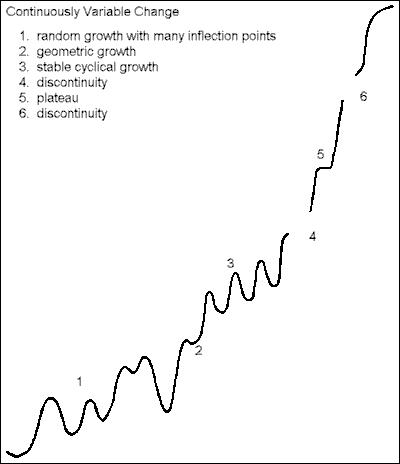
Continuous variable change

The key is that more is different (nearly the motto of the discipline).5 The common sense imagining, prior to the fallacy of composition, is that things scale in a linear way. More means more of the same. Then there is second order sophistication about scale. People add in the notion of a discontinuity. Things scale until they reach a certain threshold, at which point there is a discontinuity. More is different. But this is still a relatively binary conception with simply two sides of the discontinuity: one side of the discontinuity where the logic of linear growth prevails and the other where that of emergence or complexity prevails. There is a third order sophistication about scale where the binary view of second order thinking is still too simple; where the relationship between scale and properties is continuously variable.

As opposed to these simpler first and second order notions, continuously variable growth and development happen through many phases distinguished by differing logics or marked by different epiphenomena (something more like the imaginary graph above). As a system or network gains in members or in interactions, one set of behaviors becomes strained and unstable as it approaches the upper-bound threshold of the given logic. The threshold crossed, the previous logic gives way to a new logic. The pattern repeats, with the new logic holding for a period, but it too petering out in favor of a subsequent logic. And so on. Or perhaps there are tiers of controlling logics operative simultaneously. There may be meta-epi-phenomena as the various transitions admit a pattern of cycling logics or a second order logic to their or relations.6 No behavior or sequence is fundamental to systems, or the process of growth or to any particular phenomenon. We should dispense with the idea of a sin qua non behavior of systems in favor of a continuum of potentially many different behaviors as a system grows and changes.7

I will make a few examples to demonstrate the changing relation of prevailing logic and a system phenomena under growth.

Bak-Tang-Wiesenfeld sandpile growth model

  1. Multiple logics. Consider that paradigmatic example of complexity: grains of sand falling onto a pile (a Bak-Tang-Wiesenfeld sandpile). As grains fall onto the pile, they tumble down the side, and come to a rest according to a standard distribution. Most come to a rest close to the drop point so the pile grows in height, but only a few roll all the way to the bottom so the base remains largely the same area resulting in the incline of the sides of the pile grow ever steeper. But there is a range of values for which the ratio of base to height is stable. When the pile reaches its upper bound of stability, the pile collapses. But it doesn’t collapse all the way to a layer of sand one grain thick. The collapse comes to a halt once the pile has reached the lower bound of the ratio of base to height (the lower bound being where the slope of the side of the pile is such that friction overcomes gravity and momentum). The pile recommences its growth in height. With a new, broader base having been established, it will achieve a greater height this time before reaching the critical threshold.

    The pile doesn’t grow continuously until collapse though. It is constantly experiencing local collapse. The sand pile demonstrates scale symmetry in so far as there are slides of all sizes starting with a single grain previously stable coming lose and tumbling a little further down a side. Single grains frequently start a chain reaction leading to larger slides. The collapse of the whole pile isn’t an phenomenon of it’s own, unrelated to the logic of local slides, as the catastrophic collapse of the pile is usually the result of a local slide running away to the scale of the entire pile.

    But fractal collapse isn’t a constant. Rather, its probability is a function of where the pile is in the growth-collapse cycle. At the lower bound of the range of stability any collapse is almost impossible. A single grain may break lose and tumble to a more stable location, but owing to the widespread state of stability, it is not likely to set off a chain reaction leading to a large slide. At the top end, catastrophic collapse approaches certainty. A growing proportion of sand grains are in unstable positions. More are likely to break lose and, having broken lose, collide with other unstable grains setting off chain reactions. As the pile goes through the positive phase of the growth-collapse cycle, it traverses a range of increasing collapse probability from almost impossible to almost certain and its fractal dimension grows.

    Tally the sheer number of logics at work in this seemingly unnoteworthy phenomenon. The overall pattern is linear growth — the pile grows in mass in equal units in equal time. The shape of the pile demonstrates an oscillating pattern, between a steep cone and a shallow cone. The height of the pile superficially demonstrates cyclical growth. Upon closer inspection, the growth of the height of the pile turns out to be fractal. But even that fractal growth isn’t constant, but one of increasing fractal dimension.

  2. A complicated interstitiary. A discontinuity is probably always preceded by some sort of turbulence, a breakdown in the previously prevailing relationship. A prevailing logic doesn’t yield instantaneously to its successor. In at least materials science this is well documented in the form of the microstructure of phase transitions.

    As a social scientific example, nuclear weapons represent a discontinuity in the growth of military power, but how much of one? Countries had already acquired “city-busting” and potentially civilization destroying capability using the regular old Newtonian technologies of modern air power and chemical explosives. The U.S. imagined “bombing Vietnam back to the stone age” employing conventional methods. So it would seem that military power (technology) had already crossed an inflection point and gone non-linear in a way that was necessitating major strategic reconsideration prior to the discontinuity of nuclear weapons.

  3. Many discontinuities. People have a tendency to conceptualize consciousness in the model of the binary discontinuity. Neural networks grow in size from tiny nerve bundles in nematode worms up to pre-hominids and then somewhere in the Pleistocene whamo, the discontinuity and consciousness and that’s the pinnacle. Some people imagine the difference between regular people and geniuses to be a little discontinuity, rather than a difference of quantity. Hence the obsession with Einstein’s brain, Descartes’s skull, and so on.

    But I imagine consciousness rather than a big bang being a development with perhaps a number of discontinuities and plateaus — the first reflex, the first pain, the first internal world model, the first declarative memory, the first language of discrete symbols, the first syntax, the first theory of mind — on the way to humans. But our intelligence is just another plateau on the path. There is the singularity somewhere beyond us and still more discontinuities, unimaginable to us even beyond that. As intelligence is not one thing, I imagine each of the many faculties having its own trajectory, each with multiple discontinuities of their own, as well as the synergy of the many faculties being of uneven development and their interplay subject to system effects.8

Instead of relying on the sort of intuitionism that says something like “We know that there has been a discontinuity in strategic thought because we read Thomas Schelling now instead of Helmuth von Moltke” we should dispenses with this intuitionistic approach in favor of systematic mathematical methods to analyze change — to determine when and where system effects are at work, which ones are at work, the extent of their range, the exact location of inflection points or discontinuities, where the logic of a tipping point takes over and the pace of accelerating assertion of the logic of the new régime, to study turbulence, islands of stability, equilibria, feedback and other patterns that can develop.9

Notes

  1. I am prone to write “collective intelligence” in place of “society,” but an ancillary point here is that all intelligence is collective (composite), whether it’s a society, so to speak, of individually dumb neurons in the brain of an individual or the more commonplace idea of a society, namely wisdom of crowds, invisible hand, social networking, superorganism type phenomena.

  2. Though not necessarily so: we are learning how to harness emergent properties to our purposes, to design them in.

  3. Though structure might be a concomitant emergent property, e.g. ecologies might exist in equilibrium, but that’s not because competition among species is well ordered.

  4. This category error of misconstruing different component-composition behavior types, or not even identifying the second type at all, is perhaps illuminating to the overarching issue of intelligent design’s constant irreducible complexity mongering. One of the favorite analogies from their rhetoric is that of the mousetrap: remove a single component and it isn’t a slightly less effective mousetrap, it isn’t an anything and natural selection can’t function on constellations that display no function. But notice how this relies entirely on the machine type of component-composition thinking. But if one sees phenotypic expression as an emergent property of genotypic change, than one might shift to the later version of the component-composition model. A heavily determined trait will be stable over many changes in the underlying genes, until a critical threshold is reached at which time rapid change in phenotype (the emergent property) could occur. A perfect example of the contrast between the two types of thinking that I am describing here is that version of evolution as the long, slow accumulation of mutation down through the millennia, which sees a more or less consistent, linear change, versus something like punctuated equilibrium which imagines different logics of change predominating under different circumstances. I would go further to say that punctuated equilibrium is only a theory of discontinuity. A more elaborate theory of the deep history dynamics of evolution, or a marcotheory of evolution, as opposed to the microtheory we have at present, is required.

  5. More is not binary, though more is frequently discrete — neural networks grow in whole neurons, societies grow in whole people. But not always. System happens as much in analog as in digital phenomena, e.g. strategy must adapt as power or capability increase, but power does not grow in discrete units.

  6. Meta-epi-phenomena would be something observable only over extremely long timeframes for most phenomena with which we are familiar. Kondratiev cycles (45-60 years) and Forrester waves (200 years) would be examples from economics and sociology. The existence of such long patterns, whose period is outside the scope of our limited record, is part of the explanation for black swan type phenomena. I imagine that there are small models, probably in physics and biology, where the dynamcs of such systems could be worked out in detail, then recognized in longer term examples based on partial data. As the patterns of systems theory are largely substratum independent, patterns discovered in one area are relevant to another. A well organized sub-discipline would better allow for the abstraction of higher-order patterns from their original fields of discovery and facilitate interdisciplinary transmission of knowledge. A pattern well characterized in observations of one phenomenon might be revolutionary to another area where the phenomenon is insufficiently well observed to know the entire continuum of behavior, but observed well enough to recognize that it is an instance of the former pattern. Systems-type phenomena are present throughout the various sciences. Just as mathematics is used throughout the sciences, but is consolidated into a discipline of its own, so too systems science should become a better organized and consolidated sub-discipline. As it involves such a diverse range of the sciences, it would be an interdisciplinary field, not one as autonomous as mathematics.

  7. While none fundamental, there are, presumably, a finite set of possible system patterns. I wrote on the possibility of cataloguing and organizing them on some sort of periodic table of logics in “Formal Cognition,” 1 January 2008.

  8. Animals have developed a variety of different types and levels of intelligence; there’s no reason to think that machine intelligence will be any different.

  9. The problem is that the data sets that we have aren’t big enough, granular enough and are riddled with bad data. With two points you can’t tell linear from geometric growth. With three points you can’t tell geometric growth from linear growth with noise. And of course it gets much worse than this. And we don’t even know how to operationalize a large segment of the really interesting phenomena. How would we quantify something as elusive as national power — something international relations theorists are trying to do all the time — when even the component statistics are a mess?

Emergence and Aufhebung (Hegel and the Swarm)

I like Charles Mudede’s scaled down explanation of emergence (“Interlace in Dubai,” SLOG, 3 December 2008):

In the theory of emergence it is understood that complexity has a limit. For example, when the population of an ant colony reaches a certain point, 80,000 or so, changes begin to happen. Army ants swarm another colony or lots of ants move out and wander or start a new colony. What is clear is one behavior ends and another one begins.

One controlling logic relinquishes to a subsequent controlling logic. Emergence is a discontinuity in growth.

I don’t know that he is right to characterize this as “complexity having a limit.” An emergent property is an aufhebung: a simultaneous preservation and transformation. The emergent property doesn’t sweep aside all previous behavior, but preserves the original behavior and builds a new layer or interpretive characteristics on top of it. I think of “the invisible hand” of capitalist markets here. People don’t stop bargaining when market clearing happens. People continue to negotiate, clip coupons, shop around, seek out sales, innovate, invest and compete. Market clearing is a second order interpretation of the ground level behavior that persists just under this interpretive overlay. Or in the example of the prisoners’ dilemma, the participants don’t cease to be rational outcome maximizes when the logic of suboptimum outcomes takes over. Their goals and reasoning stay the same. If anything, by preserving all the original complexity and adding a superstructure of new behavior, emergence is complexity unbound from its first order confines.

Everything Malcolm Gladwell

Malcolm Gladwell’s new book, Outliers: The Story of Success, hit the stores today. As a loser, I’m not super-enthused about successful people. That said, I’ve become a big Malcolm Gladwell fan, so here are a few links.

He’s just the sort of person who should have a blog; and he has one. He maintains an archive of his published writings, as does The New Yorker where he is a staff writer. His previous two books are The Tipping Point (2000) and Blink (2005).

He’s presented on some of his ideas at the 2006 and 2007 New Yorker conferences. He’s been on Q&A with Brian Lamb. Apparently Charlie Rose is a big fan because Mr. Gladwell had been on his show seven times. NPR has done a number of profiles, interviews and reviews which can be found in their archive. And of course he’s given a TED Talk. It’s on the origin of extra chunky pasta sauce and the proliferation within product lines. More fundamentally it’s on the death of Platonism in the commercial food industry.

He’s been profiled in Fast Company (Sacks, Danielle, “The Accidental Guru,” January 2005), The New York Times (Donadio, Rachel, “The Gladwell Effect,” 5 February 2006) and now for his latest book New York Magazine (Zengerle, Jason, “Geek Pop Star,” 9 November 2008).

I used one of his articles as the basis for a little snark with “Malcolm Gladwell’s Infinite Monkey Theorem” (27 May 2008).

The funny thing you’ll notice if you follow a few of these links is that the hair isn’t the only big thinker factor. Despite a considerable speaker’s fee, Mr. Gladwell doesn’t own many suits.

The Ouroboros Economy II

A few months ago I took the opportunity of the Business Week cover depicting the economy as ouroboros for a few snickers (“Ouroboros to Mise en Abyme,” 28 July 2008). Now the ouroboros economy makes another appearance, this time in the much more serious pages of The New Yorker (Lanchester, John, “Melting into Air,” 10 November 2008, pp. 80-84). Again, I don’t have anything in mind: it’s just an icon shopping around for more meanings. But Mr. Lanchester gives it a novel and grandiose go:

… finance, like other forms of human behavior, underwent a change in the twentieth century, a shift equivalent to the emergence of modernism in the arts — a break with common sense, a turn toward self-referentiality and abstraction and notions that couldn’t be explained in workaday English. In poetry, this moment took place with the publication of “The Waste Land.” In classical music, it was, perhaps, the première of “The Rite of Spring.” Jazz, dance, architecture, painting — all had comparable moments. The moment in finance came in 1973, with the publication of a paper in the Journal of Political Economy titled “The Pricing of Options and Corporate Liabilities,” by Fischer Black and Myron Scholes.

The revolutionary aspect of Black and Scholes’s paper was an equation that enabled people to calculate the price of financial derivatives based on the value of the underlying asset. … The trade in these derivatives was hampered, however, by the fact that — owing to the numerous variables of time and risk — no one knew how to price them. The Black-Scholes formula provided a way to do so. It was a defining moment in the mathematization of the market. The trade in derivatives took off, to the extent that the total market in derivative products around the world is counted in the hundreds of trillions of dollars. Nobody knows the exact figure, but the notional amount certainly exceeds the total value of all the world’s economic output, roughly sixty-six trillion dollars, by a huge factor — perhaps tenfold.

It seems wholly contrary to common sense that the market for products that derive from real things should be unimaginably vaster than the market for things themselves. With derivatives, we seem to enter a modernist world in which risk no longer means what it means in plain English, and in which there is a profound break between the language of finance and that of common sense. …

If the invention of derivatives was the financial world’s modernist dawn, the current crisis is unsettlingly like the birth of postmodernism. For anyone who studied literature in college in the past few decades, there is a weird familiarity about the current crisis: value, in the realm of finance capital, evokes the elusive nature of meaning in deconstructionism. According to Jacques Derrida, the doyen of the school, meaning can never be precisely located; instead, it is always “deferred,” moved elsewhere, located in other meanings, which refer and defer to other meanings — a snake permanently and necessarily eating its own tail. This process is fluid and constant, but at moments the perpetual process of deferral stalls and collapses in on itself. Derrida called this moment an “aporia,” from a Greek term meaning “impasse.” There is something both amusing and appalling about seeing his theories acted out in the world markets to such cataclysmic effect.