Relativism and Conflict

Ezra Klein references Nickolas Kristof’s column yesterday as bringing “striking clarity” on the Israeli-Palestinian issue, but the clarity is all in Mr. Klein’s interpretation (“Tough Love for Israel?,” The New York Times, 24 July 2008; “The Dual Realities of Israel / Palestine,” TAPPED, The American Prospect, 24 July 2008, respectively):

But he [Kristof] offers a counter-fact: “B’Tselem, the Israeli human rights organization, reports that a total of 123 Israeli minors have been killed by Palestinians since the second intifada began in 2000, compared with 951 Palestinian minors killed by Israeli security forces.”

When Jews talk about the ethics of the Israeli response, they tend to emphasize the recklessness and cruelty of Palestinian terrorists. The words most often heard are “target civilians.” The Israelis are right, in other words, because they carry out limited military operations against discrete targets, which sets them ethically apart from members of Hamas who murder innocents because it’s an effective tactic. That is indisputable.

Palestinians, by contrast, speak of the war in terms of absolute costs: They have suffered more, buried more, seen more of their freedoms and land and dignity taken from them. To them, it seems insane to condemn Palestinian tactics when the Israelis have killed so many more innocent children. That too is indisputable.

Both sides are right. There’s a passage in Aaron David Miller’s excellent book The Much Too Promised Land that makes this point elegantly. “The prospects of reconciling the interests of an occupied nation with those of a threatened one seemed slim to none,” he says. In many ways, that’s the essential truth of the conflict: The two sides don’t judge themselves similarly. The Israelis see themselves as threatened innocents, not oppressors. The Palestinians see themselves as an occupied and humiliated nation, not aggressors. The Israelis see themselves as inexplicably under attack, and acting only in defense. The Palestinians see themselves as losing a war against a much stronger, and demonstrably more brutal, occupier.

This is all true of Israel / Palestine and an important point to keep in mind when trying to understand the claims and counterclaims of the parties.

What Israel needs is, as Mr. Kristof calls it, tough love. What that means at a more operative level is the U.S. needs to provide Israeli moderates with additional reasons they can point to in opposing Israeli extremists (messianic Jews, settlers, etc.). The Palestinians aren’t the only ones whose country is being destroyed by the extremists in their midst.

In addition to pointing out some salient facts about the nature of the particular dispute in question, this is a perfect real-world example of relativism. Most people think of relativism and think it means amorality, or moral capitulation, or a dispensing-with of any notion of the facts of the matter. But what I think this explanation shows is that relativism is compatible with an objective account of things — or that relativism as an ethical theory is well compartmentalized from any particular metaphysical substratum. And relativism is a theory that provides a very good account of many disputes in the world. People aren’t necessarily in dispute over what is true and what false, or the proper moral criteria. For instance, no one in this situation is necessarily disputing the numbers killed or whether killing is right or wrong. The facts of the matter or the morality of any individual act considered in complete isolation is not in dispute. What is in dispute is the proper context in which to weigh the facts and adjudicate the contending claims of moral priority. It’s a question of interpretation. Different sets of acts of violence become at least plausibly justifiable depending on which gestalt narrative one adopts. Change total narrative and the moral weight of the various acts shifts around.

This is the way it is in almost all disputes. The rhetoric that people deploy usually very quickly leaves behind particular matters of fact or the morality or immorality of specific acts and it becomes a contest of dueling grand narratives. A conversation about a particular environmental harm becomes one about the tragedy of the commons and evil corporations versus the road to serfdom. A conversation about a reproductive decision becomes one of recidivist patriarchy versus the suicide of Western culture. The fact of the matter is that no one can quite see individuals as individuals and consider their actions as such. Everyone sees all people as deeply embedded in social structures and patterns and duty-bound to speculative forces of society and history.
Bush’s Götzen-Dämmerung; Obama’s Revaluation of All Values

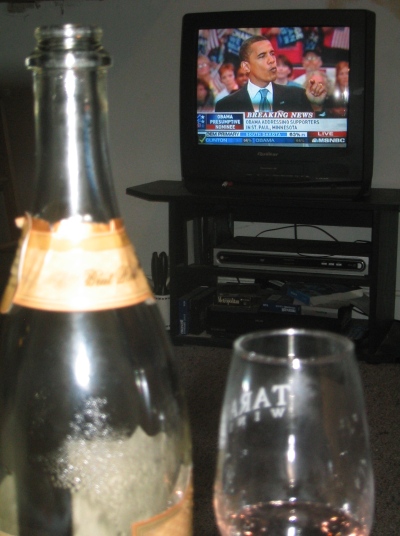
This does even more for me than Hillary Clinton’s drinking habits:

Obama himself went through a period of “devouring” the work of Nietzsche while living in New York. It’s difficult to say what Obama might have absorbed from the German philosopher, mostly because Nietzsche himself is so hard to pin down, but one of Obama’s favorite instructors at Occidental told Mendell that anyone who immersed themselves in his thought would learn “to call everything into question.”

(Miller, Laura, “Barack by the Books,” Salon.com, 7 July 2008)

New York and Nietzsche! Could it be any more élitist? It kinda makes ya see the theme of change in a different light. As Nietzsche said, “… only beginning with me are there hopes again” (Ecce Homo, “Why I am a Destiny,” §1, trans. Walter Kaufmann, 1976).

The Central Question Regarding Barack Obama

Paul Krugman opens Monday’s editorial asking the central question for the left about Barack Obama (“The Obama Agenda,” The New York Times, 30 June 2008):

It’s feeling a lot like 1992 right now. It’s also feeling a lot like 1980. But which parallel is closer? Is Barack Obama going to be a Ronald Reagan of the left, a president who fundamentally changes the country’s direction? Or will he be just another Bill Clinton?

Oddly enough, I found myself a supporter of Hillary Clinton in the primaries because I suspect the latter. Perhaps that was a little naive as I also suspect that Senator Clinton is fundamentally and genuinely conservative politically and personally.

No one can fight every battle and not every battle should be fought in the most direct manner. One must marshal one’s resources for the critical moment, and more times than not maneuver is superior to grabbing the bull by the horns. I presume that Senator Obama recognizes two things: first he has to get into the White House before he can do anything else and once there he will only be able to accomplish a small number of his objectives so he needs to dispense with the lesser objectives and focus on the really important ones.

For instance, voting for the FISA bill last week was, I presume, tactical. It takes that accusation off the table for the duration of the campaign. Everyone runs a stealth campaign anymore. You’ve got to avoid at all costs doing anything that could be used to provoke the middling mind of the independent voter. Once in the White House, then he will really be in a position to address the problems of the FISA program. Again, first win the election, then come the reforms. Would losing to John McCain serve the cause of FISA reform?

Presidents can only have limited power and limited time to accomplish their agenda. Senator Obama has to be eyeing that Oval Office desk and thinking Economy, Budget, Healthcare, Iraq, Afghanistan, War on Terrorism and everything else will just have to take the back seat.

At least this is the story I am feeding myself to assuage my severe doubts that this will be another eight years of cowed liberalism. Senator Obama is giving us plenty of reason to believe otherwise.

The Most Terrible Power of All Concentrated in One Man

In response to a reader question, Matthew Yglesias says that if President Bush so decides, there is nothing anyone can do to prevent air strikes against Iran (“By Request: What if Bush Bombs Iran?,” TheAtlantic.com, 1 July 2008):

… if Bush orders air strikes against Iranian targets, nobody can stop him. A plain reading of the text of the U.S. Constitution would seem to suggest that it would be unconstitutional for the military to follow any such order absent a declaration of war or some other form of congressional authorization. But the settled precedent, ratified by key Democratic Party leaders as recently as the bombing of Serbia during the Kosovo crisis, is that no such authorization is necessary. I’m not happy with this situation and think it’s crazy that we as a country have moved away from the constitutional procedure, but the cat’s been out of the bag for a while now and if Bush wants to bomb Iran Bush will bomb Iran.

Democracy is based in part on a notion of the wisdom of crowds — or in the negative formulation, it is based on the recognition of the perfidy of powerful men. It is terrifying to think that when it comes to the most fateful questions facing a nation — the most terrible expenditure of the nations resources a country might undertake, one that throws the very survival of the country into the pot, one capable of completely remaking the social order of a people — we have abdicated that power to a single man.

On the right there is this constant carping about the founders’ intent, originalism, strict constitutionalists and activist judges, but when it comes to this issue, perhaps the most gross violation of the founders’ intent and the plain language of the Constitution, Republicans are complete subscribers to the cult of the great leader — at least until that power passes to a Democratic president, that is.

This is one of the reasons that I like The American Conservative. They actually see this situation for the massive threat to American liberties and the American way of life that it is.

Some future president, less ambitious, more moderating, ought return to the traditional confines of the office and forfeit this unofficial power. And a Congress more attune to it’s Constitutional duty than to it’s party platform ought to reassert this prerogative by threatening impeachment to any president who dares usurp it.

Climate Change Comes to Flyover Country

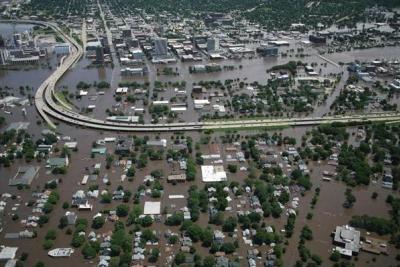
Flooding in downtown Cedar Rapids, Iowa, 13 June 2008

We’re not even getting the worst of it, just the feeble remnants, but still, the waves of storms that have been blowing through D.C. have been terrifying, violent, disruptive events. They have been apocalyptic, with the sky darkening and the air becoming restless as the storm approaches. Last week the street lights all came on at three o’clock in the afternoon, so dark had it become. We all gathered at the windows watching the oncoming storm in amazement. We looked across to the neighboring building where the occupants of nearly all eleven floors gathered at their windows too. I’ve lived in D.C. for five years now and I have never seen storms so violent as these.

A few days ago S. said that it turns out that New Orleans wasn’t the U.S. city that got wiped off the map, but rather, merely the first U.S. city to be wiped of the map. And in the perverse logic of the greenhouse effect, where the weather becomes not generally hotter or colder or wetter or dryer, but variably more extreme in every direction, I’ll bet by August the news of flooding has been replaced by stories of drought and wildfire.

It was pretty easy for middle-American public figures to be smug about climate change when it was just sinful, elitist coastal cities that were going to be destroyed by rising sea levels. But it turns out that the gods make no distinctions among we mortals between the righteous and the wicked. Climate change will come to the heartland just as much as it will to the decadent coastal cities.

Just as in Iraq, people tend to contrast the costs of a change in direction with the costs of doing nothing as if doing nothing were free. There are no costs to the status quo. The right digs out all these numbers about the drag on the economy of various plans to prevent climate change, but it is presented as if it were an absolute, rather than a comparative cost. Do nothing and continue along that same unencumbered glide-path to prosperity; change direction and it’s the road to serfdom. In fact, there has even been a spate of articles as of late on how climate change is going to be an economic boon — at least for some. But one no longer needs a month of simulation time on a supercomputer — a window and a cable subscription will suffice — to see that there are coasts to doing nothing.

Conviction Versus Expediency: A Quandary

The consensus on the left is that Senator Clinton’s 2002 vote to authorize President Bush to go to war was the top line problem that cost her the nomination. Ezra Klein says (“What Went Wrong?,” Tapped, 4 June 2008),

… among the more heartening and broadly applicable lessons of this campaign is that supporting a misguided, but politically expedient, war in 2002 turns out to have been a serious mistake.

For Matthew Yglesias it has been an ongoing theme, but in his post-Obama-victory analysis he says (“It’s the War,” TheAtlantic.com, 4 June 2008),

At the end of the day, Hillary Clinton had (and has) much more credibility with the liberal base than does the average person who shares her position on the war. If she can be held accountable, and if John McCain (until very recently the most popular politician in America) can be held accountable, then the sky’s the limit.

The problem here is that perhaps the majority of Democrats who voted to authorize the Iraq war in 2002 did so because they remember the consequences of opposing an earlier Bush’s war with Iraq in 1991. Back then the Democratic party was reflexively anti-war and voted in a large block to oppose war in 1991. They confidently predicted another Vietnam. Then the war went swimmingly, approval ratings of President Bush, Sr. went through the roof and Congressional Democrats were left with egg on their faces.

Any politician with presidential ambitions in 2004 or 2008 was sure to tick off the “willing to kick rogue country butt” requirement on their political CV — all except one, that is. But what’s a politician to do when it turns out that neither stout conviction nor craven expediency does the trick?

A Western Union?

Okay, I’m going to advocate one of those bigthink political ideas that has absolutely no possibility of becoming reality (see, e.g., Foreign Affairs).

The United States should join the European Union.

Commentators are concerned that the world may be breaking into competing trade blocks, with North America and Europe being the most contentious. Both are constantly at odds over their respective agricultural subsidies. The U.S. engages the E.U in an epic battle at the WTO over its banana import regime. European antitrust czar Mario Monti vetoes the merger of General Electric and Honeywell and finds Microsoft €497 million for anticompetitive practices after the U.S. gives both a free pass. Both countries have strategically critical airplane manufacturers, Boeing and AirBus. The U.S. complains that AirBus is E.U. subsidized. The E.U. retorts that the U.S. hides its subsidies of Boeing in the Department of Defense budget. Why not take all these high-stakes squabbles out of the indeterminate realm of international disputes and bring them under the more normal procedures of federal politics?

In denial of its complete impracticality, the United States and Great Britain have already experienced a considerable amount of political harmonization — which I take to be the prerequisite to political union. Margaret Thatcher and Ronald Reagan ushered in simultaneous conservative revolutions in each country. Both were followed by short-lived toadies in the persons of John Major and George Bush, Sr.

But it doesn’t stop at Britain. Much of mainland Europe seems to be on a nearly synchronized political periodicity. As Thatcher and Reagan were putting their revolutions in place, French President François Mitterrand was backing off from his socialist program to become one of that country’s historic liberalizers. Germany was also headed by the conservative Helmut Kohl in the 1980s, to be followed by the third-way Gerhard Schröder in 1998. Indeed the trio of like-minded politicians Bill Clinton, Tony Blair and Gerhard Schröder seemed quite a phenomenon at the time.

The United States already has a treaty of military alliance with Europe in the form of NATO. At the WTO the U.S. and the E.U. form a more or less unified negotiating block against the G-20 group of developing nations and Mercosur.

There is much idol discussion of a league of democracies so supplement or maybe supplant the United Nations. A U.S.-E.U. union would get us most of the way there. Throw in the British Commonwealth of Nations — Canada, Australia, New Zealand, India and so on — and what more is left?

If we’re on the way to one world government, but convergence is what is required, this seems like the next most logical step.

Finally, there is a persistent, nagging, Spenglerian fret over the decline of the West. Call it civilizational status anxiety. If the United States is serious about the idea of the West and defending it, why not make it official. Instead of the West being an idea from books or a lose political affiliation, make it a real political entity.

On the downside, it would really get us well on the way to Oceania, Eurasia and Eastasia and would reify the clash of civilizations.

Markets: Plan A or Plan B?

In an aside to an article on genetic determinism, The National Review comments on markets and the limits of information science (Manzi, Jim, “Undetermined,” vol. LX, no. 10, 2 June 2008, pp. 26-32):

In the middle of the 20th century, Friedrich Hayek and the libertarians he inspired faced those who asserted that the economy could be successfully planned. The libertarian position was not that such planning could be proved impossible in theory, but that we lacked sufficient information and processing power to accomplish it. The world of economic interaction was so complex that it overwhelms out ability to render it predictable; hence the need for markets to set prices.

I don’t for a moment believe that the Libertarian Party will disband once we cross some floating point operation threshold on supercomputers. There is the practical and there is the principled reason for subscribing to the libertarian position and I have read some of its proponents specifically state that even if the command economy could deliver superior performance, they would still be libertarians because of the component of human freedom.