Patterned Lawlessness

Back in July Will Wilkinson made a point that I thought was interesting at the time, but that has stuck in my grey matter and is gradually working it’s way toward becoming a fundamental component of my worldview (“Note About Rational Scofflaws,” The Fly Bottle, 11 July 2008):

I wonder how many drivers exceed the speed limit basically whenever they judge that it won’t cause anybody any problems. I’d guess, approximately, all of them. Also, there are very clear laws about, say, using turn signals, or using turn signals when parallel parking (do you do this?), or not taking a right hand turn on red lights when it is marked, not double parking, even if you’re just going to be one minute while you fetch your latte. And so on. When’s the last time you jaywalked? Lunch? People are more or less rational and tend to respond to incentives, and therefore the roads are a zone of patterned lawlessness. We all know what infractions the cops care about — how much over the speed limit is too much over, etc. — and we tend to respond accordingly. We even tend to internalize and moralize the rules whose expected cost of violation is relatively high. It’s more efficient that way. And thus our huffing indignation is easily riled by those who face different incentives and so flout different rules than the ones we flout without reflection.

This morning on my ride to work I coasted through a stop sign in front of a police cruiser that was approaching from the road to my right. I gave a little embarrassed smile and a little wave. She made a little disapproving face and waved back. It’s anarchy I tell you. Anarchy! I got to work in four minutes.

I have always thought of anarchism as a proscriptivist political program. It’s never occurred to me to consider anarchism as a positivist description of what’s actually going on behind normal law-conforming behavior.

People have an imagination of the law as somehow an ultimately hard thing. We hear expressions like “the iron law of …” or we use the same word, “law,” in physics as we do in our social imaginings. By linking the law with morality and construing morality as partaking of the metaphysical, the associations flow back the other direction as well.

And reference to the law would serve as a good explanation in most instances. Why does everyone so assiduously follow the lines painted on the roads, or when they drive over them, do so in such a regular fashion? And thus we might explain the vast middle hump of the bell curve of driving behavior. But then someone swerves over the line into oncoming traffic. To account for all driving behavior — the outliers as well as the vast middle of the curve — another theory with more breadth is required.

I also like the way that this theory strips morality of its metaphysical pretensions, paints the metaphysics as mere rhetorical device, or sees the inclination to render our ordering prescripts as fundamental as merely a pragmatic shorthand, or as the ideological reification of particularly strong emotions. Really we just react in a pragmatic way to the incentives that we find around us. It should be noted that some of those incentives are natural and some institutional. This is perhaps part of the basis for distinction, a la Elliot Turiel, between prohibitions of morality and prohibitions of social convention.

Patterned lawlessness is also a description of affairs that comports with the existential account of law-conforming behavior. So entrenched is our notion of the law as somehow inviolable, or so cowed is our thinking by the high wall of consequence erected by the law that we are prone to see dictates of the law as things about which there simply is no other option but to do as we are told. Existentialism was born in part as a reaction to the horrors of amorality and unreason to which people were pushed at the behest of state bureaucracies in the Twentieth Century, namely the Somme, the Holocaust. Existentialism contains the admonition that at every moment we stand free to do otherwise, even where the law is concerned.
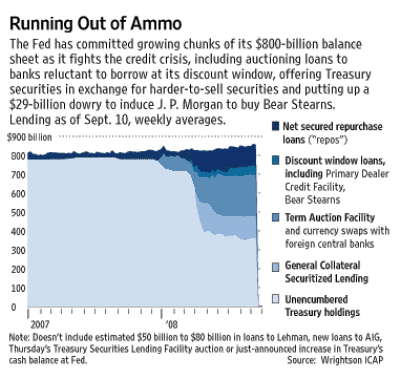
Federal Reserve Balance Sheet

Amid news that the Federal Reserve is establishing this multi-billion dollar line of credit, extended that many billion in overnight repurchase agreements, contributed $30 billion to the J.P. Morgan buyout of Bear Stearns and spending $83 billion for the purchase of A.I.G., the question lingering in the back of my mind is how is the balance sheet of the Federal Reserve looking right about now. The Federal Reserve doesn’t have unlimited resources at it’s disposal. It has about $800 billion in assets which only buys it a limited amount of credibility. It’s not all that much relative to the scale of modern financial flows.

Anyway, wonder and The Wall Street Journal will deliver (Blackstone, Brian, “U.S. Moves to Bolster Fed Balance Sheet,” 18 September 2008, p. A3 [subscription required]):

Federal Reserve assets, The Wall Street Journal, 18 September 2008

The Treasury, responding to worries that the Federal Reserve could be running out of financial ammunition to deal with the credit crisis, moved to reload the Fed’s gun with $100 billion worth of bullets.

The central bank’s bailouts of Bear Stearns and American International Group Inc., as well as lending programs created in the past year, are putting the Fed’s once-mighty balance sheet at risk. Financial markets have begun to fear that if nothing is done, the Fed might have trouble putting out fires in the future.

The Fed held close to $800 billion in Treasury securities a year ago. By last week, that had dwindled to just under $480 billion. The amount drops to less than $200 billion if the $200 billion pledged to the Term Securities Lending Facility — a Fed lending program created in March for investment banks — and the full $85 billion line to AIG are accounted for, Fed watchers say.

“The tally is so low that it is becoming imperative for the Fed to take actions to enlarge its balance sheet,” said Tony Crescenzi, a strategist at Miller Tabak in New York.

When the Fed lends money to a financial institution, it usually sells an asset such as Treasurys separately in the market and absorbs the cash created by the loan. The goal is to keep a proper level of money flowing through the financial system. If the Fed were to run too low on Treasurys to conduct these operations, it could lose its ability to drain money from the banking system and control inflation.

On Wednesday, the Treasury announced a temporary program to bolster the Fed’s balance sheet and sold $40 billion in 35-day Treasury bills. It announced later in the day that it would hold two additional auctions of Treasury bills on Thursday totaling $60 billion. In effect, Treasury is auctioning off more securities than are needed to fund the federal government, and carrying out the draining function in place of the Fed. The cash from the Treasury’s sales is parked at the Fed.

Of course the government has infinite money, but it comes at a cost. As long as the Fed coffers are topped off, Chairman Bernanke is his own man. But already Federal Reserve assets are approaching levels where he will increasingly be at the behest of Treasury Secretary Paulson and House Financial Services Committee Chairman Barney Frank.

Capitalist Systematics and Individual Freedom

In his economic speech on Monday Senator McCain had the following to say about the present financial crisis:

The top of our economy is broken. We have seen self-interest, greed, irresponsibility and corruption undermine the hard work of the American people.

Then on Tuesday morning he said to Joe Scarborough:

Wall Street has betrayed us. They’ve broken the social contract between capitalism and the average citizen and the worker. … This is a result of excess and greed and corruption. And that’s exactly what is plaguing Americans today.

I imagine that a lot of people would call me a leftist and a socialist, but from these two comments it seems to me that John McCain must have a pretty contorted idea of what exactly capitalism is underneath the rhetorical hood.

What’s happening on Wall Street isn’t a corruption of capitalism. It’s not that people are angles and in capitalism we’ve finally found an economic system equal to ourselves. The genius of capitalism is that people are greedy, self-interested wretches and capitalism is a system that channels their greed into social good. What’s wrong with what’s going on with the financial system in recent weeks is not that financiers are greedy, or even excessively greedy, but that the system is rigged wrong.

When Democrats call for a new regulatory regime, this is what they are calling for: a different arrangement of the system. Different prohibitions, different incentives, different inducements. It’s the Nudge approach. Align the incentives right and then laissez faire.

The alternative to systematic change is the reengineering of the human heart. And proposals to change the hearts of men are not very conservative. This is why capitalism and liberalism are so closely conjoined. Capitalism is indifferent to the characteristics of the corpuscles that comprise the system. It is the economic system most compatible with self-determination because it doesn’t require people of any particular character to function. It’s even sufficiently robust as to be compatible with extremes of behavior. Other systems less fault-tolerant and rely for their sustainability on the virtue of their participants. As such other systems maintain an interest in the condition of the souls of their members. Some see this as a virtue of these alternate systems.

Recent weeks don’t argue my case very well. It would seem that capitalism is in fact not very robust and in need of quite a bit of extra-systematic shoring up. But that’s owing to fifteen years of willful neglect. Professed admiration for capitalism on the right is not so compatible with the sustainability of capitalism. If you get the system right, you don’t have to worry about the character of the people.

But this is one of the things that’s distinct about Senator McCain. He isn’t that into leaving people alone. He’s a proponent of a particular type of civic virtue and is interested in cajoling people, even cajoling them rather convulsively, into demonstrating his brand thereof. And on the right more generally opposition to business regulation is so inflexible that social engineering is the acceptable alternative.

Not So Fast on the Moral Hazard

Last week American International Group requested assistance in the amount of $40 billion from the Federal Reserve. This was rejected only to have A.I.G. come back with a second request, this time for $75 billion. Over the weekend the Federal Reserve and the Treasury decided to let Lehman Brothers fail. On Monday and today the editorial pages were full of adulation about the reinstantiation of the rule of moral hazard. “If Lehman is able to liquidate without a panic … the benefits would include the reassertion of ‘moral hazard’ on Wall Street.” (“Wall Street Reckoning,” The Wall Street Journal, 15 September 2008, p. A22) “It was a brave decision. By abandoning Lehman Brothers, a 158-year-old piece of Wall Street furniture, and refusing to remove their hands from their pockets when Merrill Lynch came calling, Hank Paulson, US Treasury secretary, and Tim Geithner, governor of the Federal Reserve Bank of New York, had one of the busiest weekends of dispassion on record.” (Persaud, Avinash, “Lehman Had to Fall to Save the Financial System,” Financial Times, 16 September 2008, p. 13).

But then on midday Monday, New York state started waiving insurance regulations to allow A.I.G. to make a complex set of financial transfers to try to gather up enough collateral to cover it’s debts at a downgraded credit rating. At midday today when it started to look like a private bailout package being negotiated between J.P. Morgan and Goldman Sachs was faltering, the Federal Reserve stepped in to assist in the negotiations. Then it appeared that the Federal Reserve would be playing a key role in the package, but Fed spokesman was declining comment. Now, late this evening the Federal Reserve is announcing that it’s not going to be facilitating a private loan to, but outright buying a controlling interest in A.I.G. (de la Merced, Michael J. and Eric Dash, “Fed Readies A.I.G. Loan of $85 Billion for an 80% Stake,” The New York Times, 16 September 2008):

In an extraordinary turn, the Federal Reserve was close to a deal Tuesday night to take a nearly 80 percent stake in the troubled giant insurance company, the American International Group, in exchange for an $85 billion loan, according to people briefed on the negotiations.

In return, the Fed will receive warrants, which give it an ownership stake. All of A.I.G.’s assets will be pledged to secure the loan, these people said.

The Fed’s action was disclosed after Treasury Secretary Henry M. Paulson and Ben S. Bernanke, president of the Federal Reserve, went to Capitol Hill on Tuesday evening to meet with House and Senate leaders. Mr. Paulson called the Senate majority leader, Harry Reid, Democrat of Nevada, about 5 p.m. and asked for a meeting in the Senate leader’s office, which began about 6:30 p.m.

The Federal Reserve and Goldman Sachs and JPMorgan Chase had been trying to arrange a $75 billion loan for A.I.G. to stave off the financial crisis caused by complex debt securities and credit default swaps. The Federal Reserve stepped in after it became clear Tuesday afternoon that the banking consortium would not be able to complete the deal.

Extraordinary indeed! It would seem that the Federal Reserve and the Treasury aren’t so bullish on moral hazard after all.

The Palin Speech

After the pounding that McCain-Palin have taken over the last week I think that a lot of people tuned in to Sarah Palin’s speech for a spectacle. And she got off to a start that suggested a neophyte out of her league, but she rapidly adjusted and delivered a real stemwinder. As many have commented, she is a mastermind of the caustic aside.

I think that just about everyone in the country saw what was going on all at the same time. All week long the analysis of the Republican VP choice is that it was an attempt to drive a wedge between the Hillary Clinton and the Barack Obama supporters. About a quarter the way through her introduction of her family it dawned on S. and I the true case for her selection by the McCain campaign. When her speech was over and MSNBC cut to Chris Matthews, his opening point was that analysts have been misreading the Palin pick all week long, that it was a culture war move; it’s aim was the elitism narrative. I feel like the knife has been held just outside my field of vision and only in the midst of the speech last night did I catch the first glint of whetted steal.

The whole clan is too much. The candidate herself is unmistakably an aging beauty queen. Her husband, a fisherman, a union member, an Alaskan Men cover model, a “snow machine racer” is right out of central casting. The son solemn and stern in anticipation of shipping out for Iraq. The daughter, starting to show, is too fast on the heals of Jamie Lynn Spears and Juno (the damn film and its namesake are even named for and Alaskan city). Contrary to the Republican mythos, the “heartland” is plagued by degeneracy and altogether too many of these people will be able to identify. The down syndrome child is clearly dog whistle politics. It’s a lesser-known subject of discussion that almost no down syndrome children are born anymore and on the right it dovetails into the strawman connection between reproductive freedom and eugenics. To flout one is a clear symbol to the illuminati about Ms. Palin’s position on abortion. As Peggy Noonan inadvertently said, Governor Palin is narrative, not policy or capability.

From this speech it’s clear that the coming election will be the culture war all over again. It’s going to be a rerun of the 2004 election and it’s going to be nasty. It’s really amazing that the Republicans have only one script.

It’s completely dismaying the degree to which the future of the country is in the hands of a fairly unsophisticated media. If on Monday Time, Newsweek and U.S. News all have glowing cover stories on her then the Democrats are fucked. If the litany of lurid, tabloid-esque stories don’t abate, then everything will be okay.

The Democrats Reborn?

I’m trying to keep up my jaundiced eye here, but I feel like tonight I have seen a Democratic party unlike any I have seen before in my lifetime. Walter Mondale was perhaps the last of the old guard still to possess some fight, but after that, not Dukakis, or Clinton, or Al Gore or John Kerry. They all seemed too timid, too poll tested, too cowed. First last night in Joe Biden’s speech and then again tonight in Barack Obama’s I heard a Democratic party unbowed, spirited, confident.

Senator Biden’s introduction by his son and his own discussion of his family was surprisingly emotional and seemingly so for everyone involved. His speech was the version of values that Democrats should be putting forward, it was tough on foreign policy, and unlike Democrats for the last eight years, effortlessly sincere, uncontrived. As Matthew Yglesias pointed out (“It’s Biden,” ThinkProgress, 23 August 2008), the selection of Biden for VP “signals as desire to take the argument to John McCain on national security policy” and deliver to voters “a full-spectrum debate about the issues facing the country rather than a positional battle in which one party talks about the economy and the other talks about national security.” In Joseph Biden I think I first, finally saw a different, rejuvenated Democrats.

The same was true for Barack Obama’s speech tonight. His cadence was off in places, but it was defiant, pugilistic and signaled to me that the Senator has absorbed all the right lessons about the campaign. I think many of the myths that have plagued the Senator as well as the party at large for the last few weeks have been definitively left behind after tonight. It showed some of the populism that worked so well for Al Gore in the final weeks of the 2000 election. My favorite part, like with Senator Biden, was when Senator Obama took the foreign policy issue by the horns:

You don’t defeat — you don’t defeat a terrorist network that operates in 80 countries by occupying Iraq. You don’t protect Israel and deter Iran just by talking tough in Washington. You can’t truly stand up for Georgia when you’ve strained our oldest alliances.

If John McCain wants to follow George Bush with more tough talk and bad strategy, that is his choice, but that is not the change that America needs.

If Chris Matthews waxing rapturous is any indication, then he achieved everything he needed to do. After Chris Matthews, what more can you ask for? Who knows, maybe even Maureen Dowd will write a positive review. I think McCain’s speech a week from now will look pretty wooden in comparison.

My only concern is as, I think it was Patrick Buchanan said last night, after a week of the Republicans ripping into Senator Obama next week, the Democrats may regret going so easy on Senator McCain. Alternately, Democrats may finally have learned that you have to run your negative stuff stealth.

The Omission of Lyndon Johnson from the Democratic Pantheon

If there is a unifying thread to U.S. history it is that of the ongoing process of bringing American practice into line with American principle, of the march of freedom, of the expansion of the franchise. In this story there is one great subplot that stands above all others: that of the experience of the African American: the middle crossing, slavery, the fatal flaws of the U.S. Constitution, the Civil War, Reconstruction, Jim Crow and the civil rights movement. At the denouement of this story stand two characters, towering over all others: Martin Luther King, Jr. and Lyndon Baines Johnson.

Taylor Branch was right to structure his biography of Martin Luther King, Jr. around Exodus. King led African Americans out of the dessert, but was not allowed to enter the Promised Land himself. Lyndon Johnson, on the other had, is an exile: a man from the heart of the franchise, who is today persona non grata.

Today, Lyndon Johnson would have been a hundred years old (27 August 1908 – 22 January 1973) and George Packer comments on the strange exclusion of this giant of the left from the Democratic pantheon (“L.B.J.’s Moment,” Interesting Times, The New Yorker, 24 August 2008):

Whenever Democrats gather to celebrate the party, they invoke the names of their luminaries past. The list used to begin with Jefferson and Jackson. More recently, it’s been shortened to F.D.R., Truman, and J.F.K. The one Democrat with a legitimate claim to greatness who can’t be named is Lyndon Johnson. The other day I asked Robert Caro, Johnson’s Pulitzer-Prize-winning biographer and hardly a hagiographer of the man, whether he thought Johnson should be mentioned in Denver. “It would be only just to Johnson,” Caro said. “If the Democratic Party was going to honestly acknowledge how it came to the point in its history that it was about to nominate a black American for President, no speech would not mention Lyndon Johnson.” Caro is now at work on the fourth volume of his epic biography, about Johnson’s White House years. “I am writing right now about how he won for black Americans the right to vote. I am turning from what happened forty-three years ago to what I am reading in my daily newspaper — and the thrill that goes up and down my spine when I realize the historical significance of this moment is only equaled by my anger that they are not giving Johnson credit for it.”

In the week of Johnson’s one hundredth birthday, I would like to believe that there is some Democrat in Denver who will do him the justice of speaking his name.

Membership Has Its Limitations

I am vehemently opposed to any sort of loyalty cards that are now de rigueur at almost all stores where you make a purchase of any regularity or size. I think a lot of people see them as a harmless way to save a few bucks. And that’s what they are — for now. But they are obviously a foundation on which to build. But build what? Well, the FTC’s deceptive marketing practices lawsuit against CompuCredit is sure suggestive (Silver-Greenberg, Jessica, “Your Lifestyle May Hurt Your Credit,” BusinessWeek, 19 June 2008):

The allegations, in part, focus on CompuCredit’s Aspire Visa, a subprime credit card for risky borrowers. The FTC claims that CompuCredit didn’t properly disclose that it monitored spending and cut credit lines if consumers used their cards at certain places. Among them: tire and retreading shops, massage parlors, bars, billiard halls, and marriage counseling offices. “The company touted that cardholders could use their credit cards anywhere,” says J. Reilly Dolan, assistant director for financial practices at the FTC. “What they didn’t say was that you could be punished for specific kinds of purchases.”

And the more general point:

With competition increasing, databases improving, and technology advancing, companies can include more factors than ever in their models. And industry experts say financial firms increasingly are looking at consumer behavior, as CompuCredit did.

Of course the corporate idiocy here is mind-boggling. First they target a sub-prime demographic, but then cut them off for the very behaviors that made these people sub-prime in the first place. Really? CompuCredit was unaware that the underclass blew their money on scratch tickets and payday loans?

I don’t suspect that this is leading to some insidious world of PreCrime, where government thugs scoop you up, guilty on the basis of a statistical analysis. Rather, nudge style, it will just become the accepted background of people’s expectations. People will recognize an incentive and respond accordingly. “Oh, no, we can’t go out for happy hour. We’re trying to get our credit score up for a home loan.”

Reason and Power

Charles Mudede on reason and politics (“As Jets Roar Over Seattle,” SLOG, The Stranger, 3 August 2008):

The handle on politics is too hot for the grasp of nous.

This we must remedy. A more firm grip? Or a sacrifice of pink bourgeois hands for the calloused hands of a laborer?

Politics is about power and for power, reason is but a convenient cloak. When no longer needed or useful, power will draw back its cloak to reveal itself in all its bald injustice.