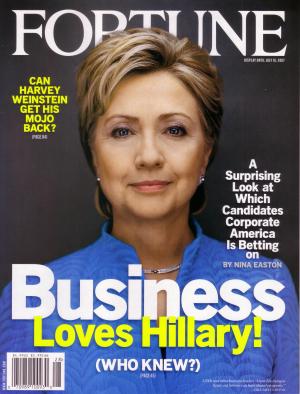
One of Hillary Clinton’s most important courtships began early last year, around a formal dinner table at Georgetown’s Four Seasons Hotel. Her targets were Morgan Stanley CEO John Mack and his wife, Christy. Mack was already active politically — but on behalf of Clinton’s political opponents. A Bush “Ranger,” he had raised at least $200,000 for the President’s reelection bid and was one of the most prominent business names on GOP donor lists. At one time his name had circulated as a potential Bush Treasury Secretary.
…
The conversation that night ranged widely, but always returned to one subject: health-care reform. …
Hillary Clinton was on familiar territory — and managed to charm the couple not only with her “intelligence and educated responses,” as Christy Mack recalls, but also with her one-on-one charisma. “You have these preconceived ideas about people you see in the public eye,” says Christy. “But we were extremely impressed with her ability to connect with every single person. She was an amazing listener, with tremendous warmth.”
The relationship could have ended there — a New York Senator engaging her local constituents. But early this year Clinton upped the ante with a phone call to the Morgan Stanley CEO, asking him to support her presidential bid. When he demurred, she asked for a meeting. Once again — this time over coffee — John and Christy Mack found themselves enticed. When Mack returned to his office, he told Nides he was ready to commit. “John, you can wait, you don’t have to commit yet,” Nides responded. “No,” Mack replied, “early support is better support.” Days later Mack picked up the phone and sealed the deal. Clinton, Nides recalls, “put the time in.”
On the one hand, this bodes well in that some have pointed out that Senator Clinton has nowhere to go but up and when people are exposed to Hillary Clinton in person instead of Hilary Clinton the myth, they are pleasantly surprised. On the other hand, one would really like to know what Senator Clinton could say (or maybe even promise?) to a Bush Ranger — in 2004 nonetheless — about healthcare that would cause him to back her for the presidency.
Cusping on a new Gilded Age, it would perhaps be best to have a candidate that business loathed. But I guess that’s what cusping on a new Gilded Age means: the money men vote first, then the rest of us chose from the slate they have prescreened.
The White House press office and has periodically made it known what books the President is reading. On a few occasions even the President himself has staged a mini publicity stunt to show off the same, for instance when he very deliberately paraded around with a copy of Bernard Goldberg’s book Bias to demonstrate his low opinion of the press or Eliot Cohen’s Supreme Command to signal to the military that the administration wasn’t about to be pushed around by a bunch of generals with their dictates of military requirement.
I am currently reading Adam Zamoyski’s Moscow 1812: Napoleon’s Fatal March. Sometimes it’s hard to imagine that a work was not written with an eye to current events. And sometimes they are. Robert Massie has specifically said that he wrote Dreadnought, his book about how the naval arms race between Britain and Germany precipitated the First World War, in part to illustrate the dangers of the Regan nuclear arms buildup.
When I read passages like the following, it is hard not to think that Mr. Zamoyski doesn’t have a certain contemporary swashbuckling world leader in mind. With the La Grande Armée fully ensconced in Moscow, harried by marauding Cossacks, Napoleon contemplates his next move:
Napoleon was far too astute not to realize that his strategy had gone badly wrong, and that Caulaincourt had been right all along. But he did not like to admit it. And he recoiled from the only logical next step, which was to withdraw. He liked neither the idea of retreat, which went against his instincts, nor the implications of such a withdrawal on the political climate in Europe. He also had an extraordinary capacity for making himself believe something just be decreeing it to be true. “In many circumstances, to wish something and believe it were for him one and the same thing,” in the words of General Bourienne. So he hung on, believing that Alexander’s nerve would break or that his own proverbial luck would come up with something.
He had studied the weather charts, which told him that it did not get really cold until the beginning of December, so he did not feel any sense of urgency. What he did not realize, in common with many who do not know those climates, was just how sudden and savage changes of temperature can be, and how temperature is only one factor, which along with wind, water and terrain can turn nature into a viciously powerful opponent.
The unusually fine weather at the beginning of October contributed to his complacency. He teased Caulaincourt, accusing him of peddling stories about the Russian winter invented to “frighten children.” “Caulaincourt thinks he’s frozen already,” he quipped. He kept on saying that it was warmer than Fontainebleau at that time of year, and dismissed suggestions that the army provide itself with gloves and items of warm clothing. …
With every day Napoleon spent in Moscow, the harder it was to leave without loss of face, and the usually decisive Emperor became immobilized by the need to choose between an unappealing range of options on the one hand, and a stubborn belief in his lucky star on the other. He fell into the trap of thinking that by delaying a decision he was leaving his options open. In fact, he only really had one option, and he was reducing the chances of its success with every day he delayed. (pp. 351-352)
For the outcome of this story, one need only consult Charles Minard’s famous chart portraying the destruction of the French Army. Substitute a few terms and this sounds strikingly like the current situation of the United States in the Middle East. For those of you who object to the comparison in the first sentence of the excerpt, “Napoleon was far too astute not to realize that his strategy had gone badly wrong,” I ask, do you really think that CIA director Michael Hayden told the Iraq Study Group that the “instability” in Iraq seems “irreversible” and that he could not “point to any milestone or checkpoint where we can turn this thing around,” (Woodward, Bob, “CIA Said Instability Seemed ‘Irreversible’,” Washington Post, 12 July 2007, p. A1) but that he has been telling the President in his daily briefings that everything is coming up roses? President Bush has been told the situation in Iraq, and in some dark corner of his mind he knows what it is — altogether too often one can see this in his broken, impromptu remarks to the press where his pleading, too strident by half tone seems addressed as much to himself as anyone else in the room. He just doesn’t have the strength of mind — and that is what it takes — to come to terms with the truth.
Via TPM Cafe and Think Progress, today for the first time, a Hindu gave the opening invocation in the Senate. Considering that the other hundred-and-few-score days that Congress is in session the invocation will be safely Christian, one might have imagined this to be a harmless gesture toward the religious diversity of the country. But no, Christian activists were in the Senate gallery waiting to shout down the Hindu guest:
“Lord Jesus, forgive us father for allowing a prayer of the wicked, which is an abomination in your sight”
“Our answer is,” Benham said, “When one stands up in the face of gross idolatry being allowed in the Senate, in the chamber of the United States Senate, it is incumbent on a Christian to stand up and speak the truth. No matter what, we must obey God rather than men.”
“When you stand up and are arrested, and the Hindu is allowed to go free, this country has gone upside-down,” Benham added — though when asked, he later clarified that he does not believe people of other religions should be arrested for their beliefs. “Now, why are Hindus allowed here? Why are Muslims allowed here? Because we are a nation that’s free, built upon the principles of almighty God.”
Typical. Christianists will say something that on the surface seems like advocacy of religious freedom, but then always qualify the performative avowal in a way that voids the phrase of any meaning. Yes, yes, Hindus and Muslims shouldn’t be arrested, but they should remain quiet and stay out of the public sphere. They should acquiesce to a political order in which they have no part — and trust that such an order will treat them justly. And in a portent of how justly they would be treated, if they won’t voluntarily vacate the public sphere, witness how Christian vigilantes will be there to force them out.
To me, the truly chilling part of Mr. Benham’s remarks is his assertion that “No matter what, we must obey God rather than men.” So what, again, is the difference between Christian and Islamic fundamentalists? Oh, yeah, Christians haven’t started routinely bombing places. At least not yet. Remember, god’s will must be obeyed “no matter what.”
Matthew Yglesias excerpts what he considers an interesting point from David Brooks’s latest column (“Why I Read David Brooks,” 10 July 2007″; The New Lone Rangers,” The New York Times, 10 July 2007).
Now young people face a social frontier of their own. They hit puberty around 13 and many don’t get married until they’re past 30. That’s two decades of coupling, uncoupling, hooking up, relationships and shopping around. This period isn’t a transition anymore. It’s a sprawling life stage, and nobody knows the rules.
Think about the way many straight people live today. After college, straight men and women move to the big city. Their first orders of business are landing good jobs and finding cool apartments. Then the hunt for sex begins. Most young straights aren’t interested in anything serious, so they avoid dating and look for “friends with benefits,” or they just “hook up,” a.k.a. engage in no-strings-attached sex with anonymous or nearly anonymous partners. Some want to have relationships, but find it hard to make a commitment, so they engage in what’s known as “serial monogamy,” i.e., they have a series of sexually exclusive, short-term relationships. When they’re not having sex, they’re going to gyms, drinking, and dancing. And since they don’t have kids, these young, hip, urban straight people have lots of disposable income to spend on art, travel, clothes, restaurants, booze and other recreational drugs.
And do you know what all of that hooking up, drinking, and partying used to be called? “The Gay Lifestyle.” Substitute “trick” for “hook-up,” and “fuck buddies” for “friends with benefits,” and “unstable relationships” for “serial monogamy,” and straight people all over the United States are living the Gay Lifestyle, circa 1978. The only difference is that social conservatives don’t condemn straights for being hedonists or attempt to legislate against the straight version of the Gay Lifestyle. (pp. 147-148)
It’s strange that Mr. Savage would make this last point since he has been so vociferous about the ambition and breadth of right-wing anti-sex activities and their extension to include straight sexuality as well (e.g. the “Straight Rights Updates” at the end of the following Savage Love columns: “Worry Warts,” 19 May 2005; “Stepdad Seeking,” 10 November 2005; “Ford Puff,” 15 December 2005; “Downers,” 23 March 2006). But it would seem that at least the public face of right-wing anti-heterosexual sex is not demagoguery so much as sentimentality and weepy attempts to talk youngsters out of their errant ways. And this brings me back to David Brooks.
The problem with Mr. Brooks’s social commentary is that he is an interesting, observant, sensitive man who happens to have his intellect polluted by an ideology to which he clings too insistently. He has a way of starting with a very interesting social observation, chasing it about a quarter the way down the path of analysis, but before he can unpack the phenomena in all its complexity, he then ever so gingerly hammers it into the standard right-wing social categories, at which point analysis dies.
I can’t help but gag myself with a spoon every time a read one of these wilting flower articles by David Brooks or Leon Kass or Harvey Mansfield. Will young women be permanently emotionally scarred by their ordeal with an ambiguous social situation? How can they possibly recover from a few “lost years”? Will young women be able to endure the trial of uncertainty about the future? While right-wing social intellectuals put the back of their wrist to their forehead and look to the sky over these burning questions, others might see these situations as vital growth experiences. Would enduring a little disappointment kill a person? Who doesn’t have to cope with ambiguity and uncertainty in numerous aspects of their lives?
But the sexual ideal of these men is to be an emotional rock to a woman who sits at a lower station, folds her legs gently to the side and looks up admiringly at hubby. And they are of the opinion that their sexual ideal should be ours too.
Terri Schiavo finally died today (objectively yesterday, but subjectively today as I am still awake). I am tempted to say that the body of the former person Terri Schiavo finally stopped working today, but it seems a little too party-line.
As this drama has played itself out, a passage from an old article has acted as an interlocutor as I have turned this issue around in my head.
A few years ago The New York Times Magazine published a few thousand word essay titled “Unspeakable Conversations” (16 February 2003) by Charleston, South Carolina based attorney and disabled persons activist Harriet McBryde Johnson.
The article was more human interest than polemical. It was about Ms. Johnson’s acceptance of an invitation from Peter Singer and Princeton University to participate in two forums on infanticide and assisted suicide.
Mr. Singer, if you haven’t heard his name, is a rather famous philosopher focusing on ethics. Asserting that personhood is coterminous with cognition, he has argued in favor of abortion rights, euthanasia, assisted suicide and in some cases infanticide. Oddly enough, he is also a vegetarian and the author of one of the classics of the animal rights movement, Animal Liberation.
The dramatic tension of the essay was that Ms. Johnson is a disabled persons activist and the Professor argues in favor of killing disabled infants at birth. From her perspective, Mr. Singer is a monster. How is one to behave towards a person held in such contempt? Many of her fellow activists encouraged Ms. Johnson not to legitimize Mr. Singer by appearing with him in the forum, but she accepted nonetheless. After her visit, Ms. Johnson’s sister asks her, “You kind of like the monster, don’t you?” She replies, “He’s not exactly a monster. He just has some strange ways of looking at things.”
The article is a well-crafted and interesting piece of writing. The passage from Ms. Johnson’s article to which I give a few minutes of sustained consideration every couple of weeks when it comes to me is an interchange between the Professor and the Attorney:
In the classroom there was a question about keeping alive the unconscious. In response, I told a story about a family I knew as a child, which took loving care of a nonresponsive teenage girl, acting out their unconditional commitment to each other, making all the other children, and me as their visitor, feel safe. This doesn’t satisfy Singer. “Let’s assume we can prove, absolutely, that the individual is totally unconscious and that we can know, absolutely, that the individual will never regain consciousness.”
I see no need to state an objection, with no stenographer present to record it; I’ll play the game and let him continue.
“Assuming all that,” he says, “don’t you think continuing to take care of that individual would be a bit — weird?”
“No. Done right, it could be profoundly beautiful.”
Profoundly beautiful. That is the phrase that has stuck with me. I think that I am firmly in the camp declaring such a use of human resources absurd. Worse than absurd: granting that preserving someone in a neither-death-nor-yet-life state is morally neutral, pressing their caretakers into empty medical rituals, acts that would be difficult even where the rewards great and obvious, or into meaningless labor, no matter how generously remunerated, is the unbearable pinnacle of absurdity. Doesn’t it devalue life to devote it to so meager an end? The incongruence of the tremendous technological feats and the expenditure of the heights of human ingenuity to no effect whatsoever, in the service of nothing so much as proving a point — a point that could be better made in so many other ways, for life is so cheap in this world — is demoralizing in its own way.
These are all just platitudes. I don’t really have an answer to the proposition of profound beauty. I want to say that there is something gnawing about the statement, but I don’t know if it is the power or the starkness of the statement that provokes me so.
I don’t know how much moral seriousness to accord Ms. Johnson: when presented with her seemingly double standard regarding the value of the lives of animals versus humans in a persistent vegetative state, she cut off Mr. Singer, saying, “Look. I have lived in blissful ignorance all these years, and I’m not prepared to give that up today.” How can one be so morally inflamed about an issue that is obviously of great interest to one’s self, yet insistent on flippant disregard on all others?
One might think Ms. Johnson a profound moral thinker, but this is only the most outstanding example from the piece of what is a sectarian agenda the makes little consideration of anything beyond its own particularistic and selfish aims. And particularistic and selfish is exactly what Mr. Singer has set himself against.
Despite my criticisms, I cannot recommend the essay enough. As a pissed off liberal I have come to hate the word “nuance,” but the article very clearly complexifies (a neologism, but still better than “nuance”) an issue too often portrayed as simple.
The question, “Why do they hate us?” was, for a short period, earnestly asked by Americans of all stripe. Least doubt grow in the superior stewardship of those charged with our protection, the question has been safely contained by Bush’s simplistic formulation that they are evil and we are good, buffeted by a fusillade of conservative accusations of America hating against anyone who has offered any alternative to Bush’s sage analysis.
Now, the September 11th Commission offers its answer:
Bin Ladin also relies heavily on the Egyptian writer Sayyid Qutb. A member of the Muslim Brotherhood11 executed in 1966 on charges of attempting to overthrow the government, Qutb mixed Islamic scholarship with a very superficial acquaintance with Western history and thought. Sent by the Egyptian government to study in the United States in the late 1940s, Qutb returned with an enormous loathing of Western society and history. He dismissed Western achievements as entirely material, arguing that Western society possesses “nothing that will satisfy its own conscience and justify its existence.”12
Three basic themes emerge from Qutb’s writings. First, he claimed that the world was beset with barbarism, licentiousness, and unbelief (a condition he called jahiliyya, the religious term for the period of ignorance prior to the revelations given to the Prophet Mohammed). Qutb argued that humans can choose only between Islam and jahiliyya. Second, he warned that more people, including Muslims, were attracted to jahiliyya and its material comforts than to his view of Islam; jahiliyya could therefore triumph over Islam. Third, no middle ground exists in what Qutb conceived as a struggle between God and Satan. All Muslims — as he defined them — therefore must take up arms in this fight. Any Muslim who rejects his ideas is just one more nonbeliever worthy of destruction.13
Bin Ladin shares Qutb’s stark view, permitting him and his followers to rationalize even unprovoked mass murder as righteous defense of an embattled faith. Many Americans have wondered, “Why do ‘they’ hate us?” Some also ask, “What can we do to stop these attacks?”
Bin Ladin and al Qaeda have given answers to both these questions. To the first, they say that America had attacked Islam; America is responsible for all conflicts involving Muslims. Thus Americans are blamed when Israelis fight with Palestinians, when Russians fight with Chechens, when Indians fight with Kashmiri Muslims, and when the Philippine government fights ethnic Muslims in its southern islands. America is also held responsible for the governments of Muslim countries, derided by al Qaeda as “your agents.” Bin Ladin has stated flatly, “Our fight against these governments is not separate from our fight against you.”14 These charges found a ready audience among millions of Arabs and Muslims angry at the United States because of issues ranging from Iraq to Palestine to America’s support for their countries’ repressive rulers.
Bin Ladin’s grievance with the United States may have started in reaction to specific U.S. policies but it quickly became far deeper. To the second question, what America could do, al Qaeda’s answer was that America should abandon the Middle East, convert to Islam, and end the immorality and godlessness of its society and culture: “It is saddening to tell you that you are the worst civilization witnessed by the history of mankind.” If the United States did not comply, it would be at war with the Islamic nation, a nation that al Qaeda’s leaders said “desires death more than you desire life.”15
The Muslim Brotherhood, which arose in Egypt in 1928 as a Sunni religious/nationalist opposition to the British-backed Egyptian monarchy, spread throughout the Arab world in the mid-twentieth century. In some countries, its oppositional role is nonviolent; in others, especially Egypt, it has alternated between violent and nonviolent struggle with the regime.
Sayyid Qutb, Milestones (American Trust Publications, 1990). Qutb found sin everywhere, even in rural midwestern churches. Qutb’s views were best set out in Sayyid Qutb, “The America I Have Seen” (1949), reprinted in Kamal Abdel-Malek, ed., America in an Arab Mirror: Images of America in Arabic Travel Literature: An Anthology (Palgrave, 2000).
This passage is very good, but it should be more clear that al Qaeda’s objectives are two. The second is the murderous, uncompromising advancement of fundamentalist Islam, an objective the West cannot accommodate. The first objective, however, is merely territorial: al Qaeda and fellow travelers want the agents of Western influence out of the dar al-Islam (abode of peace, or Islamic territory). The writers of the 9/11 Commission Report have attempted to portray first objective as equally hysterical to the second by characterizing Islamic militants’ territorial objectives as wholly the result of a paranoid and endlessly wounded pride. Nonetheless, they do point out that one of the goals of al Qaeda et. al. is limited and, hence, rational.
Kevin Drum starts off his first post on the 9/11 Commission Report saying, “I would rather stick bamboo shoots under my toenails than actually read the entire 9/11 report.” This is too bad because the report is very well written, more like any other book you might read on the post-September 11th world than a government commission report. It might be even more important than other books in its category because it was written with the highest level of access imaginable. It’s endnotes include references not just to witness testimony and classified government documents, but academic and popular literature on the subject, NPR segments and so on.
The strange thing about the report is its sensitivity and the restrained, yet dramatic use of language with which it is written. Let me make three examples from the first chapter.
After a few pages of material about the hijackers checking in at the airports, the quality of the metal detection wand screenings, and respective times of airplane departure that are true to the tedium of the airport experience, the report suddenly changes direction, hitting the reader with the poignant cause for all this seemingly innocuous information:
The 19 men were aboard four transcontinental flights. They were planning to hijack these planes and turn them into large guided missiles, loaded with up to 11,400 gallons of jet fuel. By 8:00 A.M. on the morning of Tuesday, September 11th, 2001, they had defeated all the security layers that America’s civil aviation security system then had in place to prevent a hijacking. (4)
I recently took another look at some photographs from that morning. The one of the south tower with the impossibly huge fireball coming out of the side opposite the impact was as shocking as if it had happened yesterday. That last sentence in the above passage gave me a similar pause — and was, I suspect, calculated to do so. A sentence of calculated emotional efficacy in a government report is highly unusual.
In the the story of the hijacking of United flight 175, the report recounts telephone calls from Peter Hanson and Brian Sweeney to their parents:
At 8:58, the flight took a heading toward New York City.
At 8:59, Flight 175 passenger Brian David Sweeney tried to call his wife, Julie. He left a message on their home answering machine that the plane had been hijacked. He then called his mother, Louise Sweeney, told her the flight had been hijacked, and added that the passengers were thinking about storming the cockpit to take control of the plane away from the hijackers.
At 9:00, Lee Hanson received a second call from his son Peter:
“…I think we are going down — I thing they intend to go to Chicago or someplace and fly into a building — don’t worry, Dad — If it happens, it’ll be very fast — My God, my god.”
The call ended abruptly. Lee Hanson had heard a woman scream just before it cut off. He turned on a television, and in her home so did Louise Sweeney. Both of them saw the second aircraft hit the World Trade Center. (8)
This story adds nothing to our understanding of the causes and the security failures that led to the successful attacks, nor the reforms necessary to prevent future attacks. What it does add is something of an understanding of what those directly affected when through that day.
There is almost an element of “a people’s history” of September 11th. When future historians turn to one of their primary sources on the subject, it will contain the names and stories of some of the people, usually overlooked or addressed only as “the three thousand”, who died that day. The report calls out the names of the pilots of the flights, all the terrorist hijackers, the stewardesses such as Betty Ong who made phone calls to alert ground staff, Daniel Lewin, the former Israeli military officer whose throat was slashed as he jumped up to stop Mohamed Atta, not realizing that one of the hijackers was seated right behind him, Barbara Olson’s calls to her husband, the Solicitor General of the United States. It is terrifying reading.
Recognition is growing that the passengers of United flight 93 did something amazing the morning of September 11th. The Commission Report makes a near memorial of itself when recounting their efforts with the stark sentences,
With the sounds of the passenger counterattack continuing, the aircraft plowed into an empty field in Shanksville, Pennsylvania, at 580 miles per hour, about 20 minutes’ flying time from Washington, D.C.
Jarrah’s objective was to crash his airliner into symbols of the American Republic, the Capitol or the White House. He was defeated by the alerted, unarmed passengers of United 93. (14)
The use of the lofty term, “the American Republic,” suggests much more than a mere government report.
Interpreting their mandate as “sweeping,” the commission goes way beyond the immediate failures of intelligence enabling the September 11, 2001 attacks, and lays out an entire history of militant Islam and a strategy to combat it.
I think that David Brooks (“War of Ideology,” The New York Times, 24 July 2004), is accurate when he writes,
When foreign policy wonks go to bed, they dream of being X. They dream of writing the all-encompassing, epoch-defining essay, the way George F. Kennan did during the cold war under the pseudonym X.
Careers have been spent racing to be X. But in our own time, the 9/11 commission has come closer than anybody else.
I suspect that the 9/11 Commission Report will play a significant roll in our future policy debates. As such, it deserves as wide a reading as it may be getting.
Everybody waxed fantastic about Bill Clinton after his speech at the Democratic convention. I heard a random news commentator on one of the networks call him a “rock star,” and say, “They don’t call him ‘Elvis’ for nothing.”
The Washington Monthly’s Amy Sullivan, who helped Kevin Drum blog the convention at Political Animal, said the following about Clinton’s convention appearance:
As for the Clintons, if you were in the Fleet Center and heard “Don’t Stop Thinking About Tomorrow” blasting and watched Clinton take command of the stage and didn’t get a little geeked up…then you probably didn’t vote for him. Love him or hate him, the man is a rockstar. As I rode home tonight, the cabdriver asked me, “Why do you Americans have this rule about not electing a president more than twice? If the people would vote for him, why not let him run? I’d be the first one in line!” He liked Kerry, he told me, but thought Clinton was just on a whole different level. Similarly, the woman from Southie who cut my hair this afternoon said she’d only recently warmed to Kerry after listening to him instead of the Bush/Cheney commercials about him. But she loved Clinton.
Will Clinton overshadow Kerry? Who cares? He has a way of talking about Democratic principles that reminds people why they’re proud to be Democrats.
Even Andrew Sullivan said,
Clinton was magnificent…If the constitution didn’t prevent it, the man would still be president. After last night’s speech, you can see why.
I too can get a little wound up over “Don’t Stop Thinking About Tomorrow,” but I think that Clinton has been a disaster for the Democrats and for the nation. The sooner we purge ourselves of our nostalgia for the man and his policies — the sooner we free ourselves of his relentlessly seductive cooing that causes us to overlook the terrifying grip that his dead hand has on our wrist like we were some collective Paula Jones — the sooner we can get on to rebuilding our crippled party.
Of the disaster that was the Clinton administration, allow me to make a few examples.
The first Clinton foreign policy team — Les Aspen at the Pentagon, Anthony Lake as National Security Adviser and Warren Christopher as Secretary of State — was the most abysmal that I can think of. The Carter administration, widely considered to have had one of the weakest foreign policies in the post war era, looks like a team of super stars next to the Clinton line up. Why the Democrats continue to roll that Nosferatu, Warren Christopher, out of his coffin is beyond me. For losing the 2000 Florida recount battle — especially the part of in that was in the mind of the public — Christopher should be forever struck from the Democrat rolls. It is often said that the Democrats kill their wounded. If only.
This team did not just lack imagination and will, they put their vacuousness to work.
When Powell went over the head of the President-elect to write an editorial in The New York Times against intervention in Bosnia and to deliver a graduation speech at the Naval Academy encouraging officers to resign in protest of homosexual integration, arguably acts of gross insubordination warranting a dishonorable discharge, Clinton continued to woo him to accept an administration appointment, hoping to glom some of Powell’s bonifieds to himself (Christopher Hitchens, Powell’s Secret Coup, The Nation, 4 January 2001).
Of course they still didn’t like him enough to heed his councils on military-political relations. Rather than follow the advice of Powell, hitherto one of the most skillful bureaucratic players in D.C., and dodge the issue of homosexuals in the military for a cooling off period, the administration pushed ahead hoping for a quick delivery on a campaign promise. But they had neither the will to simply order it, like Truman did with racial desegregation in the military, nor the Washington experience to maneuver it to victory. So they ended up with “don’t ask, don’t tell,” a compromise that permanently pissed of what is alternately the most dangerous but useful bureaucracy in the world, the Department of Defense, and has, ten years later, left homosexuals in uniform not one iota better off.
In Somalia, a humanitarian operation began while the first Bush was still pumped up on his victory in Iraq and allowed “mission creep” under Colin Powell, the Clinton administration didn’t send any heavy armor because it didn’t want to appear to be escalating the conflict, even while it did just that with soldiers’ missions. Too scared to face the public with either an abandonment of the mission or an escalation, Clintonian triangulation came to a deadly climax in Mogadishu. Despite poles showing Americans willing to sustain still higher levels of casualties than those taken in Mogadishu for the humanitarian cause, the administration withdrew from Somalia anyway, giving Osama bin Laden an example to point to when arguing that the West was decadent and would crumble with a single blow.
From then on, the Clinton administration would be unable to assert a proper constitutional civilian control over the military. When the ethnic violence of Rwanda and states of the former Yugoslavia broke out, the Clinton administration was paralyzed, forced to split legal hairs about the definition of “genocide.” I would remind you that the Clinton administration did not merely sit idly, but actively thwarted attempts by other nations to prevent the Rwandan genocide, vetoing the U.N. resolutions on the matter (it was the now lauded Richard Clarke who took then U.N. Ambassador Madeleine Albright’s phone call and issued the veto order). The right still fumes over Clinton’s disputations on the meaning of the word “is” when the subject of an Oval Office blow-job was at stake. They positively insisted that he muddle the definition of “genocide” with the expediently invented if entirely synonymous “acts of genocide” when the lives of 800,000 Africans were at stake. And Clinton obliged.
By 1999, Clinton did finally get over his crash debut as Commander in Chief and do something about the “acts of genocide” in Kosovo, but his diminished stature only allowed for the kind of action that Halberstam would call War in a Time of Peace. How close Clinton came to delegitimizing NATO is not widely known, but his strategically incompetent (but domestic-politically shrewd) early ruling out of ground forces gave Milosevic the confidence that he could weather NATO’s worst. Were it not for the heavily leaked insistence by Wesley Clark that NATO begin preparations for a ground invasion — an intransigence that got him fired by Clinton’s almost equally pathetic second foreign policy team — NATO’s bluff — and maybe the alliance itself — would have collapsed in the face of this teapot totalitarian’s determination.
Conservatives are correct to call the Clinton foreign policy a “holiday from history” (Krauthammer, Charles, “Holiday from History,” The Washington Post, 14 February 2003). Administration thinkers were always trying to come up with some formulation of the U.S. post-Cold War roll: “the indispensable nation” or “aggressive multilateralism.” Behind the rhetoric, Clinton had no long term strategy and simply engaged in ad hoc crisis management. Lacking the political capital for any serious initiatives, Clinton merely postponed Iraq, North Korea and al Qaeda; he was completely rolled on missile defense; in Israel, eight year’s labor was undone by an afternoon’s jaunt by Ariel Sharon.
As I believe Stefan Halper and Jonathan Clarke have recently argued, having a plan at the ready can be decisive in one’s favor when the government faces a crisis. When the September 11, 2001 attacks occurred, the neoconservatives had a plan about which they had spent nearly a decade thinking and arguing. Officials often feel constrained by the actions of previous administrations, but after eight years the Clinton administration had established neither precedent nor strategy or done anything to institutionalize its assessments and piecemeal responses (what is had done was heavily ridiculed within the Bush administration as “pounding sand” or “launching a $600 million cruse missile into a $10 tent”). With nothing to displace, the neoconservative plan met no resistance; with nothing to defend, liberal critics were in disarray.
Those who think that Bush, Jr. is heavy-handed, disrespectful of Congress and some of his more reputable Cabinet members, captured by a coterie of insiders and oblivious to real-world data on policy ought to revisit the disaster of Clinton’s first year attempt to reform health care (an excellent source on this is J. Bradford DeLong’s review of Haynes Johnson and David Broder’s book, The System: The Death of Health Care Reform in 1993-1994). The hash that Clinton amateurishly made of this effort became the springboard for Gingrich’s midterm takeover of Congress. Faced with an ideological and vindictive Congress, Clinton’s agenda was permanently compromised and the path to Lewinski and impeachment was cleared.
Clinton’s only “legacy,” as he calls it, is what Jonathan Chait calls “the progressive use of fiscal conservatism” (“Clinton’s Bequest,” The American Prospect, 19 December 2001). As somewhat of a fiscal conservative myself (I might prefer “fiscal rationalist”) I consider this a welcome bequest. The problem is that Greenspan stabbed Clinton in the back when he suddenly spoke out in favor of Bush’s tax cuts. Rather than being put to any progressive use, Clinton’s fiscal conservatism became the ultimate justification for the Bush tax cuts, a policy that will prevent any subsequent administration from doing anything for at least the next decade other than trying to fix the budget mess. Hence, Clinton’s fiscal conservatism has played perfectly into Republican plans to dismantle the welfare state.
More than just playing into the Republican plot to roll back the Twentieth Century, Clinton took an active part with his initiative to “end welfare as we know it.” As Barbara Ehrenreich has pointed out (“Am I Exploiting My Nanny?,” Slate, 18 February 2004), feminists opposed welfare reform because they believe that poor mothers should have the option of staying home with their children (AFDC goes almost exclusively to single mothers). Clinton apparently thought that they were an expendable constituent for the Democrats.
Loathing Ralph Nader has become almost a hobby among Democrats, but Al Gore lost the election in 2000 for a multitude of reasons: his own indecisiveness, his weird performance in the debates, a hostile media, election night Fox News shenanigans, control of a key swing state by his opponent’s allies and so on. But what those who blame Nader most overlook is that the most significant factor in Gore’s 2000 defeat was Clinton’s inability to control his libido. As an astute Wall Street Journal editorial (Robert L. Bartley, “Ken Starr’s Vindication,” 30 October 2000) noted, the issue that most impelled voters into the Bush column was morality and “restoring honor to the oval office.”
Clinton cost the Democrats the 2000 election, laid the groundwork for the Bush tax cuts, capitulated in the Democrats’ twenty year fight against star wars and left the incoming administration a foreign policy vacuum that they eagerly filled with their right wing dreams.
Don’t get me wrong: I don’t feel that Clinton is as bad as, say, Bush or Reagan. He was looking at a veto-proof majority in Congress to override any attempt to end the ban on openly serving homosexuals in the military. After the midterms, a less cruel version of welfare reform was probably necessary to stave off a fully cruel bill. Fixing the budget is the right thing to do; Democrats can’t inherit a screwed up fiscal situation and make it worse. Clinton’s sound economic management may have played somewhat of a roll in the late 1990’s boom, a period during which the erosion of lower and lower-middle class wages stalled. It’s not progress, but it is something. And the changing perception of which party is the fiscally responsible one — a perception furthered by the recklessness of the Bush administration working with Frist and Hastert’s Congress — may pay off in the long term. Clinton has temporarily taken the “law and order” issue off the table. He did have to fly back to Arkansas during the campaign to preside over the execution of a mentally handicapped African-American to do it, though. But too much remains undone.
Clinton could have thrown his weight behind the unionization of retail and service workers, offered NAFTA as part of a grand deal with labor, wherein the social safety net was strengthened, allowing a more flexible workforce that didn’t have to fear the dislocations of globalization — actions that could have creating something akin to a twenty-first century New Deal coalition. He could have pushed for a defense reorganization akin to the Goldwater-Nichols Act 1986, to create state-building and peacekeeping forces and lock in his foreign policy ideas.
By way of contrast, every initiative Bush has undertaken, he has done so simultaneously with an eye to the main Republican constituencies, the electorate at large, the next election, building the next Republican coalition and achieving the Republicans’ long term goals. Clinton’s DLC, Eisenhower Democrat triangulations have, arguably, weakened the party. Even his lauded “Save Social Security first” was merely a short-term budgetary tactic, dreamed up in the spur of the moment while rehearsing the state of the union address. What exactly is the Democrats’ strategy to save Roosevelt’s legacy from Bush’s idea of an “ownership society”? For eight years we had the resource of the White House at our disposal to come up with it, but there is nothing.
Democrats should remember the Clinton didn’t get the nomination because he was the leading candidate. He got it because at the time the campaign was getting under way, Bush was perceived as unbeatable after his victory in Iraq and many potential candidates decided to wait until 1996. And he didn’t win because he was such an outstanding nominee. Clinton won because Perrot split the conservative vote. He was a governor of a small state and it showed. He failed to understand the workings of Washington until it was too late and he didn’t develop his modicum of foreign policy until very late into his second term.
President Bush has ruthlessly rammed multiple tax cuts through congress, enforced the most strict discipline on his own party members, leapt upon foreign policy snarls with boldness (if also with ill consideration) and covered all of his bases. He has said, “We are not going to compromise with ourselves.”
In Washington winning begets winning — and Bush started with big wins. He has plowed his mounting political capital into ever bigger endeavors with the gusto of an arbitrage investor. Clinton on the other hand wilted in the White House. Micro-initiatives were just that: micro. But apparently he made a lot of Democrats feel better about themselves. I am tempted to say that if that’s enough to satisfy them, then they get what they deserve. What stops me is that I don’t think that the rest of America, or the rest of the world, deserves what the Republicans have in store for them.
I don’t want to seem as if I started a blog solely to rant about David Brooks, but Michael Kinsley’s very clever review (“Suburban Thrall,” The New York Times, 23 May 2004) of Brooks’s new book, On Paradise Drive: How We Live Now (and Always Have) in the Future Tense warrants a few remarks. First, Kinsley points out how easily liberals have been duped by Brooks:
For several years, in the world of political journalism, David Brooks has been every liberal’s favorite conservative. This is not just because he throws us a bone of agreement every now and then. Even the most poisonous propagandist (i.e., Bill O’Reilly) knows that trick. Brooks goes farther. In his writing and on television, he actually seems reasonable. More than that, he seems cuddly. He gives the impression of being open to persuasion. Like the elderly Jewish lady who thinks someone must be Jewish because “he’s so nice,” liberals suspect that a writer as amiable as Brooks must be a liberal at heart. Some conservatives think so too.
There is a prize for being the liberals’ favorite conservative, and Brooks has claimed it: a column in The New York Times.
Lay off, Kinsley. I admit it: I thought that he seemed cuddly too. I was excited by the New York Times column. I am five posts into this thing and already I’m airing opinions this easily lampooned.
The problem that I am having with Brooks it that the humor serves to weaken, or at least confuse the critical faculty. I don’t know how to read Brooks. Is he a political humorist like P.J. O’Rourke or Al Franken? But I don’t have trouble reading O’Rourke and Franken: they are sure to be clear about when they are interjecting a joke or two and when they are making a serious point. Is he a sociologist who employs a snappy commercial shorthand instead of the dry phrasing of academia? But Brooks seems to want an undue amount of hyperbolic license to make his case, to the point where his exaggerations becomes simply misleading.
Citing Sasha Issenberg’s fact checking of Brooks (“Boo-Boos in Paradise,” Philadelphia Magazine April 2004; to be filed right next to Thomas Frank’s essay and my earlier post), Kinsley spends some time on the essential unseriousness of Brooks’s analyses: “Brooks does not let the sociology get in the way of the shtick, and he wields a mean shoehorn when he needs the theory to fit the joke.” This is a more genial version of Frank’s criticisms, which recognized the insidiousness of Brooks’s under the radar take on class in America:
The tools being used are the blunt instruments of propaganda, not the precise metrics of sociology. The “two Americas” commentators showed no interest in examining the mysterious inversion of the nation’s politics in any systematic way. Their aim was simply to bolster the stereotypes using whatever tools were at hand …
Even if his chosen style makes a muddle of it, Brooks is correct to point out the deep divides separating Americans. As his structuring metaphors of consumerism call out, much of this has to do with materialist factors. Here is Kinsley’s attempt to make sense:
… our defining — and uniting — characteristics as Americans, according to Brooks, are that we’d rather leave than fight, and we’re always thinking about the future instead of dwelling on the past. That means the enormous gulfs in values, aspirations, understanding of the world and food preferences he outlines so wittily in the first part of “On Paradise Drive” don’t turn Americans against one another … We all prosper in our various cultural cul-de-sacs (or as Brooks puts it, much better: “Everybody can be an aristocrat within his own Olympus”), and we don’t trouble ourselves about what the folks in the next cul-de-sac might be up to.
I bookmark this phenomena because I will have a lot more to write about it in some future posts on micro-fame and the technological changes that drive and structure it.
Fortunately, I’m not the only one who thinks that David Brooks is lost in la-la land. Thomas Frank, whose book, What’s the Matter With Kansas: How Conservatives Won the Heart of America is currently receiving a good deal of liberal acclaim, writes the following in an excerpt thereof published in Harper’s (“Lie Down for America,” April 2004, p. 37):
David Brooks, who has since made a career out of projecting the liberal stereotype onto the [red and blue map of the 2000 election], took to the pages of The Atlantic to admit on behalf of everyone who lives in a Blue zone that they are all snobs, toffs, wusses, ignoramuses, and utterly out of touch with the authentic life of the people:
We in the coastal metro Blue areas read more books and attend more plays than the people in the Red heartland. We’re more sophisticated and cosmopolitan — just ask us about our alumni trips to China or Provence, or our interest in Buddhism. But don’t ask us, please, what life in Red America is like. We don’t know. We don’t know who Tim LaHaye and Jerry B. Jenkins are … We don’t know what James Dobson says on his radio program, which is listened to by millions. We don’t know about Reba and Travis … Very few of us know what goes on in Branson, Missouri, even though it has seven million visitors a year, or could name even five NASCAR drivers … We don’t know how to shoot or clean a rifle. We can’t tell a military officer’s rank by looking at his insignia. We don’t know what soy beans look like when they’re growing in a field.
One is tempted to dismiss Brooks’s grand generalizations by rattling off the many ways in which they’re wrong: by pointing out that the top three soybean producers — Illinois, Iowa, and Minnesota — were in fact Blue states; or by listing the many military bases located on the coasts; or by noting that when it came time to build a NASCAR track in Kansas, the county that won the honor was one of only two in the state that went for Gore. Average per capita income in that same lonely Blue county, I might as well add, is $16,000, which places it well below Kansas and national averages, and far below what would be required for the putting on of elitist or cosmopolitan airs of any kind.
It’s pretty much a waste of time, however, to catalogue the contradictions* and tautologies** and huge, honking errors*** blowing round in a media flurry like this. The tools being used are the blunt instruments of propaganda, not the precise metrics of sociology. The “two Americas” commentators showed no interest in examining the mysterious inversion of the nation’s politics in any systematic way. Their aim was simply to bolster the stereotypes using whatever tools were at hand: to cast the Democrats as the party of a wealthy, pampered, arrogant elite that lives as far as it can from real Americans; and to represent Republicanism as the faith of the hard working common people of the heartland, an expression of their unpretentious, all American ways, just like country music and NASCAR. At this pursuit they largely succeeded.
—
* Consider what we might call the snowmobile dilemma. David Brooks insists that one can trace the Red-state/Blue-state divide by determining whether a person does outdoor activities with motors (the good old American way) or without (the pretentious Blue state way): “We [Blue state people] cross country ski; they snowmobile.” And yet in Newsweek’s take on the Blue/Red divide (it appeared in the issue for January 1, 2001), a “town elder” from Red America can be found railing against people who drive snowmobiles precisely because they signal big city contempt for the “small town values” of Bush Country!
** In the selection printed above, David Brooks tosses off a few names from the conservative political world as though they were uncontroversial folk heroes out in the hinterland, akin to country music stars or favorite cartoonists. But the real reason liberals don’t know much about James Dobson or Tim LaHaye is not because they are out of touch with America but because both of these men are ideologues of the right. Those who listen to Dobson’s radio program or buy LaHaye’s novels, suffused as they are with Bircher style conspiracy theory, tend to be people who agree with them, people who voted for Bush in 2000.
*** The central, basic assertion of the Blue state-Red state literature is that the Democrats are the party of the elite while the Republicans are the party of average, unpretentious Americans. Accordingly, David Brooks asserts in his Atlantic essay that “Upscale areas everywhere” voted for Gore in 2000. As a blanket statement about the rich, this is not even close to correct. Bush was in fact the hands down choice of corporate America: According to the Center for Responsive Politics, Bush raised more in donations than Gore in each of ten industrial sectors; the only sector in which Gore came out ahead was “labor.” In fact, Bush raised more money from wealthy contributors than any other candidate in history, a record he then broke in 2003.
Nor is Brooks’s statement valid even within its limited parameters. When he says “upscale areas everywhere” voted for Gore, he gives Chicago’s North Shore as an example of what he means. And yet, when you look up the actual 2000 voting returns for those areas of the North Shore known for being “upscale,” you find that reality looks very different from the stereotype. Lake Forest, the definitive and the richest North Shore burb, chose the Republican, as it almost always does, by a whopping 70 percent. Winnetka and Kenilworth, the other North Shore suburbs known for their upscaliness, went for Bush by 59 percent and 64 percent, respectively.
And there were obviously many other “upscale areas” where Bush prevailed handily: Fairfax County, Virginia (suburban D.C.), Cobb County, Georgia (suburban Atlanta), DuPage County, Illinois (more of suburban Chicago), St. Charles County, Missouri (suburban St. Louis), and Orange County, California (the veritable symbol of upscale suburbia), to name but a few.

 Marching Under Banners
