The Stable North of Iraq

Things may be a disaster between the Shi’ia and the Sunnis in the south of Iraq, but at least the Kurdish north is stabilized. Think again (Traynor, Ian, “Upsurge in Kurdish Attacks Raises Pressure on Turkish Prime Minister to Order Iraq Invasion,” The Guardian, 9 October 2007):

Turkey’s prime minister, Recep Tayyip Erdogan, came under intense pressure last night to order an invasion of northern Iraq following the deadliest attacks for over a decade on the Turkish military and civilians by separatist Kurdish guerrillas. Mr Erdogan, who has resisted demands from the Turkish armed forces for the past six months for a green light to cross the border.

Mr Erdogan, who has resisted demands from the Turkish armed forces for the past six months for a green light to cross the border into Iraqi Kurdistan, where the guerrillas are based, called an emergency meeting of national security chiefs to ponder their options in the crisis, a session that some said was tantamount to a war council.

A Turkish incursion is fiercely opposed by Washington since it would immensely complicate the US campaign in Iraq and destabilise the only part of Iraq that functions, the Kurdish-controlled north.

And Turkey isn’t the only country with a Kurdish problem. Iran has a Sunni Kurdish population in its northwestern region with which it has engaged in numerous clashes. Iran is already operating in Iraq in support of the Shi’ia and both Iran and Turkey have conducted simultaneous attacks on Kurdish rebels and a few cross-border artillery attacks.

I would say that the notion advocated by Democrats of drawing down U.S. forces in Iraq to maybe 50,000 massed primarily in the Kurdish north is no solution.

Iraq and Vietnam; Civil Wars and Asymmetric Conflict

Someone at some point should drive home to the right that Iraq and Vietnam are not some apparition or anomaly requiring exceptional explanation — namely the Dolchstoßlegende — but in fact the historical trend.

Our historical-materialist problems in Iraq are multifaceted. Iraq is a combination of two pernicious trends: one relating to civil wars and one relating to asymmetric conflict.

First, on the issue of civil wars, they are by nature long, intractable and fought to the bitter, bloody end. The Los Angeles Times had the good sense to have Barbara F. Walter, author of the study, Committing to Peace: The Successful Settlement of Civil Wars (2002), write a brief summary of her survey of civil wars and the likely meaning for Iraq (Walter, Barbara F., “You Can’t Win With Civil Wars,” Los Angeles Times, 2 October 2007):

The approximately 125 civil wars — conflicts involving a government and rebels that produce at least 1,000 battle deaths — since 1945 tell us several things: The civil war in Iraq will drag on for many more years; it will end in a decisive victory for either the Shiites or the Sunnis, not in a compromise settlement; and the weaker side will never sign a settlement or lay down its arms because it has no way to enforce the terms.

Civil wars don’t end quickly. The average length of all civil wars since 1945 is 10 years. Conflicts in Burma, Angola, India, the Philippines, Chad and Colombia have lasted more than 30 years. Wars in Afghanistan, Cambodia, Lebanon, Sudan and Peru have lasted more than 15 years. Even Iraq’s previous civil war, fought against the Kurds, lasted 14 years.

This suggests that, historically speaking, Iraq’s current civil war could be in its early stages, with nothing to suggest that it will be a short, easy war.

Another lesson from history is that the greater the number of factions involved in a civil war, the longer it is likely to persist. Iraq simply has too many factions, with too much outside support, to come to a compromise settlement now. Not only is there no Shiite or Sunni who can speak for all of his side’s factions, but the parliament seems incapable of stopping the violence between these groups.

Civil wars rarely end in negotiated settlements. In research for a book on the topic, I found that 76% of civil wars between 1945 and 2005 ended only after one side had defeated all others. Only 24% ended in some form of negotiated solution. This suggests that the war in Iraq will not end at the bargaining table but on the battlefield.

Second, on the issue of asymmetric conflict, the trend over the last two centuries is toward small powers defeating larger ones, to the point where in the latter half of the Twentieth Century, small powers actually defeat large powers more often than not. Below is figure 2 from Ivan Arreguín-Toft, “How the Weak Win Wars: A Theory of Asymmetric Conlict,” (International Security, vol. 26, no. 1, Summer 2001, pp. 93–128).
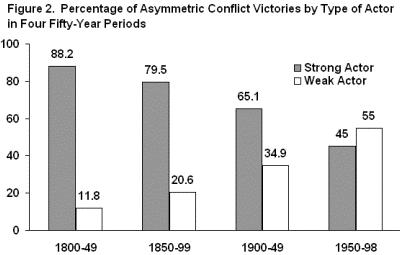
Arreguín-Toft, Ivan, "How the Weak Win Wars: A Theory of Asymmetric Conlict," International Security, vol. 26, no. 1, Summer 2001, pp. 93–128, Figure 2: Percentage of Asymmetric Conflict Victories by Type of Actor in Four Fifty-Year Periods

Given these two trends, the deck was stacked against the U.S., even with the greatest effort, but since it was undertaken by the Solomon Grundy administration (Wikipedia | Sean Baby) we never stood a chance. They know how to smash and that’s about it.

Neither of these two observations are new: both trends were generally known at the time of the invasion of Iraq — Ms. Walter’s book is from 2002 and Mr. Arreguín-Toft’s article is from 2001 and neither were breaking new ground. Five year on, it is now completely apparent outside of administration propagandists that the key strategic judgment with respect to Iraq was not how many soldiers in the initial invasion, or how many in the subsequent occupation, or whether to intervene in the looting, or to disband the Iraqi army, or seasoned experts versus right-wing sycophants to staff the CPA, or any of the many, many other mistakes, but whether to go into Iraq or not in the first place. Barring sufficient historical awareness here, at least the administration should have known and acted like the odds were not in favor of success. Instead we got the fast-talker’s sales pitch.

And as the Dolchstoßlegende crowd now attempts to rewrite the history of the Iraq debacle a la the Vietnam War version thereof, it should be born in mind that that war was part and parcel of these trends.

A Revival of the Southern Strategy?

I’m going to venture a prediction. And it’s a pretty easy prediction to make in that it’s based on an unlikely hypothetical and if things branch as I suspect, I’ll never be taken to account for my prediction.

There’s been a lot of twittering on the left about the persistent racism of the Republican party and of the Southern strategy. Rick Perlstein is writing a book about it (tentatively titles Nixonland), Paul Krugman’s column last week was on it (“Politics in Black and White,” The New York Times, 24 September 2007) and the Daily Show really took candidates to task for it last night.

Every time someone goes off on this tangent, I get a little uncomfortable in that it seems like a tired liberal saw that is well into diminishing returns. Surely today’s Republican party has retired all but the last few holdouts and dead-enders. But then it is good to look back at the ol’ red and blue map of election returns by county — the urban archipelagos map — and recall just how rural, white-flight ex-urban and Southern the Republican party remains. And even the younger generation and sophisticates aren’t all that sophisticated. I have a strongly Republican-identified friend who, however much liberals may grate on her, cannot bring herself to make any Republican friends because she finds them such a despicable lot. And I should add that she is a person with a considerable threshold for creepy.

Anyway, my prediction is this: that however latent, in remission, or coded the current Republican racist streak or Southern strategy may be, if Barack Obama gets the Democratic nomination, it is going to come galloping back with a vengeance.

It won’t come out all at once. The racism isn’t knee-jerk. But as the campaign wears on and the truly dire condition in which George W. Bush and Karl Rove have left the Republican party becomes apparent to the Republican nominee, the donor base, the 527s and the pundits, I expect a paroxysm of pseudo- and overt racism to pour forth. The Republican candidate will realize that the American public has soured on whatever affirmative message the Republican party has on offer and that the only way to win is to scare the pants off votes over hypothetical nominee Barack Obama. At that point the campaign will go totally negative — or at least its various minions, toadies and proxies will — the candidate must remain pristine from partisanship. I fully anticipate all those dark murmurs that were heard a while back — that Barack Obama’s middle name is Hussein, that he was educated in a madrassa, that he is a angry black man (could anything be further from the truth?), that he has a chip on his shoulder against white people — to come slithering back out from the dark corners or the mind of red America.

Moral Hazard and Optimization

Lawrence Summers has an editorial in yesterday’s Financial Times arguing against excess concern with moral hazard (“Beware the Moral Hazard Fundamentalists,” 24 September 2007, p. 11). It is a well deserved and long overdue point. Whenever an economic crisis looms, the usual suspects trot out all the laissez faire tut-tuting. It was probably a day or two after the major news stories about the most recent central bank interventions that The Wall Street Journal editorial page started in with the boiler plate about how a few routine government interventions today spelled cataclysm of serfdom down the road. Mr. Summers’s editorial or others like it should be kept at the ready at more responsible economic editorial boards around the country.

I’m going to refrain from reposting Mr. Summers’s analysis because it is long, but it is worth reading at the link. It is worth noting that Mr. Summers doesn’t split hairs about the significance of his argument though.

Moral hazard fundamentalists misunderstand the insurance analogy, fail to recognise the special features of public actions to maintain confidence in the financial sector and conflate what are in fact quite different policy issues. As a consequence, their proposed policies, if followed, would reduce the efficiency of the financial sector in normal times, exacerbate financial crises and increase economic instability.

Mr. Summers’s three points of contention all argue that moral hazard, as its soothsayers characterize it, does not in fact obtain. I’m not an economist, but I’m going to go further and suggest that even if it did, under sufficiently dire circumstances, we still shouldn’t concern ourselves too much with it.

The economy isn’t a system that admits a state of perfect tune, but instead of optimization. Many factors trade off and the object is a state of affairs where maximum benefit is derived from a given factor without the deleterious effects of said factor overwhelming the positive. The Philips curve or patent protection are good examples, but others abound. It’s part of the power of economic-like thinking. And the economy is dynamic: the advantageousness or deleteriousness of a certain ratio of factors may change with time, or in relation to a third factor. For instance, central banks may have an easier time controlling inflation and may be able to do so at lower rates of interest when governments balance their budgets.

Given a dynamic balance of harms and advantages, moral hazard is a factor like any other. Moral hazard trades off with other objectives. Like the present, the most common example that people point to where it trades off is with capitol liquidity. Mr. Summers compiles a good list of examples of so objected government programs to preserve liquidity.

Moral hazard is indeed something to be minimized when times are good, it’s affordable, and its harms relatively troubling compared to the mix of harms on the horizon. But it is a goal to be relaxed when its attainment becomes extremely costly in the face of our other goals.

Think of it like this. Not spilling hot coffee in out lap is one of our objectives and under most circumstances it’s a pretty affordable one. On the go, you may have to drink from one of those sippy-cups and lean into a swig as an extra precaution, but still pretty easy. When suddenly an oncoming car swerves mid-coffee-sip into your lane, the equation shifts and the time, attention and dexterity to maneuver the coffee cup into your car’s dashboard cup holder becomes unaffordable. In order to achieve some of your other goals, you may forgo the no-hot-coffee-in-lap objective and just drop the damn cup to get the second hand on the steering wheel in a timely fashion.

When faced with a potential economic crisis, a little moral hazard may be an acceptable sacrifice. So long as the government preserves an element of roulette and just deserts in who survives and who perishes in a crisis and cultivates a reputation of preferred laissez faire — or at least an adequate amount of uncertainty about where and when it will intervene — then economic actors will remain sufficiently terrified about the future as to plan accordingly.

Syria Gets the Osirak Treatment?

Also in nuclear news, despite some pretty severe smack-downs from some prominent names in the arms control community, Glenn Kessler and the Washington Post are apparently sticking by their story that Israel bombed a Syrian nuclear installation on 6 September 2007 (“Israel, U.S. Shared Data On Suspected Nuclear Site,” 21 September 2007, p. A1).

Joseph Cirincione, coauthor of the widely consulted reference, Deadly Arsenals: Nuclear, Biological and Chemical Threats, calls this story “nonsense” (“North Korea-Syria Nuclear Ties: Déjà Vu All Over Again?,” Foreign Policy, Passport, 14 September 2007) and Jeffrey Lewis of Arms Control Wonk goes so far as to call it “bullshit” (“Did Israel Strike a Syrian Nuclear Facility?, 16 September 2007). Mr. Cirincione writes and Mr. Lewis excerpts approvingly:

The Washington Post story should have been headlined “White House Officials Try to Push North Korea-Syria Connection.” This is a political story, not a threat story. The mainstream media seems to have learned nothing from the run-up to war in Iraq. It is a sad commentary on how selective leaks from administration officials who have repeatedly misled the press are still treated as if they were absolute truth. Once again, this appears to be the work of a small group of officials leaking cherry-picked, unvetted “intelligence” to key reporters in order to promote a preexisting political agenda.

This is definitely the administration that has cried wolf too many times, but the Washington Post article seems pretty heavily sourced. And I don’t believe that Syria is an Israeli bombing range where the IDF just flies out for practice missions. If they went in, they must have had some pretty serious concerns. I’m going to need a lot more than unnamed Bush officials and bluster before passing judgment on this story.

Pink Slips All Around — Banishment for Maureen Dowd

So it’s great that The New York Times Select wall has come down. I always told myself that if The New York Times went subscription, I would subscribe. It’s too important to do without. But instead of making such a cut-and-dry situation, they only made part of their content subscription, so I didn’t know what to do. I wanted to read Paul Krugman, but I could buy the paper off the stand for $2.00 per week, or $8.00 per month — $1.00 more than the Select subscription rate. The extra $1.00 was totally worth it to not be exposed to the rest of The New York Times’s lackluster editorial page. As much as I wanted the ease of access to Paul Krugman, I just couldn’t bring myself to pay for the rest of those dismal nobodies.

How is it that “the paper of record” ended up with such a weak stable? If I were in charge, I would keep Krugman, Brooks and Friedman and dump the rest in favor of a real feisty debate — not the thin gruel they are currently serving up. That would leave six slots to fill. I would pick maybe two real devotees each, right and left and two people rightish and leftish, but unorthodox and hard to pin down. The amazing thing is that such a bunch of mediocrits have the megaphone of The New York Times editorial page when so many amazing talents are backbenched at lesser read magazines like The Progressive, The American Conservative et cetera. Time for some promotions.

On the right I’d get someone smart — not a hack — who can occasionally refrain from reworking party talking points. Say Max Boot or David Frum. For the two on the left I would definitely go with Barbara Ehrenreich. She filled in for Thomas Friedman for a few weeks once and it was great and she would help to make up for the shameful lack of women on the page. Then maybe someone like Rick Pearlstein, Thomas Frank or Jonathan Chait. For the hard to pin down I would go with someone like Andrew Sullivan, Christopher Hitchens, Michael Lind or Virginia Postrel.

Check that, I’d fire Thomas Friedman too and replace him with someone similar, but less Howdy Doody. Maybe Fareed Zakaria if he could be lured away from his already pretty sweet post at Newsweek or Andrew Bacevich — he could double as the hard to pin down as well.

More important than anything else is that is that Maureen Dowd be forced back behind some — any — kind of wall. She’s like a Ritalin sedated cross between Bertie Wooster’s aunt Dahlia and Carrie Bradshaw. Does the left really need its own Peggy Noonan? And yet has anyone ever done so much damage to the left, irregardless of which way she turns her poison pen? Her petty rages against the left are the purest breed of the once established, insurmountable standard narratives that capture media coverage and yet her juvenile sprite-bitch screeds against the right are frame-ready examples of the right-wing character of the left. And I swear, no one is working so relentlessly to undermine the feminist cause as Dowd with her preening, prissy socialite stylings. When I read her column I need to remind myself that she is a freak and that women are in fact capable of serious thought. Do you know that she actually won a Pulitzer? What can that possibly mean?

I see that her current column is already the most e-mailed article on the site. She could be ignored as a writer more suited to Entertainment Tonight were this not the ase twice a week. It’s enough to make me think that Ann Coulter is on to something with her descriptions of peevish, smug, small-minded Upper West Siders.

Transformation of Media

Dan Savage strikes a forward-looking tone in discussing some organizational changes at The Stranger (“The More Things Change,” SLOG, 19 September 2007):

You’re reading this online, so you’re probably aware that The Stranger isn’t just a newspaper anymore: In addition to our weekly print edition, we’ve got blogs, podcasts, video, tons of expanded web content, and the occasional amateur porn contest. In order to manage the growth of our editorial content — in order to keep putting out Seattle’s only newspaper while at the same time running the best alt-weekly website in the country — we’ve had to change our editorial department’s structure.

Media is changing, as inevitably it will under the pressure of technology. One can be matter-of-fact about it, or try to get out ahead of it and shape the coming new world or one can endure the slow extinction of a species whose ecological niche is dwindling. “The Stranger isn’t just a newspaper anymore.” What a breath of fresh air. And this from a man who just two years ago wrote as a guest blogger (“Who Am I? Why Am I Here?, Daily Dish, 8 August 2005),

“Savage Love” readers have been asking me to start a blog of my own for, oh, six or seven years now and I’ve resisted. I’m a Luddite, I confess, one of the ways in which my deeply conservative soul expresses itself. It was only a few years ago that I started accepting email at “Savage Love” …

This reminds me that Matthew Yglesias had a subdued blog-triumphalism mini-kick back in July-August that unlike most blog-triumphalism was really pretty interesting.

Now With Charts,” The Atlantic.com, 24 July 2007

This is a reminder, I think, of why we should look forward to the day when the op-ed column is a dead format and everyone just blogs. Brooks’ original column would, obviously, have been better if it — like Nyhan’s reply — had come with links to data and charts. What’s more, it’d be good if we could expect Brooks to reply to the sort of criticisms he’s getting from Nyhan, Dean Baker, and others. Maybe he has something fascinating to say on his own behalf. But the way the columnizing world works, there’s almost no chance he’ll address his next column to trying to rebut the critics of this one. But a back-and-forth debate on this subject with links and charts and data would be much more interesting than what we’re going to get instead where liberals decide Brooks is a liar and Brooks remains convinced that liberals are crazy.

Better Get a New Job,” The Atlantic.com, 19 August 2007

As Kevin Drum says there was no crowding out here where what Marty Lederman or Duncan Black or Andrew or I were doing somehow made it more difficult for newspapers to do investigative reporting. If anything, the reverse is true. The widespread availability of a vast sea of armchair analysis and commentary on the internet will, over time, force large, professionalized news organizations to focus on their core, hard-to-duplicate competencies — and spend less time on the sort of fact-averse punditry Skube’s doing right here.

It was easier to see the harrumphing of the recording industry as what it was: the slothful groan of the vested interest in the face of a new upstart. There was too much crass money lying around for us to not see through all their protestations about art. Journalists and writers have a more subtly wrought tale to spin.

I particularly like Mr. Yglesias’s second point. The bloggosphere and the mainstream media are like countries in the economist’s parable of comparative advantage. And like the citizenry of those countries, bloggers and journalists can’t help but see the shifts and specialization from which the advantage arises as anything but threatening. “They took our jobs.”

It’s worth noting that in the theory of comparative advantage both countries benefit from specialization even when one country is superior at all activities in question. Perhaps it won’t matter so much that bloggers are just a bunch of guys in their pajamas and that politicians have learned how to game the press.

September 11th

In the days after 11 September 2001, as the disbelief and shock began to subside in favor of a sense of what had happened and what came next, CNN uncovered an old documentary, Building the World Trade Center, made by the New York Port Authority and aired it’s entire twenty minutes. I was lucky to catch it and it has since become a favorite piece of film for me. The first ten minutes of the video are an interesting, if stylistically dated, discussion of some of the features of the site and novel construction techniques and design features employed in the building. What makes me return to the film again and again is that at about time 10:05 — on the factual tidbit that after the foundational structures were in place construction proceeded according to a formula at the rate of about three floors every ten days — the film switches from informative documentary to whimsical art film. Set to Johann Strauss, Jr.’s Vianna Blood is an uninterrupted five minute dance of building rising. Watch a crane operator rotate a huge section of sheet metal at 12:25-12:36, the pan around the partly completed towers at 13:44-14:00 or the documentary makers themselves at 14:20-14:25 — it could be Stanly Kubrick. It’s a wonderful little paean to labor and ingenuity and capitalism.

The Disconnect

Paul Krugman makes a seemingly notable observation about the recent economic expansion (“Where’s My Trickle?,” [$ | free], The New York Times, 10 September 2007):

As far as I can tell, America has never before experienced a disconnect between overall economic performance and the fortunes of workers as complete as that of the last four years.

It is a strange fact that throughout the Twentieth Century the benefits of industrialization, productivity gain and comparative advantage have been so well spread among workers. It is also a strange fact that over perhaps the last thirty years this has so progressively ceased to be the case. One might think that some serious analytic attention could be brought to bear on this transformation, but instead it seems that more tightly squeezed shut eyes and more urgent repetition of past dogma has been the response.

Oddly enough it is the center that is most in denial here. On the far left there is Robert Brenner and others around the New Left Review and the world-systems people like Immanuel Wallerstein and on the far right (the paleoconservatives) it seems like Patrick Buchanan and the people around The American Conservative are genuinely concerned about theses issues as well. Where are the neoliberals who will squarely face the problem and propose neoliberal remedies?

And in his usual fashion, Mr. Krugman doesn’t shy from a boldly leftist position, at least of a sort:

Guaranteed health insurance, which all of the leading Democratic contenders (but none of the Republicans) are promising, would eliminate one of the reasons for this disconnect. But it should be only the start of a broader range of policies — a new New Deal — designed to turn economic growth into something more than a spectator sport.

That’s all fine and good but I hope that Mr. Krugman will devote a future column to an outline sketch of what such a policy would look like, because short of direct redistribution — with all the problems that entails — I really don’t know. But Mr. Krugman is an economist and remains at least half-beholden to the idea of economic efficiency. Perhaps some Robert Reich-like scheme of investment in labor plus grand bargain between trade liberalization and labor entailing significant deals of the same, not the pathetic job retraining micro-initiative included as a part of the NAFTA legislation. But what programs, specifically? There’s only so much job retraining the government can do.

Hard-Line in a Smart Way?

In case you were in need of some sort of a litmus test on Thomas Barnett, here is what he says in response to Michael Ledeen’s new book on Iran (“An Interesting Book on Iran,” 8 September 2007):

Ledeen’s a hard-liner on Iran but in a smart way.

Yeah, kinda like Austria-Hungary was hard-line on Serbian separatists, but in a smart way.

And while we’re at it, hey, “some self-confidence, America, please!” I’m going to vote for less self-confidence and more circumspection.