Jacksonians and the Comprehensive Nuclear Test Ban Treaty

Yesterday I argued that ideological factors took precedent over more pragmatic considerations of national security in the right-wing fervor for deployment of an ABM system. Another example of this phenomena would be the proposed new generation of small-yield “bunker buster” nuclear weapon and the reliable replacement nuclear warhead. A significant debate revolves around whether the United States would have to resume nuclear testing to certify these weapons, or whether simulation and component-level testing would be sufficient. And why not? If simulation and component-level testing are good enough for ABM aren’t they good enough for a new nuclear weapon? But for proponents of these weapons, resumption of testing is not a means to an end product, but is rather the whole point.

In the Nuclear Non-Proliferation Treaty of 1970 the United States and other declared nuclear powers committed themselves to complete nuclear disarmament. But this commitment wasn’t entirely sincere. For supporters of the NNPT on the left it was sincere, but for supporters on the right, it was a throwaway provision. And they weren’t out of their minds for thinking so: a fair amount of language in treaties is nonoperative, there to paper over disagreements. Supporter on the right in favor of a creating a double standard figured that Article VI obligations on declared nuclear powers could be perpetually kicked down the road.

But the United States began to covertly disarm. The Partial Test Ban Treaty of 1963, the unilateral test moratorium announced by George Bush, Sr. in 1992 and the Comprehensive Nuclear Test Ban Treaty were disarmament through the back door: with a bar against testing having cut off the path to new nuclear weapons, all that was required for disarmament to obtain was to wait for the last weapon in the existing stockpile to be decertified. But the right caught on to this scheme and the Senate rejection of the CNTBT in 1999 called it to a halt.

But it isn’t enough to stop the left from imposing a test ban. A new generation of weapons and new testing are required to depose the regime of piecemeal nuclear disarmament. Ginning up some new nuclear weapons systems was intended to begin the process of rolling back this development. The RRW was a particularly brilliant maneuver in that one could pick off a number of people who in defense of the de facto non-testing regime might otherwise have opposed a new generation weapon by arguing that the purpose of the new weapon was to preserve the commitment to no nuclear testing. But no one should miss the fact that there is not an across the board disavowal of the need to test these new weapons, but instead a debate about whether they will have to be tested. There should be little surprise that should the Jacksonians find themselves in power again, they will determine that in fact they do need to be tested. The motive is not the simple certification of a weapons system — again, witness ABM: noncertification is acceptable when it serves the ideological objective — but wrecking fundamental damage to one international system, that it might be replaced with another more to their ideological liking.

ABM

In the wake of the U.S.-Russia dustup over placement of an ABM interceptor site there has been a raft of articles on the U.S. missile shield. The October 2007 issue of Arms Control Today devotes the cover and six articles to it. Matthew Yglesias (“Preemption, 12 October 2007) calls his readers’ attention to a long story in Rolling Stone on the subject (Hitt, Jack, “The Shield,” Issue 1036, 4 October 2007).

I think that Mr. Yglesias is correct to say that the real purpose of ABM is “to facilitate American first strikes.” That the U.S. seeks such a capacity is the conclusion of a RAND report (Buchan, Glen C., et. al., Future Roles of U.S. Nuclear Forces: Implications for U.S. Strategy, Santa Monica, California: RAND, 2003, see p. 61) and Keir Lieber and Daryl Press suggest (“The End of MAD: The Nuclear Dimension of U.S. Primacy,” International Security, vol. 30, No. 4, Spring 2006, pp. 7-44, see p. 28) that in such a scheme, mop-up of a small number of surviving missiles launched after a disarming counterforce strike might be a job for which an ABM system of limited capability might be adequately suited.

But this isn’t the whole of the story: there are three reasons that the right has in the past and continues today to be so in favor of an anti-ballistic missile system.

  1. More fundamental than anything else is the American cultural reason for the fervor for ABM on the right. The culturally Scotch-Irish descended, Jacksonian segment of the United States subscribes to a very specific notion of warfare and the law of nations. War is to be fought all out with no restraint. Victory resulting in complete submission of the opponent is the objective. It is retributive in its notion of justice and particularistic rather than universalizing and legalistic in its reasoning. It is a mentality that never made the leap to the counterintuitive reasoning of the nuclear age. Its members have never understood limited war or restraint in warfare. Hence the angst over Vietnam, the use of torture in Iraq and opposition to all forms of arms control.

    The basis of arms control in the 60s and 70s was the gradual acceptance by nuclear strategists of MAD and its institutionalization in the Anti-Ballistic Missile Treaty of 1972. That nuclear powers would intentionally remain vulnerable to attack was the linchpin in stabilizing the nuclear arms race, but this flew in the face of the Jacksonian notion of war. Conspiring with one’s enemies to limit one’s capabilities and limit the uncontainable violence of war didn’t fit their paradigm and ever since they have been raging to tear down the entire structure. The intense interest in deploying an anti-ballistic missile system has had less to do with pragmatic considerations of national security than with the ideological struggle between two strategic paradigms. No policy debate would be so intense and fought out over generations of strategists and politicians were it just a weapons system at stake. The aim of moving to deploy an ABM system so urgently — even before it has been adequately demonstrated to work — is specifically to destroy the existing arms control regime and international system more generally in favor of one more in line with Jacksonian notions.

    This is why opponents of ABM have done so much to pillor Ronald Reagan, the id of 1970s and 80s America, and why the label “star wars,” with its invocation of psycho-cultural tropes, was so effective. The whole debate about ABM has taken place where strategic reasoning leaves off and social-psychology picks up.

  2. Hedging one’s opposition to ABM on technical infeasibility is probably a bad option. First, Americans, with their infinite faith in technology and can-do attitude won’t buy it. Second, at some point a system of at least some rudimentary capability will probably be up and running. A review of the history of nearly every weapon today touted as a miracle system shows that at some point in its development it was widely considered a boondoggle that would never work.

    The Patriot Missile is a good example here. During development in the late 1970s there was endless harping that the technical hurdles were insurmountable and that it would never work. The first battery was deployed in 1984 as an anti-aircraft weapon, but it was designed to be a modular system and underwent a number of major and minor upgrades, including the 1988 upgrade that gave it the anti-ballistic missile capability for which it is so well known today. In the 1991 Gulf War CNN footage of Patriot missiles rising to destroy incoming Scuds over Israel and Saudi Arabia are some of the most memorable images of the war. Subsequent studies have indicated that the success rate of the Patriot was significantly lower than initially reported, but additional upgrades throughout the 1990s have further refined the performance of the weapon. In the invasion of Iraq the weapon misidentified and shot down two allied aircraft, but it is hardly the only system to have malfunctioned resulting in friendly-fire deaths. It is presently undergoing an upgrade that is nearly a complete system redesign and will significantly enhance performance in nearly every aspect. The important point is that it managed to overcome its technical hurdles, with significant progress being made post-deployment and has undergone a number of modifications that have pushed a thirty year old system well beyond its initial specifications. A similar story could be told for the Tomahawk cruise missile or the B-2 stealth bomber.

  3. As Senator Lyndon Johnson argued to liberal skeptics who thought the 1957 civil rights bill didn’t go far enough, it was more important that a bill get passed than any particular content of the bill. Or as Senator Johnson put it, “Once you break the virginity, it’ll be easier next time.” Senator Edward Kennedy has offered a similar defense of his votes for micro-initiative healthcare programs or No Child Left Behind. If a comprehensive universal healthcare bill is unpassable, than pass it in a million little pieces. Or, it is more important to get Congress to agree in principle on federal education spending. The program can later be reengineered with amendments.

    One of the notable features of the post Newt Gingrich / George W. Bush right is the degree to which they have learned to use the very things they most hate about government to their advantage. One is that a budget line-item never dies. All that was necessary was to fund ABM once, then there would be interest groups, a bureaucracy, a scientific community, a lobby and the fundamental human laziness of just carrying a line-item forward. The program would then live in perpetuity.

    Combine this with number two, that the technological problems can be ironed out in the field with enough money, and the important point is to get systems in place. The pressures of real-world operability plus the bureaucratic juggernaut will force a system into existence. The arguments that Mr. Hitt in the Rolling Stone piece thinks his strongest are, at this high-level, no argument at all. You really have to dig down into the nitty-gritty — which he does not do — before such arguments start to have any impact. In this scenario, a few negative GAO reports are no threat. In fact, they could shame politicians to throw good money after bad, lest failure show their previous votes in a new light. In fact, I’ll wager that if the Democrats capture Congress and the White House in 2008, the ABM juggernaut just keeps rolling on unabated.

The real problem with an anti-ballistic missile system is that it is a Maginot Line. This is the case for three reasons.

  1. ICBM counter-measures and ABM system requirements don’t scale at the same rate so would-be attackers can defeat ABM — or at least confound it to the point where a defender could not factor it into their strategic considerations with any reliability — much more easily and affordably than defenders can adapt. And being on the right side of a scalability calculation is how one wins a strategic competition.

    If the technical countermeasures aren’t enough, it’s worth noting that the calculation of an ABM system is that its OODA loop is inside that of an ICMB flight time. As terrifyingly short as ICBM flight times are, they are long enough compared to modern C3I. To defeat ABM, all one has to do is compress ballistic missile flight time to less than the OODA of ABM. The 25 minutes from Asia to the U.S. is a relatively long time, but park a missile submarine loaded with intermediate-range ballistic missiles (IRBMs) a few hundred miles off the coast and now you are talking about flight times of more like five minutes. Many IRBMs are suborbital so even if detected and reacted to, there just might not be enough air under a warhead for a ground-based interceptor to work its magic.

    Reaction time of ABM could be shortened too, with the first C of C3I — Command — being the lowest hanging fruit. But automate the decision-making component and SkyNet goes live.

    All of these calculations explain why the Chinese are spending so heavily on SSBNs (Lewis, Jeffrey, “Two More Chinese Boomers?,” Arms Control Wonk, 4 October 2007) as well as why the United States continues to turn out attack submarines ($2.7 billion for one Virginia class submarine in the FY 2008 budget) nearly 20 years after the end of the Cold War and without a single navy peer competitor prowing the seas.

  2. Once it becomes clear that ballistic missiles are under threat, states will quickly realize that the future is in cruise missiles.

    Having watched a number of U.S. air power attacks on CNN, Americans think that cruise missiles are an exclusive U.S. technology. While, say, the U.S. Tomahawk cruise missile is an extremely sophisticated weapon, cruise missiles are not beyond the reach of less capable powers. The German V-1 “flying bomb”, first flown in 1944, was essentially a cruise missile. The United States deployed its first cruise missile, the problem-prone Snark, in 1961 and initially development of the cruise missile was considerably ahead of that of the ICBM. The Europeans have the Storm Shadow. During the invasion of Iraq, Saddam Hussein attacked Kuwait with a Chinese-made Silkworm cruise missile, first deployed in the early 1980s. Proliferation of cruise missiles is proceeding apace and the technology is not so sophisticated as to be intercepted by export control regimes. Hell, the flight control system of a Tomahawk runs on an 8086 processor. And it’s not even manufactured by Intel anymore. The design has been licensed to a bunch of low-end Asian chip fabricators.

    Cruise missiles fly low and under radar detection systems, are capable of maneuver and because they don’t follow set, easily calculable trajectories like ICBMs, are not subject to easy intercept. Cruise missiles usually have shorter ranges, so we are potentially back talking about anti-submarine warfare again.

  3. Then, of course, there is the most radical delivery system. If I were a terrorist or rogue state plotting to get a weapon of mass destruction to a U.S. city, I would just FedEx it.

    As has been fairly well observed, modern terrorism and to an increasing extent, modern war in general, is parasitic on the very highways and byways of globalization. There is no killer app here that can solve the problem. This is more labor-intensive problem demanding a myriad of heterogeneous and creative operations.

It would seem to me that given the scalability issue covered in number one, ABM is a grand-strategic looser. Much more security per dollar could be had through the tried and true means of anti-proliferation, traditional deterrence, counterforce, anti-submarine warfare and the newer, but relatively affordable area of homeland security.

The Stable North of Iraq

Things may be a disaster between the Shi’ia and the Sunnis in the south of Iraq, but at least the Kurdish north is stabilized. Think again (Traynor, Ian, “Upsurge in Kurdish Attacks Raises Pressure on Turkish Prime Minister to Order Iraq Invasion,” The Guardian, 9 October 2007):

Turkey’s prime minister, Recep Tayyip Erdogan, came under intense pressure last night to order an invasion of northern Iraq following the deadliest attacks for over a decade on the Turkish military and civilians by separatist Kurdish guerrillas. Mr Erdogan, who has resisted demands from the Turkish armed forces for the past six months for a green light to cross the border.

Mr Erdogan, who has resisted demands from the Turkish armed forces for the past six months for a green light to cross the border into Iraqi Kurdistan, where the guerrillas are based, called an emergency meeting of national security chiefs to ponder their options in the crisis, a session that some said was tantamount to a war council.

A Turkish incursion is fiercely opposed by Washington since it would immensely complicate the US campaign in Iraq and destabilise the only part of Iraq that functions, the Kurdish-controlled north.

And Turkey isn’t the only country with a Kurdish problem. Iran has a Sunni Kurdish population in its northwestern region with which it has engaged in numerous clashes. Iran is already operating in Iraq in support of the Shi’ia and both Iran and Turkey have conducted simultaneous attacks on Kurdish rebels and a few cross-border artillery attacks.

I would say that the notion advocated by Democrats of drawing down U.S. forces in Iraq to maybe 50,000 massed primarily in the Kurdish north is no solution.

Iraq and Vietnam; Civil Wars and Asymmetric Conflict

Someone at some point should drive home to the right that Iraq and Vietnam are not some apparition or anomaly requiring exceptional explanation — namely the Dolchstoßlegende — but in fact the historical trend.

Our historical-materialist problems in Iraq are multifaceted. Iraq is a combination of two pernicious trends: one relating to civil wars and one relating to asymmetric conflict.

First, on the issue of civil wars, they are by nature long, intractable and fought to the bitter, bloody end. The Los Angeles Times had the good sense to have Barbara F. Walter, author of the study, Committing to Peace: The Successful Settlement of Civil Wars (2002), write a brief summary of her survey of civil wars and the likely meaning for Iraq (Walter, Barbara F., “You Can’t Win With Civil Wars,” Los Angeles Times, 2 October 2007):

The approximately 125 civil wars — conflicts involving a government and rebels that produce at least 1,000 battle deaths — since 1945 tell us several things: The civil war in Iraq will drag on for many more years; it will end in a decisive victory for either the Shiites or the Sunnis, not in a compromise settlement; and the weaker side will never sign a settlement or lay down its arms because it has no way to enforce the terms.

Civil wars don’t end quickly. The average length of all civil wars since 1945 is 10 years. Conflicts in Burma, Angola, India, the Philippines, Chad and Colombia have lasted more than 30 years. Wars in Afghanistan, Cambodia, Lebanon, Sudan and Peru have lasted more than 15 years. Even Iraq’s previous civil war, fought against the Kurds, lasted 14 years.

This suggests that, historically speaking, Iraq’s current civil war could be in its early stages, with nothing to suggest that it will be a short, easy war.

Another lesson from history is that the greater the number of factions involved in a civil war, the longer it is likely to persist. Iraq simply has too many factions, with too much outside support, to come to a compromise settlement now. Not only is there no Shiite or Sunni who can speak for all of his side’s factions, but the parliament seems incapable of stopping the violence between these groups.

Civil wars rarely end in negotiated settlements. In research for a book on the topic, I found that 76% of civil wars between 1945 and 2005 ended only after one side had defeated all others. Only 24% ended in some form of negotiated solution. This suggests that the war in Iraq will not end at the bargaining table but on the battlefield.

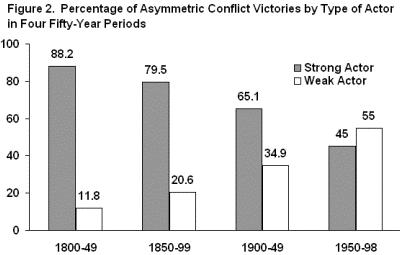
Second, on the issue of asymmetric conflict, the trend over the last two centuries is toward small powers defeating larger ones, to the point where in the latter half of the Twentieth Century, small powers actually defeat large powers more often than not. Below is figure 2 from Ivan Arreguín-Toft, “How the Weak Win Wars: A Theory of Asymmetric Conlict,” (International Security, vol. 26, no. 1, Summer 2001, pp. 93–128).

Arreguín-Toft, Ivan, "How the Weak Win Wars: A Theory of Asymmetric Conlict," International Security, vol. 26, no. 1, Summer 2001, pp. 93–128, Figure 2: Percentage of Asymmetric Conflict Victories by Type of Actor in Four Fifty-Year Periods

Given these two trends, the deck was stacked against the U.S., even with the greatest effort, but since it was undertaken by the Solomon Grundy administration (Wikipedia | Sean Baby) we never stood a chance. They know how to smash and that’s about it.

Neither of these two observations are new: both trends were generally known at the time of the invasion of Iraq — Ms. Walter’s book is from 2002 and Mr. Arreguín-Toft’s article is from 2001 and neither were breaking new ground. Five year on, it is now completely apparent outside of administration propagandists that the key strategic judgment with respect to Iraq was not how many soldiers in the initial invasion, or how many in the subsequent occupation, or whether to intervene in the looting, or to disband the Iraqi army, or seasoned experts versus right-wing sycophants to staff the CPA, or any of the many, many other mistakes, but whether to go into Iraq or not in the first place. Barring sufficient historical awareness here, at least the administration should have known and acted like the odds were not in favor of success. Instead we got the fast-talker’s sales pitch.

And as the Dolchstoßlegende crowd now attempts to rewrite the history of the Iraq debacle a la the Vietnam War version thereof, it should be born in mind that that war was part and parcel of these trends.

Syria Gets the Osirak Treatment?

Also in nuclear news, despite some pretty severe smack-downs from some prominent names in the arms control community, Glenn Kessler and the Washington Post are apparently sticking by their story that Israel bombed a Syrian nuclear installation on 6 September 2007 (“Israel, U.S. Shared Data On Suspected Nuclear Site,” 21 September 2007, p. A1).

Joseph Cirincione, coauthor of the widely consulted reference, Deadly Arsenals: Nuclear, Biological and Chemical Threats, calls this story “nonsense” (“North Korea-Syria Nuclear Ties: Déjà Vu All Over Again?,” Foreign Policy, Passport, 14 September 2007) and Jeffrey Lewis of Arms Control Wonk goes so far as to call it “bullshit” (“Did Israel Strike a Syrian Nuclear Facility?, 16 September 2007). Mr. Cirincione writes and Mr. Lewis excerpts approvingly:

The Washington Post story should have been headlined “White House Officials Try to Push North Korea-Syria Connection.” This is a political story, not a threat story. The mainstream media seems to have learned nothing from the run-up to war in Iraq. It is a sad commentary on how selective leaks from administration officials who have repeatedly misled the press are still treated as if they were absolute truth. Once again, this appears to be the work of a small group of officials leaking cherry-picked, unvetted “intelligence” to key reporters in order to promote a preexisting political agenda.

This is definitely the administration that has cried wolf too many times, but the Washington Post article seems pretty heavily sourced. And I don’t believe that Syria is an Israeli bombing range where the IDF just flies out for practice missions. If they went in, they must have had some pretty serious concerns. I’m going to need a lot more than unnamed Bush officials and bluster before passing judgment on this story.

Ten More Years in Iraq

As the September date for the report on the effects of the surge in Iraq approaches, the right has been ginning up the rhetoric over what happens if the United States withdraws from the country. But almost no symmetrical consideration is given to the scenario of what happens if the United States stays. “The surge is working; we need to give it more time,” or “The United States is making progress in Iraq; our soldiers need to be given the opportunity to finish their mission there,” or some such thing is what one hears. But that’s more or less the extent of the scenario for staying. So we stay. But what then? The way the dialog around the issue is happening it’s as if deciding to continue in Iraq means the surge will get another four or five months and then … and then … and then thoughts trail off.

But war opponents should point out that the calculation isn’t withdraw, genocidal civil war ensues versus stay, no further conclusion. Some people are thinking about what staying in Iraq means and it’s not what anyone signed up for back in 2003.

For instance, the Washington Post reports on the findings that Representative Jan Schakowsky (Democrat-Illinois) brought back from her recent visit to Iraq (“ After Iraq Trip, Unshaken Resolve,” The Washington Post, 26 August 2007):

Rep. Jan Schakowsky made her first trip to Iraq this month, the outspoken antiwar liberal resolved to keep her opinions to herself. “I would listen and learn,” she decided.

At times that proved a challenge, as when Deputy Prime Minister Barham Salih told her congressional delegation, “There’s not going to be political reconciliation by this September; there’s not going to be political reconciliation by next September.” Schakowsky gulped — wasn’t that the whole idea of President Bush’s troop increase, to buy time for that political progress?

But the military presentations left her stunned. Schakowsky said she jotted down Petraeus’s words in a small white notebook she had brought along to record her impressions. Her neat, looping handwriting filled page after page, and she flipped through to find the Petraeus section. “‘We will be in Iraq in some way for nine to 10 years,’ ” Schakowsky read carefully. She had added her own translation: “Keep the train running for a few months, and then stretch it out. Just enough progress to justify more time.”

“I felt that was a stretch and really part of a PR strategy — just like the PR strategy that initially led up to the war in the first place,” Schakowsky said. Petraeus, she said, “acknowledged that if the policymakers decide that we need to withdraw, that, you know, that’s what he would have to do. But he felt that in order to win, we’d have to be there nine or 10 years.”

And Ted Koppel relates a private conversation in which Senator Clinton relates some of her thoughts about staying on in Iraq (“A Duty to Mislead: Politics and the Iraq War,” National Public Radio, 11 June 2007):

I ran into an old source the other day who held a senior position at the Pentagon until his retirement. He occasionally briefs Senator Clinton on the situation in the Gulf. She told him that if she were elected president and then re-elected four years later she would still expect U.S. troops to be in Iraq at the end of her second term.

Ten years. Is anyone prepared for another ten years in Iraq?

If the United states were to stay in Iraq for the next ten years, that would make it by far the longest war in U.S. history, nearly twice as long as the Vietnam war (168 versus 90 months). Say we simply project forward the current casualty rate. There are all sorts of problems with this, but also some reasons that this is probably a pretty good basis for such a calculation. Today the confirmed total U.S. killed is 3,724. So if the United States stays in Iraq for the next ten years the total by then will be 13,000 Americans killed. The cost of the war to date has been $450 billion. A simple linear projection puts the cost at the end of the next ten years at $1.5 trillion, which would be not bad considering some have been projecting $2 trillion.

Those are the costs to the United States of staying. Iraq Body Count puts total Iraqi deaths since the onset of the war at 70 to 77 thousand. In another ten years that would amount to between 245 and 270 thousand Iraqis killed. But Iraq Body Count only tallies directly reported deaths in the English language media and requires two independent sources before counting a death, so this is a very conservative number.

A quarter of a million Iraqis may be killed even if the United States stays in Iraq. War supporters talk of a bloodbath that will ensue if the U.S. withdraws. Do they think that it will be worse than a quarter of a million? And if they do think that it will be a worse number, can they really argue that by reducing the death toll from their hypothetical number to a hypothetical quarter-million, the U.S. will have prevented a tragedy?

But who knows what could happen. The insurgency might radically accelerate. The U.S. could be drawn into a war with Iran; that could spread to Afghanistan. Pakistan might be destabilized by all this. The Saudis could intervene in Iraq. Turkey could go to war with a Kurdistan hiding under the skirt of the United States. Or things might improve. Judgment about the future is difficult. But the debate should cease to be between the options of withdrawing and terrible consequences versus staying and don’t think any further about it.

Update: Kevin Drum (“Nine or Ten Years,” Political Animal, The Washington Monthly, 26 August 2007) has been reading Michael O’Hanlon and Kenneth Pollack ‘s Iraq visit report (“Iraq Trip Report,” Brookings, August 2007) and Messrs. O’Hanlon and Pollack’s prediction for the surge is,

Over the long term, the United States must be looking to draw down its force levels in Iraq overall — probably to 100,000 or fewer troops — by about 2010/2011.

That’s two and a half more years at current force levels. Then we can go back to what was, prior to the surge, merely a heightened troop presence for an indeterminate period of time. Mr. Drum points out, “that suggests he doesn’t think total withdrawal will happen until, say, 2016/17 or so. In other words, nine or ten years.” Mr. Drum also points out that historically prolonged counterinsurgency wars have had negative consequences for nations prosecuting them.

State Resource Acquisition

As long as I am kicking Thomas Barnett, I should mention his article on the creation of AfriCom in the July issue of Esquire (“The Americans Have Landed,” Esquire, vol. 148, no. 1, July 2007, pp. 113-117, 134-137). It generated a bit of attention when it first came out (e.g. Plumer, Brad, “Surging Into Africa” and “More on Africa Command,” both 24 July 2007; Farley, Robert, “Africom,” TAPPED, The American Prospect, 24 July 2007; Yglesias, Matthew, “Africa Command,” The Atlantic.com, 24 July 2007).

Mr. Barnett pushes around a few theories about why AfriCom, but dismisses my own (“AfriCom: The New Scramble for Africa,” smarties, 1 May 2007) with some hand-waving:

There’s oil here, but the United States would get its share whether Africa burns or not, and it’s actually fairly quiet right now.

The Chinese are here en masse, typically embedded with regimes we can’t stand or can’t stand us, like Sudan and Zimbabwe. But the Chinese aren’t particularly liked in Africa and seem to have no designs for empire here. Beijing just wants its energy and minerals, and that penetration, such as it is, doesn’t warrant Africa Command, either.

The theory by which Mr. Barnett dismisses the idea that AfriCom is an economic-strategic countermove against China is that it’s unnecessary because we can all get access to the recourses we demand through the market. The problem with too facile a dismissal of this theory is that states have never wholly committed themselves to one theory of resource acquisition.

Throughout most of history governing institutions have been mercantilist and have lived by beggar-thy-neighbor. The way that a state and its clients acquired resources was by seizing them. It was only with the advent of modern liberalism that a firm division between the state and the economy emerged, but it was a slow process and up through the Second World War many a state pursued a policy of economic expansion through conquest. It was widely believed by many liberals that imperialist and economic competition was the cause of the First and Second World Wars. Hence at the end of the Second World War the United States decided to root out imperialism and replace it with a global system of open markets. Henceforth states would get out of the business of resource acquisition and it would be an entirely private activity conducted through the peaceful means of the market, not conquest. Roosevelt hated imperialism and sought to smash the European and Japanese colonial empires and made decolonization a central mission of the United Nations. Also GATT and the belated WTO were to be integral parts of this new liberal international system on par with the United Nations, the IMF and the World Bank, to prevent war and ensure smooth, open economic access — missions perceived as integral to one another by Roosevelt and his men.

But this liberal vision was a utopian fantasy of a sort in that states were never about to wholly abandon the economic foundation of their strength — and hence their survival — to the vagaries of the market. So states have wavered between theories of resource acquisition: open markets versus conquest.

The United States has been the most advanced liberal state and in the Twentieth Century became the guarantor of system of open markets. The majority of the military actions of the United States have been in support of this global system of markets. Nearly all of its interventions in Central America have been over worries that some critical resource was about to be removed from apolitical market access by a populist socialist. The U.S. intervened in Second World War Europe — among other reasons — to prevent Hitler from doing to the United States what Napoleon attempted to do to England with his continental system. The U.S. tempted Japan to war because it was unthinkable to the U.S. and other interested parties that Japan should monopolize the resources of half the Pacific rim and half of Asia. For nearly inverse reasons the United States went to war in Vietnam because it recognized — as demonstrated by Japan’s behavior leading up to the Second World War — that Japan’s economic interest in Southeast Asia was too significant for the resources of that region to fall behind the iron curtain (there were two contending world systems at that time). The First Gulf War was to prevent the emergence of too powerful an oil monopoly — sort of the Pentagon doing to greater Iraq what the FCC did to Ma Bell in 1982.

The United States is not about to trust its economic wellbeing to serendipity: it’s going to manage it — and that means a lot of things, but one thing that it means is the military. But the United States is acting — in part — on behalf of the liberal international order. That the U.S. is required to intervene as much as it does — or perceives that it has to — suggests that a lot of states the world over still want to lapse from the open market back to conquest as a means for laying hand on their necessities. On the other hand, perhaps the U.S. is a player, only posing as the referee the better to play (Calvinball?).

In Africa it may be the case that the liberal order can provide everyone what they want — or at least everyone doing the divvying up; whether the parceling of Africa’s resources will have any benefit for the Africans themselves remains to be seen. But no state — not even the primary advocate and guarantor of the liberal international order — is about to stake its future on the hope that unfettered market access is going to play out in a straightforward way (I’ve written about this before; see “China’s Strategy for Resource Competition,” smarties, 30 March 2005, bullet two). Even in this world of open markets — or especially in this world of open markets — sanctions and economic exclusion have always played a role. So states make nice and play the diplomatic game of tit-for-tat, preparing to clamp down should the time come. Favors are proffered and chits collected — for a rainy day. A few military bargains will be struck and maybe some men and hardware will be put in place so that everyone knows how things stand. No state is going to idle while a positive sum game plays out against its favor. In the event of a crisis, states are either the quick or the dead. In Africa what we are seeing is the laying out of the pieces on the board and the early maneuvers.

Where Your Boots Go, There Your Mind Will Be As Well

I think the proper way to think about our situation in Iraq is this. It may be true that many vile consequences may ensue in Iraq should the United States withdraw. But the options aren’t that the U.S. armed forces save Iraq from itself versus U.S. soldiers go back to sipping cool lemonade in the backyard. It’s entirely possible that the choice is between staying in Iraq or preventing the next September 11th.

Al Qaeda and their ilk have a grand strategy. They are not going to match their weakness against our strength. This is not the Fedayeen Saddam. They are not about to try to engage the Fourth Mechanized Infantry in Toyota pickup trucks. The Liliputian terrorists will bind Gulliver, overwhelm us with distractions, mire us in a series of diversions. Having no commitments, no obligations of their own, they will then match the nimbleness of al Qaeda against the encumberment of the United States. As Osama bin Laden himself has said, “All that we have to do is to send two Mujahideen to the furthest point East to raise a piece of cloth on which is written al-Qaida, in order to make the generals race there to cause America to suffer human, economic, and political losses without their achieving for it anything of note …”

My ever so slight sampling of the zeitgeist says that we are working our way toward a condition — material and of mind — not unlike that in the late 1990s and early 2000s as the country slouched toward September 11th. Dangerous and anarchic regions of the world are spreading, extremists are gathering strength, plots — one can imagine — are unfolding. Nothing less than the most recent NIE has suggested that the terrorist threat is growing, not waning, and that al Qaeda is gaining strength. Just as after the Cold War the United States was unable to heed the warning of both events and the prognostications of certain elites, so George Bush has the put the country into a trance of Iraq focus. Despite a changing threat profile, we can’t think about anything else. Already al Qaeda and Co. have pivoted. New threats are in the making, but mired in the thought of post-September 11th and Iraq — the irony here is too much — we are incapable of conceptualizing or doing anything to prevent the next September 11th.

The right has argued that in the post September 11th world, the old Cold War system of long-term alliances like NATO is obsolete, that the United States needs to remain nimble, to rely on ad hoc coalitions of the willing. And yet in Iraq the United States has permanently bound itself in a coalition of the compulsory. That broken statue of Hussein was the signing ceremony and there is no nullification clause in the treaty. In Iraq the United States stepped into a bear trap and it closed on our foot. It’s going to hurt and it’s going to be bloody, but its time to gnaw that foot off and hobble free — before the trapper comes to claim our pelt.

Al Qaeda’a Demands

The question, “Why do they hate us?” was, for a short period, earnestly asked by Americans of all stripe. Least doubt grow in the superior stewardship of those charged with our protection, the question has been safely contained by Bush’s simplistic formulation that they are evil and we are good, buffeted by a fusillade of conservative accusations of America hating against anyone who has offered any alternative to Bush’s sage analysis.

Now, the September 11th Commission offers its answer:

Bin Ladin also relies heavily on the Egyptian writer Sayyid Qutb. A member of the Muslim Brotherhood11 executed in 1966 on charges of attempting to overthrow the government, Qutb mixed Islamic scholarship with a very superficial acquaintance with Western history and thought. Sent by the Egyptian government to study in the United States in the late 1940s, Qutb returned with an enormous loathing of Western society and history. He dismissed Western achievements as entirely material, arguing that Western society possesses “nothing that will satisfy its own conscience and justify its existence.”12

Three basic themes emerge from Qutb’s writings. First, he claimed that the world was beset with barbarism, licentiousness, and unbelief (a condition he called jahiliyya, the religious term for the period of ignorance prior to the revelations given to the Prophet Mohammed). Qutb argued that humans can choose only between Islam and jahiliyya. Second, he warned that more people, including Muslims, were attracted to jahiliyya and its material comforts than to his view of Islam; jahiliyya could therefore triumph over Islam. Third, no middle ground exists in what Qutb conceived as a struggle between God and Satan. All Muslims — as he defined them — therefore must take up arms in this fight. Any Muslim who rejects his ideas is just one more nonbeliever worthy of destruction.13

Bin Ladin shares Qutb’s stark view, permitting him and his followers to rationalize even unprovoked mass murder as righteous defense of an embattled faith. Many Americans have wondered, “Why do ‘they’ hate us?” Some also ask, “What can we do to stop these attacks?”

Bin Ladin and al Qaeda have given answers to both these questions. To the first, they say that America had attacked Islam; America is responsible for all conflicts involving Muslims. Thus Americans are blamed when Israelis fight with Palestinians, when Russians fight with Chechens, when Indians fight with Kashmiri Muslims, and when the Philippine government fights ethnic Muslims in its southern islands. America is also held responsible for the governments of Muslim countries, derided by al Qaeda as “your agents.” Bin Ladin has stated flatly, “Our fight against these governments is not separate from our fight against you.”14 These charges found a ready audience among millions of Arabs and Muslims angry at the United States because of issues ranging from Iraq to Palestine to America’s support for their countries’ repressive rulers.

Bin Ladin’s grievance with the United States may have started in reaction to specific U.S. policies but it quickly became far deeper. To the second question, what America could do, al Qaeda’s answer was that America should abandon the Middle East, convert to Islam, and end the immorality and godlessness of its society and culture: “It is saddening to tell you that you are the worst civilization witnessed by the history of mankind.” If the United States did not comply, it would be at war with the Islamic nation, a nation that al Qaeda’s leaders said “desires death more than you desire life.”15

  1. The Muslim Brotherhood, which arose in Egypt in 1928 as a Sunni religious/nationalist opposition to the British-backed Egyptian monarchy, spread throughout the Arab world in the mid-twentieth century. In some countries, its oppositional role is nonviolent; in others, especially Egypt, it has alternated between violent and nonviolent struggle with the regime.
  2. Sayyid Qutb, Milestones (American Trust Publications, 1990). Qutb found sin everywhere, even in rural midwestern churches. Qutb’s views were best set out in Sayyid Qutb, “The America I Have Seen” (1949), reprinted in Kamal Abdel-Malek, ed., America in an Arab Mirror: Images of America in Arabic Travel Literature: An Anthology (Palgrave, 2000).
  3. For a good introduction to Qutb, see National Public Radio broadcast, “Sayyid Qutb’s America,” May 6, 2003 (online at www.npr.org/display_pages/features/feature_1253796.html).
  4. “Bin Laden’s ‘Letter to America,'” Observer Worldview, Nov. 24, 2002 (trans., online at http://observer.guardian.co.uk/worldview/story/0,11581,845725,00.html). The al Qaeda letter was released in conjunction with the release of an audio message from Bin Ladin himself.
  5. Ibid.

This passage is very good, but it should be more clear that al Qaeda’s objectives are two. The second is the murderous, uncompromising advancement of fundamentalist Islam, an objective the West cannot accommodate. The first objective, however, is merely territorial: al Qaeda and fellow travelers want the agents of Western influence out of the dar al-Islam (abode of peace, or Islamic territory). The writers of the 9/11 Commission Report have attempted to portray first objective as equally hysterical to the second by characterizing Islamic militants’ territorial objectives as wholly the result of a paranoid and endlessly wounded pride. Nonetheless, they do point out that one of the goals of al Qaeda et. al. is limited and, hence, rational.

First Impressions of The 9/11 Commission Report

Kevin Drum starts off his first post on the 9/11 Commission Report saying, “I would rather stick bamboo shoots under my toenails than actually read the entire 9/11 report.” This is too bad because the report is very well written, more like any other book you might read on the post-September 11th world than a government commission report. It might be even more important than other books in its category because it was written with the highest level of access imaginable. It’s endnotes include references not just to witness testimony and classified government documents, but academic and popular literature on the subject, NPR segments and so on.

The strange thing about the report is its sensitivity and the restrained, yet dramatic use of language with which it is written. Let me make three examples from the first chapter.

  • After a few pages of material about the hijackers checking in at the airports, the quality of the metal detection wand screenings, and respective times of airplane departure that are true to the tedium of the airport experience, the report suddenly changes direction, hitting the reader with the poignant cause for all this seemingly innocuous information:

    The 19 men were aboard four transcontinental flights. They were planning to hijack these planes and turn them into large guided missiles, loaded with up to 11,400 gallons of jet fuel. By 8:00 A.M. on the morning of Tuesday, September 11th, 2001, they had defeated all the security layers that America’s civil aviation security system then had in place to prevent a hijacking. (4)

    I recently took another look at some photographs from that morning. The one of the south tower with the impossibly huge fireball coming out of the side opposite the impact was as shocking as if it had happened yesterday. That last sentence in the above passage gave me a similar pause — and was, I suspect, calculated to do so. A sentence of calculated emotional efficacy in a government report is highly unusual.

  • In the the story of the hijacking of United flight 175, the report recounts telephone calls from Peter Hanson and Brian Sweeney to their parents:

    At 8:58, the flight took a heading toward New York City.

    At 8:59, Flight 175 passenger Brian David Sweeney tried to call his wife, Julie. He left a message on their home answering machine that the plane had been hijacked. He then called his mother, Louise Sweeney, told her the flight had been hijacked, and added that the passengers were thinking about storming the cockpit to take control of the plane away from the hijackers.

    At 9:00, Lee Hanson received a second call from his son Peter:

    “…I think we are going down — I thing they intend to go to Chicago or someplace and fly into a building — don’t worry, Dad — If it happens, it’ll be very fast — My God, my god.”

    The call ended abruptly. Lee Hanson had heard a woman scream just before it cut off. He turned on a television, and in her home so did Louise Sweeney. Both of them saw the second aircraft hit the World Trade Center. (8)

    This story adds nothing to our understanding of the causes and the security failures that led to the successful attacks, nor the reforms necessary to prevent future attacks. What it does add is something of an understanding of what those directly affected when through that day.

    There is almost an element of “a people’s history” of September 11th. When future historians turn to one of their primary sources on the subject, it will contain the names and stories of some of the people, usually overlooked or addressed only as “the three thousand”, who died that day. The report calls out the names of the pilots of the flights, all the terrorist hijackers, the stewardesses such as Betty Ong who made phone calls to alert ground staff, Daniel Lewin, the former Israeli military officer whose throat was slashed as he jumped up to stop Mohamed Atta, not realizing that one of the hijackers was seated right behind him, Barbara Olson’s calls to her husband, the Solicitor General of the United States. It is terrifying reading.

  • Recognition is growing that the passengers of United flight 93 did something amazing the morning of September 11th. The Commission Report makes a near memorial of itself when recounting their efforts with the stark sentences,

    With the sounds of the passenger counterattack continuing, the aircraft plowed into an empty field in Shanksville, Pennsylvania, at 580 miles per hour, about 20 minutes’ flying time from Washington, D.C.

    Jarrah’s objective was to crash his airliner into symbols of the American Republic, the Capitol or the White House. He was defeated by the alerted, unarmed passengers of United 93. (14)

    The use of the lofty term, “the American Republic,” suggests much more than a mere government report.

Interpreting their mandate as “sweeping,” the commission goes way beyond the immediate failures of intelligence enabling the September 11, 2001 attacks, and lays out an entire history of militant Islam and a strategy to combat it.

I think that David Brooks (“War of Ideology,” The New York Times, 24 July 2004), is accurate when he writes,

When foreign policy wonks go to bed, they dream of being X. They dream of writing the all-encompassing, epoch-defining essay, the way George F. Kennan did during the cold war under the pseudonym X.

Careers have been spent racing to be X. But in our own time, the 9/11 commission has come closer than anybody else.

I suspect that the 9/11 Commission Report will play a significant roll in our future policy debates. As such, it deserves as wide a reading as it may be getting.