How to Destroy Obama, Part I

Dinesh D’Souza brainstorms his smear against a potential nominee Obama (“Ten Truths About The Election,” TownHall.com, 31 March 2008):

If Obama is the nominee, this is the GOP campaign commercials I envision. It begins by showing the rantings of Wright: America deserved to be attacked on 9/11, the government sponsors the Ku Klux Klan, AIDS is a federal plot, God damn America! These images are accompanied by a voice-over noting that Wright is Obama’s longtime mentor, and that Obama has attended this church for two decades. Then we see Obama saying he will no more disavow Wright than he would disavow a family member. Finalloy we see pictures of the two men embracing while a voice says, “Is this the man who is going to bring America together and stand up to our enemies?” At this point, it’s done!

Of course, I am busily thinking up my own ideal hit piece against Senator McCain and I can imagine throwing in a little religious wackoness and we deserved September 11th from the right, so I guess all’s fair. Just set aside any hope of a clean campaign. The 2008 general election will be the Bush doctrine as cornered animal. Expect it to bite.

And number ten of Mr. D’Souza’s truths about the election: Hillary Clinton will have a President Obama killed (no insinuation regarding Vincent Foster, this is the respectable right here, not the loonies).

Campaign Doldrums

Way to go laying out the calendar for the primaries Democrats. Here’s George Packer on the effect (“Stop Shouting!,” Interesting Times, The New Yorker, 25 March 2008):

What we are witnessing is a controlled experiment in modern campaigning: eliminate policy differences between two candidates; space out the primary schedule so that it remains empty for seven weeks, thereby creating a political-news vacuum in which the candidates and their supporters continue to give speeches, hold press conferences, or blog nonstop; and subject every word to the scrutiny and amplification of the twenty-four-hour news machine. The predictable result is that two appealing politicians will quickly start to lose their lustre, until, by the time Pennsylvania gets to vote, on April 22nd, Barack Obama and Hillary Clinton will seem like the smallest, meanest, dirtiest, lowest, most dishonest candidates ever to run for office in the United States.

A Tale of Two Elections

My thinking on the election at this point has been twofold. First is that a Barack Obama-John McCain matchup is good on either theory of campaigning, base mobilization or capture the middle. Senator McCain fails to mobilize the base, but has a lot of crossover appeal. However, the base just won’t give him a break so the need to throw them red meat will be endless and in his desperate attempts to mollify the base, he will sacrifice whatever crossover appeal he has. Senator Obama also has crossover appeal, but with a base more than enthusiastically behind him, he will be free to concentrate entirely on capturing independents. That’s an equation that just works for Democrats.

On the other hand, I’ve thought that 2008 could see an election in which spending by 527s could dwarf that of the actual candidates campaign committees. In 2004 the John Kerry and George Bush campaigns together spent $957 million and independent advocacy groups spent another $436 million. In 2008 it is anticipated that the 527s will constitute an even larger portion of total campaign spending. The candidates’ message could become only one of many voices, lost in the din. Their ability to shape their message could be totally lost amidst the interest groups with only limited commitment to the candidate’s agenda and no organizational connection. For instance, the Swift Boat Veterans for the Truth specifically said that even if the Bush campaign or the RNC has asked them to desist their attack ads, they would not. John McCain has said that he wants to run an honorable, respectful campaign, but that may be out of his hands. Barack Obama may want to avoid any divisiveness, but similarly he may only have partial say in that.

These two thoughts are at odds because a wildly out of control, dirty campaign could end up mobilizing that right wing base that had originally resolved to stay at home. Adequately convinced of the depravity of Senator Obama, Senator McCain might start looking pretty good. The sentimental types have a hard time acknowledging this about the American character, but hate is a far more energetic motivator than affection. Similarly independents, always unsure about this black man, could be easily swayed once the flowery rhetoric is displaced by the images of an angry radical. I believe it was Karl Rove who said watch political commercials with the sound off to understand their true impact. Language is only going to get Senator Obama so far.

And so Kevin Drum gives me pause today (“Why Hillary Fights,” Political Animal, The Washington Monthly, 30 March 2008):

Of course Barack Obama can win against John McCain. And I still believe that.

But I’d be lying if I didn’t admit that the Jeremiah Wright controversy has shaken my confidence a bit. This has nothing to do with the substance of the thing, which I think has been wildly overblown, but by the conservative reaction to it. Go scan The Corner and you’ll find Mark Steyn and Victor Davis Hanson and the rest of the gang still in an absolute lather over Wright. Ditto for other conservative sites. They have no intention of allowing this to die, and I have no doubt that it will resurface with a vengeance in every last swing state this fall. When Obama continues to fail to denounce Wright thoroughly enough — and believe me, no denunciation will ever be enough with this crowd — then eventually the crossover Republicans who were singing Obama’s praises after Super Tuesday will, sadly but inevitably, use this as an excuse to switch their support to McCain. Can’t vote for a guy who doesn’t have the balls to disown an outraged black guy in a dashiki, after all. Ditto for a lot of political moderates who have fallen under the Obama spell but are really more anti-Hillary than they ever were pro-Obama.

Now, my guess is that, in the end, this won’t work. The polls taken after Obama’s race speech showed, gratifyingly, no reduction in his support, suggesting that a sleaze campaign will have a harder time working against Obama than it did against John Kerry. Still, it’s out there, and it’s pretty clearly part of the game plan for the fall campaign. I think Hillary’s folks are wrong to believe that Obama is doomed, but I’m not sure I think they’re delusional any more. There’s every sign that we have an ugly campaign ahead of us.

I just wish that once in my lifetime the Democrats would nominate someone legitimately hungry and angry, someone who had justice in their veins and realized that instituting in the world was going to require blood and who was willing to destroy the forces that stood in their way. I want the Dean scream, I want the crazy Al Gore circa 2004. I want Lyndon Johnson. Instead we get these wheedling, whining, preening milktoasts who think that an election is a word-emitting contest. I don’t know, maybe I’m a lunatic partisan at this point.

I too still think that Senator Obama will win, but it’s going to be ugly and Senator Obama still looks to me like a guy with a lot of on the job learning to do about the workings of a national campaign.

Big Trouble in Denver

Last night’s Texas, Ohio, Vermont, Rhode Island primary outcomes were very bad news. I say this in part because I am coming around to Barack Obama — he has shown some wonk and some fight — in part because I am seriously put off by Clinton campaign racist nastiness but mostly because I am a political realist: at this point, Senator Obama has the advantage.

Senator Obama is up around a hundred delegates and the Democratic primaries divvy up their delegates proportionately. With the electorate split nearly evenly, delegates will continue to be divided 51-49 between the candidates and while Senator Obama may go up or down a few delegates each primary, his approximately 100 delegate lead becomes structural.

What I think is really bad is what the Clinton end game has got to look like. Earlier in the primaries there was a lot of talk of the super delegates overruling the will of the people by voting en mass for Senator Clinton even though Senator Obama came to convention with the majority of the regular delegates. A lot of commentators tried somewhat successfully to dispel this idea, arguing that the super delegates wouldn’t do that, that they mostly follow the will of the people, that Senator Obama is having no problem picking up super delegate pledges himself.

Grant that the super delegates will follow the will of the people. What happens if the situation above plays out: say Clinton wins the remainder of the primaries and so has “momentum” and perception once more on her side. But the 51-49 wins keep up so that the Senator Obama’s 100 delegate lead more or less persists. Going into convention in this situation, there simply wouldn’t be a “will of the people” for super delegates to ratify, or at least they could overrule Senator Obama’s regular delegate majority and plausibly say that they weren’t involved in some act of anti-democratic treachery, that Senator Clinton in fact was the latter day choice of the Democrats.

The means of turning the super delegates as well as those remaining primaries will be an increasingly negative campaign. We end up with the first convention battle since — what — 1968? There will be a huge convention fight over whether or not to seat the Florida and Michigan delegations. That and the tremendous expenditure of money and effort spent by two Democrats hammering away at each other could be trouble for the eventual nominee.

But I don’t think necessarily. A convention battle could garner all sorts of free, exciting news coverage that could cement the Democratic candidate’s name in the minds of many an undecided voter and the pathos that accrues to the eventual winner could make for a compelling narrative. That and people constantly under-estimate the WWF factor in U.S. politics.

I happen to think that a Clinton victory in this scenario is highly unlikely because Senator Obama is having little trouble picking up super delegate pledges himself. And where he lacks the backroom advantage, he will have the likes of Ted Kennedy and John Kerry — both super delegates — working that angle for him. Nonetheless, this is the strategy that the Clintons are playing by staying in.

The certain danger is that Democrats forfeit precious time. John McCain has proven an lackluster fund raiser, has allowed his political persona to go off the rails and is really in the squeeze between the need to bring out a less than enthusiastic base and regain his independent appeal. As Carl Bernstein pointed out that night on CNN, what John McCain needs is time and by not dropping out, what Senator Clinton has given him is just that: time. Time to store up some cash, time to continue to pander to the base without having to worry about a dedicated opponent making hay about it and time to get his personae back on track.

And then there’s money. Barack Obama raised $50 million last month, Hillary Clinton raised $30 million. If Senator Clinton would drop, Senator Obama couldn’t capture it all, but could start to approach $80 million months. As it is, all that money is going to be blown on Democrats pillorying one another.

The dramatic high point of last night was Barack Obama’s speech. First of all, this scenario caught him unaware. A couple of minutes into his speech, I asked a viewing companion, “Is he just going to deliver his standard stump speech?” I imagine his campaign having prepared some magnanimous speech complementing his opponents on a campaign hard-fought and honorably conducted, outlining a vision for the future of the party, etc. only to have to abandon it at the last minute for some tweaks to what they had on hand.

Second, Obama was visibly pissed. His eyebrow smoldered and his eyes flashed angrily as he delivered the speech. It was quite an impressive display.

But Senator Obama continued his recent strategy of meaning John McCain when he refers to “my opponent” and “Hillary who?” Act like the winner and people will respond accordingly. Again, some fight.

Off

Missouri is the bellwether state. It is currently 98 percent reporting and none of the networks can call it. When it’s that close, even when it eventually falls into one candidate’s column, can it be said to mean anything? I’d say it’s groundhog’s day: it means six more weeks of primaries.

The real headline tonight is on the Republican side. For some time now I have imagined that the Democrats will have a candidate by the end of Super Tuesday and that Republicans will go all the way to the convention with three viable contenders. It has completely reversed. The headline tomorrow should be that Romney is done for. Governor Huckabee seems more viable than him at this point. In terms of delegates Romney only bested Huckabee by thirty. John McCain collected more delegates than both of them combined.

Update, 6 February 2008, 4:35 AM: The opening line from Mike Huckabee’s speech was great (“Mike Huckabee’s Super Tuesday Speech,” Associated Press, 5 February 2008):

You know, over the past few days a lot of people have been trying to say that this is a two-man race. Well, you know what? It is. And we’re in it!

The Surge

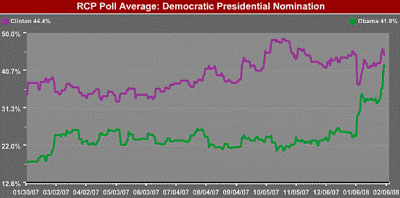
Real Clear Politics, Democratic primary poll graph, February 2008

In the last few days Barack Obama has been really surging fast. A look at the graph above from Real Clear Politics shows a considerable spike. Talk has been of him closing the gap, but I just got an e-mail alert linking to a Reuters / C-SPAN / Zogby poll showing Senator Obama not only to have closed the gap, but gone up thirteen points (Whitesides, John, “Obama, Romney lead in California on Super Tuesday, Reuters, 5 February 2008).

The problem is that the polls over the last few days have been all over the map. CNN was freaking out last night because they had polls showing that both Clinton and Obama, both McCain and Romney would be winning California. I think that this Reuters / C-SPAN / Zogby poll is probably accurate because it is in keeping with the trend.

There are two interesting things that I see in the Real Clear Politics graph. The first is the real significance of the outcome of Iowa. Senator Obama spikes around 6 January 2008. And it is not a blip. After that he plateaus. The gains he made in Iowa became permanent. This is nothing but speculation, but I presume it was the perceived inevitability of Hillary Clinton that was artificially suppressing Obama support. Once that perceived inevitability had been broken, Obama support broke out and dug in.

The second think I notice is that there are two spikes for Senator Obama. The first spike comes drastically at the expense of Senator Clinton: people were defecting from the Clinton camp to that of Obama — again the end of the inevitability thing. But my second point is the second, more recent jump in support for Senator Obama. It comes at the same time as support for Hillary Clinton is also rising, just not all that much. This second spike suggests an answer for a long standing question: which way will Edwards supporters break after he drops out. The second large spike in Obama support — a ten percent increase compared to only a three percent increase for Senator Clinton — says that the majority went for Senator Obama.

Anyway, stoked by a few such scraps of data, my inclination is to say that tonight will be a big series of upset wins for Barack Obama. Hillary Clinton will continue to fight it out all the way to the convention and hoping to win a convention battle. She will be counting on the see-sawing that has gone on to date to continue and this is not an unreasonable expectation considering the primaries to date. In fact, there is probably some dynamic among bleeding-heart liberal voters of sympathy for the loser buying them a few votes in the next contest. I know that I hate it that one of these two is going to have to lose for good at some point. Whatever the case, I suspect that Senator Clinton is going to look like a real weak horse after tonight.

The Most Awesome Political Strategist Ever

John McCain’s comeback from loosing the nomination in 2000 and being so far down in this primary that people were talking about him dropping out before Iowa because he didn’t even have the money to gas up the Straight Talk Express to now having won New Hampshire, South Carolina and Florida and the presumed winner out of Super Tuesday is nothing short of amazing. It shows what an incredibly strong candidate he is — and has been all along.

The thing that this determined comeback suggest is that McCain was the rightful Republican candidate in 2000. He had the potential to be a national and a unifying candidate. And were in not for the balls to the wall tactics of Karl Rove, he would have been.

Not just that: Al Gore was the anointed successor to a President Clinton leaving office one of the most popular in history, at the end of the longest uninterrupted economic expansion in history. By all rights, Al Gore should have been the 43rd President of the United States.

And for all his weaknesses, John Kerry was running against what was widely perceived at the time to be a sure looser. If you look at George W. Bush, Jr.’s approval ratings, they had dropped below half well before the 2004 election. He had a loosing war and a weak economy on his hands. He was a draft-dodger running against a purple-hear winner. But then, late in 2004 he bumped slightly above 50 percent and won a second term by one of the narrowest margins in hstory.

The thing that strikes me, seeing how tough a contender John McCain is, is that Karl Rove is the most awesome political strategist of his generation.

As bitter as John McCain must be at Mr. Rove, if he gets the nomination — or whoever gets it — they should beg, borrow and steal to get him to at least consult on their campaign. He may be tainted, but he is like the giant Antaeus from Greek mythology: since he draws his power from sleaze, the further into the mud he gets ground, the stronger he becomes.

Afterthought: Karl Rove is the highest attainment of sophistry: three times he has made the weaker argument appear the stronger to world-historical consequences.

Selective Lesson Taking

After Iowa there was a lot of commentary about what it meant that both parties had repudiated their establishment candidates. The Clintons and their DLC positions are the Democratic party today. Governor Romney represents the continuation of the Reagan coalition, whereas the other candidates are all the triumph of one faction of it over the rest. For Senator Obama to win on the Democratic side and Governor Huckabee to also win on the Republican side shows that dissatisfaction with the status quo runs across both parties.

But early primary victories by anti-establishment insurgents aren’t the only course of events that mean something. When ultimately Senator Clinton and Governor Romney secure their respective parties’ nominations, people should be ready to interpret those events as well. Anti-establishment idealism is all fine and good, but people should realize that in the end the empire always strikes back.

Bipartisanship After 20 January 2009

Senator Barack Obama’s win in South Carolina was exciting from a horse-race perspective. His speech was, in my opinion, much better than his Iowa one. But I still find his whole “changing the tone in Washington” shtick hopelessly naïve. I don’t know if he buys his own bullshit — maybe he knows better and it’s just a campaign ploy — but it suggests to me a candidate completely unready for the pain of the general election and the realities of governing a divided nation.

Consider the agenda for a Democratic president their first year in office. The top line issues will be doing something about Iraq, passing some sort of healthcare legislation, fixing the federal budget and, depending on how the economy plays out in the next year, managing the recession. I also imagine that about a week after a Democratic President is sworn in Ruth Bader Ginsburg will announce her retirement from the Supreme Court. All these issues seem daunting and perhaps the sort of thing that could hobble a new president right out of the gate.

Policies in Iraq and the war on terrorism are prerogatives of the president and the sort of things that can be accomplished without any input from Congress. But Iraq is an intractable situation. I don’t think anyone — no matter how confidently they may promulgate their whitepapers — knows what to do here, but a wrong move or two could be catastrophic. There are many powerful people in D.C. whose worldview is deeply connected to the Iraq war who will be watching and waiting to parade a Democratic president’s every plausibly wrong move down Pennsylvania Avenue and across all the television talk shows. Americans constantly tell pollsters that they want out of Iraq, but it is a position that is a mile wide and an inch deep. As soon as they are faced with the rhetoric of the consequences of withdrawal, they could seriously turn against a President actually implementing their previously desired policy. There are too many reasons that the Republicans will want to paint the Democrats as the party that lost the Iraq war — not least to get this albatross off the neck of the Republicans and onto that of the Democrats. No amount of speechifying is about to change this. This stands to be a real lesson for a President Obama in the unchangableness of the tone here in Washington, D.C.

However much they promise on the campaign trail, healthcare reform more significant than bureaucratic twiddling around the margins will be a next to impossible task. I think that a Democratic administration should hand this issue off to a blue-ribbon commission or some sort of consensus-building or stakes-raising body to let it simmer for a few months to a year, but I suspect that for reason of some by-gone precedent they will make it a part of their first hundred-day agenda. Everyone in Washington, D.C. believes that early successes build momentum and political capitol for a President. Therefore Republicans, right-leaning Democrats and related interest groups will be eager to hand the new President a momentum-stunting defeat on healthcare. Success in this issue will consist almost entirely of cajoling Congress and Republicans will seek to make it the first firebreak. Political-strategic considerations aside, the amount of money riding on this issue is just going to be too much for opposition groups to avoid going apocalyptic on this issue. Whoever grabs this wolf by the ears is going to have to be prepared for a lot of snarling and snapping in the general direction of their throat.

On the issue of fixing the budget, it can’t be done without raising taxes. If nothing else, the next President will be faced with whether to allow the sunset provision of the 2000 Bush tax cut to kick in. Nearly the entire Republican caucus has signed onto Grover Norquist’s No-Tax Pledge and the party leadership is serious about enforcing it. Additionally there are a lot of right-leaning Democrats or Democrats from sensitive conservative districts that tend to vote with the Republicans. Passing a Democratic budget will be dependent on maintaining a high degree of party unity, shaming Congressmen on the margin and taking the message to the citizenry. Since such a budget will probably come down to a straight party line vote, this will mean pressuring and humiliating Republicans in front of their constituents. In other words, some standard partisan tactics are what is called for here.

Regarding a Supreme Court nominee, I imagine that the Democrats will be surprised to find that their willingness to compromise on President Bush’s two appointments not reciprocated. A Democratic President may have to insist that Harry Reid actually call Mitch McConnell’s bluff and hold a real filibuster. And to win it, again, making the Republicans look the obstructionist assholes in front of the nation will be required.

When Barack Obama rattles off one of his standard litanies of the problems that can’t be solved owing to gridlock and partisanship, they aren’t initiatives that the Republicans want to advance too were it not for some mysterious bureaucratic bickering getting in the way. The items not achieved on Senator Obama’s list aren’t failures to Republicans, but accomplishments. Partisanship doesn’t emanate from some mysterious origin lost to the mists of time, but comes about owing to day-to-day real word differences on policy as well as the tried and true methods for advancing your own agenda while thwarting that of your opponent. Unless Barack Obama thinks that his smooth words have the power to evaporate this underlying reality — and Americans for Tax Reform, the American Enterprise Institute, Cato, The Weekly Standard, The Wall Street Journal editorial page and hordes of corporate money are going to do everything they can to see to it that he fails — then he better have a plan B.

Romney on the Way to the Nomination

On Wednesday Matthew Yglesias pointed out that that Mitt Romney is the Republican leader, having won a slight majority of allocated delegates. His pie chart here is illustrative (“Romney’s Big Lead,” TheAtlantic.com, 16 January 2008). After South Carolina, Mr. Yglesias points that this trend continues (“A Small Point,” TheAtlantic.com, 19 January 2008):

This morning, Mitt Romney had more delegates than John McCain. Following today’s primaries, Romney’s lead has grown even larger because Nevada has more delegates than South Carolina and Romney won a larger proportion of the vote in NV than McCain got in South Carolina.

Here’s a little table that I pulled together of raw vote count in the Republican primaries to date.

19 January 2008, Republican Primaries Raw Vote Count

Throw in the electoral college and things get more complicated, but right now, counting state victories is hiding the underlying reality that Governor Romney is the leader.

I think that for the other candidates the best outcome of future primaries will be mixed. There’s reason to believe from here on, the race will tip in favor of Mitt Romney. Plus he has raised more money and is the establishment candidate. He’s the obvious leader. Everyone is just oblivious.