All Those Moments Will be Lost in Time

S. and I are very interested in lifecasting, life streaming, life logging, life blogging or whatever you want to call it. We are doing some early investigations of technologies, techniques and approaches. Meanwhile, I see that our friend Frank has moved on to the experimentation phase (“August 27, 2008: A Day in the Life,” Too Frank?, 27 August 2008). I also notice a number of visits to Starbucks throughout Frank’s day.

I’m completely unsure what to do at this point. I don’t think I want to have to explain in my next job interview why I’m wearing some gigantic helmet that makes me look like a borg special child. Alternately, it could be as simple as a palmtop with a built-in digital camera and a flickr account.

The lifecasting Wikipedia page has lots of leads to life logging resources, but my two favorites don’t make the list — they are pretty simple. First, I am deeply impressed by Noah Kalina’s Every Day, where he made a six minute stream out of 2,356 photos, taken one per day from 11 January 2000 – 31 July 2006. I think in his case it’s half the music that makes his project seem so profound. Mr. Kalina has prompted a number of both cool and humorous imitators, with a photo a day during the nine months of a pregnancy seeming a particularly poignant use of this documentary form. Second is Jamie Livingston who took a Polaroid photo every day starting 31 March 1979 until 25 October 1997, the day before he died of a brain tumor at the age of 41. Mr. Livingston didn’t usually take self-portraits, just a picture of what was going on around him. Chris Higgins has a good digest of photos, especially the biographical ones, from the collection along with some background information (“He Took a Polaroid Every Day, Until the Day He Died,” mental_floss, 21 May 2008). Also a powerful collection.

I was overhearing someone the other day at the table next to me explain to his dining partner that it’s only a matter of time before data storage miniaturization allows us all to carry around enough storage to record our entire lives. Of course universal wireless will probably beat hard disks to the punch and anyway you wouldn’t want to be carrying around something that important and sensitive in your pocket. You’ll want something a little more secure and fault-tolerant. Whatever the case, the day is coming and I suspect that it will be epoch-defining. One day we will look back and marvel that at one time everyone just let their lives slip away into oblivion “like tears in rain.” I’d like to get a jump on it.

The Architecture of Nightmares

Circa 1999, Lebbeus Woods, detail of Terrain 1-2

In “Imagination Unmoored” (8 August 2008) I suggested that in addition to our dreams we might end up living in our nightmares. It struck me as a strange thought when I wrote it, though I didn’t even have to think any particular scenario — the eccentric, the accidental, the illicit — all the way through for its plausibility to be apparent. Our culture already abounds in it. It is in this regard that the works of H. P. Lovecraft and Philip K. Dick have been inducted into the Library of America and that players sign up for Hord in World of Warcraft. Alternative iconography seeks stark contrasts with the mundane, with Goth tending toward horror and punk the post-apocalyptic. Pornography has always tarried with the Sadistic and the surreal.

Any art of the found will inevitably end up scavenging our calamities as well as our aspirations. Enter Lebbeus Woods whose architectural design work will be included in Dreamland: Architectural Experiments since the 1970s, an exhibit at the Museum of Modern Art (Ouroussoff, Nichlai, “An Architect Unshackled by Limits of the Real World,” 24 August 2008):

In the early 1990s he published a stunning series of renderings that explored the intersection of architecture and violence. The first of these, the Berlin Free-Zone project, designed soon after the fall of the Berlin Wall, was conceived as an illustration of how periods of social upheaval are also opportunities for creative freedom.

Aggressive machinelike structures — their steel exteriors resembling military debris — are implanted in the abandoned ruins of buildings that flank the wall’s former death zone. Cramped and oddly shaped, the interiors were designed to be difficult to inhabit — a strategy for screening out the typical bourgeois. (“You can’t bring your old habits here,” he warned. “If you want to participate, you will have to reinvent yourself.”)

This vision reached its extreme in a series of renderings he created in 1993 in response to the war in Bosnia. Inspired by sci-fi comics and full of writhing cables, crumbling buildings and flying shards of steel, these drawings seem to mock the old Modernist faith in a utopian future. Their dark, moody atmosphere suggests a world in a constant struggle for survival.

In 1999 he began working on a series of designs whose fragmented planes were intended to reflect the seismic shifts that occur during earthquakes. (“The idea is that it’s not nature that creates catastrophes,” he said. “It’s man. The renderings were intended to reflect a new way of thinking about normal geological occurrences.”)

“I’m not interested in living in a fantasy world,” Mr. Woods told me. “All my work is still meant to evoke real architectural spaces. But what interests me is what the world would be like if we were free of conventional limits. Maybe I can show what could happen if we lived by a different set of rules.”

The article actually laments that the young generation in architecture has been made facile by overuse of computers. Au contraire! That is exactly how we are to experience the architecture of the impractical, built under fanciful physics.

The Beijing Olympics Did Not Take Place

One of the amusing stories coming out of the 2008 Beijing Olympics opening ceremonies is that it turns out that a portion of the video feed of the fireworks display was actually a computer simulation spliced into the broadcast. The fireworks were set off, but planners determined that they wouldn’t be able to film them as well as they would have liked, so they manufactured a version of them according to how they wanted them to have been filmed (Spencer, Richard, “Beijing Olympic 2008 opening ceremony giant firework footprints ‘faked’,” Daily Telegraph, 10 August 2008):

Gao Xiaolong, head of the visual effects team for the ceremony, said it had taken almost a year to create the 55-second sequence. Meticulous efforts were made to ensure the sequence was as unnoticeable as possible: they sought advice from the Beijing meteorological office as to how to recreate the hazy effects of Beijing’s smog at night, and inserted a slight camera shake effect to simulate the idea that it was filmed from a helicopter.

But what does it even mean to say that portions of the event were “faked”? The whole thing was illusion and artifice. Obviously significant portions of the event were computer graphics. The scroll that served as the mat for a significant portion of the floor show included computer graphics to create the image of its rolling. The projection of the Earth inside the globe was computer graphics and the unfurling scroll around the perimeter of the stadium as the final flamebearer faux-ran to the Olympic torch was computer graphics.

Increasingly computer graphics will come to be the norm, what’s really “real” and the merely material world will become the anomaly. Already we’re at the point where the big story about the latest Batman film was not the CG, but that the stuff that would usually be CG wasn’t CG (e.g. Brown, Scott, “Dark Knight Director Shuns Digital Effects For the Real Thing,” Wired, vol. 16, no. 7, July 2008, pp. 122-127). Already people are talking about augmented reality. The problem that I have with, say, Google maps and other special data, is that it’s stuck in a little box in my hand. Where it belongs is overlayed onto the world. Real-world objects are the ultimate representational tokens.

Movable type, opening ceremonies of the Bejing Olympics, 8 August 2008

Or, to turn things around, my favorite performance of the night was the “movable type” arrangement of 897 actuating blocks that raised and lowered to create patterns like a waving flag and ripples in a pond. My first reaction was that it must be computer control that created the images of waves and ripples. I wondered at how much that many hydraulic lifts must have cost and tried to imagine the programming that could produce those patters. The first time the camera panned low and showed human legs standing and squatting I was amazed.

This was an instance of “natural” things “simulating” machines. What we were watching was giant wooden pixels. What was amazing about this performance was that humans could achieve this machine-like level of control and precision.

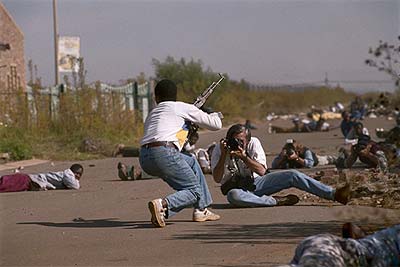
1994, David Turnley, James Nachtwey, 1994 elections in South Africa

But of course I don’t need to go to bizarre lengths. The more traditional means of artifice are well documented. There’s a reason that they call it media (middle, medium).

Imagination Unmoored

I like it when art becomes it’s own medium of response to itself, rather than leaving it to prose. I have always like Nat King Cole’s “Mona Lisa” and Don McLean’s “Vincent” (YouTube | Wikipedia). But Robbie Dingo’s recreation of Vincent van Gogh’s Starry Night in Second Life, making a video of the process of creation, then setting it to Don McLean’s song does it all one better (Au, Wagner James, “Remake the Stars,” New World Notes, 18 July 2007).

Schema of the arts and sciences aside, I like this for what is suggests for the future of virtual worlds. Hitherto our imaginations have been stunted by continuous exposure to the narrow Newtonian world of the macroscopic everyday. Witness, for example, what happens when people try to imagine fantastical animals. All that we can come up with is combinations of existing animals: griffins, mermaids, centaurs, dragons, Cerberus, et cetera.

Once we start to live in a regular way in virtual worlds of our own creation, a dynamic will form where each feat of imagining will establish a new norm and a new developmental environment from which each subsequent foray of imagining and generation of imagineer will be capable of going a little further beyond the forms of this world. As we increasingly live in worlds not constrained by the same limits as the material world, our imaginations will become completely unmoored from the forms provided to us by macroscopic nature. The true, autonomous nature of the imagination — throughout all of history shackled by the relentless, overwhelming conditioning of the narrow forms presented to us by dull matter — will be liberated.

And owing to neuroplasticity, inherited or induced, maturing and living in radically different worlds will allow us to develop new modes of being and new understandings. In the future we will live in our dreams and our nightmares. Science has laid the groundwork for our art to become the more fundamental reality. The direction of humanity is a retreat from the material world into a world composed entirely of mind.

Mr. Au mentions Akira Kurosawa’s Dreams (IMDB | Wikipedia). I think maybe it’s time to dig out and rewatch an old favorite, Until the End of the World (IMDB | Wikipedia).

Politically, for all of human history the Earth has provided the unified point of reference for all humanity. With a proliferation of possible environments, the hitherto more or less unified character of the human world will gradually degenerate. The dissolution of our political order, multiculturalism, neo-primitivism, the turning away from master narratives and the dawning of the postmodern era are natural consequences of technology.

As Vernor Vinge said of the coming of the singularity, “I can see us becoming weird — before my very eyes” (“My Apocalyptic Vision is Very Narrow,” 13 June 2008).

The Dean Scream Gank of 2008

I really don’t think I can handle the U.S. political scene and the 2008 election anymore. The right can still get away with their “liberal media” routine, despite it now being quite apparent that the media lies at the ready, waiting to gank any liberal with an even vaguely populist message at the first sign of any traction. Four years ago in what was one of the most amazing, mendacious, mean-spirited attacks on a politician that I have witnessed, Howard Dean was completely eliminated from the running in a single day and night of misfortune following the media pile-on over the Dean scream. This season it fully seems that Barack Obama has been served the same treatment.

The annoying thing is that this is working — at least on me. Maybe I’m too plugged in, whereas most voters are barely noticing, or maybe I’m not steady enough of nerve to weather what is a passing storm. I was in favor of Hillary Clinton throughout most of the primary, but after a few weeks of vague racism, typical Clintonian petty lying and unhinged desperation — doesn’t Bill Clinton really seem like a stroke victim at this point? — as well as a few positives from Barack Obama, I was convinced to switch to advocacy of the inevitable.

But after the whole Reverend Jeremiah Wright and the elitism gaff, Barack Obama seems like a pretty indefensible candidate to me. I mean, if someone took issue with Reverend Wright what would you say? Senator Obama was unfamiliar with these positions? That would be a convenient lie. That Reverend Wright’s opinions aren’t really that important? Do you plan to extend the same curtsey to John McCain regarding his religious wacko supporters? That Senator Obama is a closet atheist and just goes to church out of political necessity? Digging the hole deeper. That Reverend Wright’s points aren’t really that offensive? Let me know how that works out for you. That a politician shouldn’t have to apologize for the opinion of everyone they’ve ever come into contact with? There’s only so much mileage to be had here. Guilt by association is a lament because it has so much cred with common sense-type reasoning. And Senator Obama had been a member of Reverend Wright’s church for how long? Twenty years?

I think this is all stupid on a competitive basis. Despite the fact that John McCain has his own covenant of wacky preachers (Pat “we deserved September 11th” Robertson, John “the Catholic church is a whore” Hagee), has claimed spurious religious affiliation and in the form of national greatness conservatism has his own brand of condescension toward the decadent whims of the American citizenry, he’s getting a free pass from the media. If the media does decide to make an issue of anything about Senator McCain, it will undoubtedly skip over his war mongering and his avowed ignorance of economics to focus on the weakest case against him, that he is short and old., criticisms that will probably redound to further the liberal elitism case.

It pisses me off and I want to know when the DNC is going to dispatch Dean and Carville to the CNN Situation Room to empurple the face of Wolf Blitzer and to the Meet The Press studio to throw Tim Russert down an MSNBC fire escape stair well.

Maureen Dowd Marinated in Bitterness

Since there is no one more hateable in U.S. media than Maureen Dowd, I pass on the following screed (Kathy G., “My Maureen Dowd Story,” The G Spot, 18 April 2008):

But there’s another problem with the opening sentence of the Dowd column. “I’m not bitter.” Oh Maureen — who the hell do you think you’re kidding? The woman positively soaks in bitterness. Marinates in it. It oozes out of her pen and pours into just about every damn word she writes. Her bitterness has utterly corroded her soul. It’s turned her into a twisted freak whose chief pleasure in life seems lie in vicious, barking-mad attacks on the only people capable of ending our long national nightmare — the Democrats. Seriously, if there is any other single person in the media who’s been a more powerful enabler of Republican high crimes and misdemeanors than Modo, I don’t know who it is.

It would be one thing to be relentlessly critical of the Democrats — I am and they deserve every bit of abuse they get — if it seemed as if it were in the service of some principle. But the amazing thing about Maureen Dowd is that she doesn’t seem to have anything approaching a positive agenda or even the most remote interest in issues of policy. Her column is just a wasteland of the rote application of the worst of yesterday’s discarded pop psychology to the politician de jour. Her entire oeuvre consists of little more than pulling the wings off of political flies.

When will a shakeup at the New York Times Op-Ed page deliver us from this twice weekly phantasm? Probably never. I wonder at the wisdom of associating myself with fellow leftists every time I see that Maureen Dowd’s column is the most e-mailed of the day — as it is twice a week. It just might provoke a Christopher Hitchens-like bolt for the door.

Courtesy of Kevin Drum (“Who’s Not Bitter,” Political Animal, The Washington Monthly, 18 April 2008).

Destroy This Mad Brute

H.R. Hopps, U.S. Army First World War propaganda poster, "Destroy This Mad Brute — Enlist", 1917

Jill Filipovic at Feminista and Erica Barnett at The Stranger both think the cover of the April 2008 issue of Vogue (above, right) is some weird racist adumbration to King Kong (“I Know Vogue Isn’t Exactly Racially Conscious, But…,” 15 March 2008; “The LeBron James Vogue Cover Controversy,” 26 March 2008, respectively). In comments a lot of people discount the idea by pointing out the faint resemblance and go on to suggest that making such a leap when the source material is so vague is suggestive of some racist machinery at work in the minds of Mses. Filipovic and Barnett. SLOG has made it a poll with 88 percent of respondents — in crunchy Seattle even — declaring it not racist.

Every time I’ve walked past this issue of Vogue it has caught my attention — it’s a striking, if not attractive, photograph — but I haven’t been able to say why and just dismissed it as some visual itch that I can’t scratch. Then I read Ms. Barnett’s post on SLOG and recognized it immediately. Mses. Filipovic and Barnett are right about what’s going on here, they just have the wrong source material. The resemblance to the King Kong cell may be distant, but it is more than unmistakable that the reference to this poster is intended. The posture, the facial expression, the basketball in place of the club, even the color of Ms. Bundchen’s dress all match. In fact, to get such a resemblance I imagine that Annie Leibovitz must have had to show them the image that she was trying to recreate.

While fielding PC service calls at Amazon.com in the late 1990s I came across this H.R. Hopps U.S. Army First World War propaganda poster hanging in someone’s office (the 4th floor of the 2nd and Pike building) and immediately fell in love with it. It’s one of those images has managed to distills the worldview of an era into a single flash of the eye. And it rewards deeper viewing. I have had it hanging in my bedroom for years now and careful consideration rarely fails to inspire some new thought about the perversities of the American worldview represented therein.

In the distance the crumbling ruins of old Europe, strangely suggestive of the outcome of the air power attacks still 30 years in the future. A gorilla with a Kaiser Wilhelm II mustache and a German Pickelhaube emerging from presumably the Atlantic Ocean onto the shores of America. The helmet says “Militarism,” the bloody club “Kultur.” That Europe is portrayed as decrepit, barbaric and militaristic. What can it mean that culture is considered on par with militarism among the horrors that this mad brute visits upon the shores of America? Or that the proper metaphor for culture is a bludgeon? Is it any wonder that Americans are such philistines with a history like this?

And race imagery was common in these old propaganda pieces. Witness the exaggerated, flabby lower lip on the gorilla above (do gorillas even have large lips?).

It’s fairly obvious that this imagery derived parts of its power from tapping into that same set of ideas as the verbal formulations of white mans’ burden, mission civilisatrice, the dark continent, et cetera. People imagined a spectrum running from Christian, white European civilization to black, pagan African barbarism. Much of the dialog in the segregated U.S. partook of this scheme with a considerable discourse around the relative levels of sexuality, animal vigor, impulse control, intellectual capability and moral sociability of the races.

So whenever the time came for the denigration and dehumanization of an enemy people, this stock of tropes, civilization and barbarism, Europe and Africa, white and black was rolled out. And to add to the sense of barbarism and the anxiety of the viewer, an image of sexual peril was often thrown in. Here you have Germans depicted as an Africanized gorilla. During the Second World War depictions of Japanese in the propaganda posters were routinely made with what were then referred to as “negroid” features — dark skin, large lips and broad, flat noses — though today we might conceive Asian people as being farther down the spectrum from Africans than are Europeans. The depiction of Japanese as posing a sexual threat to white women was also a common theme.

One of the brilliant aspects of this propaganda piece is its ironic turn of the civilization and barbarism narrative against the Europeans themselves. White Americans have always considered themselves superior to their European forbearers. Set apart by the Atlantic Ocean from the corrupt realpolitik of the Continent, protected by its manifest destiny from the national compromises foisted upon a people by the necessities of maneuver against peer competitors, the United States could cultivate virtue and prosperity in peace. Purified of the distractions of vulgar kultur, America would be the new Jerusalem, the shining city on the hill. Against this development, Europeans were the first gradation of barbarism on the way to Africa. And within Europe there has always been a discourse regarding the relative levels of civilization of the various white races with the Germanic and Slavic people on the defensive. So depicting the Germans as African was natural in this context.

These are all tendencies that persist to this day. Witness the uproar over Donald Rumsfeld’s dismissal of “old Europe” or the dialog on the right where the characterization of the United States as “the last, best hope for humanity” has become a constant cliché (President Bush used the phrase in a Commencement Address at Ohio State University on 14 June 2002; William Bennett used it for the title of his two volume history of the U.S.; John McCain has used it about three dozen times on the campaign trail). On the true right — and its mirror image in fundamental American culture, the left — Henry Kissinger is reviled: a German import: too much Metternich and Talleyrand for America.

It is exactly this cultural reservoir that the imagery of the propaganda poster and through it, the cover of Vogue magazine draw. Ms. Bundchen smiles, easing the element of sexual peril — at least on the part of the participants, if not all viewers — but Mr. James lowers himself from the upright, slender man that he is to the same hunched-back incoherently yelling thug of a century ago.

Are our race perceptions so firmly entombed in the past that it’s safe to break out such images, tongue in cheek? With media spectacles of dog fighting and sex with underage groupies even among the economically successful in the African American community, horror movies depicting Eastern Europeans and Central Americans dismembering innocent Americans on vacation and constant real life stories of nice young blond American girls going missing amidst the brown peoples of the world still sewing questions in the minds of white people, does Vogue really feel that homage to some antique propaganda dredged from a crude and anxiety ridden past is in order? Or do they just channel the Zeitgeist? It would seem to me that just below the level of official or explicit statement is a raging discourse of symbols and narratives, whose points lay between the lines, regarding race which is not too far removed from the uglier, more explicit discourses of the past.

Whenever something like this happens — some ridiculously non-PC image making it into the mass media — I wonder how it was that it came about. Is some smarty-pants photographer pulling a fast one on an under-educated editor — intentionally selling them a bill of goods? Or was everyone in on the joke — it’s just that everyone top to bottom signed off on it. Or are there just cultural coincidences of this magnitude? Is it like some mental urp of the collective unconscious? Or — most likely — are our media mandarins really so cynical that something like an homage to a gang rape à la the Dolce & Gabbana advertisement seems like a good way to move product. No publicity is bad publicity.

I can understand LeBron James and Gisele Bundchen being too dense to see what’s going on in this poster, but how it is that Annie Leibovitz participated in the production of such an image is completely beyond me. I seriously wonder what Susan Sontag would have had to say about it. She certainly wouldn’t have discounted such visual allusions. Oh, to know what the state of discussion was around their apartment.

FaceBook

S. has recently become very interested in social networking sites and has drug me to get FaceBook and MySpace pages. FaceBook is pretty cool in that it’s like a social networking engine with an API for user application development. Judging by some of the applications, they give developers a lot of access. But the thing that I don’t get is why the people behind FaceBook seem to so lack ambition. First of all, they have yet to completely shed their college-oriented origins, so their network remains entirely too fragmented. But the real oversight is why, with that huge existing user database, they haven’t deployed more core functionality. Right now is seems like FaceBook is just a sort of online business card. Why haven’t they deployed dating, group scheduling and calendaring, blogging, employment, classified advertisements and so on? They could be match.com, meetup.com, livejournal.com, monster.com and craigslist.com all rolled into one. Or if not build the functionality themselves, why not partner and integrate or build some gateways? There are some features like what I am talking about, but they are rudimentary. Why not put them front and center? Seems like a recipe for obsolescence to me. In this environment it’s innovate or wither.

William Gibson’s Idoru and Blogging

I want to add one more thought about blogging before I get started. In my Inaugural Post I asked, “Why join this societal wave of exhibitionism?” and mentioned the relation of technology to surveillance, voyeurism, privacy and exhibitionism. Every time I think about these issues, a character from William Gibson’s 1996 novel Idoru comes to mind.

Before I delve into the main point, I want to say that I think William Gibson is a genius. In his first novel, Neuromancer (1984), the hit that launched the cyberpunk genre, he came up with the term cyberspace. In case you passed over that parenthetical date too quickly, let me point out that he came up with the idea of cyberspace in 1984: before there was either the Internet or virtual reality.

Yes, I am aware that Tron came out in 1982, but Tron is about a man who is sucked into a little, tiny world inside of a computer were the programs are personified (e.g. the vilan, “Master Control”) and forced to fight high-tech gladiatorial games in sexy spandex body suits. This of course will never happen and is merely a technological variant of The Fantastic Voyage, The Wizard of Oz or The Lion, The Witch and the Wardrobe. Yes, there are some silly parts of Neuromancer: the space Rastafarians are hardly the heady stuff of Arthur C. Clarke or Isaac Asimov. However, a total emersion interface to a simulated world spread over a network of computers is freaking visionary. Unlike Tron, which set people’s understanding of computers back a decade, Neuromancer is the future.

What is most relevant to blogging is his vision of celebrity and media that make up the ideological backdrop of Idoru. The novel is set in the not-too-distant future where mass media has continued to throw its net wider and wider, where, as Andy Warhol said in what must be the most accurate prediction ever made, “everyone will be famous for fifteen minutes.” Murderers are famous, the parents of their victims are famous, college students fake kidnappings to get on television, unaccomplished debutantes are famous for nothing other than ostentation, people become famous when sex tapes “accidentally” find there way on to the Internet, people elbow their way onto television for opportunities to boast about things that previously one wouldn’t even want one’s neighbors to know. Actually, I am talking about the present, but imagine this trend married to the myriad of widely affordable media production and distribution technologies chased out twenty years into the future. With thousands of television channels to fill up and with everyone’s vanity site on the Internet and with no gatekeepers, fame will devolve to the masses. Gibson has one of his characters describe it thus:

“Nobody’s really famous anymore, Laney. Have you noticed that?…I mean really famous. There’s not much fame left, not in the old sense. Not enough to go around…We learned to print money off this stuff,” she said. “Coin of our realm. Now we’ve printed too much; even the audience knows. It shows in the ratings…Except,” she said… “when we decide to destroy one.” (6-7)

Gibson spends the opening chapters of the book describing how derelict protagonist Colin Laney lost his previous job as a “researcher” at a tabloid news show called Slitscan. In this future, like our present, an increasing proportion of people’s transactions are being passively recorded in corporate databases. And also as in our present, some companies exist solely to purchase information, correlate disparate pieces in useful ways and sell it to those who might put it to some (usually pernicious) use. In this novel, Slitscan had a questionable relationship with such a data agglomeration corporation called DatAmerica and Laney’s job was to troll through the data trails left by celebrities looking for the “nodal points” — the confluences of data — that indicated something gossip-worthy for the show to report.

Laney was not, he was careful to point out, a voyeur. He had a peculiar knack with data collection architectures, and a medically documented concentration deficit that he could toggle, under certain conditions, into a state of pathological hyperfocus…he was an intuitive fisher of patterns of information: of the sort of signature a particular individual inadvertently created in the net as he or she went about the mundane yet endlessly multiplex business of life in a digital society. (30-31)

Laney was fired when, while researching the mistress of a celebrity, it became clear to him from her data trail that she intended to commit suicide and he tried unsuccessfully to intervene. Here Laney checks back with his mark after returning from a vacation:

The nodal point was different now, though he had no language to describe the change. He sifted the countless fragments that had clustered around Alison Shires in his absence, feeling for the source of his earlier conviction. He called up the music that she’d accessed while he’d been in Mexico, playing each song in the order of her selection. He found her choices had grown more life-affirming; she’d moved to a new provider, Upful Groupvine, whose relentlessly positive product was the musical equivalent of the Good News Channel.

Cross-indexing her charges against the records of her credit-provider and its credit retailers, he produced a list of everything she’d purchased in the past week. Six-pack, blades, Tokkai carton opener. Did she own a Tokkai carton opener? But then he remembered Kathy’s advice, that this was the part of research most prone to produce serious transference, the point at which the researcher’s intimacy with the subject could lead to loss of perspective. “It’s often easiest for us to identify at the retail level, Laney. We are a shopping species. Find yourself buying a different brand of frozen peas because the subject, watch out.” (66-67)

Before excerpting a passage where Gibson describes the future of gossip journalism, let me remind you that this is Gibson’s view from 1996, when MTV’s The Real World was only in its 4th season, the O.J. Simpson trial was just over, Monica Lexinsky’s blue dress was stain-free and Survivor was still four years off:

Slitscan was descended from “reality” programming and the network tabloids of the late twentieth century, but it resembled them no more than some large, swift, bipedal carnivore resembled its sluggish, shallow-dwelling ancestors. Slitscan was the mature form, supporting fully global franchises. Slitscan’s revenues had paid for entire satellites and built the building he worked in in Burbank.

Slitscan was a show so popular that it had evolved into something akin to the old idea of a network. It was flanked and buffered by spinoffs and peripherals, each designed to shunt the viewer back to the crucial core, the familiar and reliably bloody alter that one of Laney’s Mexican co-workers called Smoking Mirror.

It was impossible to work at Slitscan without a sense of participating in history, or else what Kathy Torrance would argue had replaced history. Slitscan itself, Laney suspected, might be one of those larger nodal points he sometimes found himself trying to imagine, an informational peculiarity opening into some unthinkably deeper structure.

In his quest for lesser nodal points, the sort that Kathy sent him into DatAmerica to locate, Laney had already affected the course of municipal elections, the market in patent gene futures, abortion laws in the state of New Jersey, and the spin on an ecstatic pro-euthanasia movement (or suicide cult, depending) called Cease Upon the Midnight, not to mention the lives and careers of several dozen celebrities of various kinds.

Not always for the worst, either, in terms of what the show’s subjects might have wished for themselves. Kathy’s segment on the Dukes of Nuke ‘Em, exposing the band’s exclusive predilection for Iraqi fetal tissue, had sent their subsequent release instant platinum (and had resulted in show-trials and public hangings in Baghdad, but he supposed life was hard there to begin with). (50-52)

Of course, something like Slitscan — or the Jerry Springer Show, Cops, E True Hollywood Story, Average Joe or The Fifth Wheel in our time — could not exist were it not for the sadistic voyeurism of the masses. I select this passage as much to satisfying my own snickering elitism as to illustrate the lust for other people’s misery that comprises our current and future television viewing audience:

…Slitscan’s audience…is best visualized as a vicious, lazy, profoundly ignorant, perpetually hungry organism craving the warm god-flesh of the anointed. Personally I like to imagine something the size of a baby hippo, the color of a week-old boiled potato, that lives by itself, in the dark, in a double-wide on the outskirts of Topeka. It’s covered with eyes and it sweats constantly. The sweat runs into those eyes and makes them sting. It has no mouth, Laney, no genitals, and can only express its mute extremes of murderous rage and infantile desire by changing the channels on a universal remote. Or by voting in presidential elections. (35-36)

Of course one can already see aspects of this world coming into being. Corporations are harvesting, agglomerating and correlating information at a frightening and increasing rate — but that is for another post. What I am thinking about here is the voyeuristic and micro-celebrity aspects of our quickening information age. I have a friend who reads several people’s blogs on an occasional basis, some of whom he has never even met. Of one that he hasn’t met, he maintains that this blogger is teetering on the brink of an infidelity with a coworker against his current girlfriend — an infidelity, the imminence of which he himself is not yet aware! My friend keeps returning to this blog awaiting the climactic post as if it were a soap opera.

There you have it: micro-celebrity, sadistic voyeurism, a readable data trail from which one might extrapolate future behavior with a minimal amount of theory. Admittedly, my friend is following an intentional data trail rather than a passive one, but the small difference between this situation and that of Gibson’s Laney anticipating the suicide is striking.

I don’t absolve myself of any of this. I loved the show Trauma: Real Life in the ER, which is about as sadistic of a voyeurism as you’ll find. I did say in the “Inaugural Post” that I consider this a “deeply improprietious endeavor.” I am, however, aware of the context in which I embark upon this effort.