The Federal Reserve Does Not Buy Mortgage-Backed Securities

When I saw the following story in the New York Times on Friday (Peters, Jeremy W. and Wayne Arnold, “Stocks Are Volatile After Global Sell-Off,” 10 August 2007) I fucking freaked:

The E.C.B. injected another 61 billion euros ($84 billion) into the banking system, after providing 95 billion euros the day before. The Federal Reserve today added $19 billion to the system through the purchase of mortgage-backed securities, then another $19 billion in three-day repurchase agreements. The Fed added $24 billion on Thursday.

It’s not the amounts of money that are unusual. Yes, this indicates a fairly aggressive attempt to preserve liquidity in financial markets and it is definitely earning the headlines it is getting in The Financial Times and The Wall Street Journal. But that the Federal Reserve might engage in the direct purchase of $19 billion worth of mortgage-backed securities would indicate a real problem and the adoption of extraordinary, panic measures on the part of the Federal Reserve. On Friday I was thinking how I might reinvest my 401k into gold doubloons.

Thankfully, on Saturday Dean Baker pointed out (“The Fed Does Not Buy Mortgage-Backed Securities!!!!!!,” Beat the Press, 11 August 2007) that this was just incompetence on the part of the economic reporting at The New York Times and The Washington Post (who also reported the story). That what really happed was that the Federal Reserve made a more routine loan through the discount window and accepted the $19 billion in mortgage-backed securities as collateral for the loan.

While you’re there, his post (“Tell The Post: The Problem Isn’t Subprime,” Press, 11 August 2007) pointing out that the cause of our current financial woes is not the subrime market (dirty, irresponsible poor people) is a useful reminder. The real problem is the bursting of the housing bubble more generally. The subprime market is just the first place it’s really being felt.

Where Your Boots Go, There Your Mind Will Be As Well

I think the proper way to think about our situation in Iraq is this. It may be true that many vile consequences may ensue in Iraq should the United States withdraw. But the options aren’t that the U.S. armed forces save Iraq from itself versus U.S. soldiers go back to sipping cool lemonade in the backyard. It’s entirely possible that the choice is between staying in Iraq or preventing the next September 11th.

Al Qaeda and their ilk have a grand strategy. They are not going to match their weakness against our strength. This is not the Fedayeen Saddam. They are not about to try to engage the Fourth Mechanized Infantry in Toyota pickup trucks. The Liliputian terrorists will bind Gulliver, overwhelm us with distractions, mire us in a series of diversions. Having no commitments, no obligations of their own, they will then match the nimbleness of al Qaeda against the encumberment of the United States. As Osama bin Laden himself has said, “All that we have to do is to send two Mujahideen to the furthest point East to raise a piece of cloth on which is written al-Qaida, in order to make the generals race there to cause America to suffer human, economic, and political losses without their achieving for it anything of note …”

My ever so slight sampling of the zeitgeist says that we are working our way toward a condition — material and of mind — not unlike that in the late 1990s and early 2000s as the country slouched toward September 11th. Dangerous and anarchic regions of the world are spreading, extremists are gathering strength, plots — one can imagine — are unfolding. Nothing less than the most recent NIE has suggested that the terrorist threat is growing, not waning, and that al Qaeda is gaining strength. Just as after the Cold War the United States was unable to heed the warning of both events and the prognostications of certain elites, so George Bush has the put the country into a trance of Iraq focus. Despite a changing threat profile, we can’t think about anything else. Already al Qaeda and Co. have pivoted. New threats are in the making, but mired in the thought of post-September 11th and Iraq — the irony here is too much — we are incapable of conceptualizing or doing anything to prevent the next September 11th.

The right has argued that in the post September 11th world, the old Cold War system of long-term alliances like NATO is obsolete, that the United States needs to remain nimble, to rely on ad hoc coalitions of the willing. And yet in Iraq the United States has permanently bound itself in a coalition of the compulsory. That broken statue of Hussein was the signing ceremony and there is no nullification clause in the treaty. In Iraq the United States stepped into a bear trap and it closed on our foot. It’s going to hurt and it’s going to be bloody, but its time to gnaw that foot off and hobble free — before the trapper comes to claim our pelt.

Bad Words

Dan Savage on the juvenile refusal of naughty words among mainstream publications (“Don’t Be Such a Fucking Pansy, David,” SLOG, 6 August 2007):

Oh, David. Newspapers are for adults. Blogs are for adults. And adults use words like “fuck” all the time. Certainly newspaper writers and editors do — at weeklies and dailies. Even the President and Vice President use profanity, as the Second Circuit Court of Appeals recently noted. So why are daily newspapers written and edited as if their readers are a bunch of prissy ol’ clenchbutts?

I don’t think that your average paper should be written in the tone of The Stranger, but it’s more professional to report a quote as it was spoken than to refer to some hackneyed euphemism cribbed from one of your grandmothers old-time stories. If it includes a swear word, print the swear word.

Recently I went to see Robert Dallek talk on his book, Nixon and Kissinger: Partners in Power at Politics & Prose. Now Politics & Prose is what they call a family store: for their author talks a van from an area assisted living facility regularly disgorges a mob of gray-hairs. And Mr. Dallek isn’t a young scholar anymore. But to hear Mr. Dallek rattle off excerpts from the Nixon transcripts — forget Oliver Stone, the ones who should make a film about Nixon should be the Cohen brothers (need a clue? Try the The Big Lebowski: The Fucking Short Version). And if we made it through the actual Nixon administration we can make it through a few reanimated recitals of his vulgar ramblings.

As that brilliant, closing line from Apocalypse Now goes, “We train young men to drop fire on people, but their commanders won’t allow them to write ‘fuck’ on their airplanes because it’s obscene.”

Mr. Savage follows it up with a few more words on this issue: “Ruffians?,” and “Necessary Profanity.”

Neocons Love Hillary

As if it weren’t enough that business loves Hillary, she’s William Kristol’s top Dem as well. As he tells the Washington Post (Kornblut, Anne E., “Clinton’s Foreign Policy Balancing Act,” 7 August 2007, p. A4):

Obama is becoming the antiwar candidate, and Hillary Clinton is becoming the responsible Democrat who could become commander in chief in a post-9/11 world.

It’s not exactly an endorsement, but as Matthew Yglesias points out (“Clinton Wins Coveted Bill Kristol Endorsement,” The Atlantic OnLine, 7 August 2007), when Bill Kristol says you’re the war candidate, you’re the war candidate.

And if you need still more, at today’s debate she lambasted her opponents for being too open with the electorate and the world about their foreign policy objectives:

Well, I do not believe people running for president should engage in hypotheticals and it may well be that the strategy that we have to pursue on the basis of actionable intelligence — but, remember, we’ve had some real difficult experiences with actionable intelligence — might lead to a certain action. But I think it is a very big mistake to telegraph that, and to destabilize the Musharraf regime which is fighting for its life against the Islamist extremists who are in bed with Al Qaeda and Taliban. And remember: Pakistan has nuclear weapons. The last thing we want is to have Al Qaeda-like followers in charge of Pakistan and having access to nuclear weapons. You can think big, but remember you shouldn’t always say everything you think if you’re running for president, because it has consequences across the world. And we don’t need that right now.

Of course, this sentiment won’t stop Senator Clinton from posturing on trade issues at the expense of Chinese sensitivities — the Chinese being an economically precarious leadership similarly likely to react poorly to too loose a U.S. tongue. And despite the fact that once in office a Hillary Clinton administration — or any other Democratic administration — will immediately revert to the same policy of economic liberalization that the U.S. has pursued toward China for the last 35 years, the campaign will discount future foreign policy damage for a few populist points at home with a clear conscience.

Bread and Circus Versus Nuts and Bolts

The New York correspondent for the U.K Independent opines on the latest symbol of the decline of the United States and the means by which voters are kept distracted (Usborne, David, “Baseball and Bombs Get the Cash — Bridges Are Just Dull,” 6 August 2007):

You don’t have to visit this country for long to see how its transport infrastructure has deteriorated since the interstate system was built by Eisenhower in the Fifties.

Never taken that pot-holed ride from JFK to Manhattan? Fasten your seatbelts for more turbulence. Or covered your ears in the screeching tunnels of the city’s antiquated subways? As for a cross-country ride on Amtrak, good luck.

Money here tends to flow towards items that make the pulse race. That would be elections, wars and that other national passion, sports. If there was a World Cup for baseball – rather than the so-called World Series in October which involves only the US and Canada – then finding decent venues would barely be a problem. Name a big city that doesn’t have a brand new, state of the art stadium it wants to show off.

Actually, that would be New York. But that is about to change. Its two major baseball teams, the Yankees and the Mets, are in deadly competition right now and not just to land places in the World Series play-off games this autumn. It’s about which of them can get their spanking new stadium finished first.

That’s right, while the Brooklyn Bridge gathers rust (yes, it is on the critical care list), somehow this city is building not one but two baseball stadiums barely six miles from each other, one in the Bronx, the other in Queens. It doesn’t matter that the teams have perfectly good places to play for their fans already. They are not flashy enough.

Increasingly circus is not merely some free-standing distraction, but conjoined to the very decline it serves to dissemble.

Airport Security

The last time I traveled was to Thailand in November-December 2006, shortly after the binary liquid explosive scare and new screening procedures for carrying on liquids, gels, etc. had gone into effect. Prior to that, a number of work related recruiting trips were instructive. We always brought two fingerprinting kits that use a heat-sensative red ink that turns black when you stick the fingerprint cards in a panini-grill like heating element. The units are rather expensive and were critical to our events, so we always carried them on the plane. The person who carried the unit was always pulled aside to the special extra procedures area and questioned by security. They always inspected the units and on more than one occasion swabbed them for any traces of explosive materials. While I think the whole airport security routine is a farce and studies indicate that people can still pretty effectively sneak banned items onto planes, I have hitherto thought that I had been given a pretty thorough going-over.

My impression from my most recent experience is that airport security has seriously lapsed. On this trip I was somewhat careless about metal and liquids when I packed and was carrying a router, its power adapter and thirty feet of coiled ethernet cable. I thought that surely I would be required at least to take a few things out of my bag, but no. We all went through screening extremely quickly and I was just rushed right along with nary a question. The special screening section behind the partition wall seemed like it may be growing spider webs.

After I got through, I was sufficiently struck by it that I asked S., a gargoyle always heavy-laden with personal electronics. She had gone through a separate screening station and concurred that it seemed that things had gotten pretty lax. At Sea-Tac there was a person putting out a little effort to make sure that personal electronics and liquids were out of their bags and in separate bins, but things didn’t seem much better there.

America’s Revolutionary Guard

J.K. Rowling suggests a difference between the Christianists in the United States and those of other countries (“J.K. Rowling Reflects on Fame, Fans and Harry Potter,” The Associated Press, 19 July 2007):

I had one letter from a vicar in England — this is the difference — saying would I please not put Christmas trees at Hogwarts as it was clearly a pagan society. Meanwhile, I’m having death threats when I’m on tour in America.

Of course, even the letter from the vicar is preposterous as European Christians appropriated the decorated pine tree as part of the symbolry of Christmas from early European pagans in an attempt to compete with preexisting celebrations long before — fictional, mind you — pagans reappropriated the tree to themselves.

Money is always a compelling issue — witness our China policy just for starters — and we’ve got a lot of it so people have to deal, but I wonder at what point the rest of the word declares the U.S. a bunch of incorrigible kooks and throws up their hands? Will the day come when a foreign author simply avoids the United States market, when an author is subject to the Salman Rushdie treatment in the United States? One can already almost see the analogy between the United States and Iran. A young, costal, cosmopolitan elite committed to freedom and secularism oppressed by a self-appointed and semi-officially condoned bunch of religious thugs. I can almost hear the first report of a Christian enforcer throwing acid in the face of a feminist on a book tour.

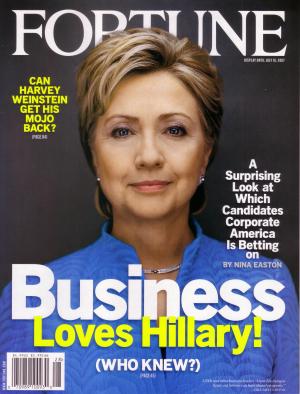
Business Loves Hillary

Business Loves Hillary Clinton, Fortune, 9 July 2007

Fortune reports (Easton, Nina, “Who Business is Betting on,” vol. 156, no. 1, 9 July 2007, pp. 45-52):

One of Hillary Clinton’s most important courtships began early last year, around a formal dinner table at Georgetown’s Four Seasons Hotel. Her targets were Morgan Stanley CEO John Mack and his wife, Christy. Mack was already active politically — but on behalf of Clinton’s political opponents. A Bush “Ranger,” he had raised at least $200,000 for the President’s reelection bid and was one of the most prominent business names on GOP donor lists. At one time his name had circulated as a potential Bush Treasury Secretary.

The conversation that night ranged widely, but always returned to one subject: health-care reform. …

Hillary Clinton was on familiar territory — and managed to charm the couple not only with her “intelligence and educated responses,” as Christy Mack recalls, but also with her one-on-one charisma. “You have these preconceived ideas about people you see in the public eye,” says Christy. “But we were extremely impressed with her ability to connect with every single person. She was an amazing listener, with tremendous warmth.”

The relationship could have ended there — a New York Senator engaging her local constituents. But early this year Clinton upped the ante with a phone call to the Morgan Stanley CEO, asking him to support her presidential bid. When he demurred, she asked for a meeting. Once again — this time over coffee — John and Christy Mack found themselves enticed. When Mack returned to his office, he told Nides he was ready to commit. “John, you can wait, you don’t have to commit yet,” Nides responded. “No,” Mack replied, “early support is better support.” Days later Mack picked up the phone and sealed the deal. Clinton, Nides recalls, “put the time in.”

On the one hand, this bodes well in that some have pointed out that Senator Clinton has nowhere to go but up and when people are exposed to Hillary Clinton in person instead of Hilary Clinton the myth, they are pleasantly surprised. On the other hand, one would really like to know what Senator Clinton could say (or maybe even promise?) to a Bush Ranger — in 2004 nonetheless — about healthcare that would cause him to back her for the presidency.

Cusping on a new Gilded Age, it would perhaps be best to have a candidate that business loathed. But I guess that’s what cusping on a new Gilded Age means: the money men vote first, then the rest of us chose from the slate they have prescreened.

Some Other Books that Bush Should Read

The White House press office and has periodically made it known what books the President is reading. On a few occasions even the President himself has staged a mini publicity stunt to show off the same, for instance when he very deliberately paraded around with a copy of Bernard Goldberg’s book Bias to demonstrate his low opinion of the press or Eliot Cohen’s Supreme Command to signal to the military that the administration wasn’t about to be pushed around by a bunch of generals with their dictates of military requirement.

I am currently reading Adam Zamoyski’s Moscow 1812: Napoleon’s Fatal March. Sometimes it’s hard to imagine that a work was not written with an eye to current events. And sometimes they are. Robert Massie has specifically said that he wrote Dreadnought, his book about how the naval arms race between Britain and Germany precipitated the First World War, in part to illustrate the dangers of the Regan nuclear arms buildup.

When I read passages like the following, it is hard not to think that Mr. Zamoyski doesn’t have a certain contemporary swashbuckling world leader in mind. With the La Grande Armée fully ensconced in Moscow, harried by marauding Cossacks, Napoleon contemplates his next move:

Napoleon was far too astute not to realize that his strategy had gone badly wrong, and that Caulaincourt had been right all along. But he did not like to admit it. And he recoiled from the only logical next step, which was to withdraw. He liked neither the idea of retreat, which went against his instincts, nor the implications of such a withdrawal on the political climate in Europe. He also had an extraordinary capacity for making himself believe something just be decreeing it to be true. “In many circumstances, to wish something and believe it were for him one and the same thing,” in the words of General Bourienne. So he hung on, believing that Alexander’s nerve would break or that his own proverbial luck would come up with something.

He had studied the weather charts, which told him that it did not get really cold until the beginning of December, so he did not feel any sense of urgency. What he did not realize, in common with many who do not know those climates, was just how sudden and savage changes of temperature can be, and how temperature is only one factor, which along with wind, water and terrain can turn nature into a viciously powerful opponent.

The unusually fine weather at the beginning of October contributed to his complacency. He teased Caulaincourt, accusing him of peddling stories about the Russian winter invented to “frighten children.” “Caulaincourt thinks he’s frozen already,” he quipped. He kept on saying that it was warmer than Fontainebleau at that time of year, and dismissed suggestions that the army provide itself with gloves and items of warm clothing. …

With every day Napoleon spent in Moscow, the harder it was to leave without loss of face, and the usually decisive Emperor became immobilized by the need to choose between an unappealing range of options on the one hand, and a stubborn belief in his lucky star on the other. He fell into the trap of thinking that by delaying a decision he was leaving his options open. In fact, he only really had one option, and he was reducing the chances of its success with every day he delayed. (pp. 351-352)

For the outcome of this story, one need only consult Charles Minard’s famous chart portraying the destruction of the French Army. Substitute a few terms and this sounds strikingly like the current situation of the United States in the Middle East. For those of you who object to the comparison in the first sentence of the excerpt, “Napoleon was far too astute not to realize that his strategy had gone badly wrong,” I ask, do you really think that CIA director Michael Hayden told the Iraq Study Group that the “instability” in Iraq seems “irreversible” and that he could not “point to any milestone or checkpoint where we can turn this thing around,” (Woodward, Bob, “CIA Said Instability Seemed ‘Irreversible’,” Washington Post, 12 July 2007, p. A1) but that he has been telling the President in his daily briefings that everything is coming up roses? President Bush has been told the situation in Iraq, and in some dark corner of his mind he knows what it is — altogether too often one can see this in his broken, impromptu remarks to the press where his pleading, too strident by half tone seems addressed as much to himself as anyone else in the room. He just doesn’t have the strength of mind — and that is what it takes — to come to terms with the truth.