Et Tu, T-Bills?

The yield on Treasury bonds went negative yesterday for the first time in history. Investors are so desperate to avoid risk that they would rather a known small loss than lend to an unknown. Reuters has considerably more information on the state of public sector debt risks and they make it sound much worse than the passing reference in the Financial Times (Siew, Walden, “S&P Says Pressure Building on U.S. ‘AAA’ Rating,” 17 September 2008):

Pressure is building on the pristine triple-A rating of the United States following a federal bailout of American International Group Inc., the chairman of Standard & Poor’s sovereign ratings committee said Wednesday.

The cost of insuring 10-year U.S. Treasury debt against default rose Wednesday to a record high, a day after the government rescued insurer AIG with an $85-million loan. …

Ten-year credit default swaps, or CDS, on Treasury debt widened three basis points to 26 basis points, according to data from CMA DataVision. This means it costs $26,000 per year to insure $10-million of U.S. Treasury debt against default.

Five-year credit default swaps on Treasury debt were steady at 21.5 basis points. That compares to 9.8 basis points on German five-year CDS and 13.2 basis points on German 10-year CDS, CMA said.

A graph of various CDS rates would be a visual of the rise and fall of the great powers.

Capitalist Systematics and Individual Freedom

In his economic speech on Monday Senator McCain had the following to say about the present financial crisis:

The top of our economy is broken. We have seen self-interest, greed, irresponsibility and corruption undermine the hard work of the American people.

Then on Tuesday morning he said to Joe Scarborough:

Wall Street has betrayed us. They’ve broken the social contract between capitalism and the average citizen and the worker. … This is a result of excess and greed and corruption. And that’s exactly what is plaguing Americans today.

I imagine that a lot of people would call me a leftist and a socialist, but from these two comments it seems to me that John McCain must have a pretty contorted idea of what exactly capitalism is underneath the rhetorical hood.

What’s happening on Wall Street isn’t a corruption of capitalism. It’s not that people are angles and in capitalism we’ve finally found an economic system equal to ourselves. The genius of capitalism is that people are greedy, self-interested wretches and capitalism is a system that channels their greed into social good. What’s wrong with what’s going on with the financial system in recent weeks is not that financiers are greedy, or even excessively greedy, but that the system is rigged wrong.

When Democrats call for a new regulatory regime, this is what they are calling for: a different arrangement of the system. Different prohibitions, different incentives, different inducements. It’s the Nudge approach. Align the incentives right and then laissez faire.

The alternative to systematic change is the reengineering of the human heart. And proposals to change the hearts of men are not very conservative. This is why capitalism and liberalism are so closely conjoined. Capitalism is indifferent to the characteristics of the corpuscles that comprise the system. It is the economic system most compatible with self-determination because it doesn’t require people of any particular character to function. It’s even sufficiently robust as to be compatible with extremes of behavior. Other systems less fault-tolerant and rely for their sustainability on the virtue of their participants. As such other systems maintain an interest in the condition of the souls of their members. Some see this as a virtue of these alternate systems.

Recent weeks don’t argue my case very well. It would seem that capitalism is in fact not very robust and in need of quite a bit of extra-systematic shoring up. But that’s owing to fifteen years of willful neglect. Professed admiration for capitalism on the right is not so compatible with the sustainability of capitalism. If you get the system right, you don’t have to worry about the character of the people.

But this is one of the things that’s distinct about Senator McCain. He isn’t that into leaving people alone. He’s a proponent of a particular type of civic virtue and is interested in cajoling people, even cajoling them rather convulsively, into demonstrating his brand thereof. And on the right more generally opposition to business regulation is so inflexible that social engineering is the acceptable alternative.

Not So Fast on the Moral Hazard

Last week American International Group requested assistance in the amount of $40 billion from the Federal Reserve. This was rejected only to have A.I.G. come back with a second request, this time for $75 billion. Over the weekend the Federal Reserve and the Treasury decided to let Lehman Brothers fail. On Monday and today the editorial pages were full of adulation about the reinstantiation of the rule of moral hazard. “If Lehman is able to liquidate without a panic … the benefits would include the reassertion of ‘moral hazard’ on Wall Street.” (“Wall Street Reckoning,” The Wall Street Journal, 15 September 2008, p. A22) “It was a brave decision. By abandoning Lehman Brothers, a 158-year-old piece of Wall Street furniture, and refusing to remove their hands from their pockets when Merrill Lynch came calling, Hank Paulson, US Treasury secretary, and Tim Geithner, governor of the Federal Reserve Bank of New York, had one of the busiest weekends of dispassion on record.” (Persaud, Avinash, “Lehman Had to Fall to Save the Financial System,” Financial Times, 16 September 2008, p. 13).

But then on midday Monday, New York state started waiving insurance regulations to allow A.I.G. to make a complex set of financial transfers to try to gather up enough collateral to cover it’s debts at a downgraded credit rating. At midday today when it started to look like a private bailout package being negotiated between J.P. Morgan and Goldman Sachs was faltering, the Federal Reserve stepped in to assist in the negotiations. Then it appeared that the Federal Reserve would be playing a key role in the package, but Fed spokesman was declining comment. Now, late this evening the Federal Reserve is announcing that it’s not going to be facilitating a private loan to, but outright buying a controlling interest in A.I.G. (de la Merced, Michael J. and Eric Dash, “Fed Readies A.I.G. Loan of $85 Billion for an 80% Stake,” The New York Times, 16 September 2008):

In an extraordinary turn, the Federal Reserve was close to a deal Tuesday night to take a nearly 80 percent stake in the troubled giant insurance company, the American International Group, in exchange for an $85 billion loan, according to people briefed on the negotiations.

In return, the Fed will receive warrants, which give it an ownership stake. All of A.I.G.’s assets will be pledged to secure the loan, these people said.

The Fed’s action was disclosed after Treasury Secretary Henry M. Paulson and Ben S. Bernanke, president of the Federal Reserve, went to Capitol Hill on Tuesday evening to meet with House and Senate leaders. Mr. Paulson called the Senate majority leader, Harry Reid, Democrat of Nevada, about 5 p.m. and asked for a meeting in the Senate leader’s office, which began about 6:30 p.m.

The Federal Reserve and Goldman Sachs and JPMorgan Chase had been trying to arrange a $75 billion loan for A.I.G. to stave off the financial crisis caused by complex debt securities and credit default swaps. The Federal Reserve stepped in after it became clear Tuesday afternoon that the banking consortium would not be able to complete the deal.

Extraordinary indeed! It would seem that the Federal Reserve and the Treasury aren’t so bullish on moral hazard after all.

The Other D-Word: Default

How bad is the current spate of financial upheavals (the federally backed buyout of Bear Stearns, the federal takeover of Fannie Mae and Freddie Mac, the hasty buyout of Merrill Lynch, the bankruptcy of Lehman Brothers, the impending joint federal-private bailout of American International Group)? In trying to explain the seeming double standard in the actions taken by the federal government in response to Bear Stearns back in March and Lehman Brothers this past weekend, today’s Financial Times Comment & Analysis section includes the following tidbit as one of a number of explanations (Persaud, Avinash, “Lehman Had to Fall to Save the Financial System,” 16 September 2008):

Third, there was an alarming factor not present at the time of Bear Stearns’ collapse that argued strongly against new government guarantees. Since the August rescue of Freddie Mac and Fannie Mae, credit markets have begun to price in the possibility of a default by the US government. The implied probability remains a fraction of 1 per cent but it is an unprecedented development.

It’s hard to know what to make of this. It could be just an investors’ parlor game, like the market on Hollywood has-been career comebacks. Or it could just go to show that unhinged paranoiacs aren’t confined to remote cabins. Some work in the bowels of high finance as well. After the past few months it would hardly be the first sign of a less than steady hand on the till. But there it is. The possibility of a default by the U.S. government has gone from beyond the pale to remote.

Membership Has Its Limitations

I am vehemently opposed to any sort of loyalty cards that are now de rigueur at almost all stores where you make a purchase of any regularity or size. I think a lot of people see them as a harmless way to save a few bucks. And that’s what they are — for now. But they are obviously a foundation on which to build. But build what? Well, the FTC’s deceptive marketing practices lawsuit against CompuCredit is sure suggestive (Silver-Greenberg, Jessica, “Your Lifestyle May Hurt Your Credit,” BusinessWeek, 19 June 2008):

The allegations, in part, focus on CompuCredit’s Aspire Visa, a subprime credit card for risky borrowers. The FTC claims that CompuCredit didn’t properly disclose that it monitored spending and cut credit lines if consumers used their cards at certain places. Among them: tire and retreading shops, massage parlors, bars, billiard halls, and marriage counseling offices. “The company touted that cardholders could use their credit cards anywhere,” says J. Reilly Dolan, assistant director for financial practices at the FTC. “What they didn’t say was that you could be punished for specific kinds of purchases.”

And the more general point:

With competition increasing, databases improving, and technology advancing, companies can include more factors than ever in their models. And industry experts say financial firms increasingly are looking at consumer behavior, as CompuCredit did.

Of course the corporate idiocy here is mind-boggling. First they target a sub-prime demographic, but then cut them off for the very behaviors that made these people sub-prime in the first place. Really? CompuCredit was unaware that the underclass blew their money on scratch tickets and payday loans?

I don’t suspect that this is leading to some insidious world of PreCrime, where government thugs scoop you up, guilty on the basis of a statistical analysis. Rather, nudge style, it will just become the accepted background of people’s expectations. People will recognize an incentive and respond accordingly. “Oh, no, we can’t go out for happy hour. We’re trying to get our credit score up for a home loan.”

The Day I Became a Hegelian

I remember distinctly 14 April 2000, the day the Dow Jones Industrial Average dropped 617.78 points, or 5.7 percent, to 10,305.77 (Fuerbringer, Jonathan and Alex Berenson, “Stock Market in Steep Drop as Worried Investors Flee; NASDAQ Has Its Worst Week,” The New York Times, 15 April 2000, p. A1). The company where I worked offered options and stock purchase plan heavy compensation packages and it was the first really precipitous drop in the stock market since the online discount stock brokers like E-Trade went really big. At the office where I worked nothing got done that day: no one could do anything but watch their portfolios plummet. I remember a group of us going out for lunch. This was in Seattle and the Harbor Steps II was still under construction. At that time it was just a reinforced concrete skeleton and a kangaroo crane. As the group of us walked down — I don’t know — probably University Street, I looked up at the concrete stack of Harbor Steps II and the bustle in and around it and it occurred to me that if the stock market were to continue to fall like it was, the development company might halt construction — that building would cease its coming into being. At that moment, I saw that it was primarily a blueprint, an architect’s vision, a developer’s profit and loss projections, investor expectations. It was less matter and more idea and at that moment I first thought that maybe there was something to this Hegel fellow.

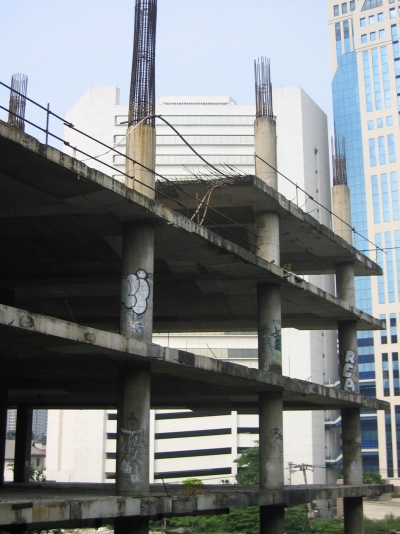
Abandoned construction, Bangkok, Thailand, approximately Sukhumvit and Soi 8, 2 December 2006

Similarly, when S. and I were in Thailand, we stayed in a neighborhood a few blocks from an abandoned, half finished concrete skeleton of a building. They were actually fairly common in Bangkok. So quickly had this construction project been abandoned that there were places where the rebar had been put in place and half the concrete had been poured when work had stopped. A pillar ended in a jagged mound of concrete with the remaining half of the uncovered rebar simply jutting skyward. I took one look at that building and said to S., “That’s probably left over from the Asian financial crisis.” That’s how suddenly and ferociously the Asian financial crisis struck: people simply walked away from multi-million dollar building projects. When the beliefs don’t pan out, the rock and the steel cease to fill out their imagined dimensions.

Ten thousand years ago ideas played almost no role in human affairs or history. Today they play a significant role, perhaps already the better part of every artifact and interaction. The Pattern On The Stone as Daniel Hillis called it. The stone is inconsequential: the pattern is everything. It is a part of the direction of history that ideas gradually at first, but with accelerating speed, displace matter as the primary constituent of the human environment.

And that, as I read it, is Hegel’s Absolute

The Mythical Economy

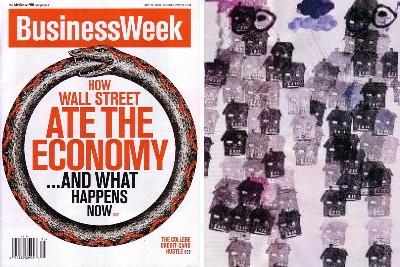
28 July 2008, BusinessWeek, Ouroboros and Moloch

BusinessWeek decides to portray the economy as Ouroboros, the serpent swallowing it’s own tail. Oddly enough, I’ve had Ouroboros on my mind quite a bit lately.

And they decide to portray Fannie Mae and Freddie Mac as Moloch.

Moloch whose buildings are judgment! … Moloch the stunned governments! …
Moloch whose blood is running money! …
Moloch whose eyes are a thousand blind windows! Moloch whose skyscrapers stand in the long streets like endless Jehovahs! …
Moloch whose soul is electricity and banks! …
Moloch! Moloch! Robot apartments! invisible suburbs! skeleton treasuries! blind capitals! demonic industries! …
They broke their backs lifting Moloch to Heaven!

Markets: Plan A or Plan B?

In an aside to an article on genetic determinism, The National Review comments on markets and the limits of information science (Manzi, Jim, “Undetermined,” vol. LX, no. 10, 2 June 2008, pp. 26-32):

In the middle of the 20th century, Friedrich Hayek and the libertarians he inspired faced those who asserted that the economy could be successfully planned. The libertarian position was not that such planning could be proved impossible in theory, but that we lacked sufficient information and processing power to accomplish it. The world of economic interaction was so complex that it overwhelms out ability to render it predictable; hence the need for markets to set prices.

I don’t for a moment believe that the Libertarian Party will disband once we cross some floating point operation threshold on supercomputers. There is the practical and there is the principled reason for subscribing to the libertarian position and I have read some of its proponents specifically state that even if the command economy could deliver superior performance, they would still be libertarians because of the component of human freedom.

More Enthusiasm for Expensive Gas

And hey, sales of compact and subcompact cars are at an all-time high, with one in five cars sold in April now from this category, up from one in eight at the height of the SUV craze. And four cylinder engines are now more popular than six cylinder. Sales of SUVs and trucks are down between 25 and 35 percent (Vlasic, Bill, “As Gas Costs Soar, Buyers Flock to Small Cars,” The New York Times, 2 May 2008).

In my own observation, I have noticed that the slug lines in D.C. — namely the one on 14th between F and G — have grown quite competitive as of late.

Regarding taxes, many critics of the holiday proposal have answered that it would simply benefit the oil companies, not consumers. But on consumers is where the burden of paying the taxes falls, right? Not exactly. Empirical studies show that consumers and oil companies roughly split the cost of gas tax increases. For example, this study excerpted by Matthew Yglesias suggests the following:

Using the estimated coefficients, we can determine the incidence of federal and state specific taxes. An increase in the federal tax by 1¢ raises the retail price by 0.47¢ and decreases the wholesale price by 0.56¢. Thus, consumers and wholesalers each pay roughly half of the federal specific tax.

(Chouinard, Hayley and Jeffrey M. Perloff, “Incidence of Federal and State Gasoline Taxes,” Economics Letters, vol. 83, no. 1, April 2004, pp 55-60; Yglesias, Matthew, “Gas Tax Incidence,” TheAtlantic.com, 2 May 2008)

These stories aren’t unrelated. Gas was hitherto imagined as one of those products for which demand was highly inelastic because it was largely a function of house purchasing and employment decisions — both factors not amenable to rapid readjustment. Consumers would only be able to adjust to increased fuel prices on the timescales in which they make house buying and employment decisions — that is, not very fast.

It turns out that consumer demand for gas isn’t as inelastic as it was previously thought. Many have pointed out that companies don’t pay taxes, they collect them. In other words, if the government taxes a corporation — they’re evil, they deserve it! — they will just pass the tax through to the consumer by building it into the price of their products. It turns out that the catch-phrase version of this story is too simple. The power of a company to pass a price along to consumers is dependent on elasticity of demand for their products. Where it’s highly inelastic, they can unproblematically pass it all on. Where consumers are more responsive, producers have less liberty and must to price with caution.

In the case of gas, it turns out that people can and do take steps to adjust their consumption — not enough that we’re going to achieve oil independence, but enough that oil companies have to think twice before passing along a price increase.

And this is all just the steps that are being taken now. I would expect urban density to begin to increase and the suburbs to start to depopulate over the next few years as those longer-term adjustments to fuel consumption come within the purview of people’s decision making.

Three Cheers for Expensive Gas

Everyone’s all worked up about the price of a barrel of oil these days, with certain pandering candidates proposing a gas tax holiday for the duration of the summer. But look what’s happening with prices being as high as they are. Drivers in the Northwest have reduced fuel consumption eleven percent to 1966 levels and long-haul freight is moving off trucks to rail, a trend driven by the 3-to-1 fuel efficiency advantage of trains over trucks. I would say this is all good news brought to you in whole by astronomical prices at the pump (Barnett, Erica C., “Northwest Gas Consumption at Lowest Level Since 1966,” SLOG, 18 April 2008; Ahrens, Frank, “A Switch on the Tracks: Railroads Roar Ahead,” The Washington Post, 21 April 2008).

Expensive gas isn’t as good as a carbon tax or a cap and trade system, but it’s progress. So let’s not give up while we’re ahead. Instead of a summer gas tax holiday, why don’t we double down? Let’s add a few more cents of gas tax. Every penny in Uncle Sam’s coffer is one less in that of the House of Saud.

And as for those truckers in Pennsylvania, it’s called creative destruction. It’s part of the capitalist system. Time to take that tech school cert in diesel engine maintenance. The rail companies are hiring like gangbusters and those are better jobs anyway. Instead of pandering on fuel prices to an industry that should be paired down to everyone’s advantage anyway, the Democrats should be pushing a grand bargain between capitol and labor: an enhanced social safety net to cushion workers against the currents of globalization in exchange for greater liberalization.

The whole argument of freemarketeers is that prices are signals to consumers and by consumers acting on those signals, optimum or near-optimum resource utilization will be achieved. I’m actually in favor of enhanced signaling. Price leveling schemes by utility companies are a convenient service to their customers who have to plan household budgets, but it is signal-dampening. I think that price leveling should be done away with favor of hyper market in utilities. Power, water and gas prices should fluctuate on a per minute or per hour basis with a price readout in every house and some smart planning tools available to consumers to help them make consumption decisions. People might run certain appliances at night when power generation and distribution systems were underutilized and the electricity at its cheapest or refrain from watering their lawns so much in the summer.