The Supernovae in Your Coffee Cup

The Supernovae in Your Coffee Cup

I loved the film π. I consider it a hugely flawed film, but what I loved about it was the way that it worked in subtle allusions to the underlying concepts motivating the film. The main character walked through a park and they point the camera skyward to show the denude winter branches of the trees, an example of fractal symmetry. One of the images that they showed a number of times throughout the film was that of a cup of coffee. Whenever someone ended up in a diner, we got a tight-in shot of them dumping the cream into their coffee and the blooms of turbulent fluid redounding from the depths. It’s a perfect example of turbulence, a phenomenon that utterly defies computation. Since π I’ve never looked at a cup of coffee the same. Every time I pour cream into my coffee it’s a little ritual where for just a second I consider the boundlessness complexity of the world, as close as the cup in my hand.

I was amused to see a recent article in New Scientist invoke the image of the cup of coffee in reference to the problem of turbulent fluids in supernovae (Clark, Stuart, “How to Make Yourself a Star,” vol. 200, no. 2679, 25 October 2008, pp. 38-41):

As the dense inner material is flung through the less dense outer layers of a star, it creates turbulence and mixes everything up. Traditional computer simulations do not model turbulence well.

“Our theoretical understanding of turbulence is incomplete,” says astrophysicist Alexei Khokhlov of the University of Chicago. In other words, you cannot write down a set of equations describing the state of a turbulent system at any given time and then use them to predict what it will look like next. Instead, you have to employ a brute-force approach, using sheer computer muscle.

To seen the scale of this problem, take your morning cup of coffee and stir in some milk. You are using turbulence to mix the two fluids. To determine how they mix, physicists mentally split the cup into boxes and assign numbers to represent the properties inside each box, such as the temperature and density of the fluid. A computer can then calculate how each box interacts with its neighbors during one brief instant of time and then re-evaluate those numbers. Once it has done this for every box, it starts again for the next slice of time and so on.

To do this massive computation perfectly, each box should be tiny and contain just one fluid particle, but before you can get anywhere near this sort of precision, the numbers become mind-bogglingly large. Scientists talk of degrees of freedom as a measure of both the numbers of particles in a system and the number of ways each particle can interact with those around it. A single cup of coffee possesses a staggering 1040 degrees of freedom — far more than you can model on today’s computers. “Maybe in 10 years we will be able to fully model a cup of coffee,” says Khokhlov.

Until then the computation will always be approximate, and thus prone to errors, because small-scale physical interactions are not being taken into account. … If it is going to take 10 years to fully model a cup of coffee, how long until we can model an entire star?

“Never,” Khokhlov says. “Not until someone comes up with a cleaver theory that does not depend on what is happening on the small scale.” The only hope is to continue to investigate turbulence to learn how to better approximate its behavior.

The Architecture of Nightmares

Circa 1999, Lebbeus Woods, detail of Terrain 1-2

In “Imagination Unmoored” (8 August 2008) I suggested that in addition to our dreams we might end up living in our nightmares. It struck me as a strange thought when I wrote it, though I didn’t even have to think any particular scenario — the eccentric, the accidental, the illicit — all the way through for its plausibility to be apparent. Our culture already abounds in it. It is in this regard that the works of H. P. Lovecraft and Philip K. Dick have been inducted into the Library of America and that players sign up for Hord in World of Warcraft. Alternative iconography seeks stark contrasts with the mundane, with Goth tending toward horror and punk the post-apocalyptic. Pornography has always tarried with the Sadistic and the surreal.

Any art of the found will inevitably end up scavenging our calamities as well as our aspirations. Enter Lebbeus Woods whose architectural design work will be included in Dreamland: Architectural Experiments since the 1970s, an exhibit at the Museum of Modern Art (Ouroussoff, Nichlai, “An Architect Unshackled by Limits of the Real World,” 24 August 2008):

In the early 1990s he published a stunning series of renderings that explored the intersection of architecture and violence. The first of these, the Berlin Free-Zone project, designed soon after the fall of the Berlin Wall, was conceived as an illustration of how periods of social upheaval are also opportunities for creative freedom.

Aggressive machinelike structures — their steel exteriors resembling military debris — are implanted in the abandoned ruins of buildings that flank the wall’s former death zone. Cramped and oddly shaped, the interiors were designed to be difficult to inhabit — a strategy for screening out the typical bourgeois. (“You can’t bring your old habits here,” he warned. “If you want to participate, you will have to reinvent yourself.”)

This vision reached its extreme in a series of renderings he created in 1993 in response to the war in Bosnia. Inspired by sci-fi comics and full of writhing cables, crumbling buildings and flying shards of steel, these drawings seem to mock the old Modernist faith in a utopian future. Their dark, moody atmosphere suggests a world in a constant struggle for survival.

In 1999 he began working on a series of designs whose fragmented planes were intended to reflect the seismic shifts that occur during earthquakes. (“The idea is that it’s not nature that creates catastrophes,” he said. “It’s man. The renderings were intended to reflect a new way of thinking about normal geological occurrences.”)

“I’m not interested in living in a fantasy world,” Mr. Woods told me. “All my work is still meant to evoke real architectural spaces. But what interests me is what the world would be like if we were free of conventional limits. Maybe I can show what could happen if we lived by a different set of rules.”

The article actually laments that the young generation in architecture has been made facile by overuse of computers. Au contraire! That is exactly how we are to experience the architecture of the impractical, built under fanciful physics.

The Beijing Olympics Did Not Take Place

One of the amusing stories coming out of the 2008 Beijing Olympics opening ceremonies is that it turns out that a portion of the video feed of the fireworks display was actually a computer simulation spliced into the broadcast. The fireworks were set off, but planners determined that they wouldn’t be able to film them as well as they would have liked, so they manufactured a version of them according to how they wanted them to have been filmed (Spencer, Richard, “Beijing Olympic 2008 opening ceremony giant firework footprints ‘faked’,” Daily Telegraph, 10 August 2008):

Gao Xiaolong, head of the visual effects team for the ceremony, said it had taken almost a year to create the 55-second sequence. Meticulous efforts were made to ensure the sequence was as unnoticeable as possible: they sought advice from the Beijing meteorological office as to how to recreate the hazy effects of Beijing’s smog at night, and inserted a slight camera shake effect to simulate the idea that it was filmed from a helicopter.

But what does it even mean to say that portions of the event were “faked”? The whole thing was illusion and artifice. Obviously significant portions of the event were computer graphics. The scroll that served as the mat for a significant portion of the floor show included computer graphics to create the image of its rolling. The projection of the Earth inside the globe was computer graphics and the unfurling scroll around the perimeter of the stadium as the final flamebearer faux-ran to the Olympic torch was computer graphics.

Increasingly computer graphics will come to be the norm, what’s really “real” and the merely material world will become the anomaly. Already we’re at the point where the big story about the latest Batman film was not the CG, but that the stuff that would usually be CG wasn’t CG (e.g. Brown, Scott, “Dark Knight Director Shuns Digital Effects For the Real Thing,” Wired, vol. 16, no. 7, July 2008, pp. 122-127). Already people are talking about augmented reality. The problem that I have with, say, Google maps and other special data, is that it’s stuck in a little box in my hand. Where it belongs is overlayed onto the world. Real-world objects are the ultimate representational tokens.

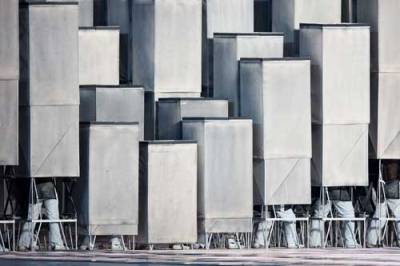
Movable type, opening ceremonies of the Bejing Olympics, 8 August 2008

Or, to turn things around, my favorite performance of the night was the “movable type” arrangement of 897 actuating blocks that raised and lowered to create patterns like a waving flag and ripples in a pond. My first reaction was that it must be computer control that created the images of waves and ripples. I wondered at how much that many hydraulic lifts must have cost and tried to imagine the programming that could produce those patters. The first time the camera panned low and showed human legs standing and squatting I was amazed.

This was an instance of “natural” things “simulating” machines. What we were watching was giant wooden pixels. What was amazing about this performance was that humans could achieve this machine-like level of control and precision.

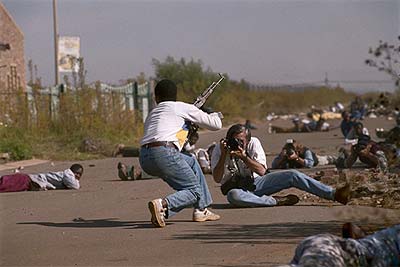
1994, David Turnley, James Nachtwey, 1994 elections in South Africa

But of course I don’t need to go to bizarre lengths. The more traditional means of artifice are well documented. There’s a reason that they call it media (middle, medium).

Imagination Unmoored

I like it when art becomes it’s own medium of response to itself, rather than leaving it to prose. I have always like Nat King Cole’s “Mona Lisa” and Don McLean’s “Vincent” (YouTube | Wikipedia). But Robbie Dingo’s recreation of Vincent van Gogh’s Starry Night in Second Life, making a video of the process of creation, then setting it to Don McLean’s song does it all one better (Au, Wagner James, “Remake the Stars,” New World Notes, 18 July 2007).

Schema of the arts and sciences aside, I like this for what is suggests for the future of virtual worlds. Hitherto our imaginations have been stunted by continuous exposure to the narrow Newtonian world of the macroscopic everyday. Witness, for example, what happens when people try to imagine fantastical animals. All that we can come up with is combinations of existing animals: griffins, mermaids, centaurs, dragons, Cerberus, et cetera.

Once we start to live in a regular way in virtual worlds of our own creation, a dynamic will form where each feat of imagining will establish a new norm and a new developmental environment from which each subsequent foray of imagining and generation of imagineer will be capable of going a little further beyond the forms of this world. As we increasingly live in worlds not constrained by the same limits as the material world, our imaginations will become completely unmoored from the forms provided to us by macroscopic nature. The true, autonomous nature of the imagination — throughout all of history shackled by the relentless, overwhelming conditioning of the narrow forms presented to us by dull matter — will be liberated.

And owing to neuroplasticity, inherited or induced, maturing and living in radically different worlds will allow us to develop new modes of being and new understandings. In the future we will live in our dreams and our nightmares. Science has laid the groundwork for our art to become the more fundamental reality. The direction of humanity is a retreat from the material world into a world composed entirely of mind.

Mr. Au mentions Akira Kurosawa’s Dreams (IMDB | Wikipedia). I think maybe it’s time to dig out and rewatch an old favorite, Until the End of the World (IMDB | Wikipedia).

Politically, for all of human history the Earth has provided the unified point of reference for all humanity. With a proliferation of possible environments, the hitherto more or less unified character of the human world will gradually degenerate. The dissolution of our political order, multiculturalism, neo-primitivism, the turning away from master narratives and the dawning of the postmodern era are natural consequences of technology.

As Vernor Vinge said of the coming of the singularity, “I can see us becoming weird — before my very eyes” (“My Apocalyptic Vision is Very Narrow,” 13 June 2008).

The Mythical Economy

28 July 2008, BusinessWeek, Ouroboros and Moloch

BusinessWeek decides to portray the economy as Ouroboros, the serpent swallowing it’s own tail. Oddly enough, I’ve had Ouroboros on my mind quite a bit lately.

And they decide to portray Fannie Mae and Freddie Mac as Moloch.

Moloch whose buildings are judgment! … Moloch the stunned governments! …
Moloch whose blood is running money! …
Moloch whose eyes are a thousand blind windows! Moloch whose skyscrapers stand in the long streets like endless Jehovahs! …
Moloch whose soul is electricity and banks! …
Moloch! Moloch! Robot apartments! invisible suburbs! skeleton treasuries! blind capitals! demonic industries! …
They broke their backs lifting Moloch to Heaven!

Anti-Humanist Architecture

I like Charles Mudede, I think he’s a pretty unique guy, but comments like this (“La Defense,” SLOG, The Stranger, 15 July 2008) make my fantasies of an architecture holocaust all the more vivid:

We see that the best buildings have in their design no humans in mind. All the better if the work is alien, monstrous, indifferent–anything more other than what we are already. A work that strives for the inhuman strives to be closer to the truth, which consistently turns out to be inhuman.

That’s all fine and good, but for the rest of us, we thought we were going shopping, commuting, trying to renew some government mandated piece of documentation, when in addition to all the rest of the litany of the day’s petty insults, we have to have an encounter with the monstrous truth as well. One may have thought that alien and indifferent were good for avant guard philosophy books, but apparently they’re a good arrangement for the DMV flagship office too. Thank you, architecture.

Commercial Pleasures

21 May 2008, David Cook wins American Idol

When I first moved to D.C. I had a roommate who was such a Redskins fan that I almost couldn’t be in the house when a game was on, so loudly did he scream at the television. I didn’t get it. There’s no excuse for getting that emotionally wrapped up in something so alien from one’s own life. Then I discovered Ninja Warrior on G4 (G4 | wikipedia). S. and I scream and wave our hands at the television with an increasing fanaticism as the contestant nears the finish line and the announcer goes ballistic with Japanese excitement.

Last night when they declared David Cook the winner of American Idol I lost it in a way that I never have before over television. From the time it of the final six (Carle, Brook, Castro, Syesha, Archuleta and Cook) it has been apparent to both S. and I that it was going to come down to a contest of the Davids and both of us have pretty much figured that Archuleta had the teenie-bops with their text-dexterous fingers all lined up and thus was going to win. Last week when Syesha was voted off I though Archuleta was going to win. Cook seems burned out and you could see the disappointment he had with himself after many of his performances. Meanwhile Archuleta’s been on the rise. “Stand by Me” couldn’t have been a better choice for him. Then on Tuesday night Archuleta’s rendition of Elton John’s “Don’t Let the Sun Go Down on Me” was perfect. Meanwhile Mr. Cook’s songs were sufficiently mediocre that after his final performance (“The World I Know“) he too was so certain that he had lost that the moment he finished his song, before Randy Jackson had said his first “Yo,” Mr. Cook started to cry. The judges all gave him consolation complements.

And I had long since made my peace with Mr. Cook coming in second. He has a tendency toward incipient pop rock as it is and being saddled with the obligations of being the American Idol was only going to further hamper him. They were going to hoist a few television commercials and a really marketable, over-produced album on him, when what he needs is to get together with someone edgier, someone who realizes that the explosive, dramatic power ballads are Mr. Cook’s forte. Better that Mr. Archuleta ends up the America Idol. He’s already a one-man boy band.

And so last night when Ryan Seacrest started, “And the winner is … ,” I interjected “Archuleta.” “David”; Seacrest paused having revealed nothing with two finalists both named David. Again I finished his sentence. “Archuleta.” When Mr. Seacrest finally let out “Cook” I leapt off the sofa. “No fucking way!” I shouted in disbelief. After fore explicatives and expressions of disbelief I tuned around in a circle and stared at the television in disbelief. Out of 97.5 million votes, Mr. Cook won 54.75 million to Mr. Archuleta’s 42.75 million, or 56 percent of the vote, a 12 million vote margin of victory. I was sure that David Cook was going to lose, but he won and in the end it wasn’t even close.

And Mr. Cook thought he knew he had lost as well. He seemed resigned to his fate and already congratulatory toward Mr. Archuleta as Mr. Seacrest taunted them with the results. I think it was the shock as much as the adulation and excitement that caused Mr. Cook to become so emotional after the announcement.

This is part justice and part tragedy. Mr. Cook is 25 years old. He got a degree in graphics design, but before settling into the nine-to-fiver he told himself that he was going to give music a few more years to see if he could make it work. One of his friends and a band-mate had already given up on music and gone to real work. Mr. Cook was nearing the end of his experiment and already had his alternative waiting in the wings. He’s been given a new lease on his dream. On the other hand, his older brother, Adam, is dying o brain cancer. I heard, I think it was his mother, say that it’s like heaven and hell: for David to be doing so well while things are going so poorly for Adam. I can’t imagine the survivor’s guilt Mr, Cook must be feeling in front of his brother. It has been an emotional rollercoaster for Mr. Cook and his family.

How did it happen? Always the political blogger — can’t avoid analyzing election returns. A few episodes ago I saw a sign waving in the audience: “Cougars for Cook.” The average age of an American Idol viewer is significantly up — witness moi. I guess the cougars overruled the teenie-bops. The other factor was his trio of performances early in the season: Lionel Richie’s “Hello,” the Beatles’s “Eleanor Rigby” and Michael Jackson’s “Billie Jean.” I think he never did anything so spectacular as “Billie Jean” and he tired as the season wound to its climax, but on those three he built a winning reputation.

I took a little walk this afternoon to go buy lunch and some coffee. I found my pace brisk and my thoughts buoyant. In the background of my mind, David Cook had won, and it has caused the slightest uplift in my mood all day long. It’s stupid I know, to be such a fan-boy. But I can’t help it: I really like David Cook.

Bob Dylan-Like Lyrics

Weird Al Yankovic exists somewhere on that thin line between being a complete doofus and a genius. His spoof of Bob Dylan’s “Subterranean Homesick Blues” (YouTube | Wikipedia) is firmly ensconced on the side of genius. In Weird Al’s version, all the lyrics are palindromes and as a method for generating Bob Dylan-like lyrics, palindromes seem to work surprisingly well.

For the original Dylan film — what we now call a music video — the person who helped Dylan make the cue cards: Allan Ginsberg.

I sometimes feel at a disadvantage in defending the nonsensical, sort of Da-Da poetry lyrics of Nirvana. Or at least merely in the vicinity of sense, insofar as one gets the sense that there is some meaning or narrative to a Nirvana song, it’s just not a sense that stands up once one begins to look closer or try to impose any sense. In this regard Nirvana seems to be well within the tradition of Dylan.

1960s: Romanticism and Decline

After years of the right-wing version of the history, there is a tendency to think of the late 1960s and early 1970s as a period of decadence and decline. But thankfully in recent years we have pulled back from the precipice. Or we think of the 60s from a post 1980s and 90s capitalist triumphalist perspective: as colorful and quixotic kitsch denude of any ethical or political import.

Last night I spent a few hours listening to Ginsberg’s Howl, watching Joe Crocker concerts on YouTube and whatnot and I challenge anyone to listen to Nina Simone’s 1969 Harlem Festival (Central Park, New York) performance of “Ain’t Got No…I’ve Got Life” and tell me we’re not a civilization that’s put an additional forty solid years of decline under out belt. To hear a song so simply constructed — it’s just two lists of commonplace items — but so evocative and watch that face like a statue but with the pathos of the entire human condition! Compared to our contemporary world of rampant materialism, status-seeking, vanity, cynicism, cleverness, conformity, vapid luxury, triviality and selflessness (by which I don’t mean generosity), the 60s and 70s look like a golden age of humanist assertion.

I would love to read a systematic comparison of the various romanticist periods of history.

On the other hand, people — at least people my age — tend to think of the period as still historically close, relevant, but when I was watching Joe Crocker last night, it occurred to me that the performances that I was watching are as far removed from us today as the Second World War was when I was a kid. 1968 was forty years ago. When I was ten, the Second World War had ended forty years ago as well and I thought of that as ancient history. The greatest generation are about to disappear, but notice that Bill Clinton, a baby boomer, is a bumbling old greyhair who’s had a stroke for crissake.