Books I Haven’t Read

Since I just bought Pierre Bayard’s How to Talk About Books You Haven’t Read, I guess that I should post on it now, not having read it, rather than later when maybe I will.

I became a book collector fairly early on and all the way up through my early post-college years I could still name the author and title of every book I owned and I had honestly familiarized myself with at least a significant chunk of each one. But then as my income grew while my available free time stayed constant or even has diminished slightly, the portion of my book collection with which I have that level of familiarity has shrunk precipitously. At this point I have to confess to being as much a book collector as a book reader. In fact, it occurred to me a few nights ago, after recently having installed three new shelves, that I may have to start budgeting my book acquisitions in shelf-inches rather than dollars (“I’m only allowed three inches this month so its either the thousand page tomb or the two 350 page jobs”).

When S. saw me unload this latest acquisition from my bag she was rather amused that I had found just the right book. But with the seed planted, on no less than three occasions throughout the day did I catch myself and stop to point out that I was just that moment talking about some text that I had not in fact read.

And this dovetails well with David Brooks’s column a few weeks ago on “The Outsourced Brain” (The New York Times, 26 October 2007) where he said,

I had thought that the magic of the information age was that it allowed us to know more, but then I realized the magic of the information age is that it allows us to know less.

In a follow-up, Ezra Klein really makes the not reading point (“The External Brain,” 26 October 2007):

But so long as [Google’s] around, I don’t need to really read anything. I just need to catalogue the existence of things I might one day read. I don’t so much study web sites as scan for impressions, for markers, for key words I’ll need if I want to return. I don’t need the knowledge so much as a vague outline of what the knowledge is and how to get back.

Indeed, not reading is the wave of the future.

When I was younger and not yet even a dilettante, still just groping toward my present pissant snobbery, my younger and even more bizarre brother, brought us both into contact with the film The Metropolitan. The class issues were lost on me at the time, but it was a revelation: people just hanging around talking about ideas and drinking cocktails. What more could a person possibly want?

The snippet of dialogue that then as now stands out to me the most is one of their salon go-rounds:

Audrey Rouget: What Jane Austen novels have you read?

Tom Townsend: None. I don’t read novels. I prefer good literary criticism. That way you get both the novelists’ ideas as well as the critics’ thinking. With fiction I can never forget that none of it really happened, that it’s all just made up by the author.

To this day I probably read twice as many book reviews as I do actual books.

Book Catalog Geek-Out

Cataloging my books on LibraryThing, Washington, D.C., 28 September 2007

S. bought me a lifetime membership to LibraryThing and I found that scanning books into a web database is the perfect distraction from sleep at 2:00 in the morning on a work night. Whenever I had a few minutes I would pull a cubby off the shelf and scan maybe a dozen books at a time. It took a few weeks like this, but soon enough I had the entire collection in.

Now if only LibraryThing had a tool to run off Dewey decimal number labels.

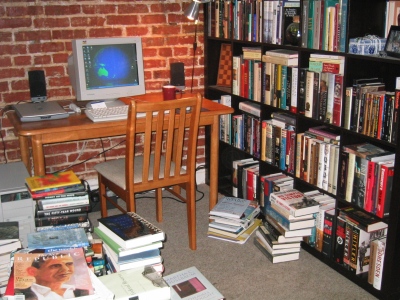
Here is my collection. It presently stands at 800 volumes. I dread having to move out of my basement apartment. The new place will undoubtedly be a third-floor walk-up and a studio to boot.

If any reader with a particularly large collection decides to catalog their books too, I highly recommend the CueCat barcode scanner. It’s cheep, ships quickly and turned a job that could have taken months into one that was only like two weeks of a few minutes each night.

Anyway, here’s a picture with most of the back side of the bookshelf to the right still stacked around my PC. It’s also the station where one third of the magic here at This Is Not A Dinner Party happens.

The Post-August Assault on the Media Budget

August is the slow month in the publishing industry. Everyone goes away on vacation and isn’t thinking about reading, so to help the first week sales figures, publishers don’t release titles in August. Being forward-looking in my book buying, I can see that September and October are make-up months and are going to decimate my book buying budget.

In economics there is the already much talked about and guaranteed to make waves title by U.C. Davis Economics Department Chairman Gregory Clark, A Farewell to Alms: A Brief Economic History of the World. Oddly enough, Mr. Clark has chosen a completely general sounding title for what is, in fact, a highly polemical and specialist book. For a taste of the controversy, see the New York Times article on the book (Wade, Nicholas, “In Dusty Archives, a Theory of Affluence,” 7 August 2007). Seemingly just in time for the next economic crisis is Robert Bruner and Sean Carr’s book, The Panic of 1907. In the immense shadow of the Great Depression no one thinks about all the lesser economic crises that preceded it, but as Bruner and Carr argue, the crisis of 1907 was really a watershed. It would, among other things, play a part in bringing about the Federal Reserve six years later in 1913. Robert Reich, one of my favorite writers, has his latest offering, Supercapitalism: The Transformation of Business, Democracy, and Everyday Life out. The cleaver cover is a dollar sign with a forked tongue. His thesis is previewed in the current issue of Foreign Policy (“How Capitalism Is Killing Democracy,” September / October 2007, pp. 38-42). The barn burner this month will undoubtedly be Alan Greenspan’s The Age of Turbulence: Adventures in a New World (due out 17 September 2007). As I previously observed (“Alan Greenspan’s Memoir,” smarties, 6 July 2007), while the title may be accurate, it is, to me, still a little off.

In history I seem to have developed a fixation on the Soviet Union and the Cold War. First is the most recent after some time without, a book on the origin of it all, Evan Mawdsley’s The Russian Civil War. Jumping ahead to the crucible of the century is a book, the title of which does not do justice to the controversial rampage beneath its covers, Norman Davies’s No Simple Victory: World War II in Europe, 1939-1945. To get a flavor for his book, one may consult Benjamin Schwarz’s paragraphs devoted to in his review, “Stalin’s Gift” (The Atlantic Monthly, May 2007). Mr. Davis is an iconoclast come to raise the American mythos, a la Stephen Ambrose, of the Second World War as the good war, to show in fact that it was really a war in which one totalitarian dictator, Joseph Stalin, crushed another, Adolph Hitler, under the sheer weight of men and machines. On the Eastern Front 400 Soviet and German divisions squared off along a thousand mile frontier. There Germany would sustain 80 percent of its war casualties. By comparison, the Western Front, were 15 U.S. and U.K. divisions faced 15 German divisions, was little more than a harassing operation. The battle of Kursk remains the largest armor battle in history and saw the most deadly single day of aerial combat. Mr. Davis sets himself to exploding such myths of the Second World War. Less polemical, Benjamin Schwarz recommended the more scrupulously historical Thunder in the East: The Nazi-Soviet War, 1941-1945 by Evan Mawdsley. But he warned that in the deluge of books on the Eastern Front, even the latest research has “already been overtaken by new sources.” One such book will, I presume, be Chris Bellamy’s Absolute War: Soviet Russia in the Second World War.

Moving on in history, one of the most prominent Cold War historians, Melvyn Leffler has a new title coming out, For the Soul of Mankind: The United States, the Soviet Union, and the Cold War. It’s another that keeps up the theme of titles not really adequately descriptive of the content. It sounds as if Mr. Leffler’s book might be about the ideological struggle between the West and Communism or about the contending views of human nature, but it is instead a book about five occasions when either side contemplated winding down the Cold War. Though he was killed in an automobile accident in April, what David Halberstam considered to be his finest book, The Coldest Winter: America and the Korean War will be published posthumously on 25 September 2007. Most significantly for me is volume three of what Richard Rhodes is now calling his Making of the Nuclear Age trilogy, Arsenals of Folly: The Making of the Nuclear Arms Race, about what is perhaps my favorite single subject.

But this monomania is all inadvertent and I remain on the lookout for broader histories. Also on the list are the longer histories of Rome and Jerusalem: The Clash of Ancient Civilizations by Martin Goodman and The Great Arab Conquests: How the Spread of Islam Changed the World We Live in by Hugh Kennedy. Mr. Goodman has edited both The Journal of Roman Studies and The Journal of Jewish Studies and has been a professor of both Roman and Jewish studies at Oxford so I presume that he is uniquely positioned to do justice to the difficult subject of the clash of Rome and Jerusalem.

In philosophy and intellectual history is Charles Taylor’s A Secular Age which will hopefully be the first title for the book group on this blog and E.M. Cioran’s Notebooks, translated by Richard Howard who has done so much for Cioran’s English language readers. It’s been given a new release date of 3 October 2007 which will hopefully be met as publication has been delayed since, I think, 2005.

Finally, in the snark department, I am eagerly awaiting Stephen Colbert’s I Am America (And So Can You!).

Taken together that’s 7500 pages and $475 (sans tax) of book. Fortunately I only ever really peck at a book so at least the pages shouldn’t be too much of a problem, but the money remains another issue. I just have to shrug my shoulders and confess to a hopeless case of bibliophilia. At least it’s pulp and not poppies.

The Bibliographic Legacy of the Cold War

Walking around a used book store in Washington, D.C. I am reminded of another as yet unresolved dilemma left over form the Cold War: what to do with all the really narrowly focused specialty books on the Soviet Union for which all the retired Kremlinologists no longer have any use. You go to the Russia section in the store and it is like the PC book section: full of titles so arcane to the average used book store buying agent that they have no idea that they are the dupe to someone’s need to offload a bunch of obsolete books. Instead of, say, a few general histories of Russia in the Nineteenth Century or some modern books on Putin’s Russia, what you have are dozens of heavily thumbed tombs dating from the Sixties and Seventies on topics such as the persistence of the third five year plan in Soviet economic planning or the roll of the Politburo in ideology formation, 1954-1960. Just like many used book stores don’t buy PC books, D.C. used book stores should adopt a policy of no books on the Soviet Union by former CIA Directorate of Analysis employees.

Seize the Opportunity to Throw One Back

I’m considering educating myself a little on Graham Greene and so, at the inspiration of a passage posted by Andrew Sullivan (“‘The Torturable Class’,” The Daily Dish, 26 July 2007), purchased a copy of Our Man in Havana. Christopher Hitchens wrote the introduction and — apropos an earlier post (“Booz-Hound Christopher Hitchens,” 28 June 2007) — he tells the following tale:

Graham Greene famously subdivided his fictions into ‘novels’ and ‘entertainments’ …

I should like to propose a third, or subcategory: the whisky (as opposed to the nonwhisky) fictions. Alcohol is seldom far from the reach of Greene’s characters, and its influence was clearly some kind of daemon in his work and in his life. A stanza of that witty and beautiful poem ‘On the Circuit,’ written in 1963, registers W. H. Auden’s dread at the thought of lecturing on a booze-free American campus and asks, anxiously and in italics:

Is this my milieu where I must
How grahamgreeneish! How infra dig!
Snatch from the bottle in my bag
An analeptic swig?

Describing a visit to a 1987 conference of ‘intellectuals’ in Moscow in the early Gorbachev years, both Gore Vidal and Fay Weldon were to record Green making exactly this dive into his bottle-crammed briefcase.

Makes me think, as Nietzsche said, that all writing is autobiographical of a sort.

Cool Dude

With the publication of his latest, Thomas Paine’s Rights of Man, Christopher Hitchens has acceded to the rank of author whose photograph is promoted from the back inside flap to displace a more topical graphic from the cover. Some authors you can understand why they go on the cover. Ann Coulter is at least hot (as right wingers go) and can be expected to move some copies, more to be admired than read. Christopher Hitchens, on the other hand, is like the Archie Bunker of the left. But I guess he’s a man whose image is an icon at this point though.

First Impressions of The 9/11 Commission Report

Kevin Drum starts off his first post on the 9/11 Commission Report saying, “I would rather stick bamboo shoots under my toenails than actually read the entire 9/11 report.” This is too bad because the report is very well written, more like any other book you might read on the post-September 11th world than a government commission report. It might be even more important than other books in its category because it was written with the highest level of access imaginable. It’s endnotes include references not just to witness testimony and classified government documents, but academic and popular literature on the subject, NPR segments and so on.

The strange thing about the report is its sensitivity and the restrained, yet dramatic use of language with which it is written. Let me make three examples from the first chapter.

  • After a few pages of material about the hijackers checking in at the airports, the quality of the metal detection wand screenings, and respective times of airplane departure that are true to the tedium of the airport experience, the report suddenly changes direction, hitting the reader with the poignant cause for all this seemingly innocuous information:

    The 19 men were aboard four transcontinental flights. They were planning to hijack these planes and turn them into large guided missiles, loaded with up to 11,400 gallons of jet fuel. By 8:00 A.M. on the morning of Tuesday, September 11th, 2001, they had defeated all the security layers that America’s civil aviation security system then had in place to prevent a hijacking. (4)

    I recently took another look at some photographs from that morning. The one of the south tower with the impossibly huge fireball coming out of the side opposite the impact was as shocking as if it had happened yesterday. That last sentence in the above passage gave me a similar pause — and was, I suspect, calculated to do so. A sentence of calculated emotional efficacy in a government report is highly unusual.

  • In the the story of the hijacking of United flight 175, the report recounts telephone calls from Peter Hanson and Brian Sweeney to their parents:

    At 8:58, the flight took a heading toward New York City.

    At 8:59, Flight 175 passenger Brian David Sweeney tried to call his wife, Julie. He left a message on their home answering machine that the plane had been hijacked. He then called his mother, Louise Sweeney, told her the flight had been hijacked, and added that the passengers were thinking about storming the cockpit to take control of the plane away from the hijackers.

    At 9:00, Lee Hanson received a second call from his son Peter:

    “…I think we are going down — I thing they intend to go to Chicago or someplace and fly into a building — don’t worry, Dad — If it happens, it’ll be very fast — My God, my god.”

    The call ended abruptly. Lee Hanson had heard a woman scream just before it cut off. He turned on a television, and in her home so did Louise Sweeney. Both of them saw the second aircraft hit the World Trade Center. (8)

    This story adds nothing to our understanding of the causes and the security failures that led to the successful attacks, nor the reforms necessary to prevent future attacks. What it does add is something of an understanding of what those directly affected when through that day.

    There is almost an element of “a people’s history” of September 11th. When future historians turn to one of their primary sources on the subject, it will contain the names and stories of some of the people, usually overlooked or addressed only as “the three thousand”, who died that day. The report calls out the names of the pilots of the flights, all the terrorist hijackers, the stewardesses such as Betty Ong who made phone calls to alert ground staff, Daniel Lewin, the former Israeli military officer whose throat was slashed as he jumped up to stop Mohamed Atta, not realizing that one of the hijackers was seated right behind him, Barbara Olson’s calls to her husband, the Solicitor General of the United States. It is terrifying reading.

  • Recognition is growing that the passengers of United flight 93 did something amazing the morning of September 11th. The Commission Report makes a near memorial of itself when recounting their efforts with the stark sentences,

    With the sounds of the passenger counterattack continuing, the aircraft plowed into an empty field in Shanksville, Pennsylvania, at 580 miles per hour, about 20 minutes’ flying time from Washington, D.C.

    Jarrah’s objective was to crash his airliner into symbols of the American Republic, the Capitol or the White House. He was defeated by the alerted, unarmed passengers of United 93. (14)

    The use of the lofty term, “the American Republic,” suggests much more than a mere government report.

Interpreting their mandate as “sweeping,” the commission goes way beyond the immediate failures of intelligence enabling the September 11, 2001 attacks, and lays out an entire history of militant Islam and a strategy to combat it.

I think that David Brooks (“War of Ideology,” The New York Times, 24 July 2004), is accurate when he writes,

When foreign policy wonks go to bed, they dream of being X. They dream of writing the all-encompassing, epoch-defining essay, the way George F. Kennan did during the cold war under the pseudonym X.

Careers have been spent racing to be X. But in our own time, the 9/11 commission has come closer than anybody else.

I suspect that the 9/11 Commission Report will play a significant roll in our future policy debates. As such, it deserves as wide a reading as it may be getting.

William Gibson’s Idoru and Blogging

I want to add one more thought about blogging before I get started. In my Inaugural Post I asked, “Why join this societal wave of exhibitionism?” and mentioned the relation of technology to surveillance, voyeurism, privacy and exhibitionism. Every time I think about these issues, a character from William Gibson’s 1996 novel Idoru comes to mind.

Before I delve into the main point, I want to say that I think William Gibson is a genius. In his first novel, Neuromancer (1984), the hit that launched the cyberpunk genre, he came up with the term cyberspace. In case you passed over that parenthetical date too quickly, let me point out that he came up with the idea of cyberspace in 1984: before there was either the Internet or virtual reality.

Yes, I am aware that Tron came out in 1982, but Tron is about a man who is sucked into a little, tiny world inside of a computer were the programs are personified (e.g. the vilan, “Master Control”) and forced to fight high-tech gladiatorial games in sexy spandex body suits. This of course will never happen and is merely a technological variant of The Fantastic Voyage, The Wizard of Oz or The Lion, The Witch and the Wardrobe. Yes, there are some silly parts of Neuromancer: the space Rastafarians are hardly the heady stuff of Arthur C. Clarke or Isaac Asimov. However, a total emersion interface to a simulated world spread over a network of computers is freaking visionary. Unlike Tron, which set people’s understanding of computers back a decade, Neuromancer is the future.

What is most relevant to blogging is his vision of celebrity and media that make up the ideological backdrop of Idoru. The novel is set in the not-too-distant future where mass media has continued to throw its net wider and wider, where, as Andy Warhol said in what must be the most accurate prediction ever made, “everyone will be famous for fifteen minutes.” Murderers are famous, the parents of their victims are famous, college students fake kidnappings to get on television, unaccomplished debutantes are famous for nothing other than ostentation, people become famous when sex tapes “accidentally” find there way on to the Internet, people elbow their way onto television for opportunities to boast about things that previously one wouldn’t even want one’s neighbors to know. Actually, I am talking about the present, but imagine this trend married to the myriad of widely affordable media production and distribution technologies chased out twenty years into the future. With thousands of television channels to fill up and with everyone’s vanity site on the Internet and with no gatekeepers, fame will devolve to the masses. Gibson has one of his characters describe it thus:

“Nobody’s really famous anymore, Laney. Have you noticed that?…I mean really famous. There’s not much fame left, not in the old sense. Not enough to go around…We learned to print money off this stuff,” she said. “Coin of our realm. Now we’ve printed too much; even the audience knows. It shows in the ratings…Except,” she said… “when we decide to destroy one.” (6-7)

Gibson spends the opening chapters of the book describing how derelict protagonist Colin Laney lost his previous job as a “researcher” at a tabloid news show called Slitscan. In this future, like our present, an increasing proportion of people’s transactions are being passively recorded in corporate databases. And also as in our present, some companies exist solely to purchase information, correlate disparate pieces in useful ways and sell it to those who might put it to some (usually pernicious) use. In this novel, Slitscan had a questionable relationship with such a data agglomeration corporation called DatAmerica and Laney’s job was to troll through the data trails left by celebrities looking for the “nodal points” — the confluences of data — that indicated something gossip-worthy for the show to report.

Laney was not, he was careful to point out, a voyeur. He had a peculiar knack with data collection architectures, and a medically documented concentration deficit that he could toggle, under certain conditions, into a state of pathological hyperfocus…he was an intuitive fisher of patterns of information: of the sort of signature a particular individual inadvertently created in the net as he or she went about the mundane yet endlessly multiplex business of life in a digital society. (30-31)

Laney was fired when, while researching the mistress of a celebrity, it became clear to him from her data trail that she intended to commit suicide and he tried unsuccessfully to intervene. Here Laney checks back with his mark after returning from a vacation:

The nodal point was different now, though he had no language to describe the change. He sifted the countless fragments that had clustered around Alison Shires in his absence, feeling for the source of his earlier conviction. He called up the music that she’d accessed while he’d been in Mexico, playing each song in the order of her selection. He found her choices had grown more life-affirming; she’d moved to a new provider, Upful Groupvine, whose relentlessly positive product was the musical equivalent of the Good News Channel.

Cross-indexing her charges against the records of her credit-provider and its credit retailers, he produced a list of everything she’d purchased in the past week. Six-pack, blades, Tokkai carton opener. Did she own a Tokkai carton opener? But then he remembered Kathy’s advice, that this was the part of research most prone to produce serious transference, the point at which the researcher’s intimacy with the subject could lead to loss of perspective. “It’s often easiest for us to identify at the retail level, Laney. We are a shopping species. Find yourself buying a different brand of frozen peas because the subject, watch out.” (66-67)

Before excerpting a passage where Gibson describes the future of gossip journalism, let me remind you that this is Gibson’s view from 1996, when MTV’s The Real World was only in its 4th season, the O.J. Simpson trial was just over, Monica Lexinsky’s blue dress was stain-free and Survivor was still four years off:

Slitscan was descended from “reality” programming and the network tabloids of the late twentieth century, but it resembled them no more than some large, swift, bipedal carnivore resembled its sluggish, shallow-dwelling ancestors. Slitscan was the mature form, supporting fully global franchises. Slitscan’s revenues had paid for entire satellites and built the building he worked in in Burbank.

Slitscan was a show so popular that it had evolved into something akin to the old idea of a network. It was flanked and buffered by spinoffs and peripherals, each designed to shunt the viewer back to the crucial core, the familiar and reliably bloody alter that one of Laney’s Mexican co-workers called Smoking Mirror.

It was impossible to work at Slitscan without a sense of participating in history, or else what Kathy Torrance would argue had replaced history. Slitscan itself, Laney suspected, might be one of those larger nodal points he sometimes found himself trying to imagine, an informational peculiarity opening into some unthinkably deeper structure.

In his quest for lesser nodal points, the sort that Kathy sent him into DatAmerica to locate, Laney had already affected the course of municipal elections, the market in patent gene futures, abortion laws in the state of New Jersey, and the spin on an ecstatic pro-euthanasia movement (or suicide cult, depending) called Cease Upon the Midnight, not to mention the lives and careers of several dozen celebrities of various kinds.

Not always for the worst, either, in terms of what the show’s subjects might have wished for themselves. Kathy’s segment on the Dukes of Nuke ‘Em, exposing the band’s exclusive predilection for Iraqi fetal tissue, had sent their subsequent release instant platinum (and had resulted in show-trials and public hangings in Baghdad, but he supposed life was hard there to begin with). (50-52)

Of course, something like Slitscan — or the Jerry Springer Show, Cops, E True Hollywood Story, Average Joe or The Fifth Wheel in our time — could not exist were it not for the sadistic voyeurism of the masses. I select this passage as much to satisfying my own snickering elitism as to illustrate the lust for other people’s misery that comprises our current and future television viewing audience:

…Slitscan’s audience…is best visualized as a vicious, lazy, profoundly ignorant, perpetually hungry organism craving the warm god-flesh of the anointed. Personally I like to imagine something the size of a baby hippo, the color of a week-old boiled potato, that lives by itself, in the dark, in a double-wide on the outskirts of Topeka. It’s covered with eyes and it sweats constantly. The sweat runs into those eyes and makes them sting. It has no mouth, Laney, no genitals, and can only express its mute extremes of murderous rage and infantile desire by changing the channels on a universal remote. Or by voting in presidential elections. (35-36)

Of course one can already see aspects of this world coming into being. Corporations are harvesting, agglomerating and correlating information at a frightening and increasing rate — but that is for another post. What I am thinking about here is the voyeuristic and micro-celebrity aspects of our quickening information age. I have a friend who reads several people’s blogs on an occasional basis, some of whom he has never even met. Of one that he hasn’t met, he maintains that this blogger is teetering on the brink of an infidelity with a coworker against his current girlfriend — an infidelity, the imminence of which he himself is not yet aware! My friend keeps returning to this blog awaiting the climactic post as if it were a soap opera.

There you have it: micro-celebrity, sadistic voyeurism, a readable data trail from which one might extrapolate future behavior with a minimal amount of theory. Admittedly, my friend is following an intentional data trail rather than a passive one, but the small difference between this situation and that of Gibson’s Laney anticipating the suicide is striking.

I don’t absolve myself of any of this. I loved the show Trauma: Real Life in the ER, which is about as sadistic of a voyeurism as you’ll find. I did say in the “Inaugural Post” that I consider this a “deeply improprietious endeavor.” I am, however, aware of the context in which I embark upon this effort.