The Day I Became a Hegelian

I remember distinctly 14 April 2000, the day the Dow Jones Industrial Average dropped 617.78 points, or 5.7 percent, to 10,305.77 (Fuerbringer, Jonathan and Alex Berenson, “Stock Market in Steep Drop as Worried Investors Flee; NASDAQ Has Its Worst Week,” The New York Times, 15 April 2000, p. A1). The company where I worked offered options and stock purchase plan heavy compensation packages and it was the first really precipitous drop in the stock market since the online discount stock brokers like E-Trade went really big. At the office where I worked nothing got done that day: no one could do anything but watch their portfolios plummet. I remember a group of us going out for lunch. This was in Seattle and the Harbor Steps II was still under construction. At that time it was just a reinforced concrete skeleton and a kangaroo crane. As the group of us walked down — I don’t know — probably University Street, I looked up at the concrete stack of Harbor Steps II and the bustle in and around it and it occurred to me that if the stock market were to continue to fall like it was, the development company might halt construction — that building would cease its coming into being. At that moment, I saw that it was primarily a blueprint, an architect’s vision, a developer’s profit and loss projections, investor expectations. It was less matter and more idea and at that moment I first thought that maybe there was something to this Hegel fellow.

Abandoned construction, Bangkok, Thailand, approximately Sukhumvit and Soi 8, 2 December 2006

Similarly, when S. and I were in Thailand, we stayed in a neighborhood a few blocks from an abandoned, half finished concrete skeleton of a building. They were actually fairly common in Bangkok. So quickly had this construction project been abandoned that there were places where the rebar had been put in place and half the concrete had been poured when work had stopped. A pillar ended in a jagged mound of concrete with the remaining half of the uncovered rebar simply jutting skyward. I took one look at that building and said to S., “That’s probably left over from the Asian financial crisis.” That’s how suddenly and ferociously the Asian financial crisis struck: people simply walked away from multi-million dollar building projects. When the beliefs don’t pan out, the rock and the steel cease to fill out their imagined dimensions.

Ten thousand years ago ideas played almost no role in human affairs or history. Today they play a significant role, perhaps already the better part of every artifact and interaction. The Pattern On The Stone as Daniel Hillis called it. The stone is inconsequential: the pattern is everything. It is a part of the direction of history that ideas gradually at first, but with accelerating speed, displace matter as the primary constituent of the human environment.

And that, as I read it, is Hegel’s Absolute

The First Non-Trivial Cyborg

There are all sorts of cyborgs already among us: my dad has plastic irises, my mom has a metal hip. But these are trivial. A team of researchers at the University of Reading, United Kingdom has produced the first non-trivial cyborg, a robot controlled entirely by neural circuitry (“A ‘Frankenrobot’ with a Biological Brain,” Agence France-Presse, 13 August 2008):

… Gordon has a brain composed of 50,000 to 100,000 active neurons. Once removed from rat foetuses and disentangled from each other with an enzyme bath, the specialised nerve cells are laid out in a nutrient-rich medium across an eight-by-eight centimetre (five-by-five inch) array of 60 electrodes.

This “multi-electrode array” (MEA) serves as the interface between living tissue and machine, with the brain sending electrical impulses to drive the wheels of the robots, and receiving impulses delivered by sensors reacting to the environment. Because the brain is living tissue, it must be housed in a special temperature-controlled unit — it communicates with its “body” via a Bluetooth radio link. The robot has no additional control from a human or computer.

From the very start, the neurons get busy. “Within about 24 hours, they start sending out feelers to each other and making connections,” said Warwick. “Within a week we get some spontaneous firings and brain-like activity” similar to what happens in a normal rat — or human — brain, he added. But without external stimulation, the brain will wither and die within a couple of months.

“Now we are looking at how best to teach it to behave in certain ways,” explained Warwick. To some extent, Gordon learns by itself. When it hits a wall, for example, it gets an electrical stimulation from the robot’s sensors. As it confronts similar situations, it learns by habit. To help this process along, the researchers also use different chemicals to reinforce or inhibit the neural pathways that light up during particular actions.

Gordon, in fact, has multiple personalities — several MEA “brains” that the scientists can dock into the robot. “It’s quite funny — you get differences between the brains,” said Warwick. “This one is a bit boisterous and active, while we know another is not going to do what we want it to.” [reparagraphed]

See also Marks, Paul, “Rise of the Rat-Brained Robots,” New Scientist, 13 August 2008, pp. 22-23.

One of the possibilities mentioned without being entirely explicit about it is that these small brain models will hasten the pace of discovery in brain research. One of the obstacles of neurology is the sheer scale of the problem. With options like this, neurology becomes considerably more experimental then observational. And it potentially unleashes the hacker ethic on the problem: the challenge of creation can be a powerful addition to that of unalloyed comprehension. One wonders when the first trained rather than remote-controlled BattleBot will make its debut or when Survival Research Labs will get in on the act.

Its also worth noting that the lead scientist on the project is Kevin Warwick of Project Cyborg and that they will be writing up some results in the Journal of Neural Engineering. Can you believe that such a journal even exists? Following on this, neural engineering will be a growth field.

Enough of the messianism, time for the snark.

1991, Terminator II: Judgment Day, Linda Hamilton

They just should have made it look more like a T-800 than Wall-E. But when you see research like this ya gotta wonder if these people have ever watched any of the Terminator films. And I guess the Wall-E-like exterior is necessary for the next round of grants. And if you make it look like a T-800 then some Linda Hamilton / Ted Kaczynski type is going to show up at your door with an AK-47 and a grenade belt across her chest. On the other hand, if I could concoct a plan whereby Linda Hamilton would show up at my door with a grenade belt strapped across her chest that would be awesome.

The Beijing Olympics Did Not Take Place

One of the amusing stories coming out of the 2008 Beijing Olympics opening ceremonies is that it turns out that a portion of the video feed of the fireworks display was actually a computer simulation spliced into the broadcast. The fireworks were set off, but planners determined that they wouldn’t be able to film them as well as they would have liked, so they manufactured a version of them according to how they wanted them to have been filmed (Spencer, Richard, “Beijing Olympic 2008 opening ceremony giant firework footprints ‘faked’,” Daily Telegraph, 10 August 2008):

Gao Xiaolong, head of the visual effects team for the ceremony, said it had taken almost a year to create the 55-second sequence. Meticulous efforts were made to ensure the sequence was as unnoticeable as possible: they sought advice from the Beijing meteorological office as to how to recreate the hazy effects of Beijing’s smog at night, and inserted a slight camera shake effect to simulate the idea that it was filmed from a helicopter.

But what does it even mean to say that portions of the event were “faked”? The whole thing was illusion and artifice. Obviously significant portions of the event were computer graphics. The scroll that served as the mat for a significant portion of the floor show included computer graphics to create the image of its rolling. The projection of the Earth inside the globe was computer graphics and the unfurling scroll around the perimeter of the stadium as the final flamebearer faux-ran to the Olympic torch was computer graphics.

Increasingly computer graphics will come to be the norm, what’s really “real” and the merely material world will become the anomaly. Already we’re at the point where the big story about the latest Batman film was not the CG, but that the stuff that would usually be CG wasn’t CG (e.g. Brown, Scott, “Dark Knight Director Shuns Digital Effects For the Real Thing,” Wired, vol. 16, no. 7, July 2008, pp. 122-127). Already people are talking about augmented reality. The problem that I have with, say, Google maps and other special data, is that it’s stuck in a little box in my hand. Where it belongs is overlayed onto the world. Real-world objects are the ultimate representational tokens.

Movable type, opening ceremonies of the Bejing Olympics, 8 August 2008

Or, to turn things around, my favorite performance of the night was the “movable type” arrangement of 897 actuating blocks that raised and lowered to create patterns like a waving flag and ripples in a pond. My first reaction was that it must be computer control that created the images of waves and ripples. I wondered at how much that many hydraulic lifts must have cost and tried to imagine the programming that could produce those patters. The first time the camera panned low and showed human legs standing and squatting I was amazed.

This was an instance of “natural” things “simulating” machines. What we were watching was giant wooden pixels. What was amazing about this performance was that humans could achieve this machine-like level of control and precision.

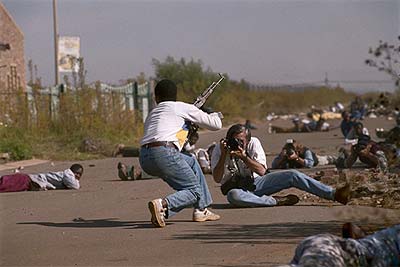
1994, David Turnley, James Nachtwey, 1994 elections in South Africa

But of course I don’t need to go to bizarre lengths. The more traditional means of artifice are well documented. There’s a reason that they call it media (middle, medium).

Imagination Unmoored

I like it when art becomes it’s own medium of response to itself, rather than leaving it to prose. I have always like Nat King Cole’s “Mona Lisa” and Don McLean’s “Vincent” (YouTube | Wikipedia). But Robbie Dingo’s recreation of Vincent van Gogh’s Starry Night in Second Life, making a video of the process of creation, then setting it to Don McLean’s song does it all one better (Au, Wagner James, “Remake the Stars,” New World Notes, 18 July 2007).

Schema of the arts and sciences aside, I like this for what is suggests for the future of virtual worlds. Hitherto our imaginations have been stunted by continuous exposure to the narrow Newtonian world of the macroscopic everyday. Witness, for example, what happens when people try to imagine fantastical animals. All that we can come up with is combinations of existing animals: griffins, mermaids, centaurs, dragons, Cerberus, et cetera.

Once we start to live in a regular way in virtual worlds of our own creation, a dynamic will form where each feat of imagining will establish a new norm and a new developmental environment from which each subsequent foray of imagining and generation of imagineer will be capable of going a little further beyond the forms of this world. As we increasingly live in worlds not constrained by the same limits as the material world, our imaginations will become completely unmoored from the forms provided to us by macroscopic nature. The true, autonomous nature of the imagination — throughout all of history shackled by the relentless, overwhelming conditioning of the narrow forms presented to us by dull matter — will be liberated.

And owing to neuroplasticity, inherited or induced, maturing and living in radically different worlds will allow us to develop new modes of being and new understandings. In the future we will live in our dreams and our nightmares. Science has laid the groundwork for our art to become the more fundamental reality. The direction of humanity is a retreat from the material world into a world composed entirely of mind.

Mr. Au mentions Akira Kurosawa’s Dreams (IMDB | Wikipedia). I think maybe it’s time to dig out and rewatch an old favorite, Until the End of the World (IMDB | Wikipedia).

Politically, for all of human history the Earth has provided the unified point of reference for all humanity. With a proliferation of possible environments, the hitherto more or less unified character of the human world will gradually degenerate. The dissolution of our political order, multiculturalism, neo-primitivism, the turning away from master narratives and the dawning of the postmodern era are natural consequences of technology.

As Vernor Vinge said of the coming of the singularity, “I can see us becoming weird — before my very eyes” (“My Apocalyptic Vision is Very Narrow,” 13 June 2008).

The Legitimacy of Argumentum ad Hominem

Will Wilkinson and Crispin Sartwell consider the satisfactions of environmental soothsaying:

As I’ve said, the insane jackup of rhetoric with regard to global warming, “the greatest crisis the species has ever faced,” the death of the planet, etc, is the secular humanist liberal apocalypse. It’s a sheer competition for who’s most dire, most obsessed, and who’s more unanimous than whom. It’s the flood, complete with the reasons: our moral culpability. I predict this: when Obama is elected, liberals will feel better about themselves and the probable verdict of cosmic judgment, and they’ll tone down the eschatology, the ranting cant.

(“Ranting Cant,” The Fly Bottle, 2 August 2008; untitled, Eye of the Storm, 2 August 2008; respectively)

For my part, I imagine there is something to this argument. Every faction has its share of less than completely rational members. But if it is the contention of Messrs. Wilkinson and Sartwell that the behavior of some of the advocates of anthropogenic climate change bears one iota of relevance on the soundness of the theory itself, then this is a picture perfect instance of the falicy of argumentum ad hominem. The emotional satisfaction that someone takes in holding a particular position would seem irrelevant to the ultimate adjudication of said position.

Some time ago when I originally made the formal cognition post (1 January 2008) K.S. said that he didn’t see the point. What was my advocacy of formal cognition meant to achieve? I couldn’t quite answer him at the time, but Mr. Wilkinson’s post really clarifies the matter for me. I’m an advocate of formal cognition against rhetoric generally, but most especially against some of its more pernitious tactics of Freudianism broadly construed as an interpretive style, sociobiology in its normative aspect (an epistemological relative of Freudianism), and secularization thesis.

For every purportedly empirical statement out there, there is built up a detritus of extraneous belief. There is the psychological baggage of the proposition: the advocacy or denial of an opinion is motivated. Cui bono? Or advocacy or denial becomes a part of one’s identity. People build an emotional complex around certain beliefs. Certain propositions become tropes mapping us into desired cultural categories. A proposition becomes cornerstone to an elaborate worldview into which their constructors invest vast amounts of intellectual energy. These people tend to become conservative about such propositions all out of proportion to the weight that the casual observer might assign to such beliefs.

It’s really easy to succumb to the desire to set aside the mater per se and argue the detritus. It’s certainly more emotionally satisfying. The purpose of a catalogue of validated logic and methodologies is to determine the soundness of a proposition and cast out the irrelevant considerations in a systematic way.

So, for example, the scientific veracity of anthropogenic climate change is within range of rational risk assessment. The systems concepts of a tipping point and self-reinforcing, accelerating change are legitimate and the potential implications of these concepts applied here are alarming. The perennial libertarian Alfred E. Neuman “What, me worry?” worldview has its own short fallings, namely that disasters are plausible and occasionally systemic.

On the other hand, there is no proposition beyond the proposing hominid. I’m not so sure that the distinction between rhetoric and formal decidability is tenable, especially once one admits the scientific method into the corpus of formal cognition. Given that induction is logically and experientially unsound, the scientific method becomes merely a highly stylized rhetoric, a rhetoric whose admissible tactics are more narrowly circumscribed. It is most certainly a rhetoric that is more reliable than others, but it nonetheless exists with other rhetorics along a continuum of variably reliable tactics, rather than being cordoned off in a privileged category all its own.

If nothing else, the absolute prohibition against argumentum ad hominem seems incompatible with Thomas Kuhn’s The Structure of Scientific Revolutions. Is it even possible for the behavior, psychology, constellation of attendant beliefs and rhetorical strategies of the advocates for a proposition to be irrelevant to the acceptance or rejection of the proposition? I think that once one dispenses with the notion of truth or falsity of a proposition in any strong sense in favor mere acceptance or rejection (the sociology of knowledge), then these previously considered extraneous factors become relevant. They are real channels by which information and belief are transmitted throughout society. They are part of the practice of acceptance and rejection as they actually happen. Argumentum ad hominem seeks to make explicit and disrupt these channels. It reduces their efficacy through ridicule.

(This is not to deny the truth or falsity of out beliefs in some ultimate sense. The truth is out there — it just doesn’t intervene in our deliberations in any radical way. Prima facie, incomplete beliefs about the world can be made workable.)

Reason and Power

Charles Mudede on reason and politics (“As Jets Roar Over Seattle,” SLOG, The Stranger, 3 August 2008):

The handle on politics is too hot for the grasp of nous.

This we must remedy. A more firm grip? Or a sacrifice of pink bourgeois hands for the calloused hands of a laborer?

Politics is about power and for power, reason is but a convenient cloak. When no longer needed or useful, power will draw back its cloak to reveal itself in all its bald injustice.

Edsger W. Dijkstra’s Blog

One of the blog parlor games is to come up with unlikely blog-like precursors. Doogie Howser, M.D. is a favorite. I’m going to propose computer scientist Edsger W. Dijkstra.

I’m a big fan of “Real Programmers Don’t Use PASCAL” which contains a few direct derogatory references to Mr. Dijkstra and is generally opposed to his views on computer science. I guess I like it more for it’s computer geek-heroic tone. Since I am mostly a proponent of system and method, I am on the side of Mr. Dijkstra. But anyway, from the Wikipedia page on Mr. Dijkstra:

Dijkstra was known for his essays on programming; … He was also known for his habit of carefully composing manuscripts with his fountain pen. The manuscripts are called EWDs, since Dijkstra numbered them with EWD as prefix. Dijkstra would distribute photocopies of a new EWD among his colleagues; as many recipients photocopied and forwarded their copy, the EWDs spread throughout the international computer science community. The topics are mainly computer science and mathematics, but also include trip reports, letters, and speeches. More than 1300 EWDs have since been scanned, with a growing number also transcribed to facilitate search, and are available online at the Dijkstra archive of the University of Texas

Mr. Dijkstra’s “blog,” EDW is hosted here.

Ouroboros to Mise en Abyme

A few unsystematic thoughts on Ouroboros and mise en abyme:

  • I almost mentioned Douglas Hofstadter’s book, I Am a Strange Loop, in last week’s post (“The Mythical Economy,” 23 July 2008). He could have gone with Ouroboros on the cover too, but instead he went with mise en abyme.

    Or maybe he couldn’t have gone with Ouroboros. While Ouroboros is, on a superficial level, obviously a strange loop and a symbol that could be seen as self-referential, a peek at the index of Hofstadter’s book at the entry for “video feedback” — a technological mise en abyme — shows that he has a thicker analogy in mind:

    video feedback, 65-71; as candidate for strange loop, 103, 187, 203, 361; epiphenomena in, 68, 70-71; fear of meltdown, 56, 57; fractalic gestalts of, 204; lack of “I” in, 203; lack of perception in, 75-77, 187, 203; lack of symbols in, 203; lack of thinking in, 203; locking-in of patterns in, 70; parameters of, 65-67, 69, 75; reverberation in, 67-68; two systems entwined in, 210-211, 253-254; vanilla loop in, 208

  • While I’m amused at the notion of an Ouroboros economy, I can’t really think of any real correlate to the slightly humorous image. Unless maybe something like a naturalistic notion of the human economy, wherein the human economy is nature parasitic upon itself. The destruction of the biological world as giving birth to the artifactual or the cybernetic world. Ouroboros reborn for the Twenty-first Century!

  • The thing that’s really causing me to bring up mise en abyme is some thoughts on how people think about the future. People are faced with the need to decide and nearly all decisions that people make are, when not completely about the future, at least future-oriented. People’s thoughts about the future are divided into two closely related activities, carried out in tandem: planning and prediction. Prediction occasionally becomes an activity of its own, but for the most part prediction is an activity carried out in service of the more pragmatic planning.

    Planning is a branching strategic game. It works like this. I have a goal whose attainment is not simple: it involves a number of steps and it could be thwarted at any one of them. I start with my known situation and have a vague idea what the path to my goal would be and I make a series of hypothetical decisions. I test the soundness of a hypothetical decision by predicting the outcome of such an action. That is, I imagine a potential future.

    In the first round, the one inaugurated in the present, I know what my options are because they are present. In the second round and in all subsequent rounds, I must employ prediction to imagine what options I will have to choose from because from then on I am dealing in an imagined future. I repeat the hypothetical decision, predict, test, simulate new options algorithm down until I reach the last round whose decision results in the attainment of the goal.

    When I make predictions about the future, I rarely make a single prediction, since prediction, especially the sort of intuitionistic variant that people employ for the purpose of most of their planning, is not a very reliable. So I predict a range of possible futures. And in each possible future I face a range of possible decisions that I can take. Predicting and planning branch. Most of these I abandon in favor of the most fruitful seeming paths. But if a path dead-ends, I back up until I find the probable fateful decision that sent me down the path to the dead end. I recollect the other options at that possible future and imagine my way down another branch. I also generally flag a number of contingency plans. I went with this predicted future, but as things actually unfold, if it turns out that I predicted wrong, I have a plan ready for that other branch too.

    When I have what I imagine to be a satisfactory path from present to goal, I lock in each decision hypothetically made into “what I’ve decided upon.”

    This is a pretty systematic model and not necessarily exactly how most people make plans. People rarely sit town and carry it out algorithmically from beginning to end. More frequently people engage in this activity in fits and starts, not taking the problem from start to finish, but working on pieces that strike them at various occasions throughout their day. They absentmindedly do it while at their work computer, or do it extremely quickly while laying a joint plan with a partner over the telephone. Or maybe they try to be thorough about it and make a list on a notepad so they can see what’s done and what still in need of attention. Whatever the case, I think that ultimately this is what people are doing.

    The important point for mise en abyme is that near future decisions can only be locked in once more distant future decisions have been validated. Each step is dependent on the one after it having been made first. One starts the planning and predicting from the present and works one’s way forward, but one decides, as it were, backward, from the future to the present. Predictions and plans regarding the immediate future include as a part within them predictions and plans regarding the immediate future, which in turn contain predictions and plans about the distant future and so on. My thoughts about the future are mise en abyme insofar as they contain within them further thoughts about more distant futures.

    What one is doing in this process of planning for the future is conducting is a depth first search of potential futures. And depth first search is canonically thought of as recursive.

  • Mise en abyme seems to have a lot more analogistic or systemizing potential. Scale symmetry (e.g. fractals) along with all the related phenomena that can be grouped under that pattern seem coterminous with mise en abyme. Hegel’s logical schema seems like a highly abstract instance of mise en abyme, where each intellectual system is subsumed into a higher order intellectual system.

  • Perhaps there is a historical development of the conceptual depth and sophistication of the idea of self-referentiality. Ouroboros is simple cyclicality, though extrapolated into a notion of infinity or eternity. Homunculus is a limited instance of scale symmetry. Modern formal recursion are the culmination.

Relativism and Conflict

Ezra Klein references Nickolas Kristof’s column yesterday as bringing “striking clarity” on the Israeli-Palestinian issue, but the clarity is all in Mr. Klein’s interpretation (“Tough Love for Israel?,” The New York Times, 24 July 2008; “The Dual Realities of Israel / Palestine,” TAPPED, The American Prospect, 24 July 2008, respectively):

But he [Kristof] offers a counter-fact: “B’Tselem, the Israeli human rights organization, reports that a total of 123 Israeli minors have been killed by Palestinians since the second intifada began in 2000, compared with 951 Palestinian minors killed by Israeli security forces.”

When Jews talk about the ethics of the Israeli response, they tend to emphasize the recklessness and cruelty of Palestinian terrorists. The words most often heard are “target civilians.” The Israelis are right, in other words, because they carry out limited military operations against discrete targets, which sets them ethically apart from members of Hamas who murder innocents because it’s an effective tactic. That is indisputable.

Palestinians, by contrast, speak of the war in terms of absolute costs: They have suffered more, buried more, seen more of their freedoms and land and dignity taken from them. To them, it seems insane to condemn Palestinian tactics when the Israelis have killed so many more innocent children. That too is indisputable.

Both sides are right. There’s a passage in Aaron David Miller’s excellent book The Much Too Promised Land that makes this point elegantly. “The prospects of reconciling the interests of an occupied nation with those of a threatened one seemed slim to none,” he says. In many ways, that’s the essential truth of the conflict: The two sides don’t judge themselves similarly. The Israelis see themselves as threatened innocents, not oppressors. The Palestinians see themselves as an occupied and humiliated nation, not aggressors. The Israelis see themselves as inexplicably under attack, and acting only in defense. The Palestinians see themselves as losing a war against a much stronger, and demonstrably more brutal, occupier.

This is all true of Israel / Palestine and an important point to keep in mind when trying to understand the claims and counterclaims of the parties.

What Israel needs is, as Mr. Kristof calls it, tough love. What that means at a more operative level is the U.S. needs to provide Israeli moderates with additional reasons they can point to in opposing Israeli extremists (messianic Jews, settlers, etc.). The Palestinians aren’t the only ones whose country is being destroyed by the extremists in their midst.

In addition to pointing out some salient facts about the nature of the particular dispute in question, this is a perfect real-world example of relativism. Most people think of relativism and think it means amorality, or moral capitulation, or a dispensing-with of any notion of the facts of the matter. But what I think this explanation shows is that relativism is compatible with an objective account of things — or that relativism as an ethical theory is well compartmentalized from any particular metaphysical substratum. And relativism is a theory that provides a very good account of many disputes in the world. People aren’t necessarily in dispute over what is true and what false, or the proper moral criteria. For instance, no one in this situation is necessarily disputing the numbers killed or whether killing is right or wrong. The facts of the matter or the morality of any individual act considered in complete isolation is not in dispute. What is in dispute is the proper context in which to weigh the facts and adjudicate the contending claims of moral priority. It’s a question of interpretation. Different sets of acts of violence become at least plausibly justifiable depending on which gestalt narrative one adopts. Change total narrative and the moral weight of the various acts shifts around.

This is the way it is in almost all disputes. The rhetoric that people deploy usually very quickly leaves behind particular matters of fact or the morality or immorality of specific acts and it becomes a contest of dueling grand narratives. A conversation about a particular environmental harm becomes one about the tragedy of the commons and evil corporations versus the road to serfdom. A conversation about a reproductive decision becomes one of recidivist patriarchy versus the suicide of Western culture. The fact of the matter is that no one can quite see individuals as individuals and consider their actions as such. Everyone sees all people as deeply embedded in social structures and patterns and duty-bound to speculative forces of society and history.

The Mythical Economy

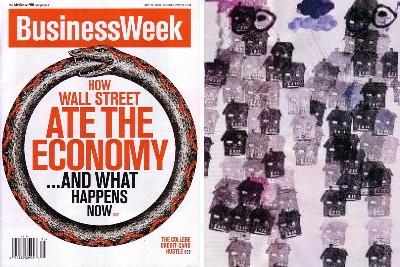
28 July 2008, BusinessWeek, Ouroboros and Moloch

BusinessWeek decides to portray the economy as Ouroboros, the serpent swallowing it’s own tail. Oddly enough, I’ve had Ouroboros on my mind quite a bit lately.

And they decide to portray Fannie Mae and Freddie Mac as Moloch.

Moloch whose buildings are judgment! … Moloch the stunned governments! …
Moloch whose blood is running money! …
Moloch whose eyes are a thousand blind windows! Moloch whose skyscrapers stand in the long streets like endless Jehovahs! …
Moloch whose soul is electricity and banks! …
Moloch! Moloch! Robot apartments! invisible suburbs! skeleton treasuries! blind capitals! demonic industries! …
They broke their backs lifting Moloch to Heaven!