The Iconography of Barack Obama: The First American

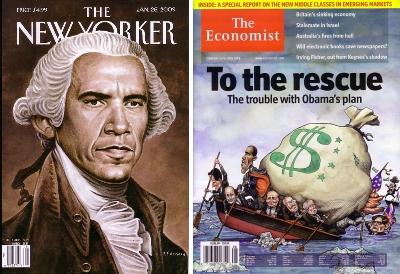
26 January 2009 The New Yorker and 14 February 2009 Economist, both with Barack Obama as George Washington

See what I’m sayin’. A lot has been made of President Obama’s appropriation of Abraham Lincoln, but why stop there. Obama is the every-president. The 26 January 2009 issue of The New Yorker put Drew Friedman’s illustration, “The First” on the cover and the 14 February 2009 issue of The Economist has for its cover a parody of Emanuel Leutze’s Washington Crossing the Delaware, both featuring Barack Obama as George Washington.

Life Logging: Not Just for Human Life Anymore

Not only should you be thinking about life logging, but you should also be thinking about it for your pet (Chansanchai, Athima, “Cooper the Cat Shows His Stuff in Photo Exhibit,” Seattle Post-Intelligencer, 13 February 2009):

For this Seattle cat, photography is his medium, a gift from his “parents” — filmmakers Michael and Deirdre Cross, who gave him a very small and light digital camera that hung from his collar one day a week for a year. It was programmed to take a picture every two minutes.

They wanted the answer to a question many pet lovers have asked themselves: What does he do all day?

He came back with thousands of answers — 16 of which are framed and on display at the Urban Light Studios in the Greenwood Collective. The exhibit opens with a reception tonight as part of the Greenwood Art Walk. The show runs through March 10.

Cooper the cat photographer has a blog dedicated to his exploits at http://cooper-catphotographer.blogspot.com/.

And while you’re at it, you may want to survey your environment for any particularly interesting non-living things, appliances, informational or gameworld agents, et cetera whose activities you might want to see in your FaceBook feed.

Update, 15 September 2011: Cooper the cat photographer’s blog has been relocated. It can now be found at http://www.photographercat.com/.

Television Disbelief

First, I can’t believe that Man v. Food is going to Beth’s Cafe. Gawd, I spent some of the best nights of my life there. Second, I can’t believe that Travel and Discovery have scheduled No Reservations and Man vs. Wild head-to-head. I have no idea how I’m going to decide between Anthony Bourdain eating a whole roast pig and Bear Grylls eating a decomposing boar.

Machine Ethics

Two great new books on the future of robots, Moral Machines: Teaching Robots Right from Wrong and Wired for War: The Robotics Revolution and Conflict in the 21st Century are out right now. I’m not going to have time for either, but in the meantime, the New York Times constantly runs articles on this subject, most recently “A Soldier, Taking Orders From Its Ethical Judgment Center” (Dean, Cornelia, 25 November 2008, p. D1). To the list of all the things that robots will be better at than humans, we can add that they will be more ethical than us:

“My research hypothesis is that intelligent robots can behave more ethically in the battlefield than humans currently can,” said Ronald C. Arkin, a computer scientist at Georgia Tech, who is designing software for battlefield robots under contract with the Army.

In a report to the Army last year, Dr. Arkin described some of the potential benefits of autonomous fighting robots. For one thing, they can be designed without an instinct for self-preservation and, as a result, no tendency to lash out in fear. They can be built without anger or recklessness, Dr. Arkin wrote, and they can be made invulnerable to what he called “the psychological problem of ‘scenario fulfillment,’ ” which causes people to absorb new information more easily if it agrees with their pre-existing ideas.

His report drew on a 2006 survey by the surgeon general of the Army, which found that fewer than half of soldiers and marines serving in Iraq said that noncombatants should be treated with dignity and respect, and 17 percent said all civilians should be treated as insurgents. More than one-third said torture was acceptable under some conditions, and fewer than half said they would report a colleague for unethical battlefield behavior.

Troops who were stressed, angry, anxious or mourning lost colleagues or who had handled dead bodies were more likely to say they had mistreated civilian noncombatants, the survey said [Mental Health Advisory Team IV, FINAL REPORT, Office of the Surgeon General, United States Army Medical Command, 17 November 2006].

It is incorrect to imagine machines as behaving more ethically than humans insofar as it construes humans and machines as occupying the same ethical continuum. We may program machines to have human-compatible ethics, but that shouldn’t confuse us; the same ethical prohibitions that apply to us will not apply to robots.

Right and wrong aren’t something floating out there on the other side of the sphere of the stars. Right and wrong are derived from the characteristics of the human body, human tastes and tendencies as endowed in us by our natural history, the structure of the human lifecycle, our conceptions of the good life, shared human experience, and communal mythos. Creatures for whom these factors are different will have different ideas about right and wrong. As the last three items on the list — conceptions of the good life and shared experience, public reference symbols — differ among people, we have different ideas about right and wrong. A creature with a transferable consciousness won’t have an essentialist view of the relation of body to self and hence won’t take moral exception to bodily damage. A creature with a polymorphous consciousness wouldn’t disparage even psychic damage (though the question of identity for such a creature would be even more difficult than it is with us, as already elusive as we are).

Creatures with different conceptions interacting have to develop ethical interfaces. The minimalist limitations of rights-based liberalism and the law of nations are to some extent that: interfaces between differing moral systems — the former an interface for people within a society, the latter between different societies. What an interface between different species, or an interface between different types of life, would look like, I have no idea. Whether such an interface is even possible is perhaps more pressing: they only seem to hold up so well amidst humans.

Neil Sinhababu, “the Ethical Werewolf,” and Ramesh Ponnuru had a go-round back in 2006 that touched on the ethical status of non-human creatures, but I don’t think it really goes beyond the natural extension of liberalism to different physical morphologies, with which liberalism has an extensive history in the various rights movements. And different physical morphologies is all that aliens and other mythological creatures, as conventionally conceived, are (Sinhababu, Neil, “Mind Matters,” The American Prospect, 23 August 2006; Ponnuru, Ramesh, “Fear Not, Frodo,” National Review Online, 28 August 2006; Sinhababu, Neil, “More on Minds,” TAPPED, 30 August 2006).

Presidential Restraint and Congress

As a part of my Whig Liberalism, I believe that Congressional supremacy is part of the Constitutional design of our system and I consider Andrew Jackson a villain of history and good governance insofar as he was able to go farther than any other president to reverse this proper ordering. The array of images, gestures and protocols that presidents have at their disposal to reify this Constitution-turned-upside-down version of tripartite government is myriad.

Among them, and one that constantly annoys me, is the protocol of congress-president relations. The president deigns to speak to Congress once a year, and then only as a pretext for a television spot; the president is never required to submit to Congressional questioning; when the president wants to influence Congress, he stays put at 1600 and sends some flunkey down Pennsylvania Avenue; but when Congress wants to deal with the president, not just some charging, but the members themselves go, and then not some junior Representative, but only the highest ranking members are allowed to participate. It sends a clear signal of executive supremacy and Congressional supplicancy. The king keeps his court. Presidential aloofness is a show of presidential authority.

I have been impressed with President Obama’s first week in office. On Wednesday he suspended military tribunals; on Thursday he ordered the closing of the Guantánamo Bay detention camp, acts of confidence in the U.S. judicial system to handle these issues and a surrendering by the executive of the power of judgment and justice to its proper place in the Constitutional order. One branch accuses, another adjudicates: that is the division of powers. Also on Wednesday he ordered full compliance with the Freedom of Information Act and rescinded former President Bush’s order allowing the executive branch to resist normal declassification of presidential records. (Glaberson, William, “Obama Orders Halt to Prosecutions at Guantánamo,” The New York Times, 21 January 2009; Mazzetti, Mark , “Obama Issues Directive to Shut Down Guantánamo,” The New York Times, 22 January 2009, p. A1; Stolberg, Sheryl Gay, “On First Day, Obama Quickly Sets a New Tone,” The New York Times, 22 January 2009, p. A1)

But of the things that have impressed me so far, none has done so much as his visit to Congress today to meet with the Republican caucus to explain, to answer questions and to advocate for the administration’s stimulus plan (Zeleny, Jeff, “Obama Visits Capitol to Press Republicans on Stimulus Plan,” The New York Times, 27 January 2009). This is how a president should behave toward Congress: as a co-equal branch.

I fear that Congressional Republicans plan on dealing the Obama administration a souring lesson on partisan intransigence in Washington, D.C. and that the administration will revert to presidential maximalism, but I hope (there’s that word again) that this is the start of a presidency of true consultation and of executive restraint. Such an example would be an accomplishment of its own.

Freedom Safely Delivered to Future Generations

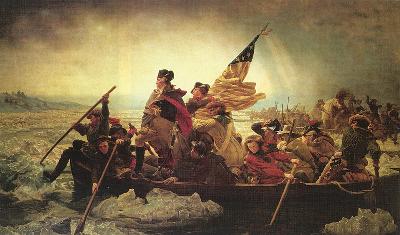
Emanuel Leutze, Washington Crossing the Delaware, 1851, Metropolitan Museum of Art, New York City

Listening to President Obama’s Inaugural Address with the variable sound quality on the Mall, I thought it was okay. An inaugural address should be more high principle and values than policy specifics and argumentation. Does the President know that he has a State of the Union Address in like 20 days? Save all of the detail and proposals and the laundry lists for then. And there was a too much of the boilerplate political rhetoric about our children and the future and freedom, et cetera.

But on a second listening, the rhetoric remains a little too detailed, but the overarching structure of the Address stands out to me, and within their context, a few lines become brilliant. The Address is constructed as a meditation on Emanuel Leutze’s 1851 painting, Washington Crossing the Delaware (above; higher resolution version here).

As SLOG’s reporter onsite Christopher Frizzelle points out (“A Review of the Speech from the Third Row,” 20 January 2009), the Address is bookended by images of storms and ice. The new President starts by saying,

The words [of the oath] have been spoken during rising tides of prosperity and the still waters of peace. Yet, every so often the oath is taken amidst gathering clouds and raging storms.

And ends with similar imagry:

… in this winter of our hardship … let us brave once more the icy currents, and endure what storms may come

Mr. Frizzelle characterizes it thus:

He is doing there what poets, namely the Romantic poets, used to do better than anyone — expressing the emotional / psychological plane of reality in terms of weather, pastoral phenomena, landscape.

The coda of the speech, the closing invocation of ice and storms, is a description of one of the darker moments during the Revolutionary War. In July of 1776 the British had landed on Staten Island and for the remainder of the year dealt a string of defeats to the Continental Army, capturing New York City, driving the Continental Army into retreat up Manhattan, across New Jersey and across the Delaware river into Pennsylvania. Washington’s army had been reduced from 19,000 to 5,000 and the Continental Congress abandoned Philadelphia anticipating British capture when the campaign season resumed in spring. It was, as President Obama described it, “a moment when the outcome of our revolution was most in doubt.”

The Continental Army encamped at McKonkey’s Ferry, Pennsylvania where General George Washington plotted a surprise attack back across the Delaware River. It was an especially unconventional move as the British had assumed the campaigning season over and established winter quarters. As President Obama relates, prior to the Christmas night crossing of the Delaware River General Washington ordered that a reading be made amidst the soldiers. The words are not General Washington’s, but those of Thomas Paine. Mr. Paine had been traveling with the Continental Army and his pamphlet, The American Crisis had just been published. It was this from that General Washington judged that the night’s inspiration would be drawn. The line that President Obama quoted from Paine is this:

Let it be told to the future world that in the depth of winter, when nothing but hope and virtue could survive, that the city and the country, alarmed at one common danger, came forth to meet it.

The victory won at the Battle of Trenton resulted in a turn away from the flagging morale of the Continental Army. When the British attempted to retake Trenton on 3 January 1777, they were outmaneuvered and quite nearly driven out of New Jersey.

The central arc of President Obama’s speech, set between the two snows and storms, reflects Thomas Paine’s image of “the depth of winter, when nothing but hope and virtue could survive.” Since it’s Barack Obama, the hope part goes without saying at this point, no? So the body of the speech addresses itself to the virtues by which the country will meet our “common danger.” Here I would like to make a list of examples, but the surprising thing about rereading this speech is how his description of the various virtues defies a simple list. They are often painted in contrasts, or without directly saying their name. I think something like constancy is a good example. “We are the keepers of this legacy.” “… the fallen heroes who lie in Arlington whisper through the ages.” For an obvious example, he says,

Our challenges may be new, the instruments with which we meet them may be new, but those values upon which our success depends, honesty and hard work, courage and fair play, tolerance and curiosity, loyalty and patriotism — these things are old.

Even when listing other values, constancy — “these things are old” — underlies them all. One of the best parts of the speech for me, especially as a leftist, was the President’s paean to workers, especially “men and women obscure in their labor.”

Among all these virtues, one receives particular recognition: unity, self-sacrifice, the common good, the gaze toward something greater than one’s self. “[Our predecessors] saw America as bigger than the sum of our individual ambitions; greater than all the differences of birth or wealth or faction.” “We will build the roads and bridges, the electric grids and digital lines that feed our commerce and bind us together.” The cynics have forgotten “… what free men and women can achieve when imagination is joined to common purpose …” “… more united, we cannot help but believe … that the lines of tribe shall soon dissolve …”

Look again now at Mr. Leutze’s painting. It’s most outstanding characteristics are an imposing river of ice between the Continental Army and the New Jersey shore, a tumult of citizen soldiers raging in boats and on the near shore. In the midst of this chaos and struggle rises the figure of General Washington, unperturbed, resolute, beyond the fray, his face fixed on distant goals and illuminated by the bursting sky.

Then study the crew of the boat. It is a microcosm of the colonies. The two oarsmen in the bow of the boat are a Scotch (note the Scottish bonnet) and an African American. There are two farmers in broad-brimmed hats toward the back. The man at the stern of the boat is quite possibly a Native American (note the satchel). There is an androgynous rower in red who is perhaps supposed to be suggestive of women. “… our patchwork heritage is our strength.”

Return now to President Obama’s Address. In this winter of adversity what persists are our virtues, above all unity. The icy currents of the bookends of the speech are the Delaware River, the middle arc of the virtues of the nation are the boat with its diverse crew of rebel irregulars. And consider the last line of the Address, “… with eyes fixed on the horizon and God’s grace upon us, we carried forth that great gift of freedom and delivered it safely to future generations.” It is a description of General Washington, father and symbol of the nation, rising out of the clamor of peoples — out of many, one — illuminated, gazing toward the future of freedom safely delivered over to the other side.

I’m not exactly a nationalist or a collectivist. I’m not so hot on all the unity talk. I more prefer an individualist, contending interest groups theory of politics. We are most markedly not one people and to say otherwise is the propaganda of an agenda. But if you dig Romanticist nationalism, then President Obama in his Inaugural Address is your artist-president, poet-in-chief.

A System of Negativity

Consider nihilism as a system of negativity. Rather than no system or anti-system, or the standard sort of system of theorem built upon axiom, et cetera, it is a system of contradiction, where each principle is canceled out by another, every theory perfectly balanced by another opposing until there is nothing left, or that the web of confusion grows so tangled that one is driven to the nihilistic act, where one has nothing left but to obliterate and wipe away the whole lot of ideas. Now consider the following two passages from Dostoevsky’s Notes from the Underground:

… on coming home on one of the foulest nights in Petersburg, I used to realize intensely that again I had been guilty of some particularly dastardly action that day, and that once more it was no earthly use crying over spilt milk; and inwardly, secretly, I used to go on nagging myself, worrying myself, accusing myself, till at last the bitterness I felt turned into a sort of shameful, damnable sweetness and finally, into real, positive delight!

Well, let us now have a look at this mouse inaction. Let us suppose, for instance, that its feelings are hurt (and its feelings are almost always hurt), and that it also wants to avenge itself. There will perhaps be a greater accumulation of spite in it than in l’homme de la nature et de la vérité. A nasty, mean little desire to repay whoever has ofended it in his own coin stirs within it more nasty perhaps than in l’homme de la nature et de la vérité; for because of his inborn stupidity l’homme de la nature et de la vérité looks upon his revenge merely as a matter of justice whereas because of its intense sensibility the mouse denies that there is any question of justice here. At last we come to the business itself, to the act of revenge. The unhappy mouse has already succeeded in piling up — in the form of questions and doubts — a large number of dirty tricks in addition to its original dirty trick; it has accumulated such a large number of insoluble questions round every one question that it is drowned in a sort of deadly brew, a stinking puddle made up of doubts, its flurries of emotion, and lastly, the contempt with which the plain men of action cover it from head to foot while they stand solemnly round as judges and dictators and split their sides with laughter at it. Well, of course, all that is left for it to do is to dismiss it with a disdainful wave of its little paw and with a smile of simulated contempt, in which it does not believe itself, and to scurry back ingloriously into its hole.

After reading Notes from the Underground it is hard not to see Nietzsche as at least partially derivative. Nietzsche was reading Dostoevsky in the years 1886-1887, including Notes from the Underground. Nietzsche wrote On the Genealogy of Morals during 1887 and it is Dostoevsky’s narrator from Notes from the Underground who is the patient that Nietzsche has on he sofa in On the Genealogy of Morals. The difference is that while Nietzsche shares Dostoevsky’s diagnosis of the sickness of the West, Dostoevsky is nostalgic for Christianity and nationalism, whereas Nietzsche advocates an experimentalism and futurism of pressing boldly on.

The Politics of Philosophy

There are three things that someone in philosophy might do. First is philosophy as traditionally understood: an autonomous science with real contributions to human understanding to be made in the existent sub-disciplines of metaphysics, epistemology, ethics and aesthetics; explicating, scrutinizing, clarifying and shoring up the foundations or logical superstructure — depending on whether you prefer an under or an over metaphor — of our more day-to-day beliefs. Philosophy as the agent of redistribution of the field of force, to use Quine’s analogy. Or philosophy is the avant garde of knowledge, preparing the ground for the eventual arrival of natural science. These activities would be philosophy’s on-label use, so to speak, philosophy per se or philosophy proper. The second common activity of people operating under the rubric of philosophy is the study of the history of ideas: decoding and deciphering what a philosopher of yore meant, study of how a philosopher came to the position that they did, the who-influenced-who game, genealogy of an idea down through the ages. These are the activities that people have in mind when they think of philosophy and this is how most philosophy institutions — university departments, publishers, journals, societies — bill themselves.

But there is a third, lesser known, and conspiratorially hidden practice within philosophy. It is philosophy as a sort of rarified politics, as inter-philosophical polemic.

It is the rare philosopher who satisfies themself with a small problem. A philosophy is a Weltanschauung, a worldview, an all-encompassing world system, a tiny nucleus of belief from which all the rest of belief might be derived. A metaphysic and an epistemology usually entail an ethics and a politics. There is hardly a philosopher in the world who is not reformist in their beliefs, who doesn’t want to see one set of ideas about things abandoned in favor of another, for the sake of the political and societal consequences it will entail. The very act of writing affects a desire for influence, to persuade and to change the world. When philosophers contend with one another about some seemingly impartial issue of ontology or logic, they are in fact arguing about what sort of society we are to have, just via a peculiar proxy. And as they do so, they are very much conscious of a series of relations where memes lead to real world consequences and this or that change in fundamental beliefs might lead to a new social organization.

I think the tendency of the non-philosophically oriented is to dismiss this as ridiculously detached — philosophy is just a parlor game! — but philosophy is the natural destination of some fairly commonplace behaviors. It has been said that science is the continuation of common sense. Philosophy is a result of a similar tact. Philosophy isn’t a dispassionate pursuit, cut off from and largely irrelevant to society, culture, politics, the economy, technology and the sciences. All of these fields are subject to contentious, political debates amidst their disparate practitioners, participants and communities. On the ground political difference is often derivative of our more upstream positions on fundamental questions. Or, perhaps more realistically, if also more Marxist and cynical: we build elaborate ideological superstructures as a means to justify our political and economic interests. The more disparate our political views, the more fundamental the disagreement that is their source. In this sense, there are factions in politics built upon philosophical affinities. In such a situation, philosophy becomes a sort of fall-back fortification after our more forward positions have been overrun. Depending on the degree of difference amidst individuals and groups, debates can be either genial, superficial affairs or can, in the quest for rhetorical supremacy, rent the fabric of our day-to-day beliefs and devolve into questioning the fundamentals of all underlying arguments. For example, it is amazing how quickly a discussion of tax policy — a discussion really only suited for specialist attorneys, OMB officials and SSA actuaries anyway — degenerates to one about human nature, the constituents of freedom and to whom we have a social responsibility.

As the breakdown of philosophical practice goes, my intuitive sense is that philosophy proper is the least practiced of the three activities and history of ideas is the second most oft engaged activity. Actually thinking a problem through, on its own terms, originally, on one’s own, is hard work. Thinking about someone else’s thinking, or thinking about how someone else thought about a problem, or application of the thought of someone else to a problem that they didn’t consider is easier — still hard, but easier — and to some extent more natural. But it is the third philosophical activity, philosophical politics, that actually constitutes the majority of what goes on amidst philosophers. In fact, the bulk of those other two philosophical activities, while performed under the pretext of philosophy per se or history of ideas, are really philosophy as politics too. Philosophers are of a certain worldview and a great deal of their reflection and reading is undertaken with the aim of strengthening that worldview, gathering intelligence on opposing camps, stress-testing their ideas by simulating critiques, rehearsing defenses and sharpening one’s own critiques of contending systems. It is philosophy as a sort of ideological fortress building. A great deal of historical explication consists of attempts to appropriate the legitimacy of some philosophical great to one’s own contemporary camp, or to delegitimate the man or idea of a rival camp.

Again, people tend to see philosophy as somehow ethereal, lofty, set apart from the hurley-burley of the world. But it is not. There is a perfect continuum between politics and philosophy. Philosophy is merely politics conducted in a more apocalyptic mode.

Durian

Durian, a large, spiky fruit of Southeast Asia known for its pungent odor

I first encountered the durian as I was studying for a 2006 Thailand vacation. I was eager to dig into the local food and the tropical fruits especially excited me. It turned out to be not much of a culinary vacation and I ate a lot less fruit than I would have hoped. I certainly never got the nerve to try the durian. Since then my fear and ambivalence has only grown, especially after this SLOG story

(Spangenthal-Lee, Jonah, “Adventures in Food with Ari and Jonah,” The Stranger, 20 April 2007) and an episode of No Reservations where Anthony Bourdain described the durian as being more like a pungent French runny cheese than fruit.

But then, on Wednesday night, I was at a dinner party where the Vietnamese host announced that there would be two disserts after the dinner: one a usual dessert, the other a challenging dessert. I had already seen the cake on the galley counter so that was known. The challenge dissert was to be a surprise. After the cake was brought to the table, our host disappeared into the kitchen and returned with the surprise dessert: durian.

I have to say that its smell and appearance are deeply intimidating. I roiled with conflicted desire: the adventuresome side desperate to taste it, my distance-operative senses sounding the alarm that this was not food and not to be put in my mouth.

So of course I tried it. Once you get it past your nose it is a wonderfully complex and delicious fruit. It has an arduous flavor that comes in a number of phases. If you divide it into four rough phases, the third quarter is the fruity high point with a wonderful, light, fresh taste characteristic of tropical fruit at the top, reminiscent of the aftertaste of strawberries as it wears on. It has a long sour tail like cheese or butter, but with an ever so slight element of rancid gym sock.

Our host explained that if you buy the durian in the husk, you never know what you’re going to get until you open it up. He recommended the packaged durian, because someone else opens it and then it only gets packed if it’s good. Good being sulfuric in this case.

The Napoleon Dynamite Problem

After casing Ben Goertzel’s blog today, the point that I find myself really chewing on is this one (“The Increasing Value of Peculiar Intelligence,” The Multiverse According to Ben, 26 November 2008):

What occurs to me is that in a transparent society, there is massive economic value attached to peculiar intelligence. This is because if everyone can see everything else, the best way to gain advantage is to have something that nobody can understand even if they see it. And it’s quite possible that, even if they know that’s your explicit strategy, others can’t really do anything to thwart it.

Yes, a transparent society could decide to outlaw inscrutability. But this would have terrible consequences, because nearly all radical advances are initially inscrutable. Inscrutability is dangerous. But it’s also, almost by definition, the only path to radical growth.

I argued in a recent blog post [“The Inevitable Increase of Irrationality,” 25 November 2008] that part of the cause of the recent financial crisis is the development of financial instruments so complex that they are inscrutable to nearly everyone — so that even if banks play by the rules and operate transparently, they can still trick shareholders (and journalists) because these people can’t understand what they see!

But it seems that this recent issue with banks is just a preliminary glimmering of what’s to come.

Inscrutability, peculiarity, the idiosyncratic are already creeping in. Mr. Goertze is right to point to the rise of the quants and mathematical finance as an example. The one that comes to mind for me is the Napoleon Dynamite problem.

NetFlix has announced a million dollar prize for anyone who can improve the precision of its recommendation engine by ten percent. The New York Times Magazine and NPR’s On the Media both did stories about it back in November (Thompson, Clive, “If You Liked This, You’re Sure to Love That,” 23 November 2008; Gladstone, Brooke, “Knowing Me, Knowing You,” 21 November 2008). It turns out that improving the quality of this sort of singular value decomposition algorithm is geometric in difficulty. Most movies are easy to predict whether someone will like or dislike them, but a small number of odd movies thwart the algorithm. Chief among them is Napoleon Dynamite. For the research group profiled in The New York Times piece, Napoleon Dynamite was responsible for a whopping fifteen percent of all recommendation errors. There is no telling on the basis of people’s past movie rating history whether or not they’ll like this movie.

But the Napoleon Dynamite problem isn’t a solitary anomaly, but rather the paradigm of a trend. What we have is a Hollywood focused on these monster, expensive productions. Increasingly the movies that Hollywood makes are global products, with as much revenue coming from abroad as from the U.S. audience, so Hollywood is careful to strip its movies of any dialogue, humor or situations which are culturally nuanced and might not translate well. So the plot and dialog that we get in big Hollywood movies today is only the most broadly recognized and basic cultural tropes. Also, Hollywood has jacked the price of a movie up to the point where viewers now almost universally make a theatre-rental division: big special effects movies that they want to see in the theatres, and the dramas for which screen size isn’t a factor. It is a division with a positive feedback loop in that movie makers are aware of it and now shape their product offerings around it.

For a particularly depressing take on this, give a listen to Malcolm Gladwell’s 2006 New Yorker Festival talk on the use of machines to produce blockbuster scripts. At the same time that institutions like NetFlix are using computers to match customers to movies with increasing efficiency on the consumer end, Hollywood is using computers to make films increasingly easy to pigeonhole and match to demographics on the production side. It’s post-Fordist cultural production perfected. Soon we will be able to take the human out of the equation and the entertainment industry will just garnish out wages.

But there is — as is always the case — a countervailing motion. Just as Hollywood productions become increasingly trite and formulaic, there is the rise of these wildly bizarre and idiosyncratic films like The Zero Effect, Adaptation, Eternal Sunshine of the Spotless Mind, Lost in Translation, The Royal Tenenbaums, I Huckabees, Burn After Reading and so on. There is this sort of shadow Hollywood with it’s own set of stars and directors branding the alt-film genera: Wes Anderson, Charlie Kaufman, the Coen brothers, Catherine Keener, John Malkovich, William H. Macy, Frances McDormand. I would be remiss if I didn’t mention Steve Buscemi here.

What we have is a hollowing out of the middle. Along a spectrum, films range from obscurantia to formulaic. In the past, most movies probably fell in some broad middle: accessible, but unique. And most movie watchers probably fell there too. But increasingly movies and the movie-watching audience is being polarized into the genera constellations at one end and the difficult to categorize peculiarities at the other. Notice that the ambiguity of suspense has been replaced by the spectacle of gore in horror; that the sort of romantic comedy for which Drew Barrymore was designed and built has completely driven the older adult romantic drama to extinction. Similarly, the sort of accessible quirky, artiness represented by Woody Allen has moved much further down the spectrum of the idiosyncratic. The people who didn’t like Woody Allen are utterly baffled by Wes Anderson.

To generalize: hitherto we have been a normal distribution society. The majority of people fall into the broad middle and are closely related. But increasingly we are on the way toward a parabolic, or inverse normal distribution society, where the preponderance resides at the antipodes and people are separated by wide gulfs. This is true across the cultural spectrum, whether it’s politics, religion, the professions and so on. In the United States it is almost happening physically with the costal regions swelling as the center of the country is abandoned to satellite guided tractors and migrant labor. Some might call this the condition of postmodernity, some might call it the dissolution of Western Civilization.