Auto-Impalement

When I was in college and struggling to get postmodernism in philosophy, I asked a friend who was a writing student what postmodernism in literature meant. His very brief description — he was dismissive like that — was that in modernist literature, ordinary, every-day occurrences drove the drama of the story. In postmodernist literature, extraordinary events drove the plot of the story. The example that he made was that a story might start one morning when a man realizes that there’s a tree growing out of his leg.

Today, Komsomolskaya Pravda Daily reports that Artyom Sidorkin of Izhevsk, in the Ural Mountain region of the Russian Federation, went for surgery to remove what doctors had believed to be a tumor, but in fact turned out to be a five centimeter tall spruce tree growing in Mr. Sidorkin’s lung (“5 cm. Fir Tree Removed from Patient’s Lung,” MosNews.com, 13 April 2009 [Warning: Images Not Safe For Dinner]).

Two observations:

  1. Life imitates art — and vice versa. It’s not just philosophy and literature that are post-modern. They are merely middling indicators. They have become so only to the extent that actual lived life has become post-modern. Trees are actually growing out of people. I’m concerned that tomorrow I might read news of a man who woke up to find that he had turned into a giant beetle, or that the latest trend among young people was to turn into a rhinoceros.

  2. Life is fucking relentless. I used to find it bizarre that a mile out into Lake Washington on the 520 floating bridge, weeds grew in the automobile soot that had accumulated in the crevices in the asphalt and spiders had spun webs amidst their stems and apparently caught enough food to survive. Here you have a tree that actually tried to make a feeder-log of a man.

Update, 2 May 2009: On Monday, Steven Colbert picked up the story for his segment, Craziest Fucking Thing I’ve Ever Heard. He offered that that’s why he uses Roundup Nasal Spray.

A Cyberpunk Rereading of German Idealism

Pattie Maes's TED talk demonstrating an enhanced reality device, February 2009

Over at SLOG there is a bit of a conversation is going on about Pattie Maes’s recent TED talk in which she demonstrated what she calls “sixth sense,” but that I would call “augmented reality” (with Pranav Mistry, “Unveiling the ‘Sixth Sense,’ Game-Changing Wearable Tech,” TED, February 2009; Hecht, Anthony, “Holy Freaking Crap,” SLOG, The Stranger, 3 April 2009).

Today Charles Mudede, one of the thinkers to whom I consider myself most close, comments on the significance of Ms. Maes’s innovations along a line similar to my own project (“The Near Future,” SLOG, The Stranger, 8 April 2008):

It’s as if Hegel’s geist in his grand narrative of the history of consciousness, Phenomenology of the Spirit, actually came true. We can laugh at Hegel and his impossible absolute spirit, but we cannot laugh at Pattie Maes and her wearable tech.

For some time now I have been thinking that a cyberpunk rereading of the German Idealists is necessary. I have made a number of posts along this line (see Related Posts below). One of the themes of this blog — one that has emerged accidentally — is of the hard materiality of that which we call “ideal”; the degree to which mind is in the world; and not just statically so, but the degree to which the balance of matter and information is giving ground to information, processes of reification, the “imperialism of information”; that tool for rendering the study of ideology a material science, the meme; of those twain machines which bridge the gap: brains and computers.

My contributions to the project to date:

The Deus ex Machina of Economic Crisis,” 25 March 2009
The Noosphere Visualized,” 1 January 2009
Emergence and Aufhebung (Hegel and the Swarm),” 5 December 2008
The Day I Became a Hegelian,” 18 August 2008
Imagination Unmoored,” 8 August 2008

“What is rational is actual, and what is actual is rational”!

Preface to The Philosophy of Right (1821)

Consider the Hermit Crab

À la David Foster Wallace’s famous essay, “Consider the Lobster” — published in Gourmet of all places (August 2004) — new research shows that hermit crabs experience pain, remember it, can recognize and take steps to avoid future encounters of a similar kind (“Crabs ‘Sense and Remember Pain’,” BBC, 27 March 2009). The full research report is:

Elwood, Bob and Mirjam Appel, “Pain Experience in Hermit Crabs?,” Animal Behaviour, vol. 77, no. 5, May 2009, pp. TBD, doi:10.1016/j.anbehav.2009.01.028.

I’m a vegetarian so of course I find the practice of boiling crustaceans alive disturbing — and have since the first time I witnessed the gruesome spectacle at about the age of eight or ten. Nevertheless, I find Professor Elwood’s characterization of the practice as “potentially very large problem” to be bizarre. “Problems” have no objective existence. A “problem” is an issue of perspective. It would seem that, say, 5,000 years and trillions of boiled crustaceans into the practice of cooking arthropods alive, it’s a little late to declare it a “potentially very large problem.” An ethical lapse is only “a problem” if the perpetrator runs afoul someone who objects and is in sufficient a position of power to do something about it. Unless we wake up in the antechamber of the afterlife and it turns out that the correct answer was Hinduism, or unless it turns out that Yahweh takes seriously that bit in Isaiah about wolves and lambs lying down together (11:6-9), or unless we vegetarians establish a GULAG and declare universal jurisdiction for crims against animals then there is no problem here — at least not for the humans.

My Interests, As Reverse Engineered by Amazon.com

According to Amazon.com’s reverse engineering of my purchases, here are my interests:

Accounting, Asia, Biology, Chaos & Systems, Cognitive Psychology, Communism & Socialism, Consciousness & Thought, Economic Conditions, Economic History, Economic Policy & Development, Epistemology, Ethics, Finance, Government, Greek & Roman, History & Surveys, History & Theory, Holocaust, Intelligence, Intelligence Agencies, International Relations, International Security, Investments & Securities, Japan, Logic, Marxism, Military & Spies, Military Science, Modern, Napoleon, Naval, Nonfiction, Nuclear, Philosophy, Physics, Political, Political History, Political Ideologies, Presidents & Heads of State, Public Policy, Purple Politics, Relations, Russia, Social Theory, Sociology, Statistics, Strategy, Theory, World War I

That reads about right. I could quibble about some omissions, e.g. where’s Europe. That being said, why do Amazon’s recommendations suck so much? How is it that I can routinely go into a bookstore and find, not obscurely hidden in a lesser-trafficked corner, but prominently displayed, some work of exceptional interest to me, but that Amazon hasn’t recommended? And the heavily cut tracks! I find that I have an occasional interest in, say, the U.S. Civil War, but that I refrain from adding a Civil War title to my wish list because the Civil War is such an overdone cottage industry: if you add a single Civil War title, next thing you know every new volume by every small-town antiquarian, about every two-bit local general is going to be recommended.

Update, 5 April 2008: And what the hell is “Purple Politics”? Everything listed under that category seems perfectly respectable, but when I hear “purple politics” I think of Jessica Cutler’s The Washingtonienne, the Starr Report or the tabloids on Nicolas Sarkozy and Carla Bruni.

The Deus ex Machina of Economic Crisis

In defense of Secretary Geithner’s economic detox plan, Christopher Carroll makes a larger point about the basis of fundamental valuation (“Treasury Rewards Waiting,” The Economist’s Forum, Financial Times, 24 March 2009):

Unlike the critics, the Treasury has absorbed the main lesson from the past 30 years of academic finance research: asset price movements mainly reflect changes in investors’ collective attitude toward risk.

Perhaps the reason this insight has not penetrated, even among academic economists, much beyond the researchers responsible for documenting it, is that it has not been expressed in layman’s terms. Here’s a try: in the Wall Street contest between “fear” and “greed,” fear fluctuates much more than greed (in academic terms, movements in “risk tolerance” explain the bulk of movements in asset prices).

In thinking about economic crises, people have a tendency to contrast fundamentals versus psychology, dismissing so-called psychological factors as “not real” or somehow illegitimately interfering with the proper functioning of the economy. But the economy is not a machine with the humans being somewhat incidental to its operation (at least not yet). Insofar as human desire, priority, ambition, plans and beliefs about what the future holds are more foundational to the enterprise than the material constituents of the economy, psychology is fundamental. At some point, the economy gives way to society as the more fundamental unit of analysis.

This is not to say that the future-oriented plan makers don’t get “spooked” — hence Keynes’s “animal spirits” — and that they are irrational over the medium term to do so; but who can deny that retrenchment is not rational within certain limited considerations. That being said, it is the role of the government to defend the commons.

CS, AI, T&A

A bit of a discussion broke out at this morning’s session over Shane Legg and Marcus Hutter’s paper, “Universal Intelligence: A Definition of Machine Intelligence” (Minds & Machines, vol. 17, no. 4, 2007, pgs. 391-444, arXiv:0712.3329v1). Following the convention of abbreviated reference to a paper by its authors’ last names, and as Hutter is pronounced “hooter,” this paper is referred to as “legs and hooters.” So there was this back and forth, “As the legs and hooters paper shows …” “You should look more carefully at legs and hooters.” “It can be hard to get you head around legs and hooters.” “We shouldn’t rush to embrace legs and hooters.” I exaggerate slightly, but I would imagine that there are better papers than Legg and Hutter’s on the subject of the definition of machine intelligence; it’s just that those other papers get passed over in favor of one granting a computer nerd the opportunity to say “legs and hooters” in all seriousness in front of a room full of people. I’ll bet that Legg and Hutter decided to collaborate on the basis that such a winning name combination guaranteed their rocket-like ascension in the ranking of most oft cited papers.

Disciplinary Normativeness and the Artificial General Intelligence Conference

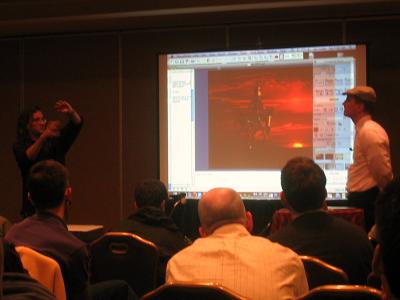
Ben Goertzel and Jürgen Schmidhuber, Artificial General Intelligence Conference 2009, keynote question and answer, 6 March 2009

S. and I are spending the weekend volunteering at the Artificial General Intelligence Conference 2009. Last night we saw organizer Ben Goertzel’s introductory talk and Jürgen Schmidhuber’s talk on various aspects of intelligence as compression and formalism in AGI (post-talk discussion, Goertzel left, Schmidhuber to the right). Today we attended Cognitive Architectures I and II and the poster session. Matthew Ikle and Ben Goertzel’s discussion of using formal economic models as a means to generate attention in the OpenCog framework and Eric Baum’s presentation on the relation between evolution and intelligence both blew my mind. I cant wait for these talks and their attendant slideshows to be up on the website.

For now the most interesting thing about the conference from the standpoint of a social scientist is the degree to which the organizer, Ben Goertzel is a Kuhnian revolutionary disciplinarian. His talk on the challenges of AGI was a perfect demonstration of the problems of prerevolutionary or pre-paradigmatic science. Pre-paradigmatic is the current state of AGI research and it would be an excellent candidate for history of science study as it will probably remain so for many years to come, but its revolution is coming.

It has gradually become clear to me the degree to which Mr. Goertzel is a leader in the field, by which I do not mean his role as an innovator — though he is definitely that — but that he is someone drawing the discipline together from its disparate strands and goading it on in its proper objectives. The problems that he identified in his opening talk — the lack of a common language, a dominate model shared by at least a plurality of researchers, a road-map for future problem identification, again, shared by at least a plurality, the lack of any metric of progress — are all classically Kuhnian problems. The conference obviously serves a number of objectives, many very traditional such as professional networking and facilitation of communication of findings. But unlike one might expect from a conference of a more mature science, there was a considerable amount of normative, discipline-definitional activity. First is the very conference itself. There is clearly no well-defined research area of artificial general intelligence. The bizarre diffusion of backgrounds and affiliations represented displayed no coherence or institutional establishment. Participants had backgrounds in neurology, cognitive science, anesthesiology, evolutionary biology, bioinfomatics, mathematics, logic, computer science and various strands of engineering. Creating the problem of a shared language, people had to be fluent in the languages of multiple disciplines and were mixing and matching as well as engaging in isolated terminological innovation. People worked as academics, corporate researchers and developers, engineers, entrepreneurs and so on.

Ill-definition means that things don’t cohere, or that what has come together naturally dissipates. It is in this sense that Mr. Goertzel is a disciplinary revolutionary. He really has a personal goal and a vision regarding AGI. At one point in his opening talk he actually delivered a brief bit of a lecture to conference participants on the problem of focusing on sub-general level intelligences for the expedience that they are achievable and money-making, though admitting to culpability in that respect as well. It is also clear what a small clique of researchers constitute the AGI world, as well as Mr. Goertzel’s position as a hub of the social and intellectual network. During the question and answer, he was able to call on most people in the room by first name. And he is clearly an intellectual celebrity with few peers. As Kuhn argued, non-scientific factors feature more prominently in the definition and direction of a science than rhetoric of objectivity would lead one to expect.

More Bold, Writers!

After any far-reaching junket to the library, I usually leave amazed at the flecks of brilliance lost by dint of the sheer mass of information that humanity churns out, like an ounce of gold alloyed in ton of oar. I often have the same feeling about the online world. For every one thing that goes viral, ten acts of genius are buried in someone’s quickly advancing feed.

Thus, today I find Suzanne Marchand, in a Journal of Modern History (vol. 63, no. 3, September 1991, pp. 608-610) review of Michael Burleigh’s book, Germany Turns Eastwards: A Study of Ostforschung in the Third Reich, concludes the following:

Overall, one might conclude that Burleigh has given us a competent, complete monograph that lacks, however, the ironic twists and adventurous spirit which would have made it a truly outstanding book.

Remember, aspiring writers, especially those under sober, academic tutelage: ironic twists and an adventurous spirit can be what separates “competent and complete” from “truly outstanding.”

Group Proprioception Goes Interspecies

Some Seattle artist and I aren’t the only ones who think your pet should be life logging: the British government does too. Reading University has been commissioned to conduct a study of how much wildlife is being destroyed by domestic cats (McKie, Robin, “Special Tags to Measure How Often Cats Kill,” The Observer, 15 February 2009):

“For the first time, cats will be fitted with data loggers that will show their movements, range and behaviour 24 hours a day. We will know when one kills an animal — typically by the way it plays with its prey.

“We will then be able to work out precisely how many animals a cat is killing every year, and from that estimate a national figure. It will be a pretty formidable number.”

Now if they could just get some sort of pattern recognition software to read the live GPS data stream coming off your cat and tweet his kills to your cell phone, then your cat would be twittering too.

The Sadism of Joss Whedon

After the first episode of the Dollhouse I was markedly not impressed. It may not ever be explicit in the plot, but it’s certainly clear external to the plot that the Dollhouse is a whore house. That’s the whole premise of the tantalizing advertising campaign. They are not delivering hostage negotiators or assassins. The hard drives in the mezzanine laboratory are full of sex kitten fantasy lives. In the flashback scene to Echo’s induction into the Dollhouse, Adelle DeWitt offers her the chance to make amends, but Echo objects that she doesn’t really have a choice, does she? It’s third-world sex slavery brought to the high-tech first world.

But I think that Joss Whedon is not confused about whether or not he’s an artist. He’s fully aware that it’s his job to turn out a product that gathers eyeballs to the FOX ad stream. And a house full of stoned-eyed, will-less, child-like babes wandering aimlessly in their yoga outfits clearly has appeal for a certain demographic. Apparently dropping the false power suite professionalism in favor of after-hours yoga-clad submissiveness is the new yuppie sexuality.

Where Whedon is an artist is that in his productions, the joke is on the studio and on us. It was no accident that the premiere of a series that’s about a bunch of sex slaves leads with an episode where one of the slaves is sent out as a hostage negotiator instead of on a sexual escapade. In the final scene where Echo goes into the kitchen to retrieve the kidnapped girl from the refrigerator, I expected the refrigerator to be upright against the wall, like refrigerators usually are, but instead it was horizontal on the ground — just like the sleeping chambers to which the Actives are sent at day’s end. “He doesn’t return them. He keeps them — until he’s done with them, or until they’re worn out,” Echo says of the kidnapper. Just like the Dollhouse will use up the Actives. The Actives are a bunch of sexual kidnap victims and episode one was Whedon accusing his entire audience of fantasizing their sexual molestation. It’s the same thing that Oliver Stone did with Natural Born Killers.

Combined with tonight’s episode, I’d say that the series is off to a pretty Sadistic start.

And is it just a coincidence that Harry Lennix, a total Barack Obama look- and sound-alike, has been cast as Echo’s handler? Does the entire country get its mind wiped clean and returned to a child-like state of naïveté after each mission? But at least we’ve got a fatherly overseer in whom we can place our complete trust.