The Fourth Generation Warfare Reason to Ditch the “War on Terrorism” Analogy

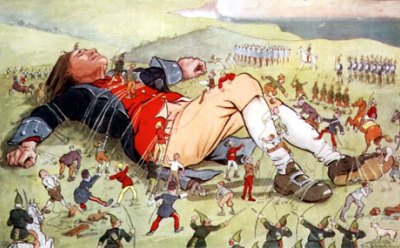
Gulliver and the Lilliputians

After the underwear bomber incident, all together too many people are talking about how Yemen is now the central front of the war on terrorism and preemptive action is necessary and if Yemen’s dysfunctional government can’t do what needs to be done then the U.S. should step in and do it for them (as usual, Senator Lieberman can be counted on as the go-to guy for idiotic pronouncements here). To me the events of recent days really show what’s wrong with the U.S. reaction being dominated by the notion of a “war on terrorism,” and the superiority of the strategy of treating terrorism as an issue of law enforcement as enunciated by, among others, John Kerry throughout 2004.

What we’re facing is the classic squeezing a balloon problem: the United States can deploy 112,000 solders to Iraq and another 98,000 to Afghanistan, and thousands more throughout Central and Southeast Asia and in the Pacific Islands and the terrorists just pick up their laptops, sell their Range Rovers and relocate their operation to the Horn of Africa, or the outer reaches of the Arabian Peninsula. Meanwhile the U.S. is stuck for the next decade in whatever country owing to the weight of tens of thousands of soldiers and hundreds of tones of heavy metal.

We are engaged in a fourth generation-type struggle with an opponent employing the classical tactics of asymmetric warfare. The object for the opponent on the presumptively disadvantaged side of the asymmetry is to adopt a strategy whereby the seeming advantages of the preponderant power are transformed into weaknesses. The war on terrorism is a contest of strategic dexterity and in this case the very weight, size and overwhelming capability of the U.S. military has become its greatest liability.

The game that has been played by al Qaeda et al. is that of miring the U.S. in regions of declining strategic importance. Terrorists are Lilliputians and the U.S. Gulliver. Only in this story Gulliver ties himself down. The Lilliputians only have to indicate where he should sink the stakes and he applies the lashes to himself.

While I am deeply skeptical of black ops, secret programs, plausible deniability, assassination, et cetera, I generally agree with the idea that the only time counter-terrorist actions should make the news is when something has gone wrong. The Predator drone and special forces operations that are being conducted along the Afghanistan-Pakistan border seems correct in conception, if still problematic in execution, to me. And of course this level of militarization is still awfully high. The FBI is the U.S. government agency with the largest presence abroad after the Pentagon and the State Department. Treasury is quickly following suite. Counter-terrorism should only become subject to special forces means under extreme circumstances. The rest of the time it should be dealt with by the various legal investigative agencies.

Whatever the case, our reaction to terrorism needs to be in kind: nimble, dynamic, human not territory oriented, multifaceted.

A strategic studies acquaintance commented the other day that he can’t wait for the reigning generation of the foreign policy establishment to retire, because they are a bunch of Cold War relics, mired in the mindset of a bygone era. The idea of stateless actors is beyond their comprehension. In this regard one of the most seminal moments in the U.S. reaction to mass-casualty terrorism was Paul Wolfowitz’s 13 September 2001 press conference, where he said the following (DoD News Briefing, The Pentagon, Arlington, VA):

I think one has to say it’s not just simply a matter of capturing people and holding them accountable, but removing the sanctuaries, removing the support systems, ending states who sponsor terrorism. And that’s why it has to be a broad and sustained campaign. It’s not going to stop if a few criminals are taken care of.

I believe that in some ultimate sense Paul Wolfowitz has been right about Islamic extremism: that it is not our war, that we cannot fight it, that it is not a war that can be won in the realm of strictly materialist forces, but that it is a struggle of ideology, that it can only be settled among those most immediately concerned, that the most the U.S. can do is indirectly effect this outcome through the opening of a space where moderate, modernist, liberal Islam can flourish. This was Secretary Wolfowitz’s idea for Iraq: that it would become the Islamic “city on the hill.” That he could simultaneously have been so wrong makes Paul Wolfowitz one of the tragic figures of the post-11 September period.

But this idea, that states and territory are what is important, this was the commanding idea of the early Bush administration. But the strategy of militarily occupying every square mile of lawless territory on the Earth and engaging in nation building in every failed state is beyond our capability. It is how the strength of a great power will be sapped.

To Understand Everything without Moving

For physicists to complete the entire task of physics without ever having set out from Earth to explore the universe — and the ratio of comprehension to capability here isn’t even close — would be like the old ideal of the rationalist philosopher who might deduce the entire system of the world from a sturdy chair in his study, or like Emily Dickinson who might feel a whole life through her Amherst window.  On the other hand, should it be possible, it will be a minor demonstration of the homogeny of the universe: it will have turned out that any given place was as good as any other for the task of comprehending the entirety of the thing.

Rolling Back the Twentieth Century Watch: Abolish the FDIC

Rortybomb, like most of blue America, originated in red America and maintains ties there that give him an occasional finger on the pulse. He reports on how many fathoms the fever swamp (Konczal, Mike, “Things I’m Reading, 12/22,” Rortybomb, 22 December 2009):

Visiting home for the holidays, it’s amazing to me how certain groups of friends, who I mostly considered in the generic Republicans/conservatives camp, have been wading deeper into the Ron Paul territory. “Abolish the Fed” is one thing, but what surprised me the most was when I was at a Christmas party several people mentioned, fairly out of nowhere, how bad FDIC is for the economy. I think they thought that regular depositors could have done a better job vetting financial institutions than major sophisticated shareholders. When I tried to point out how if there wasn’t FDIC and millions of savings accounts were getting wiped out in ordinary bank runs we’d almost certainly have a wave of turn-of-the-last-century style violence that is hard for us to even imagine now — think bomb throwing anarchist violence — they seemed to be ok with that.

President Obama Between Exceptionalism and Primacy in Afghanistan

I thought that President Obama’s speech last night was extremely diptych1 It was a continuation of his tendency to split the partisan difference on the substance of the matter, with no one getting all of what they wanted, and then throwing all parties concerned a rhetorical bone. For instance, this part of the speech was all paleoconservative, Andrew Bacevich, Christopher Preble, The American Conservative, Coalition for Realistic Foreign Policy. He even invokes the patron saint of the movement, Dwight Eisenhower:

As President, I refuse to set goals that go beyond our responsibility, our means, or our interests. And I must weigh all of the challenges that our nation faces. I don’t have the luxury of committing to just one. Indeed, I’m mindful of the words of President Eisenhower, who — in discussing our national security — said, “Each proposal must be weighed in the light of a broader consideration: the need to maintain balance in and among national programs.”

Over the past several years, we have lost that balance. We’ve failed to appreciate the connection between our national security and our economy. In the wake of an economic crisis, too many of our neighbors and friends are out of work and struggle to pay the bills. Too many Americans are worried about the future facing our children. Meanwhile, competition within the global economy has grown more fierce. So we can’t simply afford to ignore the price of these wars.

…

But as we end the war in Iraq and transition to Afghan responsibility, we must rebuild our strength here at home. Our prosperity provides a foundation for our power. It pays for our military. It underwrites our diplomacy. It taps the potential of our people, and allows investment in new industry. And it will allow us to compete in this century as successfully as we did in the last. That’s why our troop commitment in Afghanistan cannot be open-ended — because the nation that I’m most interested in building is our own.

On display is a recognition of multifaceted national objectives that trade off, of the need for choice in the face of scarce national resources, of real limits to the exercise of power, that conserving ones strength is an important means of cultivating it.

But then President Obama goes on to say the following and I hear Paul Wolfowitz, William Kristol, perpetual U.S. primacy, the Bush Doctrine and the neoliberal agenda forever:

Since the days of Franklin Roosevelt, and the service and sacrifice of our grandparents and great-grandparents, our country has borne a special burden in global affairs. We have spilled American blood in many countries on multiple continents. We have spent our revenue to help others rebuild from rubble and develop their own economies. We have joined with others to develop an architecture of institutions — from the United Nations to NATO to the World Bank — that provide for the common security and prosperity of human beings.

We have not always been thanked for these efforts, and we have at times made mistakes. But more than any other nation, the United States of America has underwritten global security for over six decades — a time that, for all its problems, has seen walls come down, and markets open, and billions lifted from poverty, unparalleled scientific progress and advancing frontiers of human liberty.

For unlike the great powers of old, we have not sought world domination. Our union was founded in resistance to oppression. We do not seek to occupy other nations. We will not claim another nation’s resources or target other peoples because their faith or ethnicity is different from ours.

The trite rhetorical temptation here is to write something like “So which is it going to be, Mr. President?,” but there’s no reason it’s got to be one path or the other. An incremental, experimental approach is possible and 30,000 seems as good a number as any — this is on top of the additional 40,000 soldiers that President Obama already approved in March 20092 — a not insubstantial commitment. Ideologues argue that while it’s all fine in practice, does it work in theory? But pragmatists tend not to be ideologically pure. President Bush disappointed many of the most maximalist elements when he announced the numbers for the surge in Iraq. The right wanted more, but the surge seemed to work. I’m aware that there’s a dispute as to whether the surge worked on the substance of the matter, but even if it didn’t work on the merits, it at least succeeded politically.

Notes

  1. President Barack Obama, Remarks by the President in Address to the Nation on the Way Forward in Afghanistan and Pakistan, Eisenhower Hall Theatre, United States Military Academy at West Point, West Point, New York, 1 December 2009

  2. Cooper, Helene and Eric Schmitt, “White House Debate Led to Plan to Widen Afghan Effort,” The New York Times, 28 March 2009, p. A1

The Continuance of the Savings Glut

With President Obama in China and the issue of the dollar-renminbi exchange rate presumably on the agenda, there has been a great deal of commentary about the threatening peril of the Chinese savings glut1. Here was Paul Krugman late in October on how the savings glut — the condition and a leading cause of the 2007-2008 financial crisis — remains unabated, continuing to propagate its distortions throughout the world economy2:

Until around 2001, you could argue that [the target value of the yuan was reasonable]: China’s overall trade position wasn’t too far out of balance. From then onward, however, the policy of keeping the yuan-dollar rate fixed came to look increasingly bizarre. First of all, the dollar slid in value, especially against the euro, so that by keeping the yuan / dollar rate fixed, Chinese officials were, in effect, devaluing their currency against everyone else’s. Meanwhile, productivity in China’s export industries soared; combined with the de facto devaluation, this made Chinese goods extremely cheap on world markets.

The result was a huge Chinese trade surplus. If supply and demand had been allowed to prevail, the value of China’s currency would have risen sharply. But Chinese authorities didn’t let it rise. They kept it down by selling vast quantities of the currency, acquiring in return an enormous hoard of foreign assets, mostly in dollars, currently worth about $2.1 trillion.

Many economists, myself included, believe that China’s asset-buying spree helped inflate the housing bubble, setting the stage for the global financial crisis. But China’s insistence on keeping the yuan / dollar rate fixed, even when the dollar declines, may be doing even more harm now.

Although there has been a lot of doomsaying about the falling dollar, that decline is actually both natural and desirable. America needs a weaker dollar to help reduce its trade deficit, and it’s getting that weaker dollar as nervous investors, who flocked into the presumed safety of U.S. debt at the peak of the crisis, have started putting their money to work elsewhere.

But China has been keeping its currency pegged to the dollar — which means that a country with a huge trade surplus and a rapidly recovering economy, a country whose currency should be rising in value, is in effect engineering a large devaluation instead.

And that’s a particularly bad thing to do at a time when the world economy remains deeply depressed due to inadequate overall demand. By pursuing a weak-currency policy, China is siphoning some of that inadequate demand away from other nations, which is hurting growth almost everywhere.

For thirty years now the prevailing grand social bargain in the United States has been that outsourcing and offshoring will be the means whereby capital will capture an increased portion of national income and the resultant consumer goods price deflation will substitute for the also resultant wage stagnation. In shorthand, this might be called the Reagan Revolution, though Reagan only brokered the deal. The conditions that gave rise to parties militating against the preceding post-war social bargain lay much deeper in the structure of the post-war international order. This social bargain is the basis of the financial problems of the U.S. as well as of the China problem.

The savings glut is not merely a problem with China, but in its Chinese component it is driven by two factors, neither of which is likely to be resolved by U.S. action. First, owing to population growth and the massive migration from rural farms to urban wage labor, China needs to create around 25 million new jobs per year. The memory of Tiananmen Square demonstrations of 1989 remains potent in the mind of Chinese Communist Party officials. It is widely believed among Chinese officials that preventing a repeat of the unrest of 1989 and hence the survival of the Party depends on the ability of the Chinese economy to provide jobs for these millions, preventing them from becoming a mass of disaffected urban unemployed. Second, the savings glut exists as a part of China’s long-term grand strategy of pursing peaceful development first and regional political realignment only once they have attained sufficient economic and military weight. For the U.S., the G-8, the IMF or whoever to ask China to abandon its policy of undervaluing the renminbi is to ask the Chinese government to commit suicide and to accept their second-tier world-political status; it is to ask them to run the highest order of political risk as an act of charity to the rest of the world. We cannot rely on China doing the U.S. any macroeconomic favors here. The only way to eliminate the macroeconomic conditions of the next financial crisis is to get our own house in order.

On the right and amidst the Lou Dobbs crowd you here these constant sidelong remarks about China holding the strings of America’s economic future. But this is not the result of some insidious plot on the part of China to acquire a financial WMD stuffed full of T-bills for deployment against the U.S. at some opportune occasion (like a WMD, to actually use it would result in mutually assured destruction). This is result of the Wal-Mart low-wage, low prices, long supply chain model of doing business (surprise: the day-to-day purchasing decisions of millions of people reach up to the commanding heights of world finance). We can try to brow-beat China to forego the opportunities of the system that we have created, but the origin of that system reaches down into what is now, under the midwifery of the right, claimed as the American way of life. And perhaps we have decided that getting off on a bad foot with the world’s next superpower is preferable to confronting our own economic culture.

Notes

  1. Dominique Strauss-Kahn, the Director of the IMF, made a speech on the subject in Beijing, The International Monetary System: Reforms to Enhance Stability and Governance, International Finance Forum, Beijing, 16 November 2009; Krugman, Paul, “World Out of Balance,” The New York Times, 16 November 2009, p. A25; Wolf, Martin, “Grim Truths Obama Should Have Told Hu,” Financial Times, 17 November 2009.

  2. Krugman, Paul, “The Chinese Disconnect,” The New York Times, 23 October 2009, p. A35

The Other Forgotten War

D.C. World War Memorial, Armistice Day, 11 November 2009

One could be forgiven for not knowing that there is a memorial to the First World War in Washington, D.C. (Wikipedia | Google Maps). The first time I stumbled across it, it was as an exploration of a curiosity. I wanted to figure out what that unknown building was, barely visible through the trees along Independence Avenue. To approach the memorial is to get a sense of what it must have been like for a Renaissance-era scholar on grand tour of the continent to come to Rome for the first time, when the ruins of Rome were still that: ruins — mysterious, forgotten, pillaged, unkempt, crumbling, ignored. The First World War Memorial is lost in a grove of trees on the south side of the Mall. It’s like coming across an abandoned temple in a forest. The flagstone paving stones of the walk up to the memorial are lose, scattered, broken and on their way to gravel. The memorial itself is blackened with mildew, its marble cracked and stained. It is like a mushroom that popped up in a forest clearing after a rain. Completed in 1931, its archaic inscription simply reads “The World War.”

Our wars aren’t merely matters of fact, narratives or parables from which we are to take the vaunted historical lesson. Our wars are tropes: they represent certain touchstones of the American consciousness. The Second World War was the good war: the forces of good arrayed against the forces of evil, proving the directionality of history. The Vietnam War is central figure in the right wing Dolchstoßlegende. They are all morality plays. The First World War is a forgotten war because it does not signify anything that fits easily into the American mythos. It is an amorality play. Its obvious meta-narratives of miscalculation, system effects, the amorality of state interest, the fleetingness of progress, the shabbiness of war, the divisions of class interest and the meaninglessness of our social conventions around war don’t figure in U.S. discourse on war. So the event is simply excised from the national consciousness, not a part of the pantheon of nostalgia writ in Neoclassical white marble in the nation’s capitol.

Mediocrity as the Camel’s Nose of Monsters

Though a central category of the critique of Modernity, the phrase “the banality of evil” is, owing to its origin, mostly associated with the Second World War and Hitler’s circle of power. John Quiggin takes the opportunity of Armistice Day to point out the relevance of the concept for the First World War (“Armistice Day,” 11 November 2009):

The cataclysm of the Great War brought forth monsters like Hitler and Stalin, who killed millions. But the War itself, with the millions and tens of millions of lives it took, directly and indirectly, was loosed on the world by political leaders more notable for mediocrity than for monstrous greatness.

The names of Asquith, Bethmann-Hollweg, Berchtold and Poincare are barely remembered, yet on any reasonable accounting they belong among the great criminals of history. Not only did they create the conditions for war, and rush (eagerly in most cases) into it, they carried on even as the death toll mounted into the hundreds of thousands and beyond. Even as the original grounds for war became utterly irrelevant, they continued to intrigue for trivial postwar benefits, carving up imagined conquests among themselves.

The First World War no longer seems like the nadir of civilization after the horrors of the Twentieth Century that were to follow — the collectivization and the famine, the purges, the Holocaust, Barbarossa, Stalingrad, Bataan, the area raids, the atomic bomb, the Great Leap Forward and the Cultural Revolution. But the First World War set the conditions. In this regard, mediocrity often prepares the ground for monsters.

Civilization is fickle and an inopportune mediocrity in governance is a great danger. Unhappily, this is probably the realm where ken pales and Fortuna runs amuck.

Political-Economy and Inflation

Paul Krugman devoted his column two weeks ago to the conduct of economic punditry as if the economy were a nineteenth century morality play: sermons about “debasing” the currency, longings for gold, fretting over inflation at the nadir of an economic crisis, a masochistic enthusiasm for “belt tightening” (“Misguided Monetary Mentalities,” The New York Times, 12 October 2009, p. A23). Taking off from this, Matthew Yglesias makes the point about the degree that class-parochial interests play in purportedly objective economic analysis (“The Monetary Hawks,” ThinkProgress, 12 October 2009):

… I would suggest that divergent analysis is in part driven by things that have relatively little to do with analysis. … if we have four or five years of near-zero inflation and 9-10 percent unemployment that will be fine for prosperous middle aged people and devastating to the interests of the poor and the young. Conversely, if we have four or five years of modest unemployment with four or five percent inflation, that will be fine for young people and poor people but potentially detrimental to the interests of wealthy people sitting on large piles of savings. Ultimately, I don’t think it helps the progressive cause to ignore the class / ideological elements to this dispute and just pretend to be engaging in a neutral technocratic dispute about the correct application of the Taylor Rule. What we’re talking about, after all, is decision-making under conditions of moderate uncertainty. What the hawks are proposing to do is to implement a policy that’s extremely attentive to minimizing downside risk to the currently wealthy whereas Krugman is proposing a policy that’s [attentive] to minimizing downside risk for people with below-average labor market prospects.

The problem is that we’ve adopted a manner of speaking about economic issues denuded of any mention of interest. The language of popular economics today is categorical: a strong dollar is good, a week dollar is bad; stable prices are good, inflation is bad; low unemployment is good, high unemployment is bad; rising house prices are good, stagnating or falling house prices are bad; et cetera. But none of these factors are categorically good or bad (few things in life are). What is omitted is the “for whom” of these characterizations of good and bad. Low employment may be good for job seekers, but high unemployment is good for employers: they have their pick of workers when hiring and they hold the majority of the bargaining power in wage negotiations. A strong dollar may be good for Wal Mart and their customers, but it’s bad for General Motors and their employees.

Real estate maintains some knowledge of contraposition with their talk of a buyers’ market versus a sellers’ market. We do not speak with a similar respect to the value of the dollar: of an investors’ dollar (strong) versus a producers’ dollar (weak) or an importers’ dollar (strong) versus an exporters’ dollar (weak). Or in employment, some people might think getting a raise or ease in finding a job are good, but these are what someone else might call labor price inflation (bad).

Economics isn’t free of the language of interest per se, so much as of one particular set of interests. The propaganda victory of the economic interests of Wall Street, the investing class, large business is so complete that their economic preferences have become de facto the whole language of economics. The awareness of the interests of all other economic actors has been totally expunged from the language of economics — well, not totally: there is the disciplinary ghetto referred to as heterodox economics, an exception that proves the rule.

To have asserted control over the linguistic territory is to have banished the political dispute; to have disappeared from the lexicon is to have ceded political legitimacy. Disputes over the political mixture of the interests of one economic class versus those of another are no longer about one set of economic relations versus another, but now take place in the frame of a rational economic order versus chaos, unreason and decline.

A firm separation between economics in its positivist, scientific role and economics in its normative, polemical and political role should be vigorously policed. Or perhaps economics is simply to value-laden, too embedded in the hurly-burley of human affairs for such a division to be tenable. Perhaps we should dispense with the notion of economics as a hard science in favor of a thoroughgoing political-economy. Even if we admit the possibility of a purely positivist economics, all that economics can do in our political deliberations is serve as a speculative tallyman of the opportunity costs of various policy options. The primacy of politics should come to the fore whenever economics crosses over from the academy to the public realm.

Target values for economic factors represent a political compromise between contending societal factions. The most well known of these is the NAIRU, the trade-off between inflation and unemployment codified in the statutory guidance of most of the world’s central banks. But inflation isn’t an unqualified evil. Its primary evils are that it has a tendency to run-away and, related, that it breeds uncertainty (a certain anticipatable regularity to the future is necessary to the function of capitalism). It used to be well known amidst the working (and indebted) classes that a certain amount of inflation served their interest and that “sound money” was merely the rallying cry of the investor class. The class conflict of easy versus sound money used to be a significant fault line separating progressive from conservative, populist from whig. Hence the advocacy of arch-populist William Jennings Bryan of an inflationary policy of bimetallism or “free silver” in the election of 1896.

There’s talk today about how vile it would be for the government to attempt to inflate away its debt (“debasing the currency” they call it), but the government doesn’t only inflate away its debt, it inflates away all dollar-denominated debts. A couple of years of higher than target inflation might be good for a country that has seen twenty years of galloping gains for the investor class, but racked up unsustainable amounts of debt among the middle and working classes. The investing class would scream bloody murder, but not because 3-5% inflation would be the end of economic reality as we know it, but because it would be a wealth transfer from creditor to debtor.

A Hive Mind of One

My friend Mick alerted me that Carl Zimmer was featured in a recent episode of RadioLab dedicated to the subject of parasites (Abumrad, Jad and Robert Krulwich, “Parasites,” 7 September 2009). Despite being somewhat annoying in format and low-density in it’s information presentation, the show contains a number of points interesting to my project.

Hookworms

In the second part of the second segment (starting at 31:25), they deal with the symbiosis between hookworms and the human immune system. The segment consists of a profile of Jasper Lawrence, a man who had severe allergies and — having chased down a certain direction of research — decided to travel to Cameroon to infect himself with hookworms. The research in question is that of the hygiene hypothesis: the notion that many developed world afflictions, including allergies, result in part from the excessively sterile human environment. Asthma is 50 percent less likely in a person who has had a hookworm and in Africa allergies are almost entirely unknown. It is theorized that similar to the dependence of digestion upon a symbiotic relationship with non-human microflora of the digestive tract, the immune system is dependent on certain microorganisms for regulation and calibration of the immunoresponse. The complex chain of events that is the immunoresponse evolved in the constant presence of parasites, evolved around parasites; they have co-evolved to the point where their presence became necessary. “We function like rainforests; we’re ecosystems,” Mr. Lawrence says. This is the hypersea washing through humanity.

Toxoplasma Gondii

The final segment is on Toxoplasma Gondii (starting at 47:55), a parasite that lives in cats and makes their feces dangerous to pregnant women. Like many parasites, it has a multi-phase lifecycle that takes place in a multiple hosts. It only reproduces in members of the Felidae family (cats), but can live the remainder of its life in any warm-blooded creature. T. gondii is expelled by cats when they shit and the cat shit is ingested by other creatures (consumption of unwashed vegetables, inhaled while digging close to the ground — which is why pregnant women are advised against gardening). T. gondii needs to get back into the digestive tract of a cat to reproduce, so it wriggles its way to the amygdale, the part of the brain responsible for emotional reaction, and causes the host to become attracted to cats, thus, in the case of small mammals or birds, becoming easy prey for cats (it is Carl Zimmer’s argument in his book, Parasite Rex that in this way parasites are like ecological catalysts, spinning food webs ever more tightly together).

But then there is the question of humans. It is one thing to say that T. gondii might make a bird or a rat suicidal. But T. gondii infects humans too. What then?

The scientific interviewee for the segment is Robert Sapolsky, a professor of neurology at Stanford University. On the question of T. gondii altering human behavior, he declares it highly plausible:

Sapolsky: Pure speculation, but people who think about this stuff view it as not purely speculative. The notion that toxo can produce some sort of attraction to cats in humans: they don’t think it’s all that crazy.

That’s right: crazy cat lady is that way because she’s been body-snatched by toxoplasma gondii.

Less controversial than the idea that T. gondii might be making crazy cat people out of us is the idea that it can make people more prone to engage in risky behavior. Dr. Sapolsky mentions two independent studies that show that people infected with T. gondii are two to six times more likely to get in a car crash than those not infected. With this information in hand, host and guest make the larger point:

Ellen Horne: It might be possible — might be possible — that toxo is guiding our emotions, changing who we are in some basic way. And if you consider that toxo might just be one of thousands of tiny little parasites inside us, pulling our strings from the inside, well that thought is pretty creepy.

Sapolsky: Even if the entire lesson with toxo is that a small subset of infected people now have one half of one percent more likelihood of wanting to drive really recklessly, even lurking in that one half of one percent are some serious implications for thinking about free will. We haven’t a clue the biology lurking in the background that makes free will seem a little bit suspect.

I’m less concerned with that old philosophical saw of free will versus determinism, than with extending an idea from segment on the hookworms. Mr. Lawrence says, “We function like rainforests; we’re ecosystems.” Presumably he is referring to our bodies. But the implication of toxoplasma gondii is that we are ecosystems in out minds as well. To the naïve sort of homunculus, Herman’s Head notion of consciousness, we must now add a few animal spirits.

Update, 23 October 2009: For instance this woman must have a pretty severe infection of T. gondii.

Update no. 2, 5 June 2010: Parasitogenic felinophilia (Toxoplasma gondii) may be treatable with haloperidol, an antipsychotic (“A Game of Cat and Mouse,” The Economist, 3 June 2010). Repost from my twitter feed.

Two Recluses on Cosmos and Psyche

Two things fill the mind with ever new and increasing admiration and reverence, the more often and more steadily one reflects on them: the starry heavens above and the moral law within.

~ Immanuel Kant, Critique of Practical Reason (1788)

The Brain — is wider than the Sky—
For — put them side by side—
The one the other will contain
With ease — and You — beside—

~ Emily Dickinson, 632