Law and Order and the Southern Strategy

Matthew Yglesias produces a graph of homicide rate and political party and makes, I think, two killing points about the relation between the Republican “law and order” rhetoric in the 1960s through 1980s and the Southern strategy (“The Crime Issue,” The Atlantic.com, 20 November 2007):

  1. … if a move to the right was really the consequence of rising crime rates, one would expect the most conservative groups in the electorate to be those most afflicted by violent crime — low-income African-Americans. But of course that’s not how it works at all.
  2. … if the appeal of “crime” messaging was really about crime, its effectiveness should have diminished in years 1972, 1988, and to some extent 1984 when GOP leadership failed to address the issue …

This is a pretty tough indictment that the law and order issues was in fact a ruse for something else.

Point two seems especially damning in light of subsequent cultural wars and the whole “what’s the matter with Kansas” critique. Economically insecure white men could have blamed globalization-catalyzing modern day robber barons for their newfound economic peril, but instead had their anger trained by an effective political rhetoric on blacks and women. Today all that would-be class warfare is being poured instead into a culture war mold. And on neither occasion — in the 1970s and 80s on crime and today on the culture war — are Republicans at all effective. They just turn around the white flight and culture war votes into increased lower middle class white economic insecurity.

Books I Haven’t Read

Since I just bought Pierre Bayard’s How to Talk About Books You Haven’t Read, I guess that I should post on it now, not having read it, rather than later when maybe I will.

I became a book collector fairly early on and all the way up through my early post-college years I could still name the author and title of every book I owned and I had honestly familiarized myself with at least a significant chunk of each one. But then as my income grew while my available free time stayed constant or even has diminished slightly, the portion of my book collection with which I have that level of familiarity has shrunk precipitously. At this point I have to confess to being as much a book collector as a book reader. In fact, it occurred to me a few nights ago, after recently having installed three new shelves, that I may have to start budgeting my book acquisitions in shelf-inches rather than dollars (“I’m only allowed three inches this month so its either the thousand page tomb or the two 350 page jobs”).

When S. saw me unload this latest acquisition from my bag she was rather amused that I had found just the right book. But with the seed planted, on no less than three occasions throughout the day did I catch myself and stop to point out that I was just that moment talking about some text that I had not in fact read.

And this dovetails well with David Brooks’s column a few weeks ago on “The Outsourced Brain” (The New York Times, 26 October 2007) where he said,

I had thought that the magic of the information age was that it allowed us to know more, but then I realized the magic of the information age is that it allows us to know less.

In a follow-up, Ezra Klein really makes the not reading point (“The External Brain,” 26 October 2007):

But so long as [Google’s] around, I don’t need to really read anything. I just need to catalogue the existence of things I might one day read. I don’t so much study web sites as scan for impressions, for markers, for key words I’ll need if I want to return. I don’t need the knowledge so much as a vague outline of what the knowledge is and how to get back.

Indeed, not reading is the wave of the future.

When I was younger and not yet even a dilettante, still just groping toward my present pissant snobbery, my younger and even more bizarre brother, brought us both into contact with the film The Metropolitan. The class issues were lost on me at the time, but it was a revelation: people just hanging around talking about ideas and drinking cocktails. What more could a person possibly want?

The snippet of dialogue that then as now stands out to me the most is one of their salon go-rounds:

Audrey Rouget: What Jane Austen novels have you read?

Tom Townsend: None. I don’t read novels. I prefer good literary criticism. That way you get both the novelists’ ideas as well as the critics’ thinking. With fiction I can never forget that none of it really happened, that it’s all just made up by the author.

To this day I probably read twice as many book reviews as I do actual books.

A Bipartisan Dupe

One of the reason that I love Paul Krugman so much is that he writes nary a word with which I disagree. Friday’s column (“Played for a Sucker,” The New York Times, 16 November 2007) on Barack Obama’s adoption of Republican “crisis” language regarding Social Security was exactly the sort of rhetoric I would hope for from a vigilant left.

But Mr. Obama’s Social Security mistake was, in fact, exactly what you’d expect from a candidate who promises to transcend partisanship in an age when that’s neither possible nor desirable.

I don’t believe Mr. Obama is a closet privatizer. He is, however, someone who keeps insisting that he can transcend the partisanship of our times — and in this case, that turned him into a sucker.

Mr. Obama wanted a way to distinguish himself from Hillary Clinton — and for Mr. Obama, who has said that the reason “we can’t tackle the big problems that demand solutions” is that “politics has become so bitter and partisan,” joining in the attack on Senator Clinton’s Social Security position must have seemed like a golden opportunity to sound forceful yet bipartisan.

But Social Security isn’t a big problem that demands a solution; it’s a small problem, way down the list of major issues facing America, that has nonetheless become an obsession of Beltway insiders. And on Social Security, as on many other issues, what Washington means by bipartisanship is mainly that everyone should come together to give conservatives what they want.

We all wish that American politics weren’t so bitter and partisan. But if you try to find common ground where none exists — which is the case for many issues today — you end up being played for a fool. And that’s what has just happened to Mr. Obama.

The left should absolutely not lay central New Deal programs — programs for which the opportunity to create may never come again — down on the negotiating table in exchange for some amorphous good will on the part of the right. And Mr. Obama or any other candidate should get that message in no uncertain terms.

Seven years ago, during the 2000 campaign, there was a fairly significant sub-debate about how time spent as a Senator did not do a very good job of prepare a politician for the presidency. The Senate is a collegial atmosphere and owing to the long terms of office, the staggered election cycle and the fact that states can’t be gerrymandered, it is a much more moderate environment than the rough-and-tumble ideological circus sideshow that is the House of Representatives — and really the rest of U.S. politics beyond the hallowed halls of the north wing of the Capitol building.

I would like to think that all Mr. Obama’s happy talk about bipartisanship is just political claptrap designed to appeal to moderate voters who don’t understand what all the partisan bickering is about. But it increasingly seems like real naivety. I would say that nothing in his experience to date has prepared Mr. Obama to fight the kind of partisan wars that he will have to fight to become the president and then more of the same to pass a legislative agenda. And for that reason he should be ruled out at the party’s presidential nominee.

The Last U.S. Veteran of the First World War

In May of 2005 The Economist chose as the subject for its obituary Albert Marshall, the last British cavalryman of the First World War, who had died on 16 May 2005 at the age of 108 (“The Last of the Mounted British Cavalry,” smarties, 3 June 2005). Mr. Marshall is only one of a series of such last survivors of the First World War. This Armistice Day both The New York Times and The Washington Post (Rubin, Richard, “Over There — and Gone Forever,” Kunkle, Fredrick, “World War I Veteran Reflects on Lessons,” 12 November 2007, respectively) ran stories about Frank W. Buckles, at age 106 the last remaining U.S. veteran of the Great War. From The New York Times:

But even more significant than the remarkable details of Mr. Buckles’s life is what he represents: Of the two million soldiers the United States sent to France in World War I, he is the only one left.

This Veterans Day marked the 89th anniversary of the armistice that ended that war. The holiday [was] first proclaimed as Armistice Day by President Woodrow Wilson in 1919 and renamed in 1954 to honor veterans of all wars … But there’s a good chance that this Veterans Day will prove to be the last with a living American World War I veteran. (Mr. Buckles is one of only three left; the other two were still in basic training in the United States when the war ended.) Ten died in the last year. The youngest of them was 105.

Four years ago, I attended a Veterans Day observance in Orleans, Mass. Near the head of the parade, a 106-year-old named J. Laurence Moffitt rode in a Japanese sedan, waving to the small crowd of onlookers and sporting the same helmet he had been wearing in the Argonne Forest at the moment the armistice took effect, 85 years earlier.

I didn’t know it then, but that was, in all likelihood, the last small-town American Veterans Day parade to feature a World War I veteran. The years since have seen the passing of one last after another — the last combat-wounded veteran, the last Marine, the last African-American, the last Yeomanette — until, now, we are down to the last of the last.

It’s hard for anyone, I imagine, to say for certain what it is that we will lose when Frank Buckles dies. It’s not that World War I will then become history; it’s been history for a long time now. But it will become a different kind of history, the kind we can’t quite touch anymore, the kind that will, from that point on, always be just beyond our grasp somehow. We can’t stop that from happening. But we should, at least, take notice of it.

If I may quibble a little bit, the First World War is not “history”: we live with its consequences every day. In fact, one might say that we still occupy its long shadow.

That aside, I concur that the notion of living memory and a direct lineage to events is significant, especially psychologically so. Plowing a field behind a team of animals, however primitive it may sound, is a part of our world owing to the presence of certain grey-hairs who will recount years of having performed such a labor. The Crimean War is something else entirely. It may as well be the Siege of Troy. The transition from living history to the history that is relegated to documents and artifacts and books and nothing else is dismaying. As Carl Sagan pointed out, we are all orphans abandoned on the doorstep of time. But we are not abandoned once. We are abandoned over and over again every time one of our own passes.

The Progressive Era and the Counter-Culture

I’ve been trying to do a little catch-up reading on the Progressive era and I think that the death of Norman Mailer is an opportune time for contrast. I have a fairly wide personal conservative streak and the romanticism, irrationalism, experimentalism, bar-brawling, violence and lawlessness of Mailer and his ilk has always provoked a violent rejection in me. Reading Norman Podhoretz’s indictments of this crowd in Ex-Friends, all due salt accounted for, made me pretty embarrassed to be partly in a position as a leftist to have to defend or at least account for the really inexcusable and discrediting behavior of these people.

But when I read about the reformism in the service of essentially conservative ends that constituted the early Twentieth Century Progressive movement, I realize how much more genial the anti-moralism of 1950s and 1960s is to me than early Progressivism. Do-gooders and small-minded busy-body conformists are intolerable. Mailer-esque lawlessness makes me embarrassed; the moralism of the early progressives makes me taste a little vomit in the back of my throat. Carrie Nation can suck my low-hanger. Gloria Steinem is another story. The benefits of real freedom — the freedom of the mind and the spirit — are worth the collective running a little risk of chaos. This doesn’t mean that I am against broad, collectivist systematization. The post-war experiment — both governing systems and mass movements such as feminism — seems to be ample demonstration that large liberal social programs are completely compatible with a radically individualist morality. In fact, it may be one of its prerequisites. Unless I am mistaken, I believe that is conservatism’s very critique of the project.

As much as Jean-Paul Sartre strikes me as a poser and essentially derivative in his philosophy, I find myself thinking that existentialist self-determination and radical difference are the proper minimalist configuration of society. A sort of sincerely and deeply felt mass Sartian existentialism seems to me the major division between pre-War Progressivism and post-War cultural liberalism. Our decadence and essential self-involvement — perhaps problematic in the face if the monolithic and variably fascist societies — is the End of History. But as Fukuyama has pointed out, progress is not smooth and consistent. It may be one step back, two steps forward. We shouldn’t fret too much about that; we should just be mindful of just how big some of those steps might be.

Not to accord Sartre too much credit, really there should be a Marxist account of Sartre as merely an instance of ideology catching up with material circumstances in so far as modern industrialism and prosperity are the true source of individualist hedonism and self-determination. In this sense perhaps it is Daniel Bell’s The Cultural Contradictions of Capitalism more than anything of Sartre’s that is the really important work here. Sartre just gave expression to the growing ethos of the age.

The Vietnam War Memorial, 25 Years

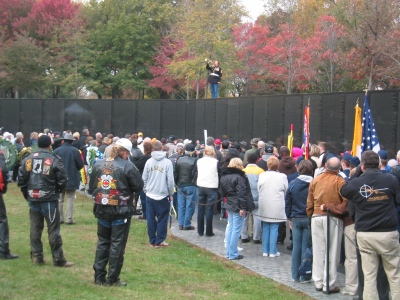
10 November 2007, The Vietnam War Memorial, 25th Anniversary, the reading of the names

This Memorial Day is the 25th anniversary of the dedication of the Vietnam War Memorial so there are a lot of events going on at the west end of the mall this weekend. Most significantly, volunteers have spent the week leading up to Memorial Day reading the names of all 58,209 people listed on the wall. In the picture above the readers took a break at noon for a Marine bugler to play taps.

When the Vietnam War and Vietnam War veterans first came to my consciousness, Vietnam vets were all pretty much people in their late thirties or forties, but it’s been forty years since the peak of the Vietnam War. Vietnam vets are old grey-hairs now. The number of people walking the wall with their wheeled walker or sitting on a bench to catch their breath was surprising. They look now more like my imagining of Second World War veterans than those of the Vietnam War. We tend to think of the Vietnam War as another generation’s war, but at this point more time has elapsed since the Vietnam War and the present day than between the Second World War and the Vietnam War.

Owing to their proximity, a larger number of people than usual were also visiting the Lincoln Memorial. I wonder how many realize that it is the memorial in Washington, D.C. of the Civil War, a war that is more commemorated on the various battlefields of the states where it was fought than in the capitol. S. and I biked past the First World War Memorial. It is a crumbling ruin in an untended and unvisited corner of the Mall. Time marches on.

As we were leaving, a rather large contingent of Native American veterans wearing their military uniforms under more traditional clothing was processing off the field. They paraded under the U.S. flag as well as the black POW/MIA flag, only their POW/MIA flag had a silhouette of a Native American. They stood in a semicircle off one of the paths greeting other passing vets. It’s weird to see someone in full Native American garb greet another Marine with “Semper Fi.”

The Vietnam War Memorial is one of the most well done monuments in Washington, D.C. To walk its length is to experience the War as a symbolic journey. The names are listed in the order they were killed. The first few panels list only a small number of names, a reminder that the war started gradually and covertly under Eisenhower and Kennedy. The panels are like a bar chart of that creeping war, until you reach the imposing nadir of the monument and start the ascent up the north wall. The last few panels, just a few inches high and with but a few names are the most tragic, each always reminding me of the young John Kerry’s words: “How do you ask a man to be the last one to die for a lost cause?”

As you ascend the north wall, it forms an arrow pointing east to the Obelisk. Further in the background you can see the dome of the Capitol. The Capitol building has always been hard to see for itself past the symbolry of its image. It’s always invoked the same thoughts as those oil paintings and illustrations of the great debates of Henry Clay, Daniel Webster or John Calhoun. It is the assembly place of the great debating society of democracy. After eight years of Republican rule the Capitol has acquired an insidiousness for me more like that of the Deathstar. It is the looming crown jewel in an empire of evil. It is an association that I don’t think will ever leave me and can almost certainly not be shorn by a few years of Democratic capers in governance.

Ascending from of the black pit of the Vietnam War to be greeted by the shining white of the Obelisk and the Capitol only serves as an indictment of the hypocrisy behind all the intended awe inspiration of the rest of the monuments of D.C. It is a reminder that those names aren’t just on the wall for a mysterious reason. The right arm of the monument points accusingly to the reason all those names are there. The Vietnam War Memorial is the only monument in Washington, D.C. that is not architecture cum propaganda.

Friday Cat Blogging: Mogley Gets an Elizabethan Collar

Mogley Gets an Elizabethan Collar, Mount Pleasant, Washington, D.C., 31 October 2007

S. is very protective of Mogley. When we’ve gone away for any length, she has put together a package of information about his medical history and the location of the emergency veterinarian and whatnot. She sends an e-mail to the cat-sitter about precautions to observe while watching him that is so detailed and imaginative that one friend commented that is seems like we are on suicide watch with the cat.

So it figures that when S. went to Ontario for a client visit last week, Mogley had been left in my exclusive care for all of one day when he went and injured himself. He was fine when I got home, but while I was ignoring him to his wild chagrin, he put on his usual show of running up and down the hall like a maniac. When next I looked at him, he was missing a pencil eraser-sized patch of fur on his face and had grown a red knot where the fur was missing. I presumed this was some sort of blunt-force injury from an uncontrolled turnabout at one end of the hall.

After a few days in which the spot wasn’t healing, but seemed to be getting worse, it was off to the vet for Mogley. I joked that he was going to get one of those lampshades around his neck to prevent animals from chewing and low and behold, here he is with what I learned is called an Elizabethan collar. His is more like a martini glass. I am tempted to throw a few skewered olives in with his head.

And 3M sure manufacturers an eclectic range of products. Who knew Elizabethan collars were among them?

It was funny at first, but the vet had warned S. that it was going to be difficult to keep the collar on him. They didn’t say why. It turns out that he has sunk into a serious deep blue funk. In addition to preventing him from rubbing his wound, the collar prevents him from taking a cat bath so he is despondent and has taken to licking the inside of the collar as a substitute. His fur has started to get shabby and he has acquired a distinct odor. He slinks around like a decrepit elderly cat and whenever he tries to do something athletic like his usual sprightly self, the collar invariably catches on something making his stunt go awry.

He has no idea of the world of human intentions and designs, hence no idea that this is temporary and for his own good. He thinks this is his life now and it’s like one of the rings of hell (OCD ass lickers dawn an Elizabethan collar for all of eternity).

As much as I like a pet that looks like a cocktail, I can’t wait to take it off him.

Foreign Policy Micro-Initiatives

Matthew Yglesias comments (“Resilience,” The Atlantic.com, 30 October 2007) on Robert Kagan’s Sunday editorial (“Free Elections Come First,” The Washington Post, 28 October 2007, p. B7):

The unfortunate reality for those like Kagan who’d like to believe that an incredibly aggressive, violent, coercion-oriented US foreign policy is the height of moral probity is that living conditions around the world are, in general, improving for the better without us. There are major exceptions in Sub-Saharan Africa and North Korea but there’s nothing about a glance at those places — Iraq, Lebanon, the Palestinian territories — that have benefited from American “democracy promotion” policy that would make any sane person think we need to Kaganize our approach to Russia or China.

This should not be to say that the U.S. should sit passive, but rather than blowing the entire budgetary and soldierly load on one or two high risk foreign policy extravaganzas, what the U.S. should pursue is multifaceted, low-grade, low risk diplomatic pressure and programs across a wide range of countries and issues. It has a higher probability of success, failures have less consequence and unlike massive military interventions, history is on our side here.

Unfortunately foreign policy thinking under the tutelage of George W. Bush, et. al. and the right more generally has taught the country to love the spectacle. The slow, meandering work of diplomacy is no longer enough to capture and hold the imagination of a people who have come to expect “shock and awe,” explosions, daisy-cutter bombs, multi-million dollar airplanes and soldiers looking like a bunch of badasses. No besuited pencil-necks touting human rights reports will suffice for this appetite.

In this regard the President and Congress are no longer really strategists who take as their primary object the international situation, so much as senior public relations people involved in the creation of images for mass public consumption. The images then become the raw material of a primal American dialog about manliness, virility, strength, fear, safety, children, et cetera that takes place in an almost entirely solipsistic fantasy world. So the terms of our foreign policy debate have become whether or not a scrawny Greek guy looks convincing driving a tank, how manly George Bush looks in a flight suite and who would be better received serving Thanksgiving dinner at a surprise visit to a FOB.

The problem with foreign policy micro-initiatives is that they don’t enter into the symbol system of U.S. political dialogue.

Hegemony Corrupts

Francis Fukuyama argues that the misbehavior of the United States in the last few years — he includes the Clinton years — is in fact systematic (“A Self-Defeating Hegemony,” Real Clear Politics, 26 October 2007):

But the fundamental problem remains the lopsided distribution of power in the international system. Any country in the same position as the US, even a democracy, would be tempted to exercise its hegemonic power with less and less restraint. America’s founding fathers were motivated by a similar belief that unchecked power, even when democratically legitimated, could be dangerous, which is why they created a constitutional system of internally separated powers to limit the executive.

Such a system does not exist on a global scale today, which may explain how America got into such trouble. A smoother international distribution of power, even in a global system that is less than fully democratic, would pose fewer temptations to abandon the prudent exercise of power.

A “smoother international distribution of power” could come about through any of a number of ways. The United States could revert to the former system whereby it conducted itself with a self-imposed restraint and voluntarily submitted to a series of treaty-based limitations on its power — ones largely imposed consistently on actors throughout the international system. This would require some measure of calm and circumspection on the part of the U.S. electorate, desiderata for which I am not going to hold my breath. The alternative is that restraint will be imposed upon us by the emergence of a competing power center. The latter is fraught with all the normal dangers of system transition.

So hopefully Mr. Fukuyama’s next book will be on the necessity for one world government.

FaceBook

S. has recently become very interested in social networking sites and has drug me to get FaceBook and MySpace pages. FaceBook is pretty cool in that it’s like a social networking engine with an API for user application development. Judging by some of the applications, they give developers a lot of access. But the thing that I don’t get is why the people behind FaceBook seem to so lack ambition. First of all, they have yet to completely shed their college-oriented origins, so their network remains entirely too fragmented. But the real oversight is why, with that huge existing user database, they haven’t deployed more core functionality. Right now is seems like FaceBook is just a sort of online business card. Why haven’t they deployed dating, group scheduling and calendaring, blogging, employment, classified advertisements and so on? They could be match.com, meetup.com, livejournal.com, monster.com and craigslist.com all rolled into one. Or if not build the functionality themselves, why not partner and integrate or build some gateways? There are some features like what I am talking about, but they are rudimentary. Why not put them front and center? Seems like a recipe for obsolescence to me. In this environment it’s innovate or wither.