It’ll All End In Tears, Redux

The Financial Times today (Stephens, Philip, “A Physicist’s Theory of the Transatlantic Relationship,” 14 December 2007):

The overarching geopolitical fact of coming decades is likely to be the relative decline of US power. The word relative is important. Measured by economic, technological and military might, America is likely to remain the pre-eminent nation during the first half of the present century and, perhaps, well beyond. But the US is already an insufficient as well as an indispensable power. As China, India and others rise, and Russia re-asserts itself, the US will become more dependent on the goodwill of others. How it responds to the shifts will in large degree shape the new international order — or disorder.

The image of the future in the minds of many is of a multipolar system, with power shared between two or three groups of nations. … Others — in the US as well as Europe — conjure up a world divided into two competing blocs: the liberal democracies on one side, the authoritarian capitalists, notably but not exclusively China and Russia, on the other. …

More probably we are on the cusp of an era of great power competition in which alliances and allegiances shift according to accidents of circumstance and geography. Those who like historical analogies could look back at the second half of the 19th century.

The problem with looking back at the second half of the Nineteenth Century is that we all know how that ended.

Confrontation Between Israel and Iran is Strategic, Not Ideological

Yesterday I went to the Center for American Progress event, Nuclear Meltdown: Rebuilding a Coherent Policy Towards Iran (Washington, D.C., 13 December 2007). It was moderated by Center for American Progress Director for Nuclear Policy Joseph Cirincione and consisted of a discussion with authors Barbara Slavin and Trita Parsi whose books are Bitter Friends, Bosom Enemies: Iran, the U.S., and the Twisted Path to Confrontation and Treacherous Alliance: The Secret Dealings of Israel, Iran, and the United States, respectively. Both Ms. Slavin and Mr. Parsi were phenomenally interesting and well informed. As Mr. Cirincione points out, their books really complement each other and both have been reviewed in tandem in most papers.

The single point that most fascinated me from their discussion — and apparently it impressed Mr. Cirincione as well as he allows in his question — is Mr. Parsi’s dismissal of the ideology and the rhetoric of Israeli-Iranian relations in favor of a purely geostrategic analysis. In this regard, the first Gulf War of 1991, rather than the Iranian revolution of 1979 was the real turning point in Israeli-Iranian relations.

The Center for American Progress already has a video of the event up and Mr. Parsi gives a thumb-nail version of his theory starting about a quarter of the way in, but here is a transcript of what he says:

… Iran and Israel did have a strong relationship during the 50s, 60s and 70s. From the Israeli’s side there was the doctrine of the periphery, the idea that Israel’s security was best achieved by making alliances with the non-Arab periphery states in the region — basically Turkey, Iran and Ethiopia — in order to weaken the Arab states in Israel’s vicinity — the inner and the outer circle.

And there is a myth out there in my view and I argue strongly against it in the book that Israeli-Iranian relations radically change in 1979 because of the revolution. And certainly the revolution did change a lot. Iran had a completely new ideology and very aggressive anti-Israeli rhetoric, but the common threats that had pushed Iran and Israel closer together during the preceding decades — the common threat from the Arab world and the common threat from the Soviet Union — was still there after 1979. And strategically Israel believed that Iran was still a very, very strong periphery power that it needed to have a strategic relationship.

And immediately after the revolution the Israelis were doing everything the could to reach out to Iran, to sell arms to Iran in spite of an American arms embargo and even lobby the United States not only to talk to Iran but also that the U.S. should sell arms to Iran and that the U.S. actually should not pay attention to Iranian rhetoric because the rhetoric was not reflective of the policy. Which is a drastically different position than the Israelis took only a couple of years later.

What really changes the relationship is the end of the Cold War and the defeat of Saddam in the first Persian Gulf War because then at the end of the Cold War the Soviet Union collapses and the last standing Arab army that could pose a conventional military threat to both Iran and to Israel was defeated by the United States. You have a completely new reconfiguration of the geopolitical map in the Middle East in which Iran and Israel emerge as two of the more powerful states. And just as much from the Israeli perspective Iran was needed to balance Iraq to a certain extent they also felt that Iraq was needed to balance Iran but there was no longer a balancer of Iran. They started to view Iran as a potential threat in the future.

So it’s in 1992 that you see a sudden shift in the Israeli position vis-à-vis Iran. Throughout the 1980s in spite of Khomeini’s tremendously aggressive rhetoric against Israel, the Israelis do not talk about an Iranian threat, they reach out to the Iranians. But after 1992 when the Iranians actually become much more pragmatic in their foreign policy their revolutionary zeal is plummeting, that’s when Israel starts to depict Iran as a global and existential threat, out of a fear that in the new Middle East if the United States was now reaching out to the Arab states as it was in the Persian Gulf War and if in addition to that they were to make some sort of a deal with the Iranians, the deal would come at the expense of Israel’s interest.

And the calculation on the Israeli side was they need to make sure that type of political process does not take place. And that is achieved by creating the political obstacles to such a process by imposing new sanctions, by depicting Iran as a global threat. And this initially actually came as a great surprise to the United States because only five years earlier the Israelis had been pushing the Iran-Contra scandal.

That last comment about the Iran-Contra scandal may just seem like a throw-away jibe at the Reagan administration, but I think it’s an important piece of evidence in favor of Mr. Parsi’s case. When I heard it, it really made things fall into place for me. I always wondered what the Israelis were doing as middle-men in that fiasco and how it was that their relationship with Iran was adequate to allow them to act in that capacity, whereas ours was not. Anyway, Mr. Parsi’s theory is what I was missing to explain that recalcitrant fact.

The Future Has a Lot of Factors

Via Kevin Drum (“Random Debate Thoughts (So Far),” Political Animal, Washington Monthly, 13 December 2007) a new factoid that Barack Obama is brandishing:

Reducing obesity to 1980 levels will save Medicare $1 trillion.

I’m too busy right now to go and fact-check this before passing it along, but when I considers the sheer number potentialities like this out there in the realm of possibility, I am reminded of Paul Krugman’s admonition regarding how to think about the financing of the U.S. welfare state (“Social Security Scares,” The New York Times, 5 March 2004):

By all means, let’s plan ahead. But let’s set some limits. When people issue ominous warnings about the cost of Medicare after 2077, my question is, Why should fiscal decisions today reflect the possible cost of providing generations not yet born with medical treatments not yet invented?

There is the pragmatic reason that the sooner we act, the less we have to do, but I think Mr. Krugman is right to suggest that there are just too may unknown unknowns — to borrow a Rumsfeldism — to seriously plan for 2077.

The Iran NIE: Mendacity, Incompetence or Just the Usual Vileness

The Iran National Intelligence Estimate finding with a high degree of confidence that Iran abandoned its pursuit of a nuclear weapon in 2003 seems on course to completely upend the state of political debate — provided some Democrat wants to make something of it instead of just leaving the story to follow its course in the press.

The NIE has been in essentially the state that it is today for a year. Apparently additional sourcing for the 2003 abandonment has caused the intelligence community to upgrade their confidence level in recent weeks, but that’s about it. This information has been in hand for a year now, during which time the administration continued to amp up their rhetoric on Iran with dark portents of World War III. Now the administration is obfuscating what was known and when. There are three stand-outs to me in their various stories:

  1. The President was only fully informed of the contents of the NIE on Wednesday, 28 November, or maybe 26 November 2007, depending on whether you believe Stephen Hadley or Seymour Hersh (“Hersh: Bush Told Olmert Of NIE Two Days Before President Was Allegedly First Briefed On It,” ThinkProgress, 4 December 2007). Or maybe some earlier date still, since all that Mr. Hersh has is a no-later-than date.

    Given that this information has been the subject of some rather significant administration infighting, possibly even resulting in the demotion of John Negroponte from the cabinet-level post of Director of National Intelligence to a Sate Department Deputy (Porter, Gareth, “Cheney Tried to Stifle Dissent in Iran NIE,” Inter Press Service, 8 November 2007), it would be hard to believe that it could have escaped the attention of the President. Hard to believe, but not impossible: President Bush’s attention is hardly inescapable.

  2. Bush was told — sort of — back in August as he hedgingly revealed in his Tuesday press conference (“Press Conference by the President,” White House, Washington, D.C., 4 December 2007):

    BUSH: I was made aware of the NIE last week. In August, I think it was John — Mike McConnell came in and said, We have some new information. He didn’t tell me what the information was. He did tell me it was going to take a while to analyze.

    One might think from this that the President’s Daily Briefing is a guessing game between the President and the Director of National Intelligence (“I’m thinking of a rogue state that sets off a Geiger counter. Can you guess which one it is?”). But reading any book on the Bush administration by — take your pick — Bob Woodward, Ron Suskind, etc. — and you quickly see that the President’s habit of punctuality and always ending meetings on time — touted by the right as a virtue over the perpetually behind schedule Bill Clinton — is actually a function of his remarkable incuriosity. Again and again you read of a briefer or primary’s amazement that after sitting through a detailed presentation, President Bush would simply jump up without a single question, issued a manly “Great work” or some such oral back-slap and exit the room.

    Given this, I wouldn’t doubt that after hearing of potential critical new information, it wouldn’t occur to President Bush to even ask what that might be. Having now become fully informed as to the new information, President Bush yesterday specifically said that it hasn’t changed his addled mind one iota. People who never reexamine their positions aren’t in need of new information, so why bother asking?

  3. The Office of the Vice President has done everything it its power to pressure the intelligence community to alter its findings (sound familiar?). Baring that, they have tried to prevent the release of the key findings and have succeeded in doing so for some months now (Porter, Gareth, ibid.). But it’s nut just for the sake of external message that they go to all these lengths. There’s been plenty of reporting on the fact that Dick Cheney and his staff engage in a significant amount of maneuver to determine who gets to speak to the President and what information reaches his desk — undoubtedly with only the best intention to wisely manage the President’s time, certainly not to squelch positions differing from that of the OVP.

    At this point President Bush is systematically kept in the dark about all manner of issues. Think of that memo from George Tennet warning about the famous sixteen words in the State of the Union that died on Stephen Hadley’s desk. Just a bureaucratic oversight?

    Of the services that an effective agent provides to a president one is that of plausible deniability in the form of the agents shielding the president from possession of certain inconvenient information, especially in the era of “what did he know and when did he know it.” It is well observed that one of the pitfalls a president faces is “the bubble.” Especially as an administration wears on, a president can wind up extremely isolated and the Oval Office is an extremely lonely place. This is an extremely complicated dynamic, but the gift of plausible deniability is one of those reasons.

    President Bush has always been more the pitch-man-in-chief more than the prime mover of this administration and to make his pitch for the administration’s policies sometimes less is more. Every president needs a sin eater and Vice President Cheney serves that roll for President Bush.

Now-a-days even the likes of Joe Scarborough are suggesting that the President is either lying or stupid (Frick, Ali, “Joe Scarborough Rips Bush On Iran NIE: He’s Either ‘Lying’ Or ‘Is Stupid’,” ThinkProgress, 5 December 2007). I see no reason to choose as I think that this administration is polymorphously evil: a nasty combination of mendacity, incompetence and the malign.

The thing I don’t get is how these people can preserve even a modicum of legitimacy. If the papers won’t just report that the President lied his way through a press conference this afternoon, you would think that at some point they might just stop reporting on what he says as it is simply too unreliable to print.

The Decline and Revival in Standards of Pompous Grandiosity

A hitherto unknown to me, but apparently famous exchange from the tense final days of the July 1914 Crisis (May, Ernest R. and Samuel R. Williamson, Jr., “An Identity of Opinion: Historians and July 1914,” The Journal of Modern History , 79, June 2007, pp. 335–387):

Famously, when Moltke protested that it was too late to concentrate forces on the Russian front rather than in the west, the kaiser exclaimed: “Your illustrious uncle would not have given me such an answer. If I order it, it must be possible.” (p. 361)

Compare this to the tepid legalism of Richard Nixon:

Well, when the president does it that means that it is not illegal.

(interview with David Frost, aired on television on 19 May 1977)

Kaiser Wilhelm II was at least disjointed enough to think that he could mandate the possible, not merely the legal.

But thank goodness our leaders have gotten back into the business of denigrating reality in favor of will.

Happy Repeal Day

5 December 2007, Repeal Day, my liquor cabinet

Dewars Scotch has the brilliantly targeted (at me and my ilk) advertising campaign of promoting the notion of Repeal Day (Dewars | independent), celebrating the end of prohibition. That’s a holiday I can get behind!

Fittingly Franklin D. Roosevelt, the last president to have been photographed with a cocktail and a cigarette, ran on the repeal of prohibition, signed the Volstead Act legalizing the brewing of beer and presided over the repeal of the Eighteenth Amendment. On 5 December 1933 Utah, of all states, ratified the Twenty-First Amendment to the United States Constitution ending prohibition. Another reason that FDR is one of the best presidents in U.S. history!

It’s snowing out and the bars in D.C. all suck so I will probably be staying in, but while setting the scene for the photograph above, I happily came across a forgotten bottle of now thirteen-year-old Glenlivet single malt scotch: the kind of thing to keep you warm on a winter night. Sorry Dewars, but your promotional failed on me as I will be drinking the competition tonight.

The Southern Strategy and the Party of Torture

File under “And when you look long into an abyss, the abyss also looks into you” (Nietzsche, Beyond Good and Evil, §146). Andrew Sullivan on torture and the American way (“Torture in American History,” The Daily Dish, TheAtlantic.com, 30 November 2007):

It is, sadly, a simple fact that torture was once a deep part of the American way of life, inextricable from slavery and racism, for a very long time. It was worst in the South, but not unknown elsewhere – well into the twentieth century. The ease with which some in the new GOP reconcile themselves to it with respect to terror suspects, as long as it is directed at “the other,” cannot be fully understood outside this context.

Combine this with Joe Klein’s observation of just how deeply the pro-torture position has become among the Republican base (“Dialing the Republicans,” Swampland, 29 November 2007):

But there was worse to come: When John McCain started talking about torture — specifically, about waterboarding — the dials plummeted again. Lower even than for the illegal Children of God. Down to the low 20s, which, given the natural averaging of a focus group, is about as low as you can go. Afterwards, Luntz asked the group why they seemed to be in favor of torture. “I don’t have any problem pouring water on the face of a man who killed 3000 Americans on 9/11,” said John Shevlin, a retired federal law enforcement officer. The group applauded, appallingly.

It follows that the party that pursued the Southern Strategy, whose base is the South, that has such a lock there that the other party can have a serious debate about whether to even bother campaigning in the South, that this party would become the party of torture.

The American character is comprised not just of the nice parts of U.S. history, just the parts that we sift through our history and authorize for incorporation, but the entirety of our history. And in today’s Republican party some of the ugliest parts are rearing their head.

Tchotchkes and Circus

Over the Thanksgiving weekend our Australian member pointed out a striking contrast. A constant topic of conversation among our group, being mid-career professionals from New York and Washington, D.C., it the outrageous price of houses. We are all at that age where we are looking and scheming, but for myself I have completely written off the prospect of ever owning a house in any place where I would like to live, namely the big city.

In the midst of one of these rants, Dean, a man with a considerable lust for gadgets mind you, pointed out that increasingly the most important things in life — housing, education, healthcare — are astronomically expensive, pushing completely unaffordable to normal middle class people. Meanwhile all the trivial junk — banana hangers, juicers, fruit dryers, bread makers, cheese straighteners — becomes ever more cheap.

This is just the economic continuation of bread and circus: as the most important things in life recede ever farther from grasp, people are distracted by trivial entertainment and petty satisfactions.

Often enough, this is offered up as adequate consolation in the bargain of trade liberalization. Yes, yes, mid-level skilled jobs may be fleeing the country at an alarming rate but this is completely offset — so the argument goes — by the stunning decrease in prices. People’s wages may have stagnated, but the goods they seek to purchase have decreased in price so their real standard of living has improved. The fly in the ointment is that the price of imported goods — cheese straighteners et. al. — has decreased while the price of domestically produced goods — healthcare, houses, education — has continued to increase apace. Or perhaps what we are witnessing is correct valuation of these dear goods: as the return on investment in these life-investments has grown, their value, like blue-chip stocks, has grown accordingly. Whatever the case, what we are witnessing is the reverse of Robert Reich’s thesis from The Work Of Nations: rather than investing in our immovable capital, namely our nation’s citizens, we are allowing them to crumble in favor of tooth brushes that match the bathroom curtains.

Owing to I-don’t-know-what — morbidity about the future and infatuation with the shimmer of the present — the calculation by which your average person discounts future prosperity is all out of whack. Contra the Virginia Postrel thesis, life may be ever more stylish and well designed, but it is simultaneously more mean and slim in its life-investment aspects. What we are experiencing is a hollowing out of the human economy. The aesthetics are just the latest in bread and circus. And I’m not talking ivory tower abstractions about what constitutes the good life — some sort of life of mind and real freedom versus crass materialist comfort. As Hans Roslings has amply demonstrated (e.g. Debunking ‘Third-World’ Myths with the Best Stats You’ve Ever Seen,”, TED, Monteray, California, February 2006) and as I’ve learned as a supervisor, basic health is perhaps the most important prerequisite to prosperity. Education is the foundation upon which future wellbeing is built. To the extent that we defer human investment in favor of spending our money on the day-to-day, we undermine our capacity to keep the circus of gadgets going.

Deregulate Marriage

Stephanie Coontz, perhaps the most successful professor at my alma mater in terms of actual impact on U.S. political debate, editorializes in today’s New York Times on why the state should get out of the business of certifying and legitimating marriages (“Taking Marriage Private,” 26 November 2007):

In the 1950s, using the marriage license as a shorthand way to distribute benefits and legal privileges made some sense because almost all adults were married…

Today, however, possession of a marriage license tells us little about people’s interpersonal responsibilities. Half of all Americans aged 25 to 29 are unmarried, and many of them already have incurred obligations as partners, parents or both. Almost 40 percent of America’s children are born to unmarried parents. Meanwhile, many legally married people are in remarriages where their obligations are spread among several households.

Possession of a marriage license is no longer the chief determinant of which obligations a couple must keep, either to their children or to each other. But it still determines which obligations a couple can keep — who gets hospital visitation rights, family leave, health care and survivor’s benefits. This may serve the purpose of some moralists. But it doesn’t serve the public interest of helping individuals meet their care-giving commitments.

A marriage is a hybrid of part administrative expedience, part contract law and part sacred cultural institution. The sacred cultural institution stuff is a part of autonomous culture and the state has little business meddling there. As for the administration and contract law portions, Ms. Coontz makes a perfectly pragmatic case for deregulation. Changing mores have rendered the original expedience obsolete.

So the argument goes in the economic sphere: the Twenty-First Century is a fast changing time for which the bureaucratic and regulatory machinery of the state is ill-suited. Best to leave it to the nimble, distributed private market to adapt to this rapidly evolving environment. So it is today also with culture. So how about extending the same courtesy to individuals as to business?

The Magnificent Seven

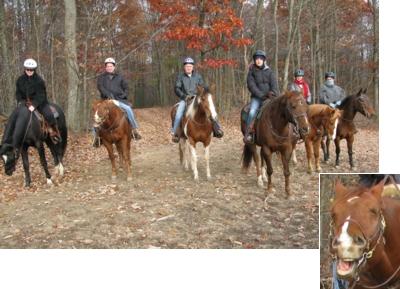
Thanksgiving weekend, 2007, Pleasant Valley Ranch, Pennsylvania, riding horses

(six in picture, seventh behind camera)

S. and I spent the Thanksgiving weekend with the usual crew of regional friends, one toddler, three dogs a cat and an Aussie, this time in the Poconos. The stuffing wars between S. and I brewed on into another season (I make mine with thyme and raisins, she makes a more stripped down version). I tried to supplement my usual entry with an experimental roast fall vegetable stuffing, but owing to insufficient time-management on my part had to be turned over to another cook to be circumscribed into merely roast vegetables, sans cornbread.

The day after Thanksgiving we went on a day hike. We ended up driving all over creation trying to locate a trail where we wouldn’t be imperiled by the stray slings and arrows of hunters. After driving past a number of trailheads, we arrived upon a national park, figuring that there wouldn’t be any hunters allowed. We parked and as we were headed for the trailhead, two young men in full camouflage, one toting a bow and arrows, the other a rifle came off the trail and towards us. This put a pall on our hiking party and we stopped them for questioning. They explained that it was hunting to the right, no hunting to the left, and that the hunters would probably have hiked quite a ways off the trail anyway. So we decided to proceed. The hutch at the trailhead greeted us with a litany of yellow warning postings. “Warning: Hunting season in effect.” “Warning: Beware of Bears,” and all the usual instructions on what to do if attacked by a bear. The next one was a bonus danger: “Warning: Venture off the marked trail at your own risk. This park is a former military base and may contain unexploded ordinance.” But the real kicker was a homemade bulletin with the row of tear-offs down one side listing the contact information for the nearest hospital and driving directions to get there. And two of the tear-offs had already been taken.

On Saturday we went horseback riding at Pleasant Valley Ranch. I don’t like horses and the only time I have ever ridden one was in probably fourth grade when a classmate and her mother rode their horses over to my parents house. I was boosted up into the saddle, wrapped my arms around the waste of my classmate and she rode me one lap up and down the dirt road off of which my parents live.

Under most circumstances I would have been much less than enthusiastic about the prospect of riding horses, but as I am presently reading quite a bit of Nineteenth Century military and diplomatic history and as horsemanship plays a significant part in this tale and is major component of martial virtue in the period, I though I should get a visceral sense of it. The ranch is twenty-something acres and we rode through wooded hollows, over grassy hills and through recently harvested corn fields. The picture above is taken as we came out of a wood at the crest of a hill overlooking a valley and a ridge, along which ran a portion of the Appalachian Trail (please note the humorous expression on the face of my horse, Bogie, inset).

As horses’ hooves rustled through the fallen leaves along the trails, I tried to imagine navigating the strange and uncharted byways of sparsely populated preindustrial Europe. I tried to imagine what it would be like to ride from Paris to Moscow in a column of 600,000 in the summer of 1812, happy and unaware. It was plenty cold out on Saturday, but I tried also to imagine what it would be like to be about as well dressed as I was this day, but in twenty-degree-below-zero weather on the retreat from Moscow. Where the road was boggy, I tried to imagine what it would be like for a team to pull a cannon through the mud.

My inspiration here is Adam Zamoyski’s gruesome book, Moscow 1812: Napoleon’s Fatal March. In a section of the book where he ponders the factors that determined who survived and who perished, Mr. Zamoyski proposes a number of possibilities. At the heading of one subsection of illustrative vignettes, he proposes, “Devotion to another could be a life-saver.” It is a misleading introduction as most of what follows are actually stories about how people died together. The horses are the subject of some of the most brutal passages in Mr. Zamoyski’s book, but of the devotion between soldier and horse he says,

Sergent Bourgogne tells of his friend Melet, a dragoon of the Guard. Melet was devoted to his horse, Cadet, with which he had been through several campaigns, in Spain, Austria and Prussia, and was determined to get it back to France with him. He always went in search of food for Cadet before thinking of himself, and when it became impossible to find any forage at all along the line of retreat of the Grand Armée he went in search of it among the Russians, donning the coat and helmet of a Russian dragoon he had killed in order to get past their pickets. Once inside the enemy’s encampment he would help himself to enough hay and oats for a few days and then make his escape. Sometimes he was discovered, but he always got away, and he did return to France with Cadet. A Bavarian Chevau-Léger whose darling mare Lisette fell through the ice of a bog outside Krasny and could not get out simply lay down to die beside her. (p. 491)

It was just a little two hour ride around the lot, but by the time the horses started to anticipate the end of the road I was fretting that it was over so soon. If you are looking to do something equine Pleasant Valley Ranch is a great experience. You couldn’t ask for a more easygoing, intelligent and attentive host.