And Humble Too …

We’ve been down for two weeks because our admin’s internet provider, Clearwire, cut off inbound port 80 with no notice. New policy: no internal web hosting. Admin had to switch to Comcast, with all the headache that entails. In case your experience with Comcast has to date been without a hitch then it’s just dumb luck. I have had a number of run-ins with their customer service which is not merely bad, but more in the category of egregious or maddeningly bad or not the sort of thing that a conscionable company desirous of success would do to its customers. But I guess it’s the sort of thing you can get away with when you are a partial monopoly

Anyway, after merely the entry-level runaround, we are back up and hopelessly dated. We’re up a little ahead of anticipation owing to Admin’s genius. As he reports,

It appears that DNS is picking up pretty quickly. (I had proactively dropped the time-to-live for DNS, knowing there would be an IP address change–’cause I’m so fucking brilliant.)

Off

Missouri is the bellwether state. It is currently 98 percent reporting and none of the networks can call it. When it’s that close, even when it eventually falls into one candidate’s column, can it be said to mean anything? I’d say it’s groundhog’s day: it means six more weeks of primaries.

The real headline tonight is on the Republican side. For some time now I have imagined that the Democrats will have a candidate by the end of Super Tuesday and that Republicans will go all the way to the convention with three viable contenders. It has completely reversed. The headline tomorrow should be that Romney is done for. Governor Huckabee seems more viable than him at this point. In terms of delegates Romney only bested Huckabee by thirty. John McCain collected more delegates than both of them combined.

Update, 6 February 2008, 4:35 AM: The opening line from Mike Huckabee’s speech was great (“Mike Huckabee’s Super Tuesday Speech,” Associated Press, 5 February 2008):

You know, over the past few days a lot of people have been trying to say that this is a two-man race. Well, you know what? It is. And we’re in it!

The Surge

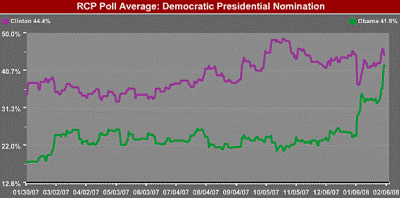
Real Clear Politics, Democratic primary poll graph, February 2008

In the last few days Barack Obama has been really surging fast. A look at the graph above from Real Clear Politics shows a considerable spike. Talk has been of him closing the gap, but I just got an e-mail alert linking to a Reuters / C-SPAN / Zogby poll showing Senator Obama not only to have closed the gap, but gone up thirteen points (Whitesides, John, “Obama, Romney lead in California on Super Tuesday, Reuters, 5 February 2008).

The problem is that the polls over the last few days have been all over the map. CNN was freaking out last night because they had polls showing that both Clinton and Obama, both McCain and Romney would be winning California. I think that this Reuters / C-SPAN / Zogby poll is probably accurate because it is in keeping with the trend.

There are two interesting things that I see in the Real Clear Politics graph. The first is the real significance of the outcome of Iowa. Senator Obama spikes around 6 January 2008. And it is not a blip. After that he plateaus. The gains he made in Iowa became permanent. This is nothing but speculation, but I presume it was the perceived inevitability of Hillary Clinton that was artificially suppressing Obama support. Once that perceived inevitability had been broken, Obama support broke out and dug in.

The second think I notice is that there are two spikes for Senator Obama. The first spike comes drastically at the expense of Senator Clinton: people were defecting from the Clinton camp to that of Obama — again the end of the inevitability thing. But my second point is the second, more recent jump in support for Senator Obama. It comes at the same time as support for Hillary Clinton is also rising, just not all that much. This second spike suggests an answer for a long standing question: which way will Edwards supporters break after he drops out. The second large spike in Obama support — a ten percent increase compared to only a three percent increase for Senator Clinton — says that the majority went for Senator Obama.

Anyway, stoked by a few such scraps of data, my inclination is to say that tonight will be a big series of upset wins for Barack Obama. Hillary Clinton will continue to fight it out all the way to the convention and hoping to win a convention battle. She will be counting on the see-sawing that has gone on to date to continue and this is not an unreasonable expectation considering the primaries to date. In fact, there is probably some dynamic among bleeding-heart liberal voters of sympathy for the loser buying them a few votes in the next contest. I know that I hate it that one of these two is going to have to lose for good at some point. Whatever the case, I suspect that Senator Clinton is going to look like a real weak horse after tonight.

Militarism: Loose It or Use It

Gareth Porter wrote a closely argued book, Perils of Dominance: Imbalance of Power and the Road to War in Vietnam, a few years ago (2005) making the contrarian argument that it wasn’t insecurity over some domino effect imperiling the United States that got us into the Vietnam war, so much as overconfidence based on known superiority of the U.S. over the Soviet Union and China.

Mr. Porter’s point was that U.S. hegemony today continues to tempt us to further foreign adventures, namely Iraq. Ezra Klein makes the same point in reference to U.S. military spending (“Your World in Charts: ‘We’re #1’ Edition,” The American Prospect, 31 January 2008):

There may, to be sure, be an argument for reducing our expenditures on hardware and increasing them on manpower, but there’s no real argument for increasing our total expenditures. This is particularly true in light of the last few years, where the size and power of our military fueled a vast overconfidence in its capabilities, which in turn helped ease our decision to invade Iraq, thus contributing to a venture that most all security experts agree has dramatically reduced our safety.

Where your money is, there your heart will be too. Or perhaps it’s not just money that burns a hole in your pocket: military power does as well.

Actually, I really doubt these are causal factors. If there was a military buildup during the 1980s that mysteriously persisted past the end of the Cold War, it was in large part owing to the work of people like then Wyoming Representative and Secretary of Defense Dick Cheney, then Director of Policy Planning Staff Paul Wolfowitz, then Assistant Secretary of Defense for International Security Policy, Richard Pearle, then head of the Ballistic Missile Threat Assessment Commission Donald Rumsfeld, as well as the rest of the usual cast of characters — the American Enterprise Institute, the Project for a New American Century, et cetera. As James Mann said in Rise of the Vulcans, one of the narratives that unites this disparate group, it is that of rebuilding the U.S. military and the country’s willingness to use it after the end of the Vietnam War — which brings us back to Mr. Porter’s point. These were people for whom no disaster could induce a measure of caution.

For this ideological coalition, the military buildup was a necessary step in a long-standing plan whereby U.S. hegemony would be preserved and extended through a series of small wars. This project was temporarily blocked by the presidency of Bill Clinton, but resumed once the actors were all brought back into office by George Bush, Jr., promotions all around.

The problem was selling the agenda to the rest of the U.S. electorate. In that regard Stormin’ Norman Schwarzkopf, Colin Powell (“First we are going to cut it off and then we’re going to kill it”) and CNN night vision footage of Patriot Missiles rising from Tel Aviv to meet incoming Scuds during the first Gulf War all went a long way toward reinstilling the invincibility and the righteousness of U.S. foreign interventions into the minds of your average voter. People say that everything changed after 11 September 2001, but in this regard, 11 September is the catalyst added to an ideological concoction that had been brewing for ten years.

The perfect juxtaposition of this point is when, in reference to Bosnia, Secretary of State Madeline Albright asked then Chairman of the Joint Chiefs of Staff Colin Powell, “What’s the point of having this superb military you’re always talking about if we can’t use it?” For a minimalist like Secretary Powell the point of having “this superb military” is so that you don’t have to use it. But it’s a self-defeating proposition because its existence eventually becomes the very argument for its use. And even liberals end up getting over-excited by too much cool military hardware.

The Most Awesome Political Strategist Ever

John McCain’s comeback from loosing the nomination in 2000 and being so far down in this primary that people were talking about him dropping out before Iowa because he didn’t even have the money to gas up the Straight Talk Express to now having won New Hampshire, South Carolina and Florida and the presumed winner out of Super Tuesday is nothing short of amazing. It shows what an incredibly strong candidate he is — and has been all along.

The thing that this determined comeback suggest is that McCain was the rightful Republican candidate in 2000. He had the potential to be a national and a unifying candidate. And were in not for the balls to the wall tactics of Karl Rove, he would have been.

Not just that: Al Gore was the anointed successor to a President Clinton leaving office one of the most popular in history, at the end of the longest uninterrupted economic expansion in history. By all rights, Al Gore should have been the 43rd President of the United States.

And for all his weaknesses, John Kerry was running against what was widely perceived at the time to be a sure looser. If you look at George W. Bush, Jr.’s approval ratings, they had dropped below half well before the 2004 election. He had a loosing war and a weak economy on his hands. He was a draft-dodger running against a purple-hear winner. But then, late in 2004 he bumped slightly above 50 percent and won a second term by one of the narrowest margins in hstory.

The thing that strikes me, seeing how tough a contender John McCain is, is that Karl Rove is the most awesome political strategist of his generation.

As bitter as John McCain must be at Mr. Rove, if he gets the nomination — or whoever gets it — they should beg, borrow and steal to get him to at least consult on their campaign. He may be tainted, but he is like the giant Antaeus from Greek mythology: since he draws his power from sleaze, the further into the mud he gets ground, the stronger he becomes.

Afterthought: Karl Rove is the highest attainment of sophistry: three times he has made the weaker argument appear the stronger to world-historical consequences.

Selective Lesson Taking

After Iowa there was a lot of commentary about what it meant that both parties had repudiated their establishment candidates. The Clintons and their DLC positions are the Democratic party today. Governor Romney represents the continuation of the Reagan coalition, whereas the other candidates are all the triumph of one faction of it over the rest. For Senator Obama to win on the Democratic side and Governor Huckabee to also win on the Republican side shows that dissatisfaction with the status quo runs across both parties.

But early primary victories by anti-establishment insurgents aren’t the only course of events that mean something. When ultimately Senator Clinton and Governor Romney secure their respective parties’ nominations, people should be ready to interpret those events as well. Anti-establishment idealism is all fine and good, but people should realize that in the end the empire always strikes back.

Bipartisanship After 20 January 2009

Senator Barack Obama’s win in South Carolina was exciting from a horse-race perspective. His speech was, in my opinion, much better than his Iowa one. But I still find his whole “changing the tone in Washington” shtick hopelessly naïve. I don’t know if he buys his own bullshit — maybe he knows better and it’s just a campaign ploy — but it suggests to me a candidate completely unready for the pain of the general election and the realities of governing a divided nation.

Consider the agenda for a Democratic president their first year in office. The top line issues will be doing something about Iraq, passing some sort of healthcare legislation, fixing the federal budget and, depending on how the economy plays out in the next year, managing the recession. I also imagine that about a week after a Democratic President is sworn in Ruth Bader Ginsburg will announce her retirement from the Supreme Court. All these issues seem daunting and perhaps the sort of thing that could hobble a new president right out of the gate.

Policies in Iraq and the war on terrorism are prerogatives of the president and the sort of things that can be accomplished without any input from Congress. But Iraq is an intractable situation. I don’t think anyone — no matter how confidently they may promulgate their whitepapers — knows what to do here, but a wrong move or two could be catastrophic. There are many powerful people in D.C. whose worldview is deeply connected to the Iraq war who will be watching and waiting to parade a Democratic president’s every plausibly wrong move down Pennsylvania Avenue and across all the television talk shows. Americans constantly tell pollsters that they want out of Iraq, but it is a position that is a mile wide and an inch deep. As soon as they are faced with the rhetoric of the consequences of withdrawal, they could seriously turn against a President actually implementing their previously desired policy. There are too many reasons that the Republicans will want to paint the Democrats as the party that lost the Iraq war — not least to get this albatross off the neck of the Republicans and onto that of the Democrats. No amount of speechifying is about to change this. This stands to be a real lesson for a President Obama in the unchangableness of the tone here in Washington, D.C.

However much they promise on the campaign trail, healthcare reform more significant than bureaucratic twiddling around the margins will be a next to impossible task. I think that a Democratic administration should hand this issue off to a blue-ribbon commission or some sort of consensus-building or stakes-raising body to let it simmer for a few months to a year, but I suspect that for reason of some by-gone precedent they will make it a part of their first hundred-day agenda. Everyone in Washington, D.C. believes that early successes build momentum and political capitol for a President. Therefore Republicans, right-leaning Democrats and related interest groups will be eager to hand the new President a momentum-stunting defeat on healthcare. Success in this issue will consist almost entirely of cajoling Congress and Republicans will seek to make it the first firebreak. Political-strategic considerations aside, the amount of money riding on this issue is just going to be too much for opposition groups to avoid going apocalyptic on this issue. Whoever grabs this wolf by the ears is going to have to be prepared for a lot of snarling and snapping in the general direction of their throat.

On the issue of fixing the budget, it can’t be done without raising taxes. If nothing else, the next President will be faced with whether to allow the sunset provision of the 2000 Bush tax cut to kick in. Nearly the entire Republican caucus has signed onto Grover Norquist’s No-Tax Pledge and the party leadership is serious about enforcing it. Additionally there are a lot of right-leaning Democrats or Democrats from sensitive conservative districts that tend to vote with the Republicans. Passing a Democratic budget will be dependent on maintaining a high degree of party unity, shaming Congressmen on the margin and taking the message to the citizenry. Since such a budget will probably come down to a straight party line vote, this will mean pressuring and humiliating Republicans in front of their constituents. In other words, some standard partisan tactics are what is called for here.

Regarding a Supreme Court nominee, I imagine that the Democrats will be surprised to find that their willingness to compromise on President Bush’s two appointments not reciprocated. A Democratic President may have to insist that Harry Reid actually call Mitch McConnell’s bluff and hold a real filibuster. And to win it, again, making the Republicans look the obstructionist assholes in front of the nation will be required.

When Barack Obama rattles off one of his standard litanies of the problems that can’t be solved owing to gridlock and partisanship, they aren’t initiatives that the Republicans want to advance too were it not for some mysterious bureaucratic bickering getting in the way. The items not achieved on Senator Obama’s list aren’t failures to Republicans, but accomplishments. Partisanship doesn’t emanate from some mysterious origin lost to the mists of time, but comes about owing to day-to-day real word differences on policy as well as the tried and true methods for advancing your own agenda while thwarting that of your opponent. Unless Barack Obama thinks that his smooth words have the power to evaporate this underlying reality — and Americans for Tax Reform, the American Enterprise Institute, Cato, The Weekly Standard, The Wall Street Journal editorial page and hordes of corporate money are going to do everything they can to see to it that he fails — then he better have a plan B.

The First Casualties of Gentrification

I suspect that the first real consequences of the gentrification of Columbia Heights are starting to hit Mount Pleasant. I was walking home tonight when I noticed that the Mount Pleasant Super Market was closed with the usual signs up in the windows. A peep through the grates revealed ransacked, bare shelves. My personal favorite grocery store, the Super Save Market has been locked up tight for probably two weeks now, but with no explanation and all the merchandise untouched — suggestive of a landlord locking them out rather than an orderly loosing of the lease.

I have to wonder when the International Progresso Market, Los Primos and the Samber Market are next. All three appear to be just barely hanging on.

The survivor will probably be BestWay which irritates the hell out of me. It’s the biggest of the grocery stores in the neighborhood, but also the most inadequate. First of all, they close way too early. Since the Super Save Market closed I have redirected to BestWay, but am already reminded why the Super Save Market was my favorite. About two thirds of the time that I head over to BestWay I find them closed. And they keep on ratcheting the hours down. It used to be that they closed at 9:00, but the floors were already mopped, the place stinking of whatever foul substance they put in their mop buckets and someone at the door trying to intimidate you from entering at 8:50. So they recently made the closing time 8:50. But everyone has adjusted accordingly. Now the place is mopped and you’re not welcome at 8:40. I frequently don’t even leave the office until 8:30. A grocery store that closes at 8:40 is a store at which I will never shop.

And then there is BestWay’s strange monomania regarding stock. BestWay is the one most like what most people think of when they think grocery store. Most of the stores in Mount Pleasant are weird hodgepodges of products heavily skewed toward the ethnicities of the neighborhood piled on improvised and mismatched shelves in a shop that doesn’t even approach ADA standards. There is a lot of minding your manners, jostling and backing down an isle only wide enough for one. BestWay is large, well stocked and has enough space for people to pass in the isles. But it’s only well-ish stocked. They have most things you would want and offer variety in nearly all product categories, but for some reason never vary the products according to the factors that matter. In the canned vegetable isle they devote a couple of feet on two shelves to tomatoes. That’s quite a lot of tomatoes — as would be expected as people eat a lot of tomatoes. But it’s all a couple of different brands of only 28 oz. cans of whole stewed tomatoes; no 14.5 oz. cans and no diced or sliced. Who makes anything with whole tomatoes? There are like five different brands of catsup — Heinz, Hunts, Del Monte, RichFood, Value Brand — but only in small bottles. But for some reason they carry vinegar in industrial quantities.

As this list may suggest, Mount Pleasant is an over-groceried neighborhood and maybe overdo for a shakeup. It’s a tiny nook of the city with multiple grocery stores in which the norm is huge residential tracts without a grocery store for miles.

I just hope Samber Market isn’t next. It has become my late night fallback now that Super Save Market is closed. It is run by an older Japanese couple and I go there because they are both so overwhelmingly pleasant. They are both very good looking, always dressed like they consider their job at the till to be very serious work, and seemingly happy to see me every time. The man holds up each item as he rings them up and gets a certain look of pride at each one — especially a bottle of wine — like he were serving the community and providing for his family with each sale. Often a boy, I presume their grandson, but maybe their son — they could go either way — is in the store roller-skating laps or climbing the taller shelves way too rambunctiously, but unimpeded by his grandparents.

They must sleep in the stock room on top of pallets of Top Ramen given the expense of living in D.C. Hopefully they’ll survive the winnowing. Hopefully this won’t end up another neighborhood without a grocery store.

Update, 27 January 2008: Yep, it’s confirmed. I walked past the Super Save Market on Friday night and there was a notice up from the D.C. Tenant Court saying that the tenant was in arrears $14,000. They had been making all sorts of upgrades to the store lately and I thought it was because they were finally making a bit of a success of themselves. I guess that it was actually some last ditch gamble to attract more business. The tragedy is that the fancy new shelves probably cost a month’s rent.

Last Days of the Bush Administration

Today the countdown begins: only 366 days left of the Bush administration (2008 is a leap year). On this day a year from now we will be swearing in a new president — provided that Dick Cheney’s office doesn’t dream up any new emergency powers of the presidency between now and then.

It’s amazing the degree to which President Bush has become a non-entity, given the collapse of the Bush Doctrine, the scuttling of their Iran agenda and the death of their domestic agenda as long ago as the defeat of the Bush Social Security privatization program in 2005. Of course, given the power and prerogative of the presidency, he could precipitate a crisis at any moment.

The turn of Bush & Co. to an announced program of peace in Israel — after seven years of neglect — is transparently unserious. Such efforts may play to a domestic audience, but, as in so many other issues, the administration seems unaware that the parties to such a peace have national security establishments of their own, bristling with salaried employees whose job it is to detect insincerity and deceit on the part of foreign powers. I imagine that whatever playing along the Israelis and Palestinians do is entirely diplomatic nicety.

A president truly committed to peace in Israel-Palestine would have to make it a top line issue for the duration of their administration and probably be prepared to hand off some unfinished business to a successor. And they would have to expend a significant portion of their political capitol on the issue. That means both time, travel and a willingness to take a lot of heat from the religious right and Israel lobby alliance.

Between campaign pandering to Christian Zionists and lame duck legacy hunting, the transformation of the Israeli-Palestinian conflict from a substantive international relations issue, into domestic opportunity for atmospherics is one of the most dangerous capitulations on a very serious foreign policy blight. All roads to peace in the Middle East lead through Israel-Palestine, but in the indispensable nation it has sunk to the level of ethanol subsidies or a commencement address at Bob Jones University.