Durian

Durian, a large, spiky fruit of Southeast Asia known for its pungent odor

I first encountered the durian as I was studying for a 2006 Thailand vacation. I was eager to dig into the local food and the tropical fruits especially excited me. It turned out to be not much of a culinary vacation and I ate a lot less fruit than I would have hoped. I certainly never got the nerve to try the durian. Since then my fear and ambivalence has only grown, especially after this SLOG story

(Spangenthal-Lee, Jonah, “Adventures in Food with Ari and Jonah,” The Stranger, 20 April 2007) and an episode of No Reservations where Anthony Bourdain described the durian as being more like a pungent French runny cheese than fruit.

But then, on Wednesday night, I was at a dinner party where the Vietnamese host announced that there would be two disserts after the dinner: one a usual dessert, the other a challenging dessert. I had already seen the cake on the galley counter so that was known. The challenge dissert was to be a surprise. After the cake was brought to the table, our host disappeared into the kitchen and returned with the surprise dessert: durian.

I have to say that its smell and appearance are deeply intimidating. I roiled with conflicted desire: the adventuresome side desperate to taste it, my distance-operative senses sounding the alarm that this was not food and not to be put in my mouth.

So of course I tried it. Once you get it past your nose it is a wonderfully complex and delicious fruit. It has an arduous flavor that comes in a number of phases. If you divide it into four rough phases, the third quarter is the fruity high point with a wonderful, light, fresh taste characteristic of tropical fruit at the top, reminiscent of the aftertaste of strawberries as it wears on. It has a long sour tail like cheese or butter, but with an ever so slight element of rancid gym sock.

Our host explained that if you buy the durian in the husk, you never know what you’re going to get until you open it up. He recommended the packaged durian, because someone else opens it and then it only gets packed if it’s good. Good being sulfuric in this case.

The Napoleon Dynamite Problem

After casing Ben Goertzel’s blog today, the point that I find myself really chewing on is this one (“The Increasing Value of Peculiar Intelligence,” The Multiverse According to Ben, 26 November 2008):

What occurs to me is that in a transparent society, there is massive economic value attached to peculiar intelligence. This is because if everyone can see everything else, the best way to gain advantage is to have something that nobody can understand even if they see it. And it’s quite possible that, even if they know that’s your explicit strategy, others can’t really do anything to thwart it.

Yes, a transparent society could decide to outlaw inscrutability. But this would have terrible consequences, because nearly all radical advances are initially inscrutable. Inscrutability is dangerous. But it’s also, almost by definition, the only path to radical growth.

I argued in a recent blog post [“The Inevitable Increase of Irrationality,” 25 November 2008] that part of the cause of the recent financial crisis is the development of financial instruments so complex that they are inscrutable to nearly everyone — so that even if banks play by the rules and operate transparently, they can still trick shareholders (and journalists) because these people can’t understand what they see!

But it seems that this recent issue with banks is just a preliminary glimmering of what’s to come.

Inscrutability, peculiarity, the idiosyncratic are already creeping in. Mr. Goertze is right to point to the rise of the quants and mathematical finance as an example. The one that comes to mind for me is the Napoleon Dynamite problem.

NetFlix has announced a million dollar prize for anyone who can improve the precision of its recommendation engine by ten percent. The New York Times Magazine and NPR’s On the Media both did stories about it back in November (Thompson, Clive, “If You Liked This, You’re Sure to Love That,” 23 November 2008; Gladstone, Brooke, “Knowing Me, Knowing You,” 21 November 2008). It turns out that improving the quality of this sort of singular value decomposition algorithm is geometric in difficulty. Most movies are easy to predict whether someone will like or dislike them, but a small number of odd movies thwart the algorithm. Chief among them is Napoleon Dynamite. For the research group profiled in The New York Times piece, Napoleon Dynamite was responsible for a whopping fifteen percent of all recommendation errors. There is no telling on the basis of people’s past movie rating history whether or not they’ll like this movie.

But the Napoleon Dynamite problem isn’t a solitary anomaly, but rather the paradigm of a trend. What we have is a Hollywood focused on these monster, expensive productions. Increasingly the movies that Hollywood makes are global products, with as much revenue coming from abroad as from the U.S. audience, so Hollywood is careful to strip its movies of any dialogue, humor or situations which are culturally nuanced and might not translate well. So the plot and dialog that we get in big Hollywood movies today is only the most broadly recognized and basic cultural tropes. Also, Hollywood has jacked the price of a movie up to the point where viewers now almost universally make a theatre-rental division: big special effects movies that they want to see in the theatres, and the dramas for which screen size isn’t a factor. It is a division with a positive feedback loop in that movie makers are aware of it and now shape their product offerings around it.

For a particularly depressing take on this, give a listen to Malcolm Gladwell’s 2006 New Yorker Festival talk on the use of machines to produce blockbuster scripts. At the same time that institutions like NetFlix are using computers to match customers to movies with increasing efficiency on the consumer end, Hollywood is using computers to make films increasingly easy to pigeonhole and match to demographics on the production side. It’s post-Fordist cultural production perfected. Soon we will be able to take the human out of the equation and the entertainment industry will just garnish out wages.

But there is — as is always the case — a countervailing motion. Just as Hollywood productions become increasingly trite and formulaic, there is the rise of these wildly bizarre and idiosyncratic films like The Zero Effect, Adaptation, Eternal Sunshine of the Spotless Mind, Lost in Translation, The Royal Tenenbaums, I ♥ Huckabees, Burn After Reading and so on. There is this sort of shadow Hollywood with it’s own set of stars and directors branding the alt-film genera: Wes Anderson, Charlie Kaufman, the Coen brothers, Catherine Keener, John Malkovich, William H. Macy, Frances McDormand. I would be remiss if I didn’t mention Steve Buscemi here.

What we have is a hollowing out of the middle. Along a spectrum, films range from obscurantia to formulaic. In the past, most movies probably fell in some broad middle: accessible, but unique. And most movie watchers probably fell there too. But increasingly movies and the movie-watching audience is being polarized into the genera constellations at one end and the difficult to categorize peculiarities at the other. Notice that the ambiguity of suspense has been replaced by the spectacle of gore in horror; that the sort of romantic comedy for which Drew Barrymore was designed and built has completely driven the older adult romantic drama to extinction. Similarly, the sort of accessible quirky, artiness represented by Woody Allen has moved much further down the spectrum of the idiosyncratic. The people who didn’t like Woody Allen are utterly baffled by Wes Anderson.

To generalize: hitherto we have been a normal distribution society. The majority of people fall into the broad middle and are closely related. But increasingly we are on the way toward a parabolic, or inverse normal distribution society, where the preponderance resides at the antipodes and people are separated by wide gulfs. This is true across the cultural spectrum, whether it’s politics, religion, the professions and so on. In the United States it is almost happening physically with the costal regions swelling as the center of the country is abandoned to satellite guided tractors and migrant labor. Some might call this the condition of postmodernity, some might call it the dissolution of Western Civilization.

The Noosphere Visualized

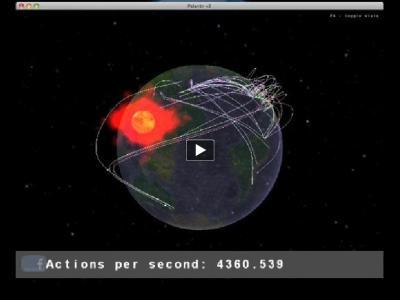
FaceBook's corner of the noosphere visualized, by Jack Lindamood

Jack Lindamood, one of the programmers at FaceBook, has produced a demonstration of an incredible tool that displays all activities on FaceBook geolocated on a rendering of the Earth. When he switches to a mode where it draws a line connecting the initiator to the recipient we get a view of something hitherto entirely invisible: a small subset of the noosphere being stitched together in real time.

I love it when he declares this “the Earth as Facebook sees it.” Then he switched to the wireframe view in which the Earth becomes just a grid for the information patterns that arc over its surface. Just as the geosphere becomes the platform for the biosphere and the biosphere becomes a geological force (Chown, Marcus, “Earth’s ‘Mineral Kingdom’ Evolved Hand in Hand with Life,” New Scientist, 19 November 2008), so the Earth is the grid on top of which the noosphere constructs itself, eventually becoming biological.

The Expanse of the Noosphere

Having all those icons stretching out into outer space looks impressive. But both the atmosphere and the crust of the Earth are proportionally thinner than the skin of an apple. And the biosphere is confined to an even narrower band than that. The noosphere’s region of activity is narrower still, with human activity limited to only a few score meters above and below the surface of the Earth. The noosphere has a tiny primary zone of hyperactivity, but tendrils reaching out to more exotic regions. Just as the biosphere is largely confined to the Earth’s surface, but extreme species inhabit the deep fissures of geysers, the bottom of ocean trenches subsisting on exotic metabolisms and at the bottom of mine shafts wherever we drill them and at whatever depth, so the noosphere stretches in tentative wisps far beyond its primary realm. Consider:

  1. Given that we have probes on other planets, in interplanetary space and in the case of the Voyager probes, approaching the heliopause and hence interstellar space, that are all beaming signals back to the Earth, the network of input devices of the noosphere is interplanetary and nearly interstellar. A small portion of the information making up the noosphere and effecting outcomes within it, is cosmic in origin.
  2. The internet has gone interplanetary. (Courtland, Rachel, “‘Interplanetary Internet’ Passes First Test,” New Scientist, 19 November 2008). NASA used to manually initiate direct, batch communication with our space probes, but now has software routers in many probes for an always on packet switched interplanetary space network. This includes orbiters and rovers roaming planetary surfaces. The time may soon come when the various surveillance and communications systems in space will have open APIs like present day Google Maps, FaceBook, Twitter and others.
  3. The first radio broadcasts powerful enough to penetrate the ionosphere were made in the late 1930s, so for the last 70 years an expanding radio sphere or future light cone has been filling with the broadcasts of our civilization, arranged in concentric spheres in reverse-chronological order (from out perspective): every electromagnetic pulse from an atomic explosion, every television broadcast, telephone conversation conducted through satellite, IP packet sent through satellite internet, the complete transcript and telemetry of every space mission and the numerous software patches and whole operating system upgrades broadcast to various space probes. In that sense the noosphere, or at least the informational exhaust wafting off the noosphere, or the electromagnetically petrified version of the noosphere already stretches out to a radius of 70 light years. At that distance it spans nearly 5,000 stars and a similar number of exosolar planetary systems.

Time is out of joint and an epoch has an extremely long tail in both direction. One begins with imperceptible first movements, and similarly only finally passes away long after anyone has noticed. We might say that even while the noosphere is still only in the primitive stages of weaving itself together here on Earth, it has already become interplanetary and arguably also interstellar.

(FaceBook video via Frank Episale)

American Ecumenicalist Pluralism

Charles Blow tells an amusing story about the essential ecumenicalist pluralism of the United States (“Heaven for the Godless?,” The New York Times, 26 December 2008, p. A25):

In June, the Pew Forum on Religion and Public Life published a controversial survey in which 70 percent of Americans said that they believed religions other than theirs could lead to eternal life.

This threw evangelicals into a tizzy. After all, the Bible makes it clear that heaven is a velvet-roped V.I.P. area reserved for Christians. Jesus said so: “I am the way, the truth and the life: no man cometh unto the Father, but by me.” But the survey suggested that Americans just weren’t buying that.

The evangelicals complained that people must not have understood the question. The respondents couldn’t actually believe what they were saying, could they?

So in August, Pew asked the question again. (They released the results last week.) Sixty-five percent of respondents said — again — that other religions could lead to eternal life. But this time, to clear up any confusion, Pew asked them to specify which religions. The respondents essentially said all of them.

And they didn’t stop there. Nearly half also thought that atheists could go to heaven — dragged there kicking and screaming, no doubt — and most thought that people with no religious faith also could go.

The full study results are here (“Many Americans Say Other Faiths Can Lead to Eternal Life,” 18 December 2008).

I suggest that this means that Americans are essentially communitarian, consequentialist and anti-foundationalist in their moral outlook.

For the fundamentalist religious person, right belief about metaphysical and factual matters is paramount and right behavior secondary. Right belief is often seen as being of such a higher order of importance that it alone is sufficient and gross moral deviance on the part of the righteous is perfectly acceptable, hence modern day religious fanaticist terrorism. But for most Americans it is the reverse. The conception of the good is primary and they bend the rest of their beliefs around this. The particular beliefs that lead to the right behavior aren’t all that important, just so long as the result is someone who is a good person. (I think here of Aristotle’s suggestion in the Nicomachean Ethics that for he who has “been brought up in good habits … the fact is a starting point, and if this is sufficiently plain to him, he will not need the reason as well; and the man who has been well brought up has or can easily get starting-points.” §1095b)

But if Americans don’t believe that right and wrong consist in adherence to a particular book of maxims, then where do they think they come from?

People decide right and wrong prior to religion — at least logically prior, if not chronologically prior. Most people think religion an okay source of moral instruction for children, but eventually attain a level of ethical sophistication where they use their own standard of right and wrong to judge religious teaching, rather than vice-a-versa. It’s Daniel Dennett’s point that many more people believe in belief than actually believe. Chronologically, I imagine people probably go through something like Kierkegaard’s three phases of the slave, the knight of infinite resignation, and the knight of faith. People develop an idea of good from their upbringing, a host of stories in the culture, their moral exemplars, their conception of their own life, their own moral experimentation and so on. Moral discourse is an equal opportunity endeavor. Armed with that, they recognize fellow good people based on an intersubjective or commonly held standard — differing one person to another, but demonstrating “family resemblance.”

The Christian right attempts to bolster the case for its monolithic policy preferences by arguing that the United States is a Christian nation, that it’s becoming more religious or that religion is essential for morality. To the degree that any of these are true, it’s not in a way that helps the case of the right. Americans are essentially pluralist, tolerant, even polyglot, pragmatic and not particularly concerned with the finer points of principle — exactly what one would expect from a real liberal democratic polity.

Have a Gay New Year

Anderson Cooper and Cathy Griffith's 2008-9 New Year's coverage on CNN

S. and I are watching Anderson Cooper and Cathy Griffith’s New Year’s show on CNN. Anderson Cooper catches a lot of flack for being high-profile and still in the closet, but he has pulled off something totally post-gay culture: he’s come out of the closet without having to have a press conference or a cover page interview with People. He’s got Cathy Griffith as his fag hag and he keeps on cutting to interviews with on-scene drag queens (Su-She in New Orleans is going to be lowered in rhinestone covered shoe in lieu of a ball or somesuch). CNN is having a totally edgy, gay New Year’s special, nothing like that middle-America friendly, stated, whitebread bullshit going on with Ryan Seacrest and Dick Clark on ABC.

The default assumption hitherto, absent active countervailing action, is heterosexuality. By having engineered a salami-slice coming-out, absent the appropriate ceremony of homosexuality, Anderson Cooper is thwarting this cultural system. I mean, we live in an era when drag queens are a regular feature of CNN’s New Year’s coverage, thanks to Anderson Cooper.

Cathy Griffith is fucking hilarious. She blurted out that they should cut away from a call with Wolf Blitzer because he was boring her, called out CNN’s on-scene reporter Richard Quest for being loaded and has admonished Anderson a number of times, “Wake up, grandpa,” for not getting one of her pop culture references. Anderson Cooper is trying as hard as he can to play along with her antics — which he obviously enjoys — but he has no emotional range.

So here’s to 2009 and the continuance of the revolution in morality.

Update, 12:57 AM, 1 January 2009: Kathy just objected to Anderson that “I don’t come to your job and knock the dicks out of your mouth.” That’s one of my favorite insults.

The Grand Historical Narrative of Postmodernism

When people think of postmodernism in philosophy, they usually have in mind a pretty specific list of thinkers such as Claude Lévi-Strauss, Jacques Lacan, Michel Foucault, Jacques Derrida, Jean-François Lyotard and a number of lesser lights among the French post-structuralists. But I am thinking of an alternate trajectory where the key figures would be Oswald Spengler and Martin Heidegger (Heidegger is at least a bridge figure in any version of postmodernism). In the grand historical narrative spun by these two, there is a founding period of the Western intellectual tradition where a series of conceptualizations dramatically circumscribed the realm of possible future development, determined the course of the developments that would occur and cut us off from other potential futures. For Heidegger it was the impressing of ουσια with the form of λογος in the metaphysics of Aristotle. The remainder of the Western tradition has unfolded within the confines of this original conception.

A point made by Spengler in The Decline of the West but similarly prominently by Harold Bloom in The Anxiety of Influence is that such an original conceptualization has only a limited potential. It is a potential of sufficient abundance as to play out over the course of millennia. Nevertheless, some time in the midst of the Long Nineteenth Century the Western tradition hit its pinnacle and has now entered, in Spengler’s terms, the autumn of its life. Either at some point in the recent past, or at some point in the imminent future the West will have exhausted itself. The parlor game is in arguing for various watershed events: the death of god, the First World War, “on or about December 1910” (Virgina Woolf).

In its negative mode, postmodernism is that attempt to clear away the debris of the wreckage of the West (Heidegger’s Destruktion or Abbau, Derrida’s deconstruction). In its affirmative mode, it is the attempt to get behind that original conceptualization, revisit that original openness to that unbounded potentiality of ουσια and to refound the Western intellectual tradition — or something more cosmopolitan still — on that basis. Hence the interest in Heidegger with the pre-Socratics, with Parmenides and Heraclitus.

I have lived in sympathy with similar such ideas for some time now in that my trajectory out of natural science into philosophy started with my first encounter with Thomas Kuhn in the May 1991 issue of Scientific American (Horgan, John, “Profile: Reluctant Revolutionary“). In Kuhn I was introduced to the notion of a domain formed by an original act of genus insight (a paradigm), but with only a limited potential, eventually to be exhausted and superseded by subsequent reconceptualization of the field.

I suspect that one of the causes of the structure of scientific inquiry as Kuhn describes is that the object of scientific inquiry is, at least phenomenologically, a moving target. A theory is derived within a certain horizon of experience, but just as quickly as a theory is promulgated, human experience moves on. The scope of human experience expands as our capabilities — for perception, for measure, for experiencing extremes of the natural world — increase. Consider that when Albert Einstein published the special and general theories of relativity people had no idea that stars were clumped into galaxies. They thought that the milky way was just one slightly more dense region of stars in a universe that consisted of an essentially homogenous, endless expanse of stars. They had identified some unusual, diffuse light patches that were referred to as nebula, but they had not realized that these nebulae were each entire galaxies of their own, tremendously distant, and that the local cluster striping our sky was the galaxy containing our sun, as viewed from the inside. And no one realized that the universe was expanding. They imagined that the spread of starts was static. Einstein — in what he later called the greatest error of his professional life — contrived his equations of relativity to so predict a static universe, whereas they had originally predicted one either expanding or contracting.

Notice that if one were to accept these ideas above, the intellectual scheme with which we would be faced would be one of cycles within cycles of superior and subordinate ideas, e.g. the Newtonian and Einsteinian and quantum mechanical scientific revolutions all take place within the horizon of ουσια qua λογος.

This is a romantic series of ideas, that a primordial act of genius is capable of radically redirecting the course of history. Of course postmodernists reject such totalizing abstractions as “Western civilization,” “the Western intellectual tradition,” and “the West” as well as the practice of constructing such grand historical narratives as the one I have sketched above. But there it is. I think that postmodernist thought is riddled with tensions, especially between its macro structure and micro tactics.

The Positive Side of the Fallacy of Composition

It’s one thing to recognize that the properties of the component aren’t those of the composite. But on the positive side and in the interstitiary of this seemingly commonplace observation lies an entire world. The fallacy of composition is perhaps the first and the most important recognition on the way to systems science. Characteristics don’t scale in a straightforward or linear way and emergent properties, complex systems, adaptation and evolution, ecology, intelligence and society1 are all the positive side of the recognition of the fallacy of composition.

I mention the notion of an interstitiary between components and composites because this distinction is often thought of as discreet and binary. That is, people imagine components and composites and no intermediate states. This is because when people think about the fallacy of composition, they tend think of a machine-type example, or one of substance and form, e.g. just because an ingot of metal is pretty durable doesn’t mean that a precision machine made of metal parts is too. But emergence-type phenomenon are a unique kind of composition not captured in the machine analogy of component and composition.

A machine is made of heterogeneous parts and that is misleading here. Each part is relatively property-thin and by themselves are just a collection of odd shapes. It is only when completely assembled that the function of the whole is manifest. Structure is everything in the machine. Intermediate states between parts strewn on the table and complete assembly accomplish nothing. Minor deviations from proscribed structure accomplish nothing. And the whole is efficient: that is, it is specifically designed to minimize emergent or any other extraneous characteristics. Design and emergence are at odds here.2

Emergence, complex systems, et cetera come about from collections of more or less homogeneous corpuscles interacting in a largely unstructured way.3 The major difference here is that while the machine has no or few remarkable intermediary states, scale is all-important in systems phenomena, which tend to display differing and unique behavior at various scales. And where the machine is highly structure sensitive, complex systems tend to be robust in their various states.4

Continuous variable change

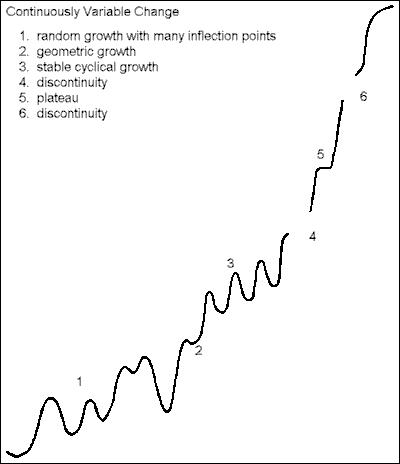
The key is that more is different (nearly the motto of the discipline).5 The common sense imagining, prior to the fallacy of composition, is that things scale in a linear way. More means more of the same. Then there is second order sophistication about scale. People add in the notion of a discontinuity. Things scale until they reach a certain threshold, at which point there is a discontinuity. More is different. But this is still a relatively binary conception with simply two sides of the discontinuity: one side of the discontinuity where the logic of linear growth prevails and the other where that of emergence or complexity prevails. There is a third order sophistication about scale where the binary view of second order thinking is still too simple; where the relationship between scale and properties is continuously variable.

As opposed to these simpler first and second order notions, continuously variable growth and development happen through many phases distinguished by differing logics or marked by different epiphenomena (something more like the imaginary graph above). As a system or network gains in members or in interactions, one set of behaviors becomes strained and unstable as it approaches the upper-bound threshold of the given logic. The threshold crossed, the previous logic gives way to a new logic. The pattern repeats, with the new logic holding for a period, but it too petering out in favor of a subsequent logic. And so on. Or perhaps there are tiers of controlling logics operative simultaneously. There may be meta-epi-phenomena as the various transitions admit a pattern of cycling logics or a second order logic to their or relations.6 No behavior or sequence is fundamental to systems, or the process of growth or to any particular phenomenon. We should dispense with the idea of a sin qua non behavior of systems in favor of a continuum of potentially many different behaviors as a system grows and changes.7

I will make a few examples to demonstrate the changing relation of prevailing logic and a system phenomena under growth.

Bak-Tang-Wiesenfeld sandpile growth model

  1. Multiple logics. Consider that paradigmatic example of complexity: grains of sand falling onto a pile (a Bak-Tang-Wiesenfeld sandpile). As grains fall onto the pile, they tumble down the side, and come to a rest according to a standard distribution. Most come to a rest close to the drop point so the pile grows in height, but only a few roll all the way to the bottom so the base remains largely the same area resulting in the incline of the sides of the pile grow ever steeper. But there is a range of values for which the ratio of base to height is stable. When the pile reaches its upper bound of stability, the pile collapses. But it doesn’t collapse all the way to a layer of sand one grain thick. The collapse comes to a halt once the pile has reached the lower bound of the ratio of base to height (the lower bound being where the slope of the side of the pile is such that friction overcomes gravity and momentum). The pile recommences its growth in height. With a new, broader base having been established, it will achieve a greater height this time before reaching the critical threshold.

    The pile doesn’t grow continuously until collapse though. It is constantly experiencing local collapse. The sand pile demonstrates scale symmetry in so far as there are slides of all sizes starting with a single grain previously stable coming lose and tumbling a little further down a side. Single grains frequently start a chain reaction leading to larger slides. The collapse of the whole pile isn’t an phenomenon of it’s own, unrelated to the logic of local slides, as the catastrophic collapse of the pile is usually the result of a local slide running away to the scale of the entire pile.

    But fractal collapse isn’t a constant. Rather, its probability is a function of where the pile is in the growth-collapse cycle. At the lower bound of the range of stability any collapse is almost impossible. A single grain may break lose and tumble to a more stable location, but owing to the widespread state of stability, it is not likely to set off a chain reaction leading to a large slide. At the top end, catastrophic collapse approaches certainty. A growing proportion of sand grains are in unstable positions. More are likely to break lose and, having broken lose, collide with other unstable grains setting off chain reactions. As the pile goes through the positive phase of the growth-collapse cycle, it traverses a range of increasing collapse probability from almost impossible to almost certain and its fractal dimension grows.

    Tally the sheer number of logics at work in this seemingly unnoteworthy phenomenon. The overall pattern is linear growth — the pile grows in mass in equal units in equal time. The shape of the pile demonstrates an oscillating pattern, between a steep cone and a shallow cone. The height of the pile superficially demonstrates cyclical growth. Upon closer inspection, the growth of the height of the pile turns out to be fractal. But even that fractal growth isn’t constant, but one of increasing fractal dimension.

  2. A complicated interstitiary. A discontinuity is probably always preceded by some sort of turbulence, a breakdown in the previously prevailing relationship. A prevailing logic doesn’t yield instantaneously to its successor. In at least materials science this is well documented in the form of the microstructure of phase transitions.

    As a social scientific example, nuclear weapons represent a discontinuity in the growth of military power, but how much of one? Countries had already acquired “city-busting” and potentially civilization destroying capability using the regular old Newtonian technologies of modern air power and chemical explosives. The U.S. imagined “bombing Vietnam back to the stone age” employing conventional methods. So it would seem that military power (technology) had already crossed an inflection point and gone non-linear in a way that was necessitating major strategic reconsideration prior to the discontinuity of nuclear weapons.

  3. Many discontinuities. People have a tendency to conceptualize consciousness in the model of the binary discontinuity. Neural networks grow in size from tiny nerve bundles in nematode worms up to pre-hominids and then somewhere in the Pleistocene whamo, the discontinuity and consciousness and that’s the pinnacle. Some people imagine the difference between regular people and geniuses to be a little discontinuity, rather than a difference of quantity. Hence the obsession with Einstein’s brain, Descartes’s skull, and so on.

    But I imagine consciousness rather than a big bang being a development with perhaps a number of discontinuities and plateaus — the first reflex, the first pain, the first internal world model, the first declarative memory, the first language of discrete symbols, the first syntax, the first theory of mind — on the way to humans. But our intelligence is just another plateau on the path. There is the singularity somewhere beyond us and still more discontinuities, unimaginable to us even beyond that. As intelligence is not one thing, I imagine each of the many faculties having its own trajectory, each with multiple discontinuities of their own, as well as the synergy of the many faculties being of uneven development and their interplay subject to system effects.8

Instead of relying on the sort of intuitionism that says something like “We know that there has been a discontinuity in strategic thought because we read Thomas Schelling now instead of Helmuth von Moltke” we should dispenses with this intuitionistic approach in favor of systematic mathematical methods to analyze change — to determine when and where system effects are at work, which ones are at work, the extent of their range, the exact location of inflection points or discontinuities, where the logic of a tipping point takes over and the pace of accelerating assertion of the logic of the new régime, to study turbulence, islands of stability, equilibria, feedback and other patterns that can develop.9

Notes

  1. I am prone to write “collective intelligence” in place of “society,” but an ancillary point here is that all intelligence is collective (composite), whether it’s a society, so to speak, of individually dumb neurons in the brain of an individual or the more commonplace idea of a society, namely wisdom of crowds, invisible hand, social networking, superorganism type phenomena.

  2. Though not necessarily so: we are learning how to harness emergent properties to our purposes, to design them in.

  3. Though structure might be a concomitant emergent property, e.g. ecologies might exist in equilibrium, but that’s not because competition among species is well ordered.

  4. This category error of misconstruing different component-composition behavior types, or not even identifying the second type at all, is perhaps illuminating to the overarching issue of intelligent design’s constant irreducible complexity mongering. One of the favorite analogies from their rhetoric is that of the mousetrap: remove a single component and it isn’t a slightly less effective mousetrap, it isn’t an anything and natural selection can’t function on constellations that display no function. But notice how this relies entirely on the machine type of component-composition thinking. But if one sees phenotypic expression as an emergent property of genotypic change, than one might shift to the later version of the component-composition model. A heavily determined trait will be stable over many changes in the underlying genes, until a critical threshold is reached at which time rapid change in phenotype (the emergent property) could occur. A perfect example of the contrast between the two types of thinking that I am describing here is that version of evolution as the long, slow accumulation of mutation down through the millennia, which sees a more or less consistent, linear change, versus something like punctuated equilibrium which imagines different logics of change predominating under different circumstances. I would go further to say that punctuated equilibrium is only a theory of discontinuity. A more elaborate theory of the deep history dynamics of evolution, or a marcotheory of evolution, as opposed to the microtheory we have at present, is required.

  5. More is not binary, though more is frequently discrete — neural networks grow in whole neurons, societies grow in whole people. But not always. System happens as much in analog as in digital phenomena, e.g. strategy must adapt as power or capability increase, but power does not grow in discrete units.

  6. Meta-epi-phenomena would be something observable only over extremely long timeframes for most phenomena with which we are familiar. Kondratiev cycles (45-60 years) and Forrester waves (200 years) would be examples from economics and sociology. The existence of such long patterns, whose period is outside the scope of our limited record, is part of the explanation for black swan type phenomena. I imagine that there are small models, probably in physics and biology, where the dynamcs of such systems could be worked out in detail, then recognized in longer term examples based on partial data. As the patterns of systems theory are largely substratum independent, patterns discovered in one area are relevant to another. A well organized sub-discipline would better allow for the abstraction of higher-order patterns from their original fields of discovery and facilitate interdisciplinary transmission of knowledge. A pattern well characterized in observations of one phenomenon might be revolutionary to another area where the phenomenon is insufficiently well observed to know the entire continuum of behavior, but observed well enough to recognize that it is an instance of the former pattern. Systems-type phenomena are present throughout the various sciences. Just as mathematics is used throughout the sciences, but is consolidated into a discipline of its own, so too systems science should become a better organized and consolidated sub-discipline. As it involves such a diverse range of the sciences, it would be an interdisciplinary field, not one as autonomous as mathematics.

  7. While none fundamental, there are, presumably, a finite set of possible system patterns. I wrote on the possibility of cataloguing and organizing them on some sort of periodic table of logics in “Formal Cognition,” 1 January 2008.

  8. Animals have developed a variety of different types and levels of intelligence; there’s no reason to think that machine intelligence will be any different.

  9. The problem is that the data sets that we have aren’t big enough, granular enough and are riddled with bad data. With two points you can’t tell linear from geometric growth. With three points you can’t tell geometric growth from linear growth with noise. And of course it gets much worse than this. And we don’t even know how to operationalize a large segment of the really interesting phenomena. How would we quantify something as elusive as national power — something international relations theorists are trying to do all the time — when even the component statistics are a mess?

Repeal Day

A cocktail on Repeal Day, 5 December 2008

Happy Repeal Day everybody! Here’s a drink for Franklin Delano Roosevelt and the State of Utah that brought rampant boozing back to the United States.

I’m presently exploring the Tom Collins. I’m making it with fresh lemon juice and liking it somewhat less than the soda sweetness of the one made with the bottled mix that first introduced me to the drink over Thanksgiving dinner preparations.

I’m skeptical of drinks that require added sugar. I mean, with the alcohol they’re already sweet enough. I tried to omit the sugar from last night’s Tom Collins and found, like with drinkboy’s discussion of the old fashioned, not only is the sugar important, but dissolving the sugar in some water before adding the rest of the ingredients is critical too.

I inherited a subset of S.B.’s booze collection when she left for Ireland a few days ago so I am now in gin and tequila for the remainder of the year and then some so I am a happy kid.

Emergence and Aufhebung (Hegel and the Swarm)

I like Charles Mudede’s scaled down explanation of emergence (“Interlace in Dubai,” SLOG, 3 December 2008):

In the theory of emergence it is understood that complexity has a limit. For example, when the population of an ant colony reaches a certain point, 80,000 or so, changes begin to happen. Army ants swarm another colony or lots of ants move out and wander or start a new colony. What is clear is one behavior ends and another one begins.

One controlling logic relinquishes to a subsequent controlling logic. Emergence is a discontinuity in growth.

I don’t know that he is right to characterize this as “complexity having a limit.” An emergent property is an aufhebung: a simultaneous preservation and transformation. The emergent property doesn’t sweep aside all previous behavior, but preserves the original behavior and builds a new layer or interpretive characteristics on top of it. I think of “the invisible hand” of capitalist markets here. People don’t stop bargaining when market clearing happens. People continue to negotiate, clip coupons, shop around, seek out sales, innovate, invest and compete. Market clearing is a second order interpretation of the ground level behavior that persists just under this interpretive overlay. Or in the example of the prisoners’ dilemma, the participants don’t cease to be rational outcome maximizes when the logic of suboptimum outcomes takes over. Their goals and reasoning stay the same. If anything, by preserving all the original complexity and adding a superstructure of new behavior, emergence is complexity unbound from its first order confines.

New York Bagels

I see that over the weekend there was much consideration of the issue of New York and Bagels. Matthew Yglesias comments (“The Stuff that Matters,” ThinkProgress, 28 November 2008):

I’ve now lived in DC long enough that I forget how much I like real bagels. But then I come back to New York for Thanksgiving and the whole sad little fantasy universe I’ve constructed for myself in which DC’s bad bagels aren’t a big deal collapses.

Kevin Drum does a little wondering as well (“Bagels!,” MoJo, 28 November 2008)

It’s hard for me to remain on topic here because Washington, D.C. is such a miserable hole of a city. It would be hard to come up with a single factor in which New York was not vastly better of a city. The only reason that anyone tolerates D.C. is that it’s the political and intellectual capitol of the country.

That said, whenever I go to New York I have a list of things that I want to do and every time it includes bagels. This visit included bagels on two out of three mornings. My friend has been living three blocks from Tal Bagels so it has been pretty convenient, but on other visits I have commuted for bagels.

I’ve heard a number of the theories (the municipal water), but I’d have to say that I think it’s a gestalt. The bagels themselves are better: crunchier on the outside, chewier on the inside. But the schemers are better too (we brought back a tub of the olive cream cheese and another of the tofu, which rather than being some vegan concession has a flavor zestier and brighter than the cream cheeses). And most important is the ambiance. Woody places with a bunch of working-class artisans in black pants, white t-shirts, white aprons, and white paper hats, with a lot of hurry and attitude is different than the hired gun Ethiopians at Au-bon-Pan. A bagel shop is a stylized thing in New York. The cream cheeses are arrayed in gigantic bowls under glass, along with a host of other Jewish foods: smoked fish, knishs, couscous salads.

My favorite bagel places in New York are Ess-a-bagle (359 1st Avenue, Manhattan, New York 10010, official site here) and Tal Bagels (977 1st Avenue, Manhattan, New York 10022), both very Jewish, and The Bagel Store (247 Bedford Ave, Brooklyn, NY 11211), a Williamsburg hipster joint, but still unbelievably good.