The Internet is Still Very, Very New

The Stranger “reviews” twitter and makes the obvious, though necessary point (Constant, Paul, “Paul Constant Reviews Twitter,” The Stranger, 30 June 2009):

So I’m going to say something that might strike you as weird and naive, but it’s true. Listen: The internet is still very, very new.

Most people haven’t even been on the internet for 10 years yet. Ten years! Every technology is lawless frontier after just 10 years.

Television was still radio with scenery 10 years after its inception. People pointed, awestruck, at planes 10 years after Kittyhawk.

We’re just learning what the internet can do, and we’ll learn a lot more once children born today grow up with today’s internet.

For the first three years of twitter, it was easy to lampoon the service as the ultimate medium for whining about first world problems. But then the Iranian election happened and overnight it became a tool for unleashing social transformation and the indispensable news medium. The Internet is still new. Many potential services lay as yet unimplemented. Many will at first seem trivial or demeaning of this or that high value (“Is Google making us stupid?”). They will seem so until the moment when they transform into something utterly other than their original intention, specification, design.

Good point aside, can we have no more articles about twitter written entirely of 140 character paragraphs. It was cute at first, but now it’s just very gimmicky. It was worth it once for the style of the thing, but now to do so only detracts from your larger point. The 140 character message has its place and it is not the short-form essay.

The Iranian Election and the New Media Revolution

I remember CNN’s moment when Bernard Shaw reported live Baghdad in 1992 as the First Gulf War commenced or Aaron Brown live from Midtown Manhattan as the first tower of the World Trade Center fell. News events like those were the height of old media accomplishment. Right now the most amazing thing happening in the world is the election protests in Iran and I turn on the television hoping for something current and relevant. I’m paying for the extended cable package because I have hitherto thought that when a major story happens, only the big news channels can offer coverage up to the magnitude of the event. On CNN Larry King is interviewing Paul Teutul about his favorite muscle cars and on FOX News Geraldo At Large is interviewing Carrie Prejean about her spat with the Miss USA Pageant. On CNN’s website the lead stories are the Six Flags bankruptcy and the troubles at the FCC hotline over the analog cable shutoff.

The only place for news on Iran right now is twitter, internet forums, YouTube, flickr and various other photo sights where individual Iranians are uploading. Twitter is serving as the guide to it all. I am regularly refreshing the #IranElection twitter hash and getting snippets of what’s happening there in bustles of disorganized 140 character updates. Right now #IranElection, Tehran, Mousavi are the numbers two, four and five highest Trending Topics on twitter. The hash #CNNfail is coming in at number three. When CNN does run some loop story about Iran, they are using still photos culled from FaceBook!

I suspect that within a few days the Iranian police will get a handle on this and the Ahmadinejad victory will be made to stick. This will be unfortunate for the Iranian people and the cause of peace.

However, the new media revolution proceeds apace.

Petrified Onions

The latest controversy to sweep the blogosphere is the outing of previously pseudonymous blogger John Blevins, a.k.a. Publius by Ed Whelan (Whelan, Ed, “Exposing an Irresponsible Anonymous Blogger,” The Corner, National Review Online, 6 June 2009; Blevins, John, “Stay Classy Ed Whelan,” Obsidian Wings, 6 June 2009; Whelan eventually apologized, “My Apologies to Publius,” The Corner, 8 June 2009). This prompts some musings on the subject of on-line personae by Matthew Yglesias (“The Metaphysics of Pseudonymity,” Think Progress, 9 June 2009):

And of course it’s a fallacy to assume a perfect identity between any Internet persona and its author(s). A whole bunch of different writers collaborate on producing Think Progress and they write in what I think is a pretty uniform voice. But like the writers behind The Economist, they’re actually all beautiful unique snowflakes who are often quite different from the TP persona. And by the same token, Matthew Yglesias “in real life” is not the same as the character I play on the Internet. On the other hand, I’m not sure it’s quite right to say that the in-the-flesh [ME] is “real” and the on-the-Internet one is somehow “fake.” This blog has existed for over seven years now, and it’s almost certainly the case that more people “know” the persona than know me. And I think that should hold all the more strongly for any prominent pseudonymous bloggers. The well-known, stable character is a person with integrity, influence, a personality, a reputation, social connections, etc., the same as anyone else. To be sure, they may be artifice in terms of the presentation of the character. But our various “in real life” self-presentations (to a boss, to a first date, to family, to friends, to people we run into at a high school reunion) involve artifice as well.

In the past you body was at least the skeleton on which your personae hung. They depended on you to take them places, to animate them. The dutiful son only existed at the family get-together, after which he was de-emanated. The nightclub alter ego only came out to play when the costume was dawned.

Media personae persist. In the era of mass participation mass media, your personae don’t need you anymore. They’re out there, being recreated by anonymous onlookers while you are sleeping.

Kurzweil Will Die

Apropos the latest Terminator film, The New York Times has a decent rundown of singularitarianism, transhumanism, A.I. and so on that touches on most of the figures in the field (Markoff, John, “The Coming Superbrain,” 24 May 2009). The conclusion:

Kurzweil will probably die, along with the rest of us not too long before the ‘great dawn,'” said Gary Bradski, a Silicon Valley roboticist. “Life’s not fair.”

Moses never gets to enter the Promised Land. Such a shame — to be the last generation to die.

A Cyberpunk Rereading of German Idealism

Pattie Maes's TED talk demonstrating an enhanced reality device, February 2009

Over at SLOG there is a bit of a conversation is going on about Pattie Maes’s recent TED talk in which she demonstrated what she calls “sixth sense,” but that I would call “augmented reality” (with Pranav Mistry, “Unveiling the ‘Sixth Sense,’ Game-Changing Wearable Tech,” TED, February 2009; Hecht, Anthony, “Holy Freaking Crap,” SLOG, The Stranger, 3 April 2009).

Today Charles Mudede, one of the thinkers to whom I consider myself most close, comments on the significance of Ms. Maes’s innovations along a line similar to my own project (“The Near Future,” SLOG, The Stranger, 8 April 2008):

It’s as if Hegel’s geist in his grand narrative of the history of consciousness, Phenomenology of the Spirit, actually came true. We can laugh at Hegel and his impossible absolute spirit, but we cannot laugh at Pattie Maes and her wearable tech.

For some time now I have been thinking that a cyberpunk rereading of the German Idealists is necessary. I have made a number of posts along this line (see Related Posts below). One of the themes of this blog — one that has emerged accidentally — is of the hard materiality of that which we call “ideal”; the degree to which mind is in the world; and not just statically so, but the degree to which the balance of matter and information is giving ground to information, processes of reification, the “imperialism of information”; that tool for rendering the study of ideology a material science, the meme; of those twain machines which bridge the gap: brains and computers.

My contributions to the project to date:

The Deus ex Machina of Economic Crisis,” 25 March 2009
The Noosphere Visualized,” 1 January 2009
Emergence and Aufhebung (Hegel and the Swarm),” 5 December 2008
The Day I Became a Hegelian,” 18 August 2008
Imagination Unmoored,” 8 August 2008

“What is rational is actual, and what is actual is rational”!

Preface to The Philosophy of Right (1821)

My Interests, As Reverse Engineered by Amazon.com

According to Amazon.com’s reverse engineering of my purchases, here are my interests:

Accounting, Asia, Biology, Chaos & Systems, Cognitive Psychology, Communism & Socialism, Consciousness & Thought, Economic Conditions, Economic History, Economic Policy & Development, Epistemology, Ethics, Finance, Government, Greek & Roman, History & Surveys, History & Theory, Holocaust, Intelligence, Intelligence Agencies, International Relations, International Security, Investments & Securities, Japan, Logic, Marxism, Military & Spies, Military Science, Modern, Napoleon, Naval, Nonfiction, Nuclear, Philosophy, Physics, Political, Political History, Political Ideologies, Presidents & Heads of State, Public Policy, Purple Politics, Relations, Russia, Social Theory, Sociology, Statistics, Strategy, Theory, World War I

That reads about right. I could quibble about some omissions, e.g. where’s Europe. That being said, why do Amazon’s recommendations suck so much? How is it that I can routinely go into a bookstore and find, not obscurely hidden in a lesser-trafficked corner, but prominently displayed, some work of exceptional interest to me, but that Amazon hasn’t recommended? And the heavily cut tracks! I find that I have an occasional interest in, say, the U.S. Civil War, but that I refrain from adding a Civil War title to my wish list because the Civil War is such an overdone cottage industry: if you add a single Civil War title, next thing you know every new volume by every small-town antiquarian, about every two-bit local general is going to be recommended.

Update, 5 April 2008: And what the hell is “Purple Politics”? Everything listed under that category seems perfectly respectable, but when I hear “purple politics” I think of Jessica Cutler’s The Washingtonienne, the Starr Report or the tabloids on Nicolas Sarkozy and Carla Bruni.

CS, AI, T&A

A bit of a discussion broke out at this morning’s session over Shane Legg and Marcus Hutter’s paper, “Universal Intelligence: A Definition of Machine Intelligence” (Minds & Machines, vol. 17, no. 4, 2007, pgs. 391-444, arXiv:0712.3329v1). Following the convention of abbreviated reference to a paper by its authors’ last names, and as Hutter is pronounced “hooter,” this paper is referred to as “legs and hooters.” So there was this back and forth, “As the legs and hooters paper shows …” “You should look more carefully at legs and hooters.” “It can be hard to get you head around legs and hooters.” “We shouldn’t rush to embrace legs and hooters.” I exaggerate slightly, but I would imagine that there are better papers than Legg and Hutter’s on the subject of the definition of machine intelligence; it’s just that those other papers get passed over in favor of one granting a computer nerd the opportunity to say “legs and hooters” in all seriousness in front of a room full of people. I’ll bet that Legg and Hutter decided to collaborate on the basis that such a winning name combination guaranteed their rocket-like ascension in the ranking of most oft cited papers.

Disciplinary Normativeness and the Artificial General Intelligence Conference

Ben Goertzel and Jürgen Schmidhuber, Artificial General Intelligence Conference 2009, keynote question and answer, 6 March 2009

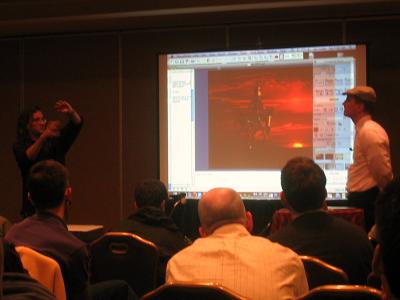
S. and I are spending the weekend volunteering at the Artificial General Intelligence Conference 2009. Last night we saw organizer Ben Goertzel’s introductory talk and Jürgen Schmidhuber’s talk on various aspects of intelligence as compression and formalism in AGI (post-talk discussion, Goertzel left, Schmidhuber to the right). Today we attended Cognitive Architectures I and II and the poster session. Matthew Ikle and Ben Goertzel’s discussion of using formal economic models as a means to generate attention in the OpenCog framework and Eric Baum’s presentation on the relation between evolution and intelligence both blew my mind. I cant wait for these talks and their attendant slideshows to be up on the website.

For now the most interesting thing about the conference from the standpoint of a social scientist is the degree to which the organizer, Ben Goertzel is a Kuhnian revolutionary disciplinarian. His talk on the challenges of AGI was a perfect demonstration of the problems of prerevolutionary or pre-paradigmatic science. Pre-paradigmatic is the current state of AGI research and it would be an excellent candidate for history of science study as it will probably remain so for many years to come, but its revolution is coming.

It has gradually become clear to me the degree to which Mr. Goertzel is a leader in the field, by which I do not mean his role as an innovator — though he is definitely that — but that he is someone drawing the discipline together from its disparate strands and goading it on in its proper objectives. The problems that he identified in his opening talk — the lack of a common language, a dominate model shared by at least a plurality of researchers, a road-map for future problem identification, again, shared by at least a plurality, the lack of any metric of progress — are all classically Kuhnian problems. The conference obviously serves a number of objectives, many very traditional such as professional networking and facilitation of communication of findings. But unlike one might expect from a conference of a more mature science, there was a considerable amount of normative, discipline-definitional activity. First is the very conference itself. There is clearly no well-defined research area of artificial general intelligence. The bizarre diffusion of backgrounds and affiliations represented displayed no coherence or institutional establishment. Participants had backgrounds in neurology, cognitive science, anesthesiology, evolutionary biology, bioinfomatics, mathematics, logic, computer science and various strands of engineering. Creating the problem of a shared language, people had to be fluent in the languages of multiple disciplines and were mixing and matching as well as engaging in isolated terminological innovation. People worked as academics, corporate researchers and developers, engineers, entrepreneurs and so on.

Ill-definition means that things don’t cohere, or that what has come together naturally dissipates. It is in this sense that Mr. Goertzel is a disciplinary revolutionary. He really has a personal goal and a vision regarding AGI. At one point in his opening talk he actually delivered a brief bit of a lecture to conference participants on the problem of focusing on sub-general level intelligences for the expedience that they are achievable and money-making, though admitting to culpability in that respect as well. It is also clear what a small clique of researchers constitute the AGI world, as well as Mr. Goertzel’s position as a hub of the social and intellectual network. During the question and answer, he was able to call on most people in the room by first name. And he is clearly an intellectual celebrity with few peers. As Kuhn argued, non-scientific factors feature more prominently in the definition and direction of a science than rhetoric of objectivity would lead one to expect.

Group Proprioception Goes Interspecies

Some Seattle artist and I aren’t the only ones who think your pet should be life logging: the British government does too. Reading University has been commissioned to conduct a study of how much wildlife is being destroyed by domestic cats (McKie, Robin, “Special Tags to Measure How Often Cats Kill,” The Observer, 15 February 2009):

“For the first time, cats will be fitted with data loggers that will show their movements, range and behaviour 24 hours a day. We will know when one kills an animal — typically by the way it plays with its prey.

“We will then be able to work out precisely how many animals a cat is killing every year, and from that estimate a national figure. It will be a pretty formidable number.”

Now if they could just get some sort of pattern recognition software to read the live GPS data stream coming off your cat and tweet his kills to your cell phone, then your cat would be twittering too.

Life Logging: Not Just for Human Life Anymore

Not only should you be thinking about life logging, but you should also be thinking about it for your pet (Chansanchai, Athima, “Cooper the Cat Shows His Stuff in Photo Exhibit,” Seattle Post-Intelligencer, 13 February 2009):

For this Seattle cat, photography is his medium, a gift from his “parents” — filmmakers Michael and Deirdre Cross, who gave him a very small and light digital camera that hung from his collar one day a week for a year. It was programmed to take a picture every two minutes.

They wanted the answer to a question many pet lovers have asked themselves: What does he do all day?

He came back with thousands of answers — 16 of which are framed and on display at the Urban Light Studios in the Greenwood Collective. The exhibit opens with a reception tonight as part of the Greenwood Art Walk. The show runs through March 10.

Cooper the cat photographer has a blog dedicated to his exploits at http://cooper-catphotographer.blogspot.com/.

And while you’re at it, you may want to survey your environment for any particularly interesting non-living things, appliances, informational or gameworld agents, et cetera whose activities you might want to see in your FaceBook feed.

Update, 15 September 2011: Cooper the cat photographer’s blog has been relocated. It can now be found at http://www.photographercat.com/.