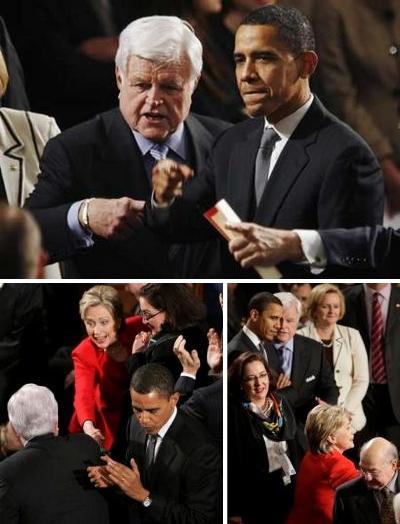
How about that for changing the tone in Washington, D.C.?
Clockwise from the top, they are the good ol’ boys’ club, courtly intrigues, and the snub.

How about that for changing the tone in Washington, D.C.?
Clockwise from the top, they are the good ol’ boys’ club, courtly intrigues, and the snub.
After Iowa there was a lot of commentary about what it meant that both parties had repudiated their establishment candidates. The Clintons and their DLC positions are the Democratic party today. Governor Romney represents the continuation of the Reagan coalition, whereas the other candidates are all the triumph of one faction of it over the rest. For Senator Obama to win on the Democratic side and Governor Huckabee to also win on the Republican side shows that dissatisfaction with the status quo runs across both parties.
But early primary victories by anti-establishment insurgents aren’t the only course of events that mean something. When ultimately Senator Clinton and Governor Romney secure their respective parties’ nominations, people should be ready to interpret those events as well. Anti-establishment idealism is all fine and good, but people should realize that in the end the empire always strikes back.
Senator Barack Obama’s win in South Carolina was exciting from a horse-race perspective. His speech was, in my opinion, much better than his Iowa one. But I still find his whole “changing the tone in Washington” shtick hopelessly naïve. I don’t know if he buys his own bullshit — maybe he knows better and it’s just a campaign ploy — but it suggests to me a candidate completely unready for the pain of the general election and the realities of governing a divided nation.
Consider the agenda for a Democratic president their first year in office. The top line issues will be doing something about Iraq, passing some sort of healthcare legislation, fixing the federal budget and, depending on how the economy plays out in the next year, managing the recession. I also imagine that about a week after a Democratic President is sworn in Ruth Bader Ginsburg will announce her retirement from the Supreme Court. All these issues seem daunting and perhaps the sort of thing that could hobble a new president right out of the gate.
Policies in Iraq and the war on terrorism are prerogatives of the president and the sort of things that can be accomplished without any input from Congress. But Iraq is an intractable situation. I don’t think anyone — no matter how confidently they may promulgate their whitepapers — knows what to do here, but a wrong move or two could be catastrophic. There are many powerful people in D.C. whose worldview is deeply connected to the Iraq war who will be watching and waiting to parade a Democratic president’s every plausibly wrong move down Pennsylvania Avenue and across all the television talk shows. Americans constantly tell pollsters that they want out of Iraq, but it is a position that is a mile wide and an inch deep. As soon as they are faced with the rhetoric of the consequences of withdrawal, they could seriously turn against a President actually implementing their previously desired policy. There are too many reasons that the Republicans will want to paint the Democrats as the party that lost the Iraq war — not least to get this albatross off the neck of the Republicans and onto that of the Democrats. No amount of speechifying is about to change this. This stands to be a real lesson for a President Obama in the unchangableness of the tone here in Washington, D.C.
However much they promise on the campaign trail, healthcare reform more significant than bureaucratic twiddling around the margins will be a next to impossible task. I think that a Democratic administration should hand this issue off to a blue-ribbon commission or some sort of consensus-building or stakes-raising body to let it simmer for a few months to a year, but I suspect that for reason of some by-gone precedent they will make it a part of their first hundred-day agenda. Everyone in Washington, D.C. believes that early successes build momentum and political capitol for a President. Therefore Republicans, right-leaning Democrats and related interest groups will be eager to hand the new President a momentum-stunting defeat on healthcare. Success in this issue will consist almost entirely of cajoling Congress and Republicans will seek to make it the first firebreak. Political-strategic considerations aside, the amount of money riding on this issue is just going to be too much for opposition groups to avoid going apocalyptic on this issue. Whoever grabs this wolf by the ears is going to have to be prepared for a lot of snarling and snapping in the general direction of their throat.
On the issue of fixing the budget, it can’t be done without raising taxes. If nothing else, the next President will be faced with whether to allow the sunset provision of the 2000 Bush tax cut to kick in. Nearly the entire Republican caucus has signed onto Grover Norquist’s No-Tax Pledge and the party leadership is serious about enforcing it. Additionally there are a lot of right-leaning Democrats or Democrats from sensitive conservative districts that tend to vote with the Republicans. Passing a Democratic budget will be dependent on maintaining a high degree of party unity, shaming Congressmen on the margin and taking the message to the citizenry. Since such a budget will probably come down to a straight party line vote, this will mean pressuring and humiliating Republicans in front of their constituents. In other words, some standard partisan tactics are what is called for here.
Regarding a Supreme Court nominee, I imagine that the Democrats will be surprised to find that their willingness to compromise on President Bush’s two appointments not reciprocated. A Democratic President may have to insist that Harry Reid actually call Mitch McConnell’s bluff and hold a real filibuster. And to win it, again, making the Republicans look the obstructionist assholes in front of the nation will be required.
When Barack Obama rattles off one of his standard litanies of the problems that can’t be solved owing to gridlock and partisanship, they aren’t initiatives that the Republicans want to advance too were it not for some mysterious bureaucratic bickering getting in the way. The items not achieved on Senator Obama’s list aren’t failures to Republicans, but accomplishments. Partisanship doesn’t emanate from some mysterious origin lost to the mists of time, but comes about owing to day-to-day real word differences on policy as well as the tried and true methods for advancing your own agenda while thwarting that of your opponent. Unless Barack Obama thinks that his smooth words have the power to evaporate this underlying reality — and Americans for Tax Reform, the American Enterprise Institute, Cato, The Weekly Standard, The Wall Street Journal editorial page and hordes of corporate money are going to do everything they can to see to it that he fails — then he better have a plan B.
Today the countdown begins: only 366 days left of the Bush administration (2008 is a leap year). On this day a year from now we will be swearing in a new president — provided that Dick Cheney’s office doesn’t dream up any new emergency powers of the presidency between now and then.
It’s amazing the degree to which President Bush has become a non-entity, given the collapse of the Bush Doctrine, the scuttling of their Iran agenda and the death of their domestic agenda as long ago as the defeat of the Bush Social Security privatization program in 2005. Of course, given the power and prerogative of the presidency, he could precipitate a crisis at any moment.
The turn of Bush & Co. to an announced program of peace in Israel — after seven years of neglect — is transparently unserious. Such efforts may play to a domestic audience, but, as in so many other issues, the administration seems unaware that the parties to such a peace have national security establishments of their own, bristling with salaried employees whose job it is to detect insincerity and deceit on the part of foreign powers. I imagine that whatever playing along the Israelis and Palestinians do is entirely diplomatic nicety.
A president truly committed to peace in Israel-Palestine would have to make it a top line issue for the duration of their administration and probably be prepared to hand off some unfinished business to a successor. And they would have to expend a significant portion of their political capitol on the issue. That means both time, travel and a willingness to take a lot of heat from the religious right and Israel lobby alliance.
Between campaign pandering to Christian Zionists and lame duck legacy hunting, the transformation of the Israeli-Palestinian conflict from a substantive international relations issue, into domestic opportunity for atmospherics is one of the most dangerous capitulations on a very serious foreign policy blight. All roads to peace in the Middle East lead through Israel-Palestine, but in the indispensable nation it has sunk to the level of ethanol subsidies or a commencement address at Bob Jones University.
On Wednesday Matthew Yglesias pointed out that that Mitt Romney is the Republican leader, having won a slight majority of allocated delegates. His pie chart here is illustrative (“Romney’s Big Lead,” TheAtlantic.com, 16 January 2008). After South Carolina, Mr. Yglesias points that this trend continues (“A Small Point,” TheAtlantic.com, 19 January 2008):
This morning, Mitt Romney had more delegates than John McCain. Following today’s primaries, Romney’s lead has grown even larger because Nevada has more delegates than South Carolina and Romney won a larger proportion of the vote in NV than McCain got in South Carolina.
Here’s a little table that I pulled together of raw vote count in the Republican primaries to date.

Throw in the electoral college and things get more complicated, but right now, counting state victories is hiding the underlying reality that Governor Romney is the leader.
I think that for the other candidates the best outcome of future primaries will be mixed. There’s reason to believe from here on, the race will tip in favor of Mitt Romney. Plus he has raised more money and is the establishment candidate. He’s the obvious leader. Everyone is just oblivious.
I realize that there is a significant debate around whether Bob Kerrey is a cat’s paw for Clinton campaign race bating directed at Barack Obama — and the Clinton campaign has had some perfidious truck with the right-wing sewer. But again, there’s debate about whether what he said was sincere or really a backhanded compliment (see e.g. Kleiman, Mark, “Kerrey and ‘Barack Hussein Obama’,” The Reality-Based Community, 16 December 2007). I think there’s reason to think that he’s sincere, but whatever the case, since he expresses the internationalist potential of Obama qua icon — or as Frank says, as signifier — so well, I’m going to excerpt it at my own risk:
I like the fact that his name is Barack Hussein Obama, and that his father was a Muslim and that his paternal grandmother is a Muslim. There’s a billion people on the planet that are Muslims, and I think that experience is a big deal.
Kevin Drum wrote a very well expressed explication of this sentiment at the time (“Fighting Terrorism,” Political Animal, Washington Monthly, 17 December 2007):
Kerrey wasn’t suggesting that electing Obama would have any direct effect on hardcore al-Qaeda jihadists. It wouldn’t. But terrorists can’t function unless they have a critical mass of support or, at a minimum, tolerance from a surrounding population. This is Mao’s sea in which the jihadists swim. Without it, terrorists simply don’t have enough freedom of movement to be effective, and their careers are short. It’s why the Red Brigades in Italy and the Baader-Meinhof gang in Germany lasted only a few years, while the IRA in Ireland has lasted decades.
What Kerrey was getting at was simple: in the long run, the only way to defeat the hardcore jihadists is to dry up their support in the surrounding Muslim world. And on that score, a president with black skin, a Muslim father, and a middle name of Hussein, might very well be pretty helpful.
For today’s jihadists, the answer is hard power. There’s no other way to stop them. But for tomorrow’s jihadists, the answer is soft power. As long as a substantial fraction of the Islamic world supports or tolerates jihadism, we’ll never stop the production of new terrorists or seriously reduce their effectiveness. But if that support dries up, we can win. This is where our foreign policy should be focused, and the fact that it hasn’t been for the past six years — that, in fact, we’ve gone backward on this score — is by far the most calamitous aspect of George Bush’s disastrous war on terror.
One of the amazing things about the six years since 11 September 2001 is that the importance of tamping down support for extremists among moderate Moslems is something that George W. Bush, at least in speech, understands. When it comes time to execute policy, it all goes out the window — actually a common feature of the Bush presidency. It’s time to address this central shortfalling.
Over the Christmas weekend Frank advanced an argument in favor of Barack Obama that remains to my mind the top-line argument in his favor: that the simple fact of his election president of the United States will have a dramatic effect on the world’s perception of the U.S. Born in one of the middle provinces of the American empire (Hawaii) to a Kenyan father and a white mother, doing part of his growing up in Indonesia, with a name like Barack Hussein Obama, may people of the world may look at the new U.S. president and see something of themselves and of an America beyond the arrogant frat-boy entitlement of the Bush administration.
On the first episode after being strong-armed back from the writers’ strike, Stephen Colbert had Andrew Sullivan on to make the same argument (Colbert Report, Comedy Central, Monday, 7 January 2008):
If you show just that face of Barack Obama on television to some teenager in Lahore, Pakistan who has this vision of America that has been determined by the Bush-Cheney years, suddenly more than any word his opinion and view of this country will change. We have a chance to win those people over and make the world love America again.
With his cover feature in last month’s Atlantic Monthly (“Goodby to All That,” vol. 300, no. 5, December 2007, pp. 40-54), Andrew Sullivan perhaps the Senator’s most outstanding booster in the commentariat. But he is also about the most naïve of the astute political commentators, prone to enthusiasms that in retrospect look premature so I’m going to keep my own counsels.
The campaign for the presidency doesn’t end at the convention and the presidency is not just election night. After convention one has to face the Republican machine and after the inauguration there are another 1,460 days and I just don’t know that Senator Obama has what it takes in either arena.
Considing that the entire world expected a repudiation of George W. Bush on election night in 2004 and that we did not deliver, a more dramatic gesture is now in order. I like John Edwards because he is the most liberal of the top three, but with a woman and an African-American within striking distance, it would be a shame to send another white man to the White House.
Following on K.’s most recent post (“Musical Offering: Introducing France’s Future First Lady,” 13 January 2008), I have been stewing over Matthew Yglesias’s dinging of the prudery and narrow-mindedness of U.S. politics (“A Different World,” TheAtlantic.com, 9 January 2008):
French President Nicholas Sarkozy got divorced early in his term, is dating a supermodel and his son’s writing songs for radical French rappers. Not only does American politics seem remarkably focused on relatively unimportant personal trivia, but our politicians don’t even have interesting trivia.
The thing that Hillary Clinton doesn’t get about campaigning — and that John Kerry and Al Gore didn’t get either — is that you need to pick a persona early and stick with it. There is an analogue in creating a persona to framing around an issue. Framing works by repetition over a long period of time. This is probably the one thing that Democrats at large don’t get.
All politicians are fake, it’s just that Republicans have a consistency in their fakeness. And when you’re consistent, people don’t catch on. When a politician grabs one persona this week and another the next, it doesn’t take long before voters conclude that such a politician is a fake.
At least with respect to his persona, Barack Obama gets this. He has been positioning himself as a certain sort of person all along so when it came primary time, people had a well cultivated set of beliefs about him that he could easily and naturally play upon. Hence the gentleness of his campaigning style: all the heavy lifting is in the frame. Hillary Clinton was the candidate of experience — until it turned out that that was not what voters wanted. They wanted change, so now she is the candidate of change. I have no doubt that should she dispatch Senator Obama, we will never hear the word “change” from her again in the general election. If she is up against Governor Huckabee then she will be all about compassion rooted in her humble upbringing and her faith. If Senator McCain gets the Republican nomination, she will be boasting about what a maverick she has been all along. If Mitt Romney gets it, well, then she can continue to be the always-yes-saying robot that she has been all along.
The crazy thing about Al Gore is that he had spent years as a Senator cultivating signature issues of the environment, nuclear weapons and high-tech. But when the 2000 campaign came around, the Democratic consultants came in with their everything-to-everybody strategy, told him to pitch his long-standing associations and cycled through a rotating list of Gore personas until everyone in America was left asking who the real Al Gore was. After the beard and paunch growth soul searching and some consultant detox, the real Al Gore is back.
If I could introduce the Democratic party to one concept, it would be opportunity cost. In order to be one thing, you have to foreclose the possibility of being some other thing. You’re going to have to piss someone off. Pick something and come to terms with saying sianora to the rest.
One of the characters of mythic proportion here in D.C. is that of the hard old pol: that tough political boss, heavily scarred from many a close-fought election battle. Think Tip O’Neal or Edward Kennedy.
Last night Senator Hillary Clinton showed that she has it. It’s not just a good ol’ boys club. Joshua Marshall points out (“Making Sense of It,” Talking Points Memo, 9 January 2008):
And I do not think that any of Clinton’s critics can say that she won this one by overpowering Obama with money or mobilizing a dominating political machine or by expectations of inevitability and certainly not with the help of a friendly press. However you slice it this was a real victory under pressure. And if she’s the nominee she’ll be a much better one for it.
After last night’s win, everyone should take a long, hard look at Senator Clinton. She’s hard to see because we’ve all been made to see her through the filter of tabloid in this modern world, but after last night, she seems more like something of an other, older tradition. The politicians who make something in this world all end up compromised in some way. There is a proper rule for how and when to hold that against a politician. It makes me think of Auda abu Tayi’s boast in Lawrence of Arabia: “I carry twenty-three great wounds, all got in battle.” Damage or disfigurement is not always a mark of shame.
In the bright light of day people will say that what they want is clarity and principle and happy things like hope for the future and positive vision and big think. But the astute know that what politics really calls for is what Senator Clinton has demonstrated. They call it the greasy pole. To climb it, you have to get a little dirty.
 Marching Under Banners