Mmm … Avocados

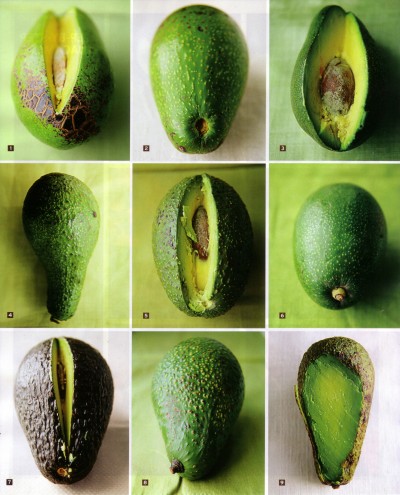
September 2007, Saveur, Avocado Love, Know Your Avocados, p. 84

The most recent Saveur has one of the most erotic fruits on the cover: the avocado (Nguyen, Andrea, “Like Butter,” no. 104, September 2007, pp. 76-87). Am I in doubt? Check out the cover art of the most recent Pearl Jam album.

As I have said before, I tend to obsess on foods. A while back it was guacamole. I was making it every few nights. At an earlier point I tried to search the stores for a packaged guacamole, but that is hopeless. Most of what goes under the label of guacamole is sour cream and onion dip died green, but even the best doesn’t even come close. It’s something that you simply must make yourself. Fortunately for me and my obsessions, while a late teenager my mother — who probably also has a tendency to obsess on foods — went through a phase where she was constantly making a very rustic guacamole, so improvising my own recipe was natural. I have recently achieved a bit of a party reputation for my guacamole — why, I don’t know: it’s about as simple a recipe as you can imagine. The only thing you need to know is how to combine the ingredients so that you don’t over-stir it and end up with too creamy and consistent a guacamole.

My Central and South America hopping brother told me that once while in Mexico he visited an avocado farm. The farm hound would patrol the fields for over-ripe avocados that had fallen from the trees and gobble them down. He reported that under his fur the dog’s skin was slightly green tinted and that he shit guacamole (the lesser known recipe). On the other hand, I have heard that avocados are poison to most domesticated animals, so I don’t know how to reconcile these two stories. On the precautionary principle, Kitty is rather vehemently shooed away from a bowl of the stuff.

The Seventeen-Year Cicadas

The last of the seventeen-year cicadas disappeared last week. The few stragglers that could be spotted were heavily battered and drained of energy. The birds were aggressively conducting cicada mopping-up operations. A wing may still occasionally be tracked into the office, but even over where I work in Klingle park, they can be neither seen nor heard. Three weeks ago they were so thick that they interfered with the kids’ soccer games and filled the whole neighborhood with their chirp-din.

I was completely taken in by them, as if a little, bug-infatuated boy again. My upwelling of youthful enthusiasm was tempered by more adult-like naturalist imaginings, so I have recorded some observations of a natural philosophic purpose, of course.

When last they came out in 1987, I was an eleven-year-old living in Washington State, but I read all about them in, I think it must have been National Geographic. As a kid, I was enthralled at the idea that there was this normal phenomena, annual cicadas — normal, green, bugish — but that once every great while, there were special cicadas that were spectacularly colored, cause of much stir, more space invader than terrestrial creature. I have kept them in the back of my mind ever since — to the point that, during a visit with family in Missouri, I was totally excited when the cat seemed to be buzzing, and upon closer inspection found in the cat’s jaws one of the annual cicadas protesting its rude handling by the feline field hand. What a fabulous occurrence that my first spring in D.C. would coincide with such a rare event!

The articles in the papers appeared earlier than the bugs themselves and as some time had elapsed since their publishing and I still hadn’t seen any cicadas, I was beginning to worry that I had missed them. The neighbor told me that they were all over the suburbs. I thought that maybe I would have to travel to see them. Then, one afternoon while lounging in the back yard, the cat seemed particularly excided about something that he was rooting at in the ground cover. I went to investigate, as kitty’s excitement usually means trouble, and found that he had caught a seventeen-year cicada. Just as my first sighting of an annual cicada was courtesy a cat, so now with the seventeen-year cicada.

When the cat found a second and then a third, I began to have a look around and it turned out that they were everywhere. There weren’t so many of the insects themselves, but the empty claws of their molted carapaces were dug into the stems of all the low vegetation that I looked at. As I walked back outside from an errand into the kitchen, I spotted two more clung to the door frame of the laundry room.

Seventeen-year cicada posed on the chain-link fence in the back yard, Mount Pleasant, Washington, D.C., circa June 2004

Seventeen-year cicada posed on the chain-link fence in the back yard, Mount Pleasant, Washington, D.C., circa June 2004

Of course, the emergence of the cicadas is not all excitement. Cicadas were born to die and the macaw display of nature’s carelessness for her creatures is a little hard to handle. The whole of D.C. has become like the killing field of some third-world genocidal war. Most insects possess the winning combination of the will to live and lightening reflexes. Cicadas have neither. Their beady read eyes stoically look on as a boot-shaped shadow blocks out the sun. One actually has to make an effort not to kill them. They can be picked up with no trouble. Occasionally a particularly feisty one will issue a chirp of protest, but they are wholly pliant. Their sole survival skill is shear numbers.

I kept on trying to save them, carefully moving to a tree trunk or planter box each cicada that I came upon in the middle of a sidewalk, but after a while this became an empathy-exhausting exercise: if I am going to make such an effort to save these creatures, they should at least meet me half way. On more than one occasion, I tried to toss one into the bushes only to have it fly, in its suicidal frenzy, right back smack in the middle of the sidewalk.

I will count for you the myriad ways that cicadas die. I do this, not to disgust, but to truly represent the oppressiveness of the carnage:

  1. Owing to the damage done by onrushing automobile windshields, the sidewalks were littered with their corpses, always attended to by a phalanx of black ant pall bearers. Unlike most bugs which splatter against the glass, cicadas break apart and scatter as if they were made of balsa wood or very delicate aluminum parts affixed to one another with little bits of solder or eye-glass screws. So the sidewalks were littered with the crunchy segments of abdomens that split nicely at the seam between exoskeleton plates, heads, legs, whole bodies sheered of extremities, thoraxes with a full compliment of wings, wings with a black stump of wing muscles, miscellaneous unrecognizable bits of carapace, et cetera.

  2. I found one that had molted in the laundry room, looking rather ashen at his predicament, stuck in the window sill and all. I thought that I was doing him a favor by setting him free. I carried him out to the fence and tried to nudge him off my hand onto a high rail where the cat wouldn’t chew him to pieces. There were already a congregation of them there delivered from the cat. Rather than crawl off, he flew. About twenty feet out, a bird swept in and thwack!, caught him in mid flight. I could hear the thump of their collision. I didn’t know birds ate these things, but I guess it makes sense: they are bugs — and juicy feasts of bugs at that. It sucks to watch something you tried to save die.

  3. While walking home, I passed an ivy-covered lawn in which a squirrel was rooting among the vines. When I made a noise to alert him to my proximity he sat up, realized the situation and jumped three feet up a tree trunk. That was enough to put him at a safe distance as the yard was atop a wall at about chest level. He seemed all too proud of himself over the cicada, still squirming in his mouth, that he had dug out of the brush.

  4. Cicadas are like turtles: once on their back, they are screwed. On field sports day at the school, I watched one fly across the school lawn and crash land — the only sort of which they seem capable — in the dust of a track that the students were using to practice for the three-legged race. I considered this fellow beyond help and watched as she squirmed on her back for what must have been five minutes in this treacherous lane. At that point I reconsidered: she is lucky and deserving of a hand.

  5. Cicadas regularly plop down on the back of one’s shirt or in the middle of a high-traffic walkway after simply falling out of a tree. Maybe they are inattentive climbers and lose their footing. Maybe it’s because they are cold-blooded creatures and when they walk into a shadow, they shut down. Whatever the case, there is a certain tree that overhangs the sidewalk on my route to work that has made for quite a mess. In addition to a grossly disproportionate number of cicadas falling from this tree, it is also dumping tones of black berries. It is a well-traveled stretch of sidewalk so the trampled cicadas and mushed berries have made a disgusting black roux of the splattered sperm and egg filled bodies of the insects, their ruptured and smeared organs, the reproductive parts of plants and a juicy-sweet fruit. The scene is just a little too much nature to handle. It busts open the myth of resplendent nature and hoists upon the unwary morning walker the gruesomeness of it all. I think of Camille Paglia every time I tiptoe around it:

    Everything is melting in nature. We think we see objects, but our eyes are slow and partial. Nature is blooming and withering in long puffy respirations, rising and falling in oceanic wave-motion. A mind that opened itself fully to nature without sentimental preconceptions would be glutted by nature’s coarse materialism, its relentless superfluity. An apple tree laden with fruit: how peaceful, how picturesque. But remove the rosy filter of humanism from our gaze and look again. See nature spuming and frothing, its mad spermatic bubbles endlessly spilling out and smashing in that inhuman round of waste, rot, and carnage. From the jammed glassy cells of sea roe to the feathery spores poured out into the air from bursting green pods, nature is a festering hornet’s nest of aggression and overkill. (Sexual Personae: Art and Decadence from Nefertiti to Emily Dickinson [New Haven: Yale University Press, 1990] p. 28)

  6. In a parking lot I watched a cicada desperately trying to get away from a bird who delivered the coup de grace in a peck, before pulling the vanquished bug’s wings off by beating it on the pavement by them and then flying off with just the juicy bit in its beak. The birds really had it good for a few weeks.

  7. One was flapping about like mad on the sidewalk such that it could be heard all down the block. I went to right it, but it wouldn’t stop. I realized that it was not merely stuck upside-down, it was spasming, probably from neurological (I hesitate to say “brain”) damage inflicted by a car windshield.

  8. I picked one up off the sidewalk on Porter street on my way through Rock Creek Park and tried to toss it into the encroaching vines. It had other ideas and instead flew straight into the street. The first of the passing automobile sent it tumbling down the pavement like a piece of garbage. It got its footing just in time for the second car to splatter it. Again, sucks to watch something you tried to save die.

  9. Finally, Cicadas bite it because people eat them. As the cicadas started appearing, there were a number of stories about them in the papers, all of which mentioned the cicada eaters (e.g. Barr, Cameron W., “Cicada: The Other White Meat,” The Washington Post, 16 April 2004, p. A1). A restaurant here in D.C. was actually going to put them on the menu, fried in butter, white wine and a few sprigs of lemon grass. No one is waxing fantastic about eating the annual cicadas: they’re just green bugs. But, Oh! The seventeen-year cicadas are such a delicacy! It seems that the amount of glee people take in eating a thing is proportional to the amount of destruction accomplished in the thing’s consumption.

On to a few slightly less morbid observations. After some time seeing their molted exoskeletons around, I was lucky enough to come across one in the process of molting one morning on my way to work. I watched for a couple of minutes. I imagined the molting process to be hours of peril for an insect, but it seemed to be going very quickly. Little contractions moved from the end of the abdomen to the top of the thorax where the old carapace had split open. It made a little wriggle side to side to get its legs and antennae free. The wings were visible, crumpled, still not unfurled and hardened and, strangely, the body was white, not yet black. Perhaps the preliminary process of splitting the old shell and the post-molt waiting for wings and new carapace to harden are time consuming. I had to move on before the new insect was free. It is clearly a process that is not perfect as I came across a few cicadas with a still wilted wing and in one case, I found a cicada, still clinging half-way up a tree, that had died part way out of its old shell. Sorry, I said that I was done with the macaw aspects of the cicadas.

Surprisingly late in the season I came across two larval cicadas that had not yet molted. They are an almost entirely different creature. They seem a little fatter but they are much more quick and have a pointy snout, rather than the metallic face-mask like a Mortal Combat ninja villain. Rather than the outlandish colors of the mature insect, they are all the same shade of creamy brown. I tried for some time to follow these two to see if they would dig their claws into the wooden handrail on which I found them and begin the molting process, but they seem extremely finicky about their selection of molt location. In my back yard, it seemed that they just ran six inches up the first stalk they could find, but I do recall a large number of abandoned carapaces about ten feet up and way out on a limb of a tree in the neighbor’s yard.

Seventeen-year cicada posed on the chain-link fence in the back yard, Mount Pleasant, Washington, D.C., circa June 2004

Seventeen-year cicada posed on the chain-link fence in the back yard, Mount Pleasant, Washington, D.C., circa June 2004

They are a beautiful little insect. Their colors are so vibrant and the contrasts between their gun metal black bodies, the gold highlights of their exoskeletal plates and gold wings and their red eyes are striking. They look like little kid roaches wearing mom’s gold jewelry. They are fat, meaty little creatures that drag their too fat abdomens around behind them. Their thorax comes to a strong point where the shoulder blade meets the wing. The groove that extends back from there, into which the wings park nicely strikes this observer as one of those examples of evolution having perfectly molded a thing for its purpose. Their story — of nibbling on tree roots underground for seventeen years, to emerge into the bright world of day for a short few weeks of mating and to die in such staggering numbers — gives them a strange pathos. Strange especially because who would have ever attributed pathos to an insect, but it is there on their stoic, unmoving faces. That they are so unmoved by death almost implies a certain knowledge on their part of their inevitability. But I get a little carried away.

Many people complained about them. I loved them. They will be there, digging around in the roots. I can’t wait to see them again in the next seventeen years.

Smarties’s First Baby Steps

From: <administrator>
To: taylordw@goodleaf.net
Date: Fri, August 15, 2003 3:30 pm
Subject: yo

Donnarino,

Sorry to have missed you when you were in Seattle. Thought you’d be interested to know that I have been browsing my apache logs. Checking out the attacks from the latest MS worm you know. Anyway, I found that someone hit your Stiglitz smarties article, and the referring link was from a google search. Your journey down the road to fame has begun.

J

httpd-access.log:164.119.68.88 — [15/Aug/2003:05:51:19 -0700] “GET /smarties/economics/stiglitz/stiglitz.html HTTP/1.1” 200 47128 “http://www.google.com/search?q=%22paul +krugman%22 +biography +council+of +economic +advisors +clinton&hl=en&lr=&ie=UTF-8&start=20&sa=N” “Mozilla/4.0 (compatible; MSIE 6.0; Windows NT 5.0)”

Inaugural Post

If I am going to join the bloggosphere, I guess that an inaugural post is in order, in which I offer certain explanations, make certain confessions, enumerate goals and make a polite gesture toward the specter of propriety (and I do think that this is a deeply improprietious endeavor). Why blogging? What am I trying to accomplish? Why should anyone care what I think? Why join this societal wave of exhibitionism?

Before I get on to the explaining, allow me to make a theoretical discussion.

In the future, content filtering will be done less by authorities such as editors and more by personally determined trust networks. I frequently fantasize about the future universal digital library. The problem (or advantage) of such a scheme is that although content providers may continue to produce on a regular, periodic schedule, content would be disaggregated from its brand name. For instance, right now I read from many different “containers”: The New York Times, The New Republic et cetera. I know what containers to draw from because I know the network of associations built around the brand names. I know which publications are reputable and I know the editorial positions associated with each publication. The brand name under which articles are currently agglomerated serves as a network of information and authority, a guarantee of quality, an indicator of various literary characteristics (for a discussion of the information content that brand names provide, see The Case for Brands and Special Report: Brands in The Economist, 6 September 2001 [subscription required]. The cover of the issue provocatively mocked the cover of Naomi Klein’s leftist hit No Logo).

In the future I might get my news via an aggregator function that pulls all the articles that I want based on subject or keyword searches, and since they all came from one “container” — the universal digital library — I might read my news without noticing which producer deposited them in the library. But I don’t want to waste time on anti-establishment diatribes, right wing conspiracies or low quality writing and investigating. I won’t want The Bremerton Sun’s take on the latest wave of attacks in Iraq; I want The New York Times’s.

Another problem is that I don’t want to read just the articles that I think I want to read: I will want to read some articles that I do not yet know that I want to read. A system needs both agglomerating and variegating functions. That is to say, systems need both to bring together many things of like kind, but then need to introduce a measure of randomness. Currently, when I bring up The New York Times web page, an editor has selected a variety of stories to present to their readers. I zoom in on the international affairs and national political stories, but also notice other stories and occasionally see something that I wouldn’t have thought to read had not the editor of The New York Times presented it to me. But I couldn’t define my searches in the universal library and then have a ten percent random function: I don’t want absolute randomness. I don’t want to read any articles on transplanting hydrangeas or comparing automobile performance. But specifying what you don’t want is exceedingly difficult.

In such a future, consumers will come to rely on a network of trusted fellow consumers, rather than professional editors to select and vouch for the legitimacy of content and content providers. This is a future that is already rapidly arriving and I can think of a couple of ways that the Internet already achieves this.

One way that this is accomplished is the oldest Internet feature, e-mail. At this point nearly every web site has an “e-mail this to a friend” function that includes an “add your comments” box. People are constantly e-mailing articles to friends they think might be interested and affixing a few comments. People know what their friends are interested in and e-mail accordingly, but people also come across a lot of novel stuff and e-mail that too, hence agglomerating and variegating.

Another example is Amazon.com which allows its users to post reading lists and reviews. When one user identifies another whose reviews are useful or whose reading list contains works similar in interest, the first user can mark the second as a “trusted” user and Amazon will use the second’s habits as a basis for recommendations to the first. Amazon is packing this trick all over the site. When one looks at a book, there is usually a “Customers who bought this book also bought…” heading that lists a few books based on the theory that if two people like one book and one of them also likes another, then the first may like that other book as well.

A third example brings us to the issue of blogging. Blog readers are largely anonymous companions that have trusted the blog writer to direct them to information that the two find mutually interesting. Most blogs are focused on a few, well advertised subjects, so one may choose blogs based on one’s interest, but most bloggers also serve the variegating function in that nearly all make occasional posts of things that vary from the main topic areas.

In a sort of synthesis, I both read J. Bradford DeLong’s blog on a daily basis and have marked him as a “trusted” user at Amazon.com. Think of this as query by ostension, which is a very complex form of specification that contains little abstraction or theory and one which captures the correct element of randomness that one would like.

With that theoretical component in place I now offer up the following list of reasons / explanations:

  1. Systematization. The Internet is about amateurs offering services, often of little earnestness, to a dispersed, frequently anonymous, network of consumers. Two magazines, Foreign Policy and The Wilson Quarterly, have, in addition to standard book reviews, summaries of recent, noteworthy articles and essays from a breadth of sources that their readers might not get to on their regular reading circuit or may not have heard of, not being a part of a particular intellectual community. I find this highly useful and would like to offer the same in a more regular and accessible way. I have my fingers in a lot of pies (see What I read and Why) so I have a lot to offer here. I am constantly trying to skim off the cream of what I read and direct it to the attention of my friends. As I insist the articles upon my friends, I frequently find myself mapping articles into the various debates in which they belong, pointing out the significance of the authors, connecting an article up with a few of its kind to give a good overview of a subject or debate or tracing the genealogy of ideas that lead up to an article’s publication. A blog should allow me to systematize this behavior.
  2. Unobtrusiveness. I engage in my fair share of the e-mailing of articles as I discussed above and sometimes have a lot to say in that little “add your comments” box. In fact, sometimes the session has timed-out on me by the time I click the send button. I am also constantly juggling a list of people to whom I send articles and remarks. “I am undoubtedly going to mention this point to so-and-so: she should get it too.” “Am I being too mean or smug if I send this to my parents?” “These people are casually interested; should I throw them in on a whim?” This push system has the short fallings of being both too intrusive and too hit-and-miss. Do people really want my opinion cluttering up their inbox on my schedule? But what if I miss someone? So I am switching to a pull system.
  3. Trial by Fire. I have always been a part of what I consider a vibrant pseudo-intellectual community, constantly engaged in heated discussion of all manner of issues. As I have grown older, that group has become more dispersed and the arguments more tempered. Further, I worry that I am growing more complacent and ossified in my thinking. I am just a little too self-satisfied. An outstanding characteristic of my previous circle was the highly contentious disagreements among us. I am looking for more challenges and a more rarified atmosphere. Since I have become an exclusively urban liberal, discussion consists of nothing more than congratulating one another on our equally enlightened opinions. The self-congratulation is becoming a little tiresome and I am hoping to find a few conservatives to lay into me. I am soliciting contention, for I love the dictum,
  4. 12Now if any man build upon this foundation gold, silver, precious stones, wood, hay, stubble;13Every man’s work shall be made manifest: for the day shall declare it, because it shall be revealed by fire; and the fire shall try every man’s work of what sort it is. (1 Corinthians 3: 12 & 13)

    Or perhaps better, Nietzsche:

    If one wants to have a friend one must also want to wage war for him: and to wage war, one must be capable of being an enemy. In a friend one should still honor the enemy…In a friend one should have one’s best enemy. You should be closest to him with your heart when you resist him. (On the Friend, Thus Spoke Zarathustra, trans. Walter Kaufman)

  5. Reading Discipline. I am hoping that this blog will bring a greater measure of discipline to my reading regiment. I frequently make my weekly magazine run, identify the most critical articles of the week and then proceed to meander through the pile, reading the more easily digested pieces in rapid sequence and never getting to the most important ones. Next thing I know, I have the next week’s magazines piled on top of those oh so important articles from last week. I don’t read with a plan. Further, I tend to neglect articles that seem to be the latest information on a story whose broad outlines are already well reported. I am hoping that the imperatives of writing make me more dogged about sticking with a story all the way to the end.
  6. Writing Mastry. I am interested in improving my writing ability — especially the speed at which I write — and in building up a cache of material to allow me to more quickly write longer pieces. For myself, I consider this blog a “half baked thought” database.Further, one frequently has not achieved mastery of a subject until one has put their knowledge of the subject into practice. For the intellectual pursuits, the practice is writing.
  7. Documentation. As I believe Andrew Sullivan is fond of pointing out, the Internet has a long collective memory. I would like to record the things that I thought while events were unfolding to see how they fare in light of the backward glance. For instance, I can recall saying in a particular argument during the lead up to the second Iraq war that I was sure that Saddam Hussein had weapons of mass destruction that he was concealing from United Nations inspectors. I had read Scott Ritter and Richard Butler’s books and I confidently asserted that when the regime had been toppled, we would find all sorts of nasties beyond the most wild imaginings of Hans Blix. However, I also recall waking up early or not going out to run errands so that I could watch Blix and ElBaradei update the U.N. Security Council on the state of inspections and very clearly remember taking note of ElBaradei’s careful and surprisingly thorough debunking of the Bush administration’s case against Iraq. I remember watching Colin Powell’s presentation and thinking it somewhat less than conclusive. In fact, I thought it rather circumstantial. What I don’t remember is exactly how nuanced was my assessment of this conflicting information. Right now, I am predicting that John Kerry is a stinker, that I will not succumb to party loyalty and ever get enthusiastic about him and that he will talk his way into losing in November. This may change (see smarties epigram) and if it does, I want a record of my original thinking on the issue as well as an account of its subsequent evolution. On the other hand, the status field in the database underlying this blog allows a value of suppressed, so maybe I won’t own up to everything.
  8. Parents. Despite some problems covered in this rather amusing piece from The Onion (“Mom Finds Out About Blog.” 12 November 2004), I currently live all the way across the country from my parents and this will allow them a measure of unprompted news on me.
  9. Physics of Information. Among the issues in which I am interested is what I might term the physics of information, or perhaps general systems theory as applied to information. I don’t want to bamboozle anyone with fancy words: I don’t know much about the subject and probably never will. However, I am very interested in visualization, strange attractors, post hoc or atheoretic analysis, object oriented design, statistical control, organization of narrative information, metadata and other issues. A blog will give me opportunities (and inflict upon me the necessities) to explore these concepts and techniques.
  10. Technology and Society. I am very interested in issues of technology and society: surveillance, voyeurism, privacy and exhibitionism; accelerated productivity growth, corporate restructuring and globalization in the economy; the leveling of hierarchies in a more networked society; non-constructive uses of technology; open-source and the extension of the do-it-yourself movement. One can comment on these issues without knowing much about the underlying technologies, but to really understand the logic driving these changes and, hence, to engage in some measure of anticipation, a detailed understanding at the level of implementation is very important.
  11. The Hacker Ethic. For those who want to put out the effort, the Internet is very much a part of the do-it-yourself movement. I, like many, am deeply concerned about us low-rent occupants being driven out by the upscale, corporate types and the Internet turning into a one-way those in powerful to pliant masses communications medium. As long as one is a mere consumer, one will have little interest in the issues faced by small produces. Smartiesis my Internet squat.There is also a deeply elitist strain to computer subculture — witness Saturday Night Live’sdead-on recurrent skit, “Your Companies Computer Guy.” I am way too fond of telling people that my first Internet access was a dial-up shell account on a Unix machine in 1993 and that I first installed Linux on my computer when it was, I think, kernel version 0.92.I frequently reread the essay Real Programmers Don’t Use PASCAL (Post, Ed. Datamation. volume 29, number 7. July 1983. pp. 263-265.) and love it. Times have changed. The first language that I learned was Pascal (though I have toggled a program into a computer using a front panel) and I currently work in PHP and Perl which are both hardly down on the bare metal. In fact, if I had to go back to a strongly typed language like C (yes, I know C is a debatable example, but it’s strong compared to PHP), I might go crazy and write a bunch of libraries to make it work like PHP. But I do prefer to be “close to the machine.” I am still sitting here at a terminal window on a Unix machine. I do all my work for smarties using Joe, about as vanilla of a text editor as one can find. Knowing “how to beat the machine every time” makes for an entirely different relationship to technology, even if sometimes I just have to use more drastic means. Smarties is my project on which I might hack.
  12. Fun. Ideology and ambition are all fine and good, but computers are just plain fun. In the past I have been rather deeply involved in computers, whether as a computer science student or as a PC tech. Lately, I haven’t had any official reason to keep my skills sharp, so I need a computer-related avocation. For some time now, I have been wanting to explore databases and information interfaces. Smarties allows me to fuse my interest in computer technology with my interest in politics.

And now a little housekeeping.

  1. Technologies for the Future. As I said in reason number eleven, I am doing this partly as an excuse to play with computers. I wrote from scratch all the databases and the code that make smartiesgo. In my rush there is a lot of spaghetti code and some of features don’t work yet (e.g. the search button above). I am going to try to go back and make the code more elegant so that (1) I can figure out what is going on if I revisit something after a long period of neglect and (2) because my interest in design issues from reason number eight. Much of smarties is functional programming and I would like for more of it to be objects so that the implementation is separated from the interface, allowing advancements in functionality to be more easily incorporated.Even now smarties spans multiple databases. I intend to add more (counter-intelligence and news archive; today in historyneeds to be fully incorporated). Database interoperability and architectures to span data sources will be big research issues for me in the near future.One of my first goals will be to make separate development and production environments. Until then, I may break a few functions trying to improve them. Don’t be surprised if smarties doesn’t load or gives garbage on occasion. I’m working on it.
  2. Interface Design. The interface is very inconsistent right now. It appears that functional groupings are listed horizontally in the green menu bar and that topic filters run down the left-hand grey menu. If only there were some nice rule. Soap Box is the blog, but only the intellectual aspect of it (politics, history, economics, philosophy and culture). Personal is posts about my goings-on. News and about smarties are (will be) static pages. When in Soap Box, left column options act as topic filters, but when in other function areas the filters act like links back into Soap Box. All very confusing. I need to bring some regularity to this mess.Also, I want the left-hand menu bar to do more. I want it to become more of an active navigation aide and to display information indicating the viewer’s position in the site map. Right now it is mostly empty screen space.
  3. Post Rate. A fair number of bloggers as of late have quit owing to burn-out. Even the mighty Andrew Sullivan recently said, “I’m unsure of how long I can keep this up.” I don’t want to post at such a high rate that I drive myself mad, but I do want to post frequently enough that people don’t forget about my page. I’m thinking about twice a week right now. These days I am almost exclusively interested in politics, but one of my longest standing interests is in economics, though, and I want to try to make a post on a periodic basis assessing the state and prospects of the national and international economy.
  4. The Third Person. I will frequently speak of myself in the third person. I know it is a little creepy, but it is also part of the tradition. Many bloggers do it. Joshua Marshall frequently says “Here at Talking Points Memo we’ve repeatedly noted…” Robert Caro never uses “I”, but always “the author of this book.” A whole episode of Seinfeld is devoted to George Costanza’s habit of referring to himself in the third person. “George is getting very angry.”
  5. Acknowledgements. Smarties isn’t created in splendid isolation. I discuss extensively with a select group of people and many of my ideas and rhetoric are borrowed when one of you plants an excellent idea in my head or expresses something better than I can. Thinking is alternately a solitary and a community activity. In order to avoid starting every post, “I was talking to so-and-so the other day…” and out of a policy of confidentiality — I have elected to make myself public, I am not going to drag everyone I know with me — I am going to largely avoid mentioning other people’s names. Certain of you will end up contributing almost as much to this site as will I. For that I am very grateful and the fact that I don’t mention you on each occasion is out of respect, not indifference.

As a final note, I suppose that an explanation of the site name is also required. Do I really feel sufficiently self-assured to promulgate my writings under the title smarties? Actually, the name was bestowed upon me by another: a frequent recipient of my editorial e-mails took to calling the recipient list — rather sardonically — “your smarties.” When I set up an e-mail group for my recipients, I named it “smarties” for lack of anything else. When brainstorming a name for the web site, I flippantly chose this barb for its self-deprecating value and as a tilt of the hat to the genesis of the site.