The Destruction of Barack Obama, Part III

Some might characterize Barack Obama’s 6 April 2008 comments as standard What’s the Matter With Kansas sort of stuff. Not William Kristol. For him it rings more reminiscent of Karl Marx (“The Mask Slips,” The New York Times, 14 April 2008):

I haven’t read much Karl Marx since the early 1980s, when I taught political philosophy at the University of Pennsylvania. Still, it didn’t take me long this weekend to find my copy of “The Marx-Engels Reader,” edited by Robert C. Tucker — a book that was assigned in thousands of college courses in the 1970s and 80s, and that now must lie, unopened and un-remarked upon, on an awful lot of rec-room bookshelves.

My occasion for spending a little time once again with the old Communist was Barack Obama’s now-famous comment at an April 6 San Francisco fund-raiser. Obama was explaining his trouble winning over small-town, working-class voters: “It’s not surprising then that they get bitter, they cling to guns or religion or antipathy to people who aren’t like them or anti-immigrant sentiment or anti-trade sentiment as a way to explain their frustrations.”

This sent me to Marx’s famous statement about religion in the introduction to his “Contribution to the Critique of Hegel’s Philosophy of Right”:

“Religious suffering is at the same time an expression of real suffering and a protest against real suffering. Religion is the sigh of the oppressed creature, the sentiment of a heartless world, and the soul of a soulless condition. It is the opium of the people.”

This isn’t completely inconceivable. When I read What’s the Matter With Kansas I was struck by a certain Dialectical Materialist tendency, but similarity is not identity. Barack Obama as Marxist dialectician? Can Denish D’Souza be far behind with a comparison between the Senator’s remarks and some musings from one of Osama bin Laden’s videos?

The grounding in sound judgment of the imaginings of the right aside, at this point I would say that whatever crossover appeal Barack Obama once had is gone. The vitriol towards him on the right is now every bit as unhinged and hysterical as that over Hillary Clinton. I regularly get forwards from my tap into the right-wing psyche describing his as “scary” and a socialist with lurid scenarios about how he will wreck everything that is decent about the U.S.

I argued early in the primaries that anticipated perceptions of the right shouldn’t be a factor in Democratic deliberations about their candidates because the right wing mentality is not one with which there can be any negotiation (insofar as the personal characteristics and voting record of a candidate are our negotiating position). The tactic presently on display is not one that takes careful stock of the facts about a Democratic candidate and reacts accordingly, but a stock tactic which, when the facts of the matter don’t fit the stereotypes on offer, simply doubles down on the demagoguery and looks twice as hard for minutia to link candidate to cliché. It was inevitable that eventually Barack Obama would end up looking about as attractive as Hillary Clinton. Lest anyone need any reminding, in 2004 a Vietnam veteran with a Purple Heart and a conscience was made the dishonorable one and a cocaine using draft dodger was lifted up as the one whose record honored the military.

This is perhaps the central point that Democrats need to learn about the operation of the right today. It doesn’t matter what candidate we choose: the resultant smear campaign will be the same. The thing is that the Republicans are a one trick pony, so you might think that Democrats would have caught on and developed a counter strategy by this late date. Apparently we don’t even have one trick.

Hillary Clinton: Reloaded

Hillary Clinton throwing back a brew, Bronko's Restaurant and Lounge, Crown Point, Indiana, 12 April 2008

Hillary Clinton hesitating over a shot of Crown Royal, Bronko's Restaurant and Lounge, Crown Point, Indiana, 12 April 2008

For the last few years it’s been kissing your way to the White House. This year for a few days it seemed like it might be sobbing your way to the White House. My hope is that it might now turn to drinking your way to the White House. After a dry drunk as president, this is a welcome change. Words won’t help you now Obama. Time to pony up. You’ve done coke so showing this old lady up should be no problem. Or maybe it’ll be like Marion Ravenwood drinking a bunch of Nepalese tough guys under the table at her bar, The Raven, in Raiders of the Lost Ark.

Campaigning at Bronko’s Restaurant and Lounge in Crown Point, Indiana, Senator Clinton was polishing of a brew when someone offered “You want a shot with that?” John Stewart mocked her for her choice of Crown Royal. But if you watch the video, when it’s suggested that she drink a shot she says, “I want something sweet.” It turns out that her idea of something sweet is actually the sweat end of bitter. When most people say “something sweet” what they mean is a Mellon Ball or a Lemon Drop. When Hillary Clinton say “something sweat” what she means is a sweat whiskey. I’m sold.

I was so amused by this that I actually can’t decide which picture I liked the most. So here she is, both a beer and a whiskey. More at The Gawker (“A Shot in the Dark: Hot Hillary Clinton Party Photos!,” 14 April 2008).

Global Versus Bilateral Nuclear War: The Good News (And Some Bad)

People persist in saying things like that the post September 11th security environment makes us pine for the simpler, more straight forward time of the Cold War or that the nuclear danger is worse now. The simple answer is that one madman trying to smuggle a poorly constructed, untested, low-yield weapon into the United States is a word of improvement over the second most powerful country in the world with 30,000 high-yield weapons on hair-trigger alert.

But prospects are better in another way, even in the face of more widespread nuclear proliferation. Consider what would happen if there actually was a nuclear war. The Cold War was global, with each country having drawn a security perimeter and established hundreds of red lines. The United States and the Soviet Union had scores of counties under their nuclear umbrella through what was called extended deterrence. “Credibility” was on the line. The crossing of any red line by the other would have initiated an escalatory path that could have lead quickly to the outbreak of full scale nuclear war. And were war to ensue, the targets would be global, preemptory and without provocation. The SIOP up through the late Nixon administration called for the destruction of targets throughout the communist block, including Eastern Europe and China, regardless of the cause of war. If the Soviet Union invaded Saudi Arabia, we were going to destroy Beijing, Warsaw and Pyongyang later that day, no matter what. Similarly, if the United States went to war with China over Taiwan, the Soviet Union could have ended up destroying Paris, Tel Aviv and Ottawa.

People talk today as if North Korea, Pakistan, India, Israel, Iran, Saudi Arabia, Brazil or Argentina possessing or acquiring nuclear weapons is a cataclysmic problem. The fact is that these countries aren’t involved in global struggles with their strategic competitors. Were nuclear war to break out between any such pair, the target list would be limited not just by technological capability, but by political consideration. Were India and Pakistan to come to nuclear war over Kashmir or some other border dispute, they would concentrate their fire on one another. India may keep some weapons in reserve to prevent China from taking advantage of the situation, but they wouldn’t simultaneously launch attacks on 50 additional countries. Similarly, hypothetical hostilities between Israel and Iran would remain regional, provided a certain third power could keep a lid on its apocalyptic enthusiasms.

And this arrangement may be systematic. In the past, a war might have caused peripheral powers to come running to the conflagration, thinking that they too might have some interest served by tilting the outcome one way or the other. But nuclear war is so devastating that only powers with a direct mortal interest in the struggle would participate. Peripheral powers might be sent scrambling, doing everything in their power to cordon off and avoid involvement in such a struggle. They might be totally preoccupied with limiting the problems of fallout, refugees and other passive damage.

The bad news is that the nuclear danger has become much more chaotic and laden. The world is more shot-through with it. The good news is that should the danger be realized, the number of weapons and the portion of the world under threat in any particular conflict is significantly less. The potential for the escalation of any given nuclear war to global war has decreased. In other words, though the probability of war may have risen, the consequences have been greatly reduced.

The key to keeping these struggles and their potential wars limited and regional, is to avoid the trap of extended deterrence. External powers may feel tempted to try to manage these regional struggles by enhancing the deterrent power of one country over another. This should be avoided, for extended deterrence creates the network by which a regional problem spreads. It’s the geopolitical analogue to the problem of fourth generation warfare, where a weak adversary can use the tight systems integration of its stronger opponent as a force multiplier. An otherwise localized attack is spread far and wide by networks (e.g., power, communication, fuel distribution, etc.).

The Cold War was a worldwide ideological struggle between two powers whose reach spanned the globe. The strategy employed on both sides was the construction of a preponderant alliance and global encirclement. Extending deterrence to the pawns and over the battlefields of the world made sense. Kashmir is not such a situation. In trying to bring home the problem of extended deterrence, strategists used to ask, “Will the United States really trade New York for Paris?” The aim of the question was to underline the difficulty of asserting that the answer was “yes.” In the case of the question of whether the United States will trade Los Angeles for Riyadh, the answer should be easy: absolutely not. If Saudi Arabia and Iran destroy each other we will bare the burden of high energy prices before we risk the sting of losing a city.

What nuclear weapons do afford these regional powers is capability against their regional competitors, but also neutralization of an opponent’s network of allies; that is, deterrence against the involvement of external powers. And the primary external power that most nuclear aspirants have in mind is the United States.

That the United States will no longer be able to afford getting involved in every dispute, managing the strategic balance of every sector of the world, bending each to our advantage, is the real reason for the manic urgency of writers who see the likes of Iran and North Korea as such a problem. That it threatens U.S. global primacy is the cause for the hysteria. It is also the case for the urgency of a U.S. anti-missile system. ABM is the top-line U.S. primacy-preserving weapons system. Without it, U.S. hegemony withers and dies; with it, it can be extended a few more decades.

It is also the cause of the continuing enhancement of U.S. nuclear capabilities: global strike, the OPLANs, enhancements to yield, accuracy and fusing for hard-target kill, the reliable replacement warhead program. Whatever other factors idealists may identify, the hard calculation of interest and history — and the cynicism engendered of folly — suggests continued modernization of the U.S. nuclear arsenal, even if carried out under the guise of numerical reduction. There is wide agreement that the current goal of the U.S. nuclear establishment is to achieve a high level of confidence in the conduct of a disarming first strike. And the political cause of this objective is to avoid being locked out of regional conflicts. These are not the tools of national security, but of continued meddling and foreign adventure.

The policy preferences of the United States are probably moot here, as the forces in play are larger than can be controlled by any country. We’re going to be run out of certain regions, whether gracefully or humiliatingly, like the British and the French after the Suez crisis of 1956. Most likely the latter. The notion of a unified global order is breaking down to one of regions, regional powers and internecine conflict. And nuclear weapons will be of a piece with this transformation.

(Sorry, the title promised good news with some bad as a caveat; it turned out to be mostly bad news. At least the whole world isn’t under threat all at once anymore!)

How to Destroy Obama, Part II

With this most recent gaff, following on the press stampede over his bowling abilities, I’d say that all the pieces are in place to plop Senator Obama firmly into the standard media narrative of the elitist liberal. Last week’s New York Times Sunday Magazine story (Sokolove, Michael , “Change Makes a Call on Levittown,” 6 April 2008) was essentially sympathetic and by a liberal supporter, but it was a toe in the water of the narrative.

Now we just need a story associating the Senator with some characteristic liberal elitist consumer good. Sacre bleu! Senator Obama welds a mean crocket mallet! Or that Malia Ann and Natasha were raised on Baby Einstein when heartland kids were running around in the woods with bb guns. Or hell, there’s nothing like the golden oldies: maybe there’s a picture of him windsurfing somewhere. Crocket playing, Baby Einstein watching, windsurfing liberal elitists! Then all that will be left is for Maureen Dowd to bless it with a few of her trademark witticisms and it will be off to the races.

Combine the Reverend Jeremiah Wright story, the budding liberal elitist story has got to be causing a lot of relief over at the McCain campaign. For the first time since his 2004 Democratic National Convention speech, Senator Obama is looking beatable.

What supporters of the Senator don’t get is that an election is not an occasion for a candidate to speak truth to electoral power. It is a contest to see who can flatter the electorate most vociferously without going so far as to sound insincere (special thanks to Mitt Romney for helping to demarcate the outer limits of this phenomenon). Every prejudice in the country must be honored, no matter how ill-founded or small-minded and no matter how much in conflict with the interest group to whom the candidate read a litany of promises just last week.

This is the problem with young, idealistic and first time voters as your base. They have no idea why it is that old politicians are so bland and cynical. It’s because that’s how one gets to be an old politician. The problem with Senator Obama is that he has had too many positive experiences telling the truth — or, honestly, well hedged and carefully parsed truth — he’s not exactly getting up in your face with it — and it has gone to his head. He started to think that he was invincible, that the sort of stuff that liberals say in their publications or to each other in closed-door strategy sessions could be said for mass consumption too. He hasn’t had enough chastenings like the one that he is presently receiving. These are lessons that most politicians learn on the small stage, before acceding to the national stage. This is what people mean when they say that Senator Clinton has superior experience.

It’s quite possible that this was the inevitable story that a month in Pennsylvania was going to generate and he would have been better off to have avoided the state altogether. But he’s in, so now he’s got to do something. The primary night election analysts are going to be zeroing in on the class, income and race demographics of returns and it will be the primary story of the night, even before the Clinton campaign begins to spin this aspect of the story hard the next day. One can already see the rumblings of the liberal elitist narrative, but the actual voting could be the story that finally gives it legs.

Now this is me playing instapundit. It’s the perception of the hour and one of the phenomenal aspects of Senator Obama so far has been his ability to come back strong. On the other hand, a similarly surprising aspect of the Senator has been his excess of conciliation with mortal opponents — witness the Samantha Power imbroglio.

Hillary Clinton’s pending win in Pennsylvania is going to do a lot to resuscitate her campaign. If she can plausibly dovetail it to a narrative about how she can win in the difficult states, that’s going to pose a real threat. Senator Obama has got to kill this. Apologies and some words about how he misspoke aren’t going to cut it.

Television Lineup of the Damned

The three most despicable shows on television this season, namely Hell’s Kitchen, Moment of Truth and Are You Smarter Than a 5th Grader are the perfect shows for the decadence of the new Rome.

Hell’s Kitchen has managed to combine the Colosseum and the Vomitorium into one unseemly arena (Mr. Ramsay actually did throw up one recent contestant’s dish into a garbage can). Just what America needs: more arrogance, intemperance and yelling. And this time from a Britt. Thanks. We need more over here so keep ’em coming. We’ll send you all our sensible and mild mannered citizens.

Moment of Truth is the perfect show for the Bush years: it’s the propaganda lulling — or jarring — us all in the mindset to unproblematically accept the surveillance state. You may think that the executive overstep is a problem, but in fact it’s fun for the whole family. Who says that capitalism is inimical to the authoritarian state? Here one is sort of the advanced team for the other.

As if Who Wants to be a Millionare wasn’t insipient enough — I found the glacial pace of the show maddening, but apparently it was necessary for the viewership to keep up with the complexities of the game — now there’s the next big game show, Are You Smarter Than a 5th Grader, where the contestants giggle unashamedly at demonstrating the answer to be “no.” Oh! for the days of Win Ben Stein’s Money. Clive Crook worries that possibly for the first time ever, retiring workers are better educated than their new entrant replacements (“The Dumbing of America,” TheAtlantic.com, 28 March 2008). The study that he discusses uses master’s degrees as its reference point. Meanwhile in the rest of America, less than grade school is the benchmark of aspiration. With over a billion people, China will soon have more people with Ph.D.s than the U.S. will have people of any and every level of educational attainment and we keep on talking about a potential future peer competitor. The CCP must find that real rich.

How to Destroy Obama, Part I

Dinesh D’Souza brainstorms his smear against a potential nominee Obama (“Ten Truths About The Election,” TownHall.com, 31 March 2008):

If Obama is the nominee, this is the GOP campaign commercials I envision. It begins by showing the rantings of Wright: America deserved to be attacked on 9/11, the government sponsors the Ku Klux Klan, AIDS is a federal plot, God damn America! These images are accompanied by a voice-over noting that Wright is Obama’s longtime mentor, and that Obama has attended this church for two decades. Then we see Obama saying he will no more disavow Wright than he would disavow a family member. Finalloy we see pictures of the two men embracing while a voice says, “Is this the man who is going to bring America together and stand up to our enemies?” At this point, it’s done!

Of course, I am busily thinking up my own ideal hit piece against Senator McCain and I can imagine throwing in a little religious wackoness and we deserved September 11th from the right, so I guess all’s fair. Just set aside any hope of a clean campaign. The 2008 general election will be the Bush doctrine as cornered animal. Expect it to bite.

And number ten of Mr. D’Souza’s truths about the election: Hillary Clinton will have a President Obama killed (no insinuation regarding Vincent Foster, this is the respectable right here, not the loonies).

Campaign Doldrums

Way to go laying out the calendar for the primaries Democrats. Here’s George Packer on the effect (“Stop Shouting!,” Interesting Times, The New Yorker, 25 March 2008):

What we are witnessing is a controlled experiment in modern campaigning: eliminate policy differences between two candidates; space out the primary schedule so that it remains empty for seven weeks, thereby creating a political-news vacuum in which the candidates and their supporters continue to give speeches, hold press conferences, or blog nonstop; and subject every word to the scrutiny and amplification of the twenty-four-hour news machine. The predictable result is that two appealing politicians will quickly start to lose their lustre, until, by the time Pennsylvania gets to vote, on April 22nd, Barack Obama and Hillary Clinton will seem like the smallest, meanest, dirtiest, lowest, most dishonest candidates ever to run for office in the United States.

A Tale of Two Elections

My thinking on the election at this point has been twofold. First is that a Barack Obama-John McCain matchup is good on either theory of campaigning, base mobilization or capture the middle. Senator McCain fails to mobilize the base, but has a lot of crossover appeal. However, the base just won’t give him a break so the need to throw them red meat will be endless and in his desperate attempts to mollify the base, he will sacrifice whatever crossover appeal he has. Senator Obama also has crossover appeal, but with a base more than enthusiastically behind him, he will be free to concentrate entirely on capturing independents. That’s an equation that just works for Democrats.

On the other hand, I’ve thought that 2008 could see an election in which spending by 527s could dwarf that of the actual candidates campaign committees. In 2004 the John Kerry and George Bush campaigns together spent $957 million and independent advocacy groups spent another $436 million. In 2008 it is anticipated that the 527s will constitute an even larger portion of total campaign spending. The candidates’ message could become only one of many voices, lost in the din. Their ability to shape their message could be totally lost amidst the interest groups with only limited commitment to the candidate’s agenda and no organizational connection. For instance, the Swift Boat Veterans for the Truth specifically said that even if the Bush campaign or the RNC has asked them to desist their attack ads, they would not. John McCain has said that he wants to run an honorable, respectful campaign, but that may be out of his hands. Barack Obama may want to avoid any divisiveness, but similarly he may only have partial say in that.

These two thoughts are at odds because a wildly out of control, dirty campaign could end up mobilizing that right wing base that had originally resolved to stay at home. Adequately convinced of the depravity of Senator Obama, Senator McCain might start looking pretty good. The sentimental types have a hard time acknowledging this about the American character, but hate is a far more energetic motivator than affection. Similarly independents, always unsure about this black man, could be easily swayed once the flowery rhetoric is displaced by the images of an angry radical. I believe it was Karl Rove who said watch political commercials with the sound off to understand their true impact. Language is only going to get Senator Obama so far.

And so Kevin Drum gives me pause today (“Why Hillary Fights,” Political Animal, The Washington Monthly, 30 March 2008):

Of course Barack Obama can win against John McCain. And I still believe that.

But I’d be lying if I didn’t admit that the Jeremiah Wright controversy has shaken my confidence a bit. This has nothing to do with the substance of the thing, which I think has been wildly overblown, but by the conservative reaction to it. Go scan The Corner and you’ll find Mark Steyn and Victor Davis Hanson and the rest of the gang still in an absolute lather over Wright. Ditto for other conservative sites. They have no intention of allowing this to die, and I have no doubt that it will resurface with a vengeance in every last swing state this fall. When Obama continues to fail to denounce Wright thoroughly enough — and believe me, no denunciation will ever be enough with this crowd — then eventually the crossover Republicans who were singing Obama’s praises after Super Tuesday will, sadly but inevitably, use this as an excuse to switch their support to McCain. Can’t vote for a guy who doesn’t have the balls to disown an outraged black guy in a dashiki, after all. Ditto for a lot of political moderates who have fallen under the Obama spell but are really more anti-Hillary than they ever were pro-Obama.

Now, my guess is that, in the end, this won’t work. The polls taken after Obama’s race speech showed, gratifyingly, no reduction in his support, suggesting that a sleaze campaign will have a harder time working against Obama than it did against John Kerry. Still, it’s out there, and it’s pretty clearly part of the game plan for the fall campaign. I think Hillary’s folks are wrong to believe that Obama is doomed, but I’m not sure I think they’re delusional any more. There’s every sign that we have an ugly campaign ahead of us.

I just wish that once in my lifetime the Democrats would nominate someone legitimately hungry and angry, someone who had justice in their veins and realized that instituting in the world was going to require blood and who was willing to destroy the forces that stood in their way. I want the Dean scream, I want the crazy Al Gore circa 2004. I want Lyndon Johnson. Instead we get these wheedling, whining, preening milktoasts who think that an election is a word-emitting contest. I don’t know, maybe I’m a lunatic partisan at this point.

I too still think that Senator Obama will win, but it’s going to be ugly and Senator Obama still looks to me like a guy with a lot of on the job learning to do about the workings of a national campaign.

Destroy This Mad Brute

H.R. Hopps, U.S. Army First World War propaganda poster, "Destroy This Mad Brute — Enlist", 1917

Jill Filipovic at Feminista and Erica Barnett at The Stranger both think the cover of the April 2008 issue of Vogue (above, right) is some weird racist adumbration to King Kong (“I Know Vogue Isn’t Exactly Racially Conscious, But…,” 15 March 2008; “The LeBron James Vogue Cover Controversy,” 26 March 2008, respectively). In comments a lot of people discount the idea by pointing out the faint resemblance and go on to suggest that making such a leap when the source material is so vague is suggestive of some racist machinery at work in the minds of Mses. Filipovic and Barnett. SLOG has made it a poll with 88 percent of respondents — in crunchy Seattle even — declaring it not racist.

Every time I’ve walked past this issue of Vogue it has caught my attention — it’s a striking, if not attractive, photograph — but I haven’t been able to say why and just dismissed it as some visual itch that I can’t scratch. Then I read Ms. Barnett’s post on SLOG and recognized it immediately. Mses. Filipovic and Barnett are right about what’s going on here, they just have the wrong source material. The resemblance to the King Kong cell may be distant, but it is more than unmistakable that the reference to this poster is intended. The posture, the facial expression, the basketball in place of the club, even the color of Ms. Bundchen’s dress all match. In fact, to get such a resemblance I imagine that Annie Leibovitz must have had to show them the image that she was trying to recreate.

While fielding PC service calls at Amazon.com in the late 1990s I came across this H.R. Hopps U.S. Army First World War propaganda poster hanging in someone’s office (the 4th floor of the 2nd and Pike building) and immediately fell in love with it. It’s one of those images has managed to distills the worldview of an era into a single flash of the eye. And it rewards deeper viewing. I have had it hanging in my bedroom for years now and careful consideration rarely fails to inspire some new thought about the perversities of the American worldview represented therein.

In the distance the crumbling ruins of old Europe, strangely suggestive of the outcome of the air power attacks still 30 years in the future. A gorilla with a Kaiser Wilhelm II mustache and a German Pickelhaube emerging from presumably the Atlantic Ocean onto the shores of America. The helmet says “Militarism,” the bloody club “Kultur.” That Europe is portrayed as decrepit, barbaric and militaristic. What can it mean that culture is considered on par with militarism among the horrors that this mad brute visits upon the shores of America? Or that the proper metaphor for culture is a bludgeon? Is it any wonder that Americans are such philistines with a history like this?

And race imagery was common in these old propaganda pieces. Witness the exaggerated, flabby lower lip on the gorilla above (do gorillas even have large lips?).

It’s fairly obvious that this imagery derived parts of its power from tapping into that same set of ideas as the verbal formulations of white mans’ burden, mission civilisatrice, the dark continent, et cetera. People imagined a spectrum running from Christian, white European civilization to black, pagan African barbarism. Much of the dialog in the segregated U.S. partook of this scheme with a considerable discourse around the relative levels of sexuality, animal vigor, impulse control, intellectual capability and moral sociability of the races.

So whenever the time came for the denigration and dehumanization of an enemy people, this stock of tropes, civilization and barbarism, Europe and Africa, white and black was rolled out. And to add to the sense of barbarism and the anxiety of the viewer, an image of sexual peril was often thrown in. Here you have Germans depicted as an Africanized gorilla. During the Second World War depictions of Japanese in the propaganda posters were routinely made with what were then referred to as “negroid” features — dark skin, large lips and broad, flat noses — though today we might conceive Asian people as being farther down the spectrum from Africans than are Europeans. The depiction of Japanese as posing a sexual threat to white women was also a common theme.

One of the brilliant aspects of this propaganda piece is its ironic turn of the civilization and barbarism narrative against the Europeans themselves. White Americans have always considered themselves superior to their European forbearers. Set apart by the Atlantic Ocean from the corrupt realpolitik of the Continent, protected by its manifest destiny from the national compromises foisted upon a people by the necessities of maneuver against peer competitors, the United States could cultivate virtue and prosperity in peace. Purified of the distractions of vulgar kultur, America would be the new Jerusalem, the shining city on the hill. Against this development, Europeans were the first gradation of barbarism on the way to Africa. And within Europe there has always been a discourse regarding the relative levels of civilization of the various white races with the Germanic and Slavic people on the defensive. So depicting the Germans as African was natural in this context.

These are all tendencies that persist to this day. Witness the uproar over Donald Rumsfeld’s dismissal of “old Europe” or the dialog on the right where the characterization of the United States as “the last, best hope for humanity” has become a constant cliché (President Bush used the phrase in a Commencement Address at Ohio State University on 14 June 2002; William Bennett used it for the title of his two volume history of the U.S.; John McCain has used it about three dozen times on the campaign trail). On the true right — and its mirror image in fundamental American culture, the left — Henry Kissinger is reviled: a German import: too much Metternich and Talleyrand for America.

It is exactly this cultural reservoir that the imagery of the propaganda poster and through it, the cover of Vogue magazine draw. Ms. Bundchen smiles, easing the element of sexual peril — at least on the part of the participants, if not all viewers — but Mr. James lowers himself from the upright, slender man that he is to the same hunched-back incoherently yelling thug of a century ago.

Are our race perceptions so firmly entombed in the past that it’s safe to break out such images, tongue in cheek? With media spectacles of dog fighting and sex with underage groupies even among the economically successful in the African American community, horror movies depicting Eastern Europeans and Central Americans dismembering innocent Americans on vacation and constant real life stories of nice young blond American girls going missing amidst the brown peoples of the world still sewing questions in the minds of white people, does Vogue really feel that homage to some antique propaganda dredged from a crude and anxiety ridden past is in order? Or do they just channel the Zeitgeist? It would seem to me that just below the level of official or explicit statement is a raging discourse of symbols and narratives, whose points lay between the lines, regarding race which is not too far removed from the uglier, more explicit discourses of the past.

Whenever something like this happens — some ridiculously non-PC image making it into the mass media — I wonder how it was that it came about. Is some smarty-pants photographer pulling a fast one on an under-educated editor — intentionally selling them a bill of goods? Or was everyone in on the joke — it’s just that everyone top to bottom signed off on it. Or are there just cultural coincidences of this magnitude? Is it like some mental urp of the collective unconscious? Or — most likely — are our media mandarins really so cynical that something like an homage to a gang rape à la the Dolce & Gabbana advertisement seems like a good way to move product. No publicity is bad publicity.

I can understand LeBron James and Gisele Bundchen being too dense to see what’s going on in this poster, but how it is that Annie Leibovitz participated in the production of such an image is completely beyond me. I seriously wonder what Susan Sontag would have had to say about it. She certainly wouldn’t have discounted such visual allusions. Oh, to know what the state of discussion was around their apartment.

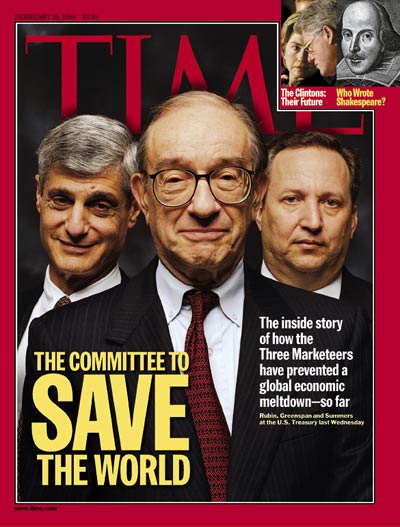
The Committee to Save the World, Ten Years On

The Committee to Save the World, Time Magazine, 15 February 1999

It’s mostly consigned to the past, but it increasingly seems to me that the Asian financial crisis of 1997-98 and the attendant reaction of U.S. economic policy makers was the watershed economic event of the present era. The economic handlers of the time, most outstandingly Alan Greenspan, Robert Rubin and Lawrence Summers came as close to the rank of heros as economic policy makers are allowed (“the committee to save the world” in Time Magazine’s famous formulation). During the period 2 July 1997 through 23 September 1998 — the floating of the Thai baht to the deal to bail out Long Term Capitol Management — the Federal Reserve held rates steady at 5.5 percent, then in September, October and November made a succession of impressively restrained off-committee 25 basis point rate cuts. The firebreak held and the U.S. economy got another 24 months of economic growth, crossing the line to become the longest uninterrupted economic expansion in U.S. history in February of 2000. On such a basis is the formidable reputation of Alan Greenspan built.

But the unenunciated strategy of Greenspan, et. al. during this period was to stave off the spreading crisis by converting the vast and voracious American body of consumers into the buyer of last resort for the world. The countries in crisis would be propped up through IMF aid packages, but also through the newly enhanced competitiveness of their goods on the U.S. market. This was accomplished through the aforementioned interest rate cuts, but also at Treasury through the strong dollar policy.

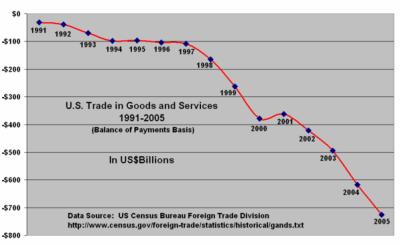
U.S. trade deficit, 1991-2005

Source: Wikipedia; U.S. Census Bureau, Foreign Trade Division

The broadest mechanism by which interest rates work is through home mortgages. As interest rates decline they set off a wave of home loan refinancing, liberating spending previously sunk into housing costs. That combined with the (psychological) wealth effect of the stock market and a historic credit binge came together in the person of the American consumer to pull the world back from the brink. A glance at the above graph of the trade deficit shows that 1997 was the inflection point.

In so far as the way that the U.S. opted to combat the global spread of the anticipated “Asian contagion” was to transform the U.S. consumer into the buyer of last resort through loose credit, the collapse of the housing market bubble is the continuation of, or the knock-on effects of the Asian financial crisis of 1997-98. It could only be postponed, not avoided; transformed, not stopped. Old wine in new bottles.

It was fairly apparent to most observers during the late 1990s and 2000s that the Federal Reserve was struggling to stave off a crisis and did the best that it could, but was merely kicking the can down the road. There was plenty of commentary at the time that the Fed was merely letting pressure off one bubble by inflating another. And inside the Fed they were fully aware that this was what they were doing, but they had to deal with the crisis at hand and figured that they would cross the bridge of the iatrogenic consequences of their policies when they came to them.

In this sense the ultimate cause of the present economic crisis is a structural imbalance in the world economy that has a tendency to generate crises. One portion of the world, the developing, produces without consuming and as a result experiences a glut of savings. The other, the U.S., consumes by borrowing the surplus savings of that other portion of the world. Witness the current account deficit of the United States with China and the strategic fallout thereof. The problem is political-economic in nature and the ultimate solution lies in the realm of politics, not behind the scenes financial wizardry.