Deliver Me From These Awful Debates

I’m the kind of person who gets wound up over the State of the Union Address like it were the Super Bowl, but both these debates bored the life out of me. I was looking at the clock and whishing for it to be over. I blame it on the Senate: it’s too insular a world. When Senator McCain said that he had written a letter to the Treasury Secretary that Senator Obama had not signed, that he whishes we could see that letter, I was one impressed customer. You wrote a letter. I’ll bet the Treasury Secretary wound up the entire department and wrote one back. God! If the next president would just write a letter to Wall Street or to Mahmoud Ahmadinejad, I’ll bet they would write letters back too.

And John McCain’s jokes were such insufferable stinkers. His stilted humor is the perfect analog to his person. And what was up with that bizarre attack on Tom Brokaw?

And where is the Barack Obama of the prepared statements? Take away rehearsal and he’s just another quibbling, rambling Senator lost in the shuffle. In the last debate when he stammered for what seemed like two or three minutes trying to get out the name of that thing we did with those other countries about those big bombs I couldn’t believe it. “The Nuclear … uh … uh … Proliferation … uh … Agreement.” It’s a treaty. What’s so hard about that?

Tom Brokaw was a dud of a moderator. Where the hell did he dig up that completely arbitrary non sequitur about holding Congress to a two year deadline to reform Social Security? Why not the proverbial first hundred days?

People who say that one candidate or the other won are either spin-meisters or possessed of higher levels of discernment than me. I think that these debates are completely inconsequential for the outcome a month from now.
A Co-President?

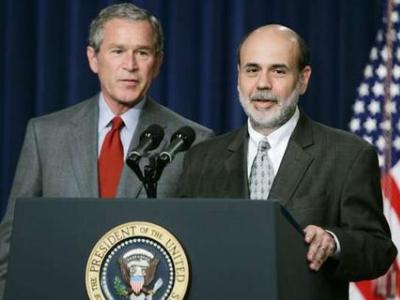
Federal Reserve Chairman Ben Bernanke and President George W. Bush

At the constitutional convention in summer of 1789 the founding fathers struggled to find an amenable compromise between those desiring a vigorous executive and those concerned about despotic overreach. One proposal to limit the executive was that instead of concentrating power in a single person, create a miniature division of powers by having a triumvirate of co-presidents.

Events of the past few weeks have been instructive. It would appear that the Federal Reserve Act of 1913 delivered us a co-presidency in a sub-constitutional manner. It would appear that they each have their own portfolio: one is commander and diplomat in chief and the other is the captain of the macro-economy. With his 20 year term, substantial independence, control over interest rates, lending capability, 800 billion in capital and a regulatory mandate over the banking system, the Federal Reserve Chairman has a vast array of powers, while not on par with the official executive, impressive nonetheless.

It’s also worth noting that, like the official President, the Federal Reserve Chairman accrues perhaps the better part of his powers through reputation, as a focal point of attention and the judicious use of his own particular bully pulpit.

This has some potentially troubling implications, depending on where you fall on the democratic spectrum. In this regard, Will Wilkinson has some interesting ruminations on what he calls “the structure of the de facto American constitution” (“What’s an Incrementalist Market Liberal to Think?,” 19 September 2008; the previous post, “The Benign Rule of Ben Bernanke and the Ideal of Democratic Equality, 18 September 2008, along the same lines is also good too).

It’s also worth noting — something that has become apparent throughout the Bush years — that many of the constraints on the presidency are not official, but adhered to only out of tradition. When the situation warrants — or ambition allows — the executive is capable of blowing through its traditional restraint, erupting into a ferocious activism. When this happens in the realm of foreign policy everyone loves it. Nothing gets people excited like a little kicking of foreigner ass. When it happens in the domestic or economic realm, people aren’t so enthusiastic, as Congressional telephone lines, recently clogged with populist anti-high finance carping, will attest.

Federal Reserve Balance Sheet

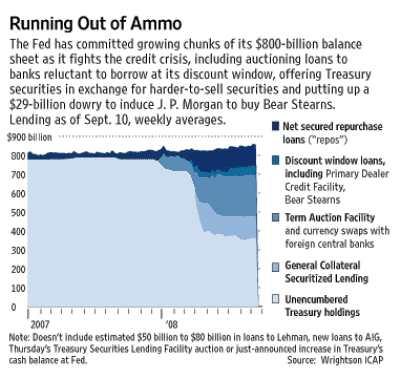
Amid news that the Federal Reserve is establishing this multi-billion dollar line of credit, extended that many billion in overnight repurchase agreements, contributed $30 billion to the J.P. Morgan buyout of Bear Stearns and spending $83 billion for the purchase of A.I.G., the question lingering in the back of my mind is how is the balance sheet of the Federal Reserve looking right about now. The Federal Reserve doesn’t have unlimited resources at it’s disposal. It has about $800 billion in assets which only buys it a limited amount of credibility. It’s not all that much relative to the scale of modern financial flows.

Anyway, wonder and The Wall Street Journal will deliver (Blackstone, Brian, “U.S. Moves to Bolster Fed Balance Sheet,” 18 September 2008, p. A3 [subscription required]):

Federal Reserve assets, The Wall Street Journal, 18 September 2008

The Treasury, responding to worries that the Federal Reserve could be running out of financial ammunition to deal with the credit crisis, moved to reload the Fed’s gun with $100 billion worth of bullets.

The central bank’s bailouts of Bear Stearns and American International Group Inc., as well as lending programs created in the past year, are putting the Fed’s once-mighty balance sheet at risk. Financial markets have begun to fear that if nothing is done, the Fed might have trouble putting out fires in the future.

The Fed held close to $800 billion in Treasury securities a year ago. By last week, that had dwindled to just under $480 billion. The amount drops to less than $200 billion if the $200 billion pledged to the Term Securities Lending Facility — a Fed lending program created in March for investment banks — and the full $85 billion line to AIG are accounted for, Fed watchers say.

“The tally is so low that it is becoming imperative for the Fed to take actions to enlarge its balance sheet,” said Tony Crescenzi, a strategist at Miller Tabak in New York.

When the Fed lends money to a financial institution, it usually sells an asset such as Treasurys separately in the market and absorbs the cash created by the loan. The goal is to keep a proper level of money flowing through the financial system. If the Fed were to run too low on Treasurys to conduct these operations, it could lose its ability to drain money from the banking system and control inflation.

On Wednesday, the Treasury announced a temporary program to bolster the Fed’s balance sheet and sold $40 billion in 35-day Treasury bills. It announced later in the day that it would hold two additional auctions of Treasury bills on Thursday totaling $60 billion. In effect, Treasury is auctioning off more securities than are needed to fund the federal government, and carrying out the draining function in place of the Fed. The cash from the Treasury’s sales is parked at the Fed.

Of course the government has infinite money, but it comes at a cost. As long as the Fed coffers are topped off, Chairman Bernanke is his own man. But already Federal Reserve assets are approaching levels where he will increasingly be at the behest of Treasury Secretary Paulson and House Financial Services Committee Chairman Barney Frank.

Et Tu, T-Bills?

The yield on Treasury bonds went negative yesterday for the first time in history. Investors are so desperate to avoid risk that they would rather a known small loss than lend to an unknown. Reuters has considerably more information on the state of public sector debt risks and they make it sound much worse than the passing reference in the Financial Times (Siew, Walden, “S&P Says Pressure Building on U.S. ‘AAA’ Rating,” 17 September 2008):

Pressure is building on the pristine triple-A rating of the United States following a federal bailout of American International Group Inc., the chairman of Standard & Poor’s sovereign ratings committee said Wednesday.

The cost of insuring 10-year U.S. Treasury debt against default rose Wednesday to a record high, a day after the government rescued insurer AIG with an $85-million loan. …

Ten-year credit default swaps, or CDS, on Treasury debt widened three basis points to 26 basis points, according to data from CMA DataVision. This means it costs $26,000 per year to insure $10-million of U.S. Treasury debt against default.

Five-year credit default swaps on Treasury debt were steady at 21.5 basis points. That compares to 9.8 basis points on German five-year CDS and 13.2 basis points on German 10-year CDS, CMA said.

A graph of various CDS rates would be a visual of the rise and fall of the great powers.

Not So Fast on the Moral Hazard

Last week American International Group requested assistance in the amount of $40 billion from the Federal Reserve. This was rejected only to have A.I.G. come back with a second request, this time for $75 billion. Over the weekend the Federal Reserve and the Treasury decided to let Lehman Brothers fail. On Monday and today the editorial pages were full of adulation about the reinstantiation of the rule of moral hazard. “If Lehman is able to liquidate without a panic … the benefits would include the reassertion of ‘moral hazard’ on Wall Street.” (“Wall Street Reckoning,” The Wall Street Journal, 15 September 2008, p. A22) “It was a brave decision. By abandoning Lehman Brothers, a 158-year-old piece of Wall Street furniture, and refusing to remove their hands from their pockets when Merrill Lynch came calling, Hank Paulson, US Treasury secretary, and Tim Geithner, governor of the Federal Reserve Bank of New York, had one of the busiest weekends of dispassion on record.” (Persaud, Avinash, “Lehman Had to Fall to Save the Financial System,” Financial Times, 16 September 2008, p. 13).

But then on midday Monday, New York state started waiving insurance regulations to allow A.I.G. to make a complex set of financial transfers to try to gather up enough collateral to cover it’s debts at a downgraded credit rating. At midday today when it started to look like a private bailout package being negotiated between J.P. Morgan and Goldman Sachs was faltering, the Federal Reserve stepped in to assist in the negotiations. Then it appeared that the Federal Reserve would be playing a key role in the package, but Fed spokesman was declining comment. Now, late this evening the Federal Reserve is announcing that it’s not going to be facilitating a private loan to, but outright buying a controlling interest in A.I.G. (de la Merced, Michael J. and Eric Dash, “Fed Readies A.I.G. Loan of $85 Billion for an 80% Stake,” The New York Times, 16 September 2008):

In an extraordinary turn, the Federal Reserve was close to a deal Tuesday night to take a nearly 80 percent stake in the troubled giant insurance company, the American International Group, in exchange for an $85 billion loan, according to people briefed on the negotiations.

In return, the Fed will receive warrants, which give it an ownership stake. All of A.I.G.’s assets will be pledged to secure the loan, these people said.

The Fed’s action was disclosed after Treasury Secretary Henry M. Paulson and Ben S. Bernanke, president of the Federal Reserve, went to Capitol Hill on Tuesday evening to meet with House and Senate leaders. Mr. Paulson called the Senate majority leader, Harry Reid, Democrat of Nevada, about 5 p.m. and asked for a meeting in the Senate leader’s office, which began about 6:30 p.m.

The Federal Reserve and Goldman Sachs and JPMorgan Chase had been trying to arrange a $75 billion loan for A.I.G. to stave off the financial crisis caused by complex debt securities and credit default swaps. The Federal Reserve stepped in after it became clear Tuesday afternoon that the banking consortium would not be able to complete the deal.

Extraordinary indeed! It would seem that the Federal Reserve and the Treasury aren’t so bullish on moral hazard after all.

The Other D-Word: Default

How bad is the current spate of financial upheavals (the federally backed buyout of Bear Stearns, the federal takeover of Fannie Mae and Freddie Mac, the hasty buyout of Merrill Lynch, the bankruptcy of Lehman Brothers, the impending joint federal-private bailout of American International Group)? In trying to explain the seeming double standard in the actions taken by the federal government in response to Bear Stearns back in March and Lehman Brothers this past weekend, today’s Financial Times Comment & Analysis section includes the following tidbit as one of a number of explanations (Persaud, Avinash, “Lehman Had to Fall to Save the Financial System,” 16 September 2008):

Third, there was an alarming factor not present at the time of Bear Stearns’ collapse that argued strongly against new government guarantees. Since the August rescue of Freddie Mac and Fannie Mae, credit markets have begun to price in the possibility of a default by the US government. The implied probability remains a fraction of 1 per cent but it is an unprecedented development.

It’s hard to know what to make of this. It could be just an investors’ parlor game, like the market on Hollywood has-been career comebacks. Or it could just go to show that unhinged paranoiacs aren’t confined to remote cabins. Some work in the bowels of high finance as well. After the past few months it would hardly be the first sign of a less than steady hand on the till. But there it is. The possibility of a default by the U.S. government has gone from beyond the pale to remote.

The Palin Speech

After the pounding that McCain-Palin have taken over the last week I think that a lot of people tuned in to Sarah Palin’s speech for a spectacle. And she got off to a start that suggested a neophyte out of her league, but she rapidly adjusted and delivered a real stemwinder. As many have commented, she is a mastermind of the caustic aside.

I think that just about everyone in the country saw what was going on all at the same time. All week long the analysis of the Republican VP choice is that it was an attempt to drive a wedge between the Hillary Clinton and the Barack Obama supporters. About a quarter the way through her introduction of her family it dawned on S. and I the true case for her selection by the McCain campaign. When her speech was over and MSNBC cut to Chris Matthews, his opening point was that analysts have been misreading the Palin pick all week long, that it was a culture war move; it’s aim was the elitism narrative. I feel like the knife has been held just outside my field of vision and only in the midst of the speech last night did I catch the first glint of whetted steal.

The whole clan is too much. The candidate herself is unmistakably an aging beauty queen. Her husband, a fisherman, a union member, an Alaskan Men cover model, a “snow machine racer” is right out of central casting. The son solemn and stern in anticipation of shipping out for Iraq. The daughter, starting to show, is too fast on the heals of Jamie Lynn Spears and Juno (the damn film and its namesake are even named for and Alaskan city). Contrary to the Republican mythos, the “heartland” is plagued by degeneracy and altogether too many of these people will be able to identify. The down syndrome child is clearly dog whistle politics. It’s a lesser-known subject of discussion that almost no down syndrome children are born anymore and on the right it dovetails into the strawman connection between reproductive freedom and eugenics. To flout one is a clear symbol to the illuminati about Ms. Palin’s position on abortion. As Peggy Noonan inadvertently said, Governor Palin is narrative, not policy or capability.

From this speech it’s clear that the coming election will be the culture war all over again. It’s going to be a rerun of the 2004 election and it’s going to be nasty. It’s really amazing that the Republicans have only one script.

It’s completely dismaying the degree to which the future of the country is in the hands of a fairly unsophisticated media. If on Monday Time, Newsweek and U.S. News all have glowing cover stories on her then the Democrats are fucked. If the litany of lurid, tabloid-esque stories don’t abate, then everything will be okay.

The Democrats Reborn?

I’m trying to keep up my jaundiced eye here, but I feel like tonight I have seen a Democratic party unlike any I have seen before in my lifetime. Walter Mondale was perhaps the last of the old guard still to possess some fight, but after that, not Dukakis, or Clinton, or Al Gore or John Kerry. They all seemed too timid, too poll tested, too cowed. First last night in Joe Biden’s speech and then again tonight in Barack Obama’s I heard a Democratic party unbowed, spirited, confident.

Senator Biden’s introduction by his son and his own discussion of his family was surprisingly emotional and seemingly so for everyone involved. His speech was the version of values that Democrats should be putting forward, it was tough on foreign policy, and unlike Democrats for the last eight years, effortlessly sincere, uncontrived. As Matthew Yglesias pointed out (“It’s Biden,” ThinkProgress, 23 August 2008), the selection of Biden for VP “signals as desire to take the argument to John McCain on national security policy” and deliver to voters “a full-spectrum debate about the issues facing the country rather than a positional battle in which one party talks about the economy and the other talks about national security.” In Joseph Biden I think I first, finally saw a different, rejuvenated Democrats.

The same was true for Barack Obama’s speech tonight. His cadence was off in places, but it was defiant, pugilistic and signaled to me that the Senator has absorbed all the right lessons about the campaign. I think many of the myths that have plagued the Senator as well as the party at large for the last few weeks have been definitively left behind after tonight. It showed some of the populism that worked so well for Al Gore in the final weeks of the 2000 election. My favorite part, like with Senator Biden, was when Senator Obama took the foreign policy issue by the horns:

You don’t defeat — you don’t defeat a terrorist network that operates in 80 countries by occupying Iraq. You don’t protect Israel and deter Iran just by talking tough in Washington. You can’t truly stand up for Georgia when you’ve strained our oldest alliances.

If John McCain wants to follow George Bush with more tough talk and bad strategy, that is his choice, but that is not the change that America needs.

If Chris Matthews waxing rapturous is any indication, then he achieved everything he needed to do. After Chris Matthews, what more can you ask for? Who knows, maybe even Maureen Dowd will write a positive review. I think McCain’s speech a week from now will look pretty wooden in comparison.

My only concern is as, I think it was Patrick Buchanan said last night, after a week of the Republicans ripping into Senator Obama next week, the Democrats may regret going so easy on Senator McCain. Alternately, Democrats may finally have learned that you have to run your negative stuff stealth.

The Omission of Lyndon Johnson from the Democratic Pantheon

If there is a unifying thread to U.S. history it is that of the ongoing process of bringing American practice into line with American principle, of the march of freedom, of the expansion of the franchise. In this story there is one great subplot that stands above all others: that of the experience of the African American: the middle crossing, slavery, the fatal flaws of the U.S. Constitution, the Civil War, Reconstruction, Jim Crow and the civil rights movement. At the denouement of this story stand two characters, towering over all others: Martin Luther King, Jr. and Lyndon Baines Johnson.

Taylor Branch was right to structure his biography of Martin Luther King, Jr. around Exodus. King led African Americans out of the dessert, but was not allowed to enter the Promised Land himself. Lyndon Johnson, on the other had, is an exile: a man from the heart of the franchise, who is today persona non grata.

Today, Lyndon Johnson would have been a hundred years old (27 August 1908 – 22 January 1973) and George Packer comments on the strange exclusion of this giant of the left from the Democratic pantheon (“L.B.J.’s Moment,” Interesting Times, The New Yorker, 24 August 2008):

Whenever Democrats gather to celebrate the party, they invoke the names of their luminaries past. The list used to begin with Jefferson and Jackson. More recently, it’s been shortened to F.D.R., Truman, and J.F.K. The one Democrat with a legitimate claim to greatness who can’t be named is Lyndon Johnson. The other day I asked Robert Caro, Johnson’s Pulitzer-Prize-winning biographer and hardly a hagiographer of the man, whether he thought Johnson should be mentioned in Denver. “It would be only just to Johnson,” Caro said. “If the Democratic Party was going to honestly acknowledge how it came to the point in its history that it was about to nominate a black American for President, no speech would not mention Lyndon Johnson.” Caro is now at work on the fourth volume of his epic biography, about Johnson’s White House years. “I am writing right now about how he won for black Americans the right to vote. I am turning from what happened forty-three years ago to what I am reading in my daily newspaper — and the thrill that goes up and down my spine when I realize the historical significance of this moment is only equaled by my anger that they are not giving Johnson credit for it.”

In the week of Johnson’s one hundredth birthday, I would like to believe that there is some Democrat in Denver who will do him the justice of speaking his name.

The Central Question Regarding Barack Obama

Paul Krugman opens Monday’s editorial asking the central question for the left about Barack Obama (“The Obama Agenda,” The New York Times, 30 June 2008):

It’s feeling a lot like 1992 right now. It’s also feeling a lot like 1980. But which parallel is closer? Is Barack Obama going to be a Ronald Reagan of the left, a president who fundamentally changes the country’s direction? Or will he be just another Bill Clinton?

Oddly enough, I found myself a supporter of Hillary Clinton in the primaries because I suspect the latter. Perhaps that was a little naive as I also suspect that Senator Clinton is fundamentally and genuinely conservative politically and personally.

No one can fight every battle and not every battle should be fought in the most direct manner. One must marshal one’s resources for the critical moment, and more times than not maneuver is superior to grabbing the bull by the horns. I presume that Senator Obama recognizes two things: first he has to get into the White House before he can do anything else and once there he will only be able to accomplish a small number of his objectives so he needs to dispense with the lesser objectives and focus on the really important ones.

For instance, voting for the FISA bill last week was, I presume, tactical. It takes that accusation off the table for the duration of the campaign. Everyone runs a stealth campaign anymore. You’ve got to avoid at all costs doing anything that could be used to provoke the middling mind of the independent voter. Once in the White House, then he will really be in a position to address the problems of the FISA program. Again, first win the election, then come the reforms. Would losing to John McCain serve the cause of FISA reform?

Presidents can only have limited power and limited time to accomplish their agenda. Senator Obama has to be eyeing that Oval Office desk and thinking Economy, Budget, Healthcare, Iraq, Afghanistan, War on Terrorism and everything else will just have to take the back seat.

At least this is the story I am feeding myself to assuage my severe doubts that this will be another eight years of cowed liberalism. Senator Obama is giving us plenty of reason to believe otherwise.