The Committee to Save the World, Ten Years On

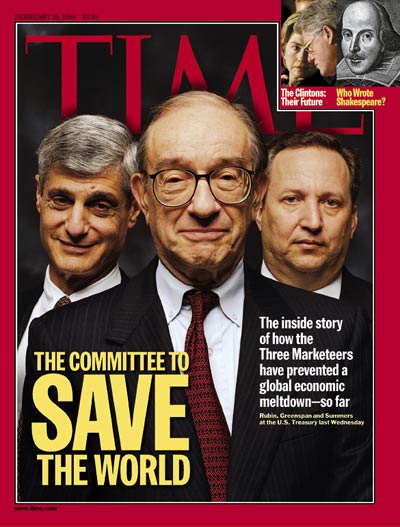
The Committee to Save the World, Time Magazine, 15 February 1999

It’s mostly consigned to the past, but it increasingly seems to me that the Asian financial crisis of 1997-98 and the attendant reaction of U.S. economic policy makers was the watershed economic event of the present era. The economic handlers of the time, most outstandingly Alan Greenspan, Robert Rubin and Lawrence Summers came as close to the rank of heros as economic policy makers are allowed (“the committee to save the world” in Time Magazine’s famous formulation). During the period 2 July 1997 through 23 September 1998 — the floating of the Thai baht to the deal to bail out Long Term Capitol Management — the Federal Reserve held rates steady at 5.5 percent, then in September, October and November made a succession of impressively restrained off-committee 25 basis point rate cuts. The firebreak held and the U.S. economy got another 24 months of economic growth, crossing the line to become the longest uninterrupted economic expansion in U.S. history in February of 2000. On such a basis is the formidable reputation of Alan Greenspan built.

But the unenunciated strategy of Greenspan, et. al. during this period was to stave off the spreading crisis by converting the vast and voracious American body of consumers into the buyer of last resort for the world. The countries in crisis would be propped up through IMF aid packages, but also through the newly enhanced competitiveness of their goods on the U.S. market. This was accomplished through the aforementioned interest rate cuts, but also at Treasury through the strong dollar policy.
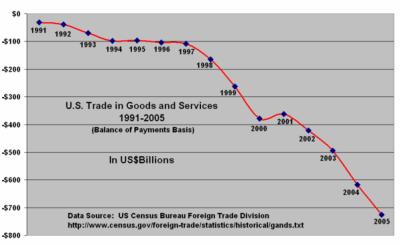
U.S. trade deficit, 1991-2005

Source: Wikipedia; U.S. Census Bureau, Foreign Trade Division

The broadest mechanism by which interest rates work is through home mortgages. As interest rates decline they set off a wave of home loan refinancing, liberating spending previously sunk into housing costs. That combined with the (psychological) wealth effect of the stock market and a historic credit binge came together in the person of the American consumer to pull the world back from the brink. A glance at the above graph of the trade deficit shows that 1997 was the inflection point.

In so far as the way that the U.S. opted to combat the global spread of the anticipated “Asian contagion” was to transform the U.S. consumer into the buyer of last resort through loose credit, the collapse of the housing market bubble is the continuation of, or the knock-on effects of the Asian financial crisis of 1997-98. It could only be postponed, not avoided; transformed, not stopped. Old wine in new bottles.

It was fairly apparent to most observers during the late 1990s and 2000s that the Federal Reserve was struggling to stave off a crisis and did the best that it could, but was merely kicking the can down the road. There was plenty of commentary at the time that the Fed was merely letting pressure off one bubble by inflating another. And inside the Fed they were fully aware that this was what they were doing, but they had to deal with the crisis at hand and figured that they would cross the bridge of the iatrogenic consequences of their policies when they came to them.

In this sense the ultimate cause of the present economic crisis is a structural imbalance in the world economy that has a tendency to generate crises. One portion of the world, the developing, produces without consuming and as a result experiences a glut of savings. The other, the U.S., consumes by borrowing the surplus savings of that other portion of the world. Witness the current account deficit of the United States with China and the strategic fallout thereof. The problem is political-economic in nature and the ultimate solution lies in the realm of politics, not behind the scenes financial wizardry.

Tchotchkes and Circus

Over the Thanksgiving weekend our Australian member pointed out a striking contrast. A constant topic of conversation among our group, being mid-career professionals from New York and Washington, D.C., it the outrageous price of houses. We are all at that age where we are looking and scheming, but for myself I have completely written off the prospect of ever owning a house in any place where I would like to live, namely the big city.

In the midst of one of these rants, Dean, a man with a considerable lust for gadgets mind you, pointed out that increasingly the most important things in life — housing, education, healthcare — are astronomically expensive, pushing completely unaffordable to normal middle class people. Meanwhile all the trivial junk — banana hangers, juicers, fruit dryers, bread makers, cheese straighteners — becomes ever more cheap.

This is just the economic continuation of bread and circus: as the most important things in life recede ever farther from grasp, people are distracted by trivial entertainment and petty satisfactions.

Often enough, this is offered up as adequate consolation in the bargain of trade liberalization. Yes, yes, mid-level skilled jobs may be fleeing the country at an alarming rate but this is completely offset — so the argument goes — by the stunning decrease in prices. People’s wages may have stagnated, but the goods they seek to purchase have decreased in price so their real standard of living has improved. The fly in the ointment is that the price of imported goods — cheese straighteners et. al. — has decreased while the price of domestically produced goods — healthcare, houses, education — has continued to increase apace. Or perhaps what we are witnessing is correct valuation of these dear goods: as the return on investment in these life-investments has grown, their value, like blue-chip stocks, has grown accordingly. Whatever the case, what we are witnessing is the reverse of Robert Reich’s thesis from The Work Of Nations: rather than investing in our immovable capital, namely our nation’s citizens, we are allowing them to crumble in favor of tooth brushes that match the bathroom curtains.

Owing to I-don’t-know-what — morbidity about the future and infatuation with the shimmer of the present — the calculation by which your average person discounts future prosperity is all out of whack. Contra the Virginia Postrel thesis, life may be ever more stylish and well designed, but it is simultaneously more mean and slim in its life-investment aspects. What we are experiencing is a hollowing out of the human economy. The aesthetics are just the latest in bread and circus. And I’m not talking ivory tower abstractions about what constitutes the good life — some sort of life of mind and real freedom versus crass materialist comfort. As Hans Roslings has amply demonstrated (e.g. Debunking ‘Third-World’ Myths with the Best Stats You’ve Ever Seen,”, TED, Monteray, California, February 2006) and as I’ve learned as a supervisor, basic health is perhaps the most important prerequisite to prosperity. Education is the foundation upon which future wellbeing is built. To the extent that we defer human investment in favor of spending our money on the day-to-day, we undermine our capacity to keep the circus of gadgets going.

Reaganomics Vindicated!

This piece from The Onion takes the piss out of right-wing economics (“Reaganomics Finally Trickles Down To Area Man,” Issue 43-41, 13 October 2007). And they really realize the potential of the original idea. After the hook it reads like a John Updike novel in miniature.

HAZELWOOD, MO — Twenty-six years after Ronald Reagan first set his controversial fiscal policies into motion, the deceased president’s massive tax cuts for the ultrarich at last trickled all the way down to deliver their bounty, in the form of a $10 bonus, to Hazelwood, MO car-wash attendant Frank Kellener.

“Back when Reagan was in charge, I didn’t think much of him,” Kellener, 57, said, holding up two five-dollar bills nearly three decades in the making. “But who would have thought that in 2007 I’d have this extra $10 in my pocket? He may not have lived to see it, but I’m sure President Reagan is up in heaven smiling down on me right now.”

Leading economists say Kellener’s unexpected windfall provides the first irrefutable proof of the effectiveness of Reagan’s so-called supply-side economics, and shows that the former president had “incredible, far-reaching foresight.”

Moral Hazard and Optimization

Lawrence Summers has an editorial in yesterday’s Financial Times arguing against excess concern with moral hazard (“Beware the Moral Hazard Fundamentalists,” 24 September 2007, p. 11). It is a well deserved and long overdue point. Whenever an economic crisis looms, the usual suspects trot out all the laissez faire tut-tuting. It was probably a day or two after the major news stories about the most recent central bank interventions that The Wall Street Journal editorial page started in with the boiler plate about how a few routine government interventions today spelled cataclysm of serfdom down the road. Mr. Summers’s editorial or others like it should be kept at the ready at more responsible economic editorial boards around the country.

I’m going to refrain from reposting Mr. Summers’s analysis because it is long, but it is worth reading at the link. It is worth noting that Mr. Summers doesn’t split hairs about the significance of his argument though.

Moral hazard fundamentalists misunderstand the insurance analogy, fail to recognise the special features of public actions to maintain confidence in the financial sector and conflate what are in fact quite different policy issues. As a consequence, their proposed policies, if followed, would reduce the efficiency of the financial sector in normal times, exacerbate financial crises and increase economic instability.

Mr. Summers’s three points of contention all argue that moral hazard, as its soothsayers characterize it, does not in fact obtain. I’m not an economist, but I’m going to go further and suggest that even if it did, under sufficiently dire circumstances, we still shouldn’t concern ourselves too much with it.

The economy isn’t a system that admits a state of perfect tune, but instead of optimization. Many factors trade off and the object is a state of affairs where maximum benefit is derived from a given factor without the deleterious effects of said factor overwhelming the positive. The Philips curve or patent protection are good examples, but others abound. It’s part of the power of economic-like thinking. And the economy is dynamic: the advantageousness or deleteriousness of a certain ratio of factors may change with time, or in relation to a third factor. For instance, central banks may have an easier time controlling inflation and may be able to do so at lower rates of interest when governments balance their budgets.

Given a dynamic balance of harms and advantages, moral hazard is a factor like any other. Moral hazard trades off with other objectives. Like the present, the most common example that people point to where it trades off is with capitol liquidity. Mr. Summers compiles a good list of examples of so objected government programs to preserve liquidity.

Moral hazard is indeed something to be minimized when times are good, it’s affordable, and its harms relatively troubling compared to the mix of harms on the horizon. But it is a goal to be relaxed when its attainment becomes extremely costly in the face of our other goals.

Think of it like this. Not spilling hot coffee in out lap is one of our objectives and under most circumstances it’s a pretty affordable one. On the go, you may have to drink from one of those sippy-cups and lean into a swig as an extra precaution, but still pretty easy. When suddenly an oncoming car swerves mid-coffee-sip into your lane, the equation shifts and the time, attention and dexterity to maneuver the coffee cup into your car’s dashboard cup holder becomes unaffordable. In order to achieve some of your other goals, you may forgo the no-hot-coffee-in-lap objective and just drop the damn cup to get the second hand on the steering wheel in a timely fashion.

When faced with a potential economic crisis, a little moral hazard may be an acceptable sacrifice. So long as the government preserves an element of roulette and just deserts in who survives and who perishes in a crisis and cultivates a reputation of preferred laissez faire — or at least an adequate amount of uncertainty about where and when it will intervene — then economic actors will remain sufficiently terrified about the future as to plan accordingly.

The Disconnect

Paul Krugman makes a seemingly notable observation about the recent economic expansion (“Where’s My Trickle?,” [$ | free], The New York Times, 10 September 2007):

As far as I can tell, America has never before experienced a disconnect between overall economic performance and the fortunes of workers as complete as that of the last four years.

It is a strange fact that throughout the Twentieth Century the benefits of industrialization, productivity gain and comparative advantage have been so well spread among workers. It is also a strange fact that over perhaps the last thirty years this has so progressively ceased to be the case. One might think that some serious analytic attention could be brought to bear on this transformation, but instead it seems that more tightly squeezed shut eyes and more urgent repetition of past dogma has been the response.

Oddly enough it is the center that is most in denial here. On the far left there is Robert Brenner and others around the New Left Review and the world-systems people like Immanuel Wallerstein and on the far right (the paleoconservatives) it seems like Patrick Buchanan and the people around The American Conservative are genuinely concerned about theses issues as well. Where are the neoliberals who will squarely face the problem and propose neoliberal remedies?

And in his usual fashion, Mr. Krugman doesn’t shy from a boldly leftist position, at least of a sort:

Guaranteed health insurance, which all of the leading Democratic contenders (but none of the Republicans) are promising, would eliminate one of the reasons for this disconnect. But it should be only the start of a broader range of policies — a new New Deal — designed to turn economic growth into something more than a spectator sport.

That’s all fine and good but I hope that Mr. Krugman will devote a future column to an outline sketch of what such a policy would look like, because short of direct redistribution — with all the problems that entails — I really don’t know. But Mr. Krugman is an economist and remains at least half-beholden to the idea of economic efficiency. Perhaps some Robert Reich-like scheme of investment in labor plus grand bargain between trade liberalization and labor entailing significant deals of the same, not the pathetic job retraining micro-initiative included as a part of the NAFTA legislation. But what programs, specifically? There’s only so much job retraining the government can do.

A Broad View of What Constitutes a Bank

In today’s column Paul Krugman (“It’s a Miserable Life,” The New York Times, 20 August 2007) points out an interesting aspect of the current financial crisis:

The key to understanding what’s happening is taking a broad view of what constitutes a bank. From an economic perspective, a bank is any institution that offers people liquidity — the ability to convert their assets into cash on short notice — while still using their money to make long-term investments.

Consider the case of KKR Financial Holdings, an affiliate of Kohlberg Kravis Roberts, a powerhouse Wall Street operator. KKR Financial raises money by issuing asset-backed commercial paper — a claim that’s sort of like a short-term C.D., used by large investors to temporarily park funds — and invests most of this money in longer-term assets. So the company is acting as a kind of bank, one that offers a higher interest rate than ordinary banks pay their clients.

It sounds like a great deal — except that last week KKR Financial announced that it was seeking to delay $5 billion in repayments. That’s the equivalent of a bank closing its doors because it’s running out of cash.

The problems at KKR Financial are part of a broader picture in which many investors, spooked by the problems in the mortgage market, have been pulling their money out of institutions that use short-term borrowing to finance long-term investments. These institutions aren’t called banks, but in economic terms what’s been happening amounts to a burgeoning banking panic.

Mr. Krugman points out that while the banking industry narrowly defined is well regulated — that is, both brought under law and made more uniform and predictable — by a host of institutions — the FDIC, the Federal Reserve, various banking laws, the Basil accords, et cetera — these other bank-like institutions are not similarly covered. Hence, the Fed can modify its rates all it wants and the FDIC may offer insurance, but these don’t effect the pricing of asset backed securities or the willingness of investors to purchase commercial paper in anything like the way that they effect regular banking.

Just as the financial sector innovates, so regulation and governing institutions should innovate as well. Unfortunately the sort of consensus that produces institutions like the Federal Reserve or the FDIC come only out of major crises — not the sort at which we are currently looking. For that, the financial system will have to build up a lot more pressure.

State Resource Acquisition

As long as I am kicking Thomas Barnett, I should mention his article on the creation of AfriCom in the July issue of Esquire (“The Americans Have Landed,” Esquire, vol. 148, no. 1, July 2007, pp. 113-117, 134-137). It generated a bit of attention when it first came out (e.g. Plumer, Brad, “Surging Into Africa” and “More on Africa Command,” both 24 July 2007; Farley, Robert, “Africom,” TAPPED, The American Prospect, 24 July 2007; Yglesias, Matthew, “Africa Command,” The Atlantic.com, 24 July 2007).

Mr. Barnett pushes around a few theories about why AfriCom, but dismisses my own (“AfriCom: The New Scramble for Africa,” smarties, 1 May 2007) with some hand-waving:

There’s oil here, but the United States would get its share whether Africa burns or not, and it’s actually fairly quiet right now.

The Chinese are here en masse, typically embedded with regimes we can’t stand or can’t stand us, like Sudan and Zimbabwe. But the Chinese aren’t particularly liked in Africa and seem to have no designs for empire here. Beijing just wants its energy and minerals, and that penetration, such as it is, doesn’t warrant Africa Command, either.

The theory by which Mr. Barnett dismisses the idea that AfriCom is an economic-strategic countermove against China is that it’s unnecessary because we can all get access to the recourses we demand through the market. The problem with too facile a dismissal of this theory is that states have never wholly committed themselves to one theory of resource acquisition.

Throughout most of history governing institutions have been mercantilist and have lived by beggar-thy-neighbor. The way that a state and its clients acquired resources was by seizing them. It was only with the advent of modern liberalism that a firm division between the state and the economy emerged, but it was a slow process and up through the Second World War many a state pursued a policy of economic expansion through conquest. It was widely believed by many liberals that imperialist and economic competition was the cause of the First and Second World Wars. Hence at the end of the Second World War the United States decided to root out imperialism and replace it with a global system of open markets. Henceforth states would get out of the business of resource acquisition and it would be an entirely private activity conducted through the peaceful means of the market, not conquest. Roosevelt hated imperialism and sought to smash the European and Japanese colonial empires and made decolonization a central mission of the United Nations. Also GATT and the belated WTO were to be integral parts of this new liberal international system on par with the United Nations, the IMF and the World Bank, to prevent war and ensure smooth, open economic access — missions perceived as integral to one another by Roosevelt and his men.

But this liberal vision was a utopian fantasy of a sort in that states were never about to wholly abandon the economic foundation of their strength — and hence their survival — to the vagaries of the market. So states have wavered between theories of resource acquisition: open markets versus conquest.

The United States has been the most advanced liberal state and in the Twentieth Century became the guarantor of system of open markets. The majority of the military actions of the United States have been in support of this global system of markets. Nearly all of its interventions in Central America have been over worries that some critical resource was about to be removed from apolitical market access by a populist socialist. The U.S. intervened in Second World War Europe — among other reasons — to prevent Hitler from doing to the United States what Napoleon attempted to do to England with his continental system. The U.S. tempted Japan to war because it was unthinkable to the U.S. and other interested parties that Japan should monopolize the resources of half the Pacific rim and half of Asia. For nearly inverse reasons the United States went to war in Vietnam because it recognized — as demonstrated by Japan’s behavior leading up to the Second World War — that Japan’s economic interest in Southeast Asia was too significant for the resources of that region to fall behind the iron curtain (there were two contending world systems at that time). The First Gulf War was to prevent the emergence of too powerful an oil monopoly — sort of the Pentagon doing to greater Iraq what the FCC did to Ma Bell in 1982.

The United States is not about to trust its economic wellbeing to serendipity: it’s going to manage it — and that means a lot of things, but one thing that it means is the military. But the United States is acting — in part — on behalf of the liberal international order. That the U.S. is required to intervene as much as it does — or perceives that it has to — suggests that a lot of states the world over still want to lapse from the open market back to conquest as a means for laying hand on their necessities. On the other hand, perhaps the U.S. is a player, only posing as the referee the better to play (Calvinball?).

In Africa it may be the case that the liberal order can provide everyone what they want — or at least everyone doing the divvying up; whether the parceling of Africa’s resources will have any benefit for the Africans themselves remains to be seen. But no state — not even the primary advocate and guarantor of the liberal international order — is about to stake its future on the hope that unfettered market access is going to play out in a straightforward way (I’ve written about this before; see “China’s Strategy for Resource Competition,” smarties, 30 March 2005, bullet two). Even in this world of open markets — or especially in this world of open markets — sanctions and economic exclusion have always played a role. So states make nice and play the diplomatic game of tit-for-tat, preparing to clamp down should the time come. Favors are proffered and chits collected — for a rainy day. A few military bargains will be struck and maybe some men and hardware will be put in place so that everyone knows how things stand. No state is going to idle while a positive sum game plays out against its favor. In the event of a crisis, states are either the quick or the dead. In Africa what we are seeing is the laying out of the pieces on the board and the early maneuvers.

Public Financial Institutions

Thomas Barnett is conservative leaning and — ironically enough — is one of those intellectuals who is stupid in exactly the way that conservatives predict intellectuals to be: he tends to trip over his own intelligence. A perfect example is his completely incoherent take on the recent, sudden burst of the housing bubble (“Nice analysis of the sub-prime ‘crisis’,” 13 August 2007):

The only crisis I see coming out of the subprime shenanigans (such new tricks to fleece people will always be with us) would involve governments assuming they should bail out all those hedge funds that long dabbled in this stuff. O’Driscoll makes a great comparison to the S&L crisis of years ago: so long as financial institutions assumed the FDIC bailout was coming, they’d pawn off the risk to the government instead of effectively discounting it themselves.

Really? The only crisis he sees is moral hazard? So we’re courting moral hazard toward no specific end?

Government intervention isn’t bailing out “all those hedge funds”: it is protecting the rest of us — not necessary culpable in the “shenanigans,” but still subject to the consequences thereof — from spreading economic misery. To suggest that this same old moral hazard argument that economic conservatives have been making since 1913 is somehow penetrating analysis of our present day woes is completely retrograde. Moral hazard is real, but people with less pronounced agendas have a lot more interesting things to say about the subject than that in the face of it we should do nothing.

The FDIC, the Federal Reserve, the SEC, punitive, but stabilizing taxes, transparency laws, etc. were created specifically because “foolish” investors engaging in “shenanigans” could be found well before any of these public sector economic institutions ever existed; and further, to protect non-privileged investors who did everything by the book from said “shenanigans” — in other words, to prevent the spread of irrationality. Once a critical mass of people begin to act irrationally — e.g. in a financial panic — rationality flips and the irrational becomes the rational thing to do.

And as if this wasn’t disconnected enough, then there’s this parenthetical aside:

(since finance is–to a large part–a young man’s game, the bulk of the front-line players tends to age out every dozen years or so, which pretty much guarantees you new forms of shenanigans with the same regular frequency)

It’s all fine and good to use pejoratives such as “shenanigans” and “foolish” — as Mr. Barnett does — to describe less than perfectly rational market actors who continue to fall for plaid-out investment schemes such as the housing bubble long after their true nature has become more than apparent, but if less than perfectly rational behavior is in fact systematic, as Mr. Barnette suggests with this theory, then what’s the point of moralizing about it? Systematic problems should be dealt with through systematic solutions — and not systematic solutions that entail mass suffering for all of society.

The Federal Reserve and Mortgage Backed Securities II

So it turns out that what was unusual about the Friday open market operations of Federal Reserve was even more narrowly technical still. The Federal Reserve always accepts mortgage backed securities as collateral, but usually issues loans backed by this sort of collateral at a less favorable rate. What was unusual on Friday was that the Federal Reserve issues all loans at the most favorable rate, no matter the collateral.

Kevin Drum passes along an e-mail from Stephen Spear, a professor of economics at Carnegie Mellon University, in which the Professor relates a conversation with a Federal Reserve colleague about the operation (“Friday’s Liquidity Event,” Political Animal, The Washington Monthly, 12 August 2007):

Here’s what I’ve been told by a colleague at the Fed:

First a minor point: Most of the open market operations that the Fed does (including Friday’s) are short-term collateralized loans and not outright purchases of securities. Friday’s loans were all overnight (well, over the weekend, actually, maturing on Monday). So the Fed is technically not buying anything; it’s been making short-term loans of cash against collateral.

The Fed accepts three categories of collateral for these loans. One is Treasury securities, another is other government agency securities, and the third is mortgage-backed securities that are federally guaranteed. Because they are federally guaranteed, the mortgage-backed securities the Fed accepts are (obviously) the very best.

Typically the interest rate on these short-term loans varies slightly depending on the type of collateral offered by the borrower. Treasuries get the lowest rate; mortgage-backed securities the highest. (The details of the last 25 OMOs, including the rates for each type of security, are available here.)

What was unusual about Friday (other than the size of the operation) is that the Fed announced it would lend against all three types of collateral at the same rate.

To quote my Fed colleague on this: “I’m not sure why we did this. I think the idea was that given the size of the operation we did not want to risk disrupting the Treasuries markets, but there may have been other motivations. The expectation was that borrowers would primarily use mortgage-backed securities, since these have the lowest opportunity cost to the borrower.”

On the web page above, you will see that for Friday’s operations, under collateral type it just says “mortgage-backed.” What this means is that mortgage-backed securities or any better securities were allowed as collateral — in other words, all three types were acceptable. Apparently, the media misinterpreted this as saying that the Fed was only accepting mortgage-backed securities, which led to the headlines about the Fed buying these things up.

So, the bottom line is that the Fed’s actions on Friday were unusual, but not tremendously so. It did three OMOs instead of the usual one. The quantity of reserves lent out was larger than normal, and the way collateral was handled was slightly unusual. But the general operating procedure, including the type of collateral accepted, was completely standard. It would seem that the media is trying to make the story a lot more sensational than it truly is.

Given the extraordinary amounts of money here along with tweaks to the usual policy, obviously the Federal Reserve sees a problem requiring extra-ordinary measures, but obviously not the panic initially reported by the press.

The Federal Reserve Does Not Buy Mortgage-Backed Securities

When I saw the following story in the New York Times on Friday (Peters, Jeremy W. and Wayne Arnold, “Stocks Are Volatile After Global Sell-Off,” 10 August 2007) I fucking freaked:

The E.C.B. injected another 61 billion euros ($84 billion) into the banking system, after providing 95 billion euros the day before. The Federal Reserve today added $19 billion to the system through the purchase of mortgage-backed securities, then another $19 billion in three-day repurchase agreements. The Fed added $24 billion on Thursday.

It’s not the amounts of money that are unusual. Yes, this indicates a fairly aggressive attempt to preserve liquidity in financial markets and it is definitely earning the headlines it is getting in The Financial Times and The Wall Street Journal. But that the Federal Reserve might engage in the direct purchase of $19 billion worth of mortgage-backed securities would indicate a real problem and the adoption of extraordinary, panic measures on the part of the Federal Reserve. On Friday I was thinking how I might reinvest my 401k into gold doubloons.

Thankfully, on Saturday Dean Baker pointed out (“The Fed Does Not Buy Mortgage-Backed Securities!!!!!!,” Beat the Press, 11 August 2007) that this was just incompetence on the part of the economic reporting at The New York Times and The Washington Post (who also reported the story). That what really happed was that the Federal Reserve made a more routine loan through the discount window and accepted the $19 billion in mortgage-backed securities as collateral for the loan.

While you’re there, his post (“Tell The Post: The Problem Isn’t Subprime,” Press, 11 August 2007) pointing out that the cause of our current financial woes is not the subrime market (dirty, irresponsible poor people) is a useful reminder. The real problem is the bursting of the housing bubble more generally. The subprime market is just the first place it’s really being felt.