David Cook

Okay, okay … dawg … I’ve become obsessed with American Idol.

I know, it’s an embarrassing shame and I tried to resist, just like I tried to resist Sex and the City, but the siren song of popular culture proved too powerful. S. spent a few weekdays with her parents who have been fans for a number of seasons and she came back transformed. The damn show is two nights a week and they draw it out like Who Wants to be a Millionaire and there are way too many chirpy and inspirational types breathlessly disgorging their fame-whore dreams to Ryan Seacrest. But it’s on and our apartment is small.

But that wouldn’t be enough to turn me into the crazy fanatic that I have become. For that, what was required was contestant David Cook (American Idol | Wikipedia). At numerous points in my life I have been aware that some local talent — a fellow college student playing around the venues of the college town, that ensemble band playing at the dark, crumbling and sticky performance spaces — was more than just an amateur like the rest, but something totally amazing. I think that Mr. Cook is such an act and somewhere in Tulsa is a cadre of small time fans lamenting that they are about to lose their intimate treasure to mass popularity.

His command of the physical and emotional repertoire of rock and roll is as developed as any presence I have ever seen. He knows how to make out with the mic, he knows the seductive tough guy expressions and he knows all the dramatic gestures designed to leave you with the impression that rock and roll is an elemental force and the performer some sort of conjurer (hence the concert special effect of the pillar of fire). Taking his queues, I remember his performances as bigger than they were (wasn’t the wind blowing in the performance of “Eleanor Rigby“? Did he pull some Neo maneuver?).

The outstanding thing about Mr. Cook is that he’s doing covers and even then his arrangements are lifted from someone else — his version of “Day Tripper” is lifted from White Snake. His arrangement of “Billie Jean” is Chris Cornell’s. But almost without exception, he does a way better version of the song than either the original or the cover he is using. As Lionel Richie said of Mr. Cook’s performance of “Hello” — a creepy song rendered acceptable — “David just played it as if it was his song from the beginning — there was no Lionel Richie involved.”

I have been going through an anti-Beetles phase for some years now — too much of the sock-hop sound that preceded them, too trite of subject matter, guess I’m a Stones man — but in Mr. Cook’s versions of “Day Tripper” and especially “Eleanor Rigby” instead of a whining barbershop quartet, I hear the darkness of the lyrics of Paul McCartney and John Lennon, but sung in a style that maps it into the field of such songs by Depeche Mode or Nine Inch Nails or stuff from the dark side of the singer-song-writer tradition, songs about foundering and folly.

I have always thought that Michael Jackson’s Billie Jean was one of the best dance songs ever recorded, but I have also had to overlook the sleazy lyrics. In Michael Jackson’s hands it’s a song about a man trying to avoid the responsibility of parenthood, an effect magnified by the video. In Jackson’s version “the kid is not my son” is a lie told to a paternity inquest.

In Mr. Cook’s version (I have bought the complete studio version from iTunes) the drama of the love affair comes to the fore and the issue of paternity becomes a subordinate part of the narrative. It’s a song about the irresistibility of desire and that old cliché, the femme fatal. The narrator wakes to his senses from the intoxication of sexuality too late, with his future having receded from his grasp. The pregnancy and the child aren’t shirked responsibility, so much as the crushing consequences of fate and the inescapable demands of animality and the body. “The kid is not my son” becomes the primal psychological denial of a man who knows the truth (“My baby cried / his eyes were like mine”) contending with his powerlessness before the forces of his own nature.

Mr. Cook emphasized the ambiguity of having been designated “the one” under vastly different circumstances and plays with the timeline. The second line of the song he asks “What do you mean ‘I am the one?'” The first time it is disbelief at having been singled out by someone desirable beyond his attainability. The second time around it means he is the father of Billie Jean’s child. Possibilities open, possibilities are foreclosed. And the song plays with the chronology, one time leading the listener to believe that they met at the dance, had a brief affair and now she has caught up to him with the baby in tow. In a second telling is seems more as if she seduces him on the dance floor and there confronts him that she is no stranger, but someone with whom he has a past. In the face of seduction and desire and our wildest emotions, how tenuous is our grasp on reality? The absurdity of the song’s admonition to “Always think twice” is underscored by Rashomon, confusion and the loss of a linear, fixed point of reference in any sort of timeline.

Al this was always in the song, but in Michael Jackson’s version it is lost amidst the dance beat. By making it a ballad and adding his cataclysmic voice to it, Mr. Cook has exposed the previously obscured aspects of the song.

Anyway, here’s his Idol oeuvre:

Happy Together (The Turtles)
All Right Now (Free)
Hello (Lionel Richie)
Eleanor Rigby (The Beatles)
Day Tripper (The Beatles)
Billie Jean (Michael Jackson)
Little Sparrow (Dolly Parton)
Innocent (Our Lady Peace)
Always Be My Baby (Mariah Carey)
The Music of the Night (Andrew Lloyd Webber)

It’s not all great. He botches the performance of “Innocent,” but the studio version has become a favorite of mine. And nothing is as good as his rendition of “Billie Jean.” S. and I have investigated some of his pre-Idol stuff and it’s pretty pedestrian. Too much typical harlequin romance songs. Hopefully after his run on American Idol he has the good sense to find his way to a decent producer (may I suggest Trent Reznor) and avoid signing a contract to do a Ford commercial.

This week is going to be Neal Diamond. If only they were taking requests. Actually, nevermind, I wouldn’t know where to start.

Ryan Seacrest’s little trick during week eight of initially sending Mr. Cook to the bottom three only to correct himself later and swap Mr. Cook into the safe group almost killed me. It’s driving me so crazy that I may have to text “vote” to whatever number they throw up on the screen. I just hope they don’t start dispensing commands to run off a cliff because with my case of the screaming meemies I just might do that too.

Hillary Clinton: Reloaded

Hillary Clinton throwing back a brew, Bronko's Restaurant and Lounge, Crown Point, Indiana, 12 April 2008

Hillary Clinton hesitating over a shot of Crown Royal, Bronko's Restaurant and Lounge, Crown Point, Indiana, 12 April 2008

For the last few years it’s been kissing your way to the White House. This year for a few days it seemed like it might be sobbing your way to the White House. My hope is that it might now turn to drinking your way to the White House. After a dry drunk as president, this is a welcome change. Words won’t help you now Obama. Time to pony up. You’ve done coke so showing this old lady up should be no problem. Or maybe it’ll be like Marion Ravenwood drinking a bunch of Nepalese tough guys under the table at her bar, The Raven, in Raiders of the Lost Ark.

Campaigning at Bronko’s Restaurant and Lounge in Crown Point, Indiana, Senator Clinton was polishing of a brew when someone offered “You want a shot with that?” John Stewart mocked her for her choice of Crown Royal. But if you watch the video, when it’s suggested that she drink a shot she says, “I want something sweet.” It turns out that her idea of something sweet is actually the sweat end of bitter. When most people say “something sweet” what they mean is a Mellon Ball or a Lemon Drop. When Hillary Clinton say “something sweat” what she means is a sweat whiskey. I’m sold.

I was so amused by this that I actually can’t decide which picture I liked the most. So here she is, both a beer and a whiskey. More at The Gawker (“A Shot in the Dark: Hot Hillary Clinton Party Photos!,” 14 April 2008).

Falafel Quest

Pennsylvania working class aren’t the only bitter ones. Matthew Yglesias is bitter as well (“Bitters,” TheAtlantic.com, 13 April 2008):

I’m bitter about the way Meridian Hill Park and the street design in Adams Morgan makes it so difficult to get from my house to the Amsterdam Falafel Shop even though it’d be really close if I could fly.

I hear ya, brother! I live on 18th Street. Amsterdam Falafel is on 18th Street. Were it not for a gigantic gorge jutting out from Rock Creek Park between Irving and Harvard, it would be a straight shot. As it is, 18th doesn’t run through and I have to go a bunch of blocks east, then south, then jog a bunch of blocks back west again. As a result, I go to Amsterdam Falafel a lot less than I would like.

Television Lineup of the Damned

The three most despicable shows on television this season, namely Hell’s Kitchen, Moment of Truth and Are You Smarter Than a 5th Grader are the perfect shows for the decadence of the new Rome.

Hell’s Kitchen has managed to combine the Colosseum and the Vomitorium into one unseemly arena (Mr. Ramsay actually did throw up one recent contestant’s dish into a garbage can). Just what America needs: more arrogance, intemperance and yelling. And this time from a Britt. Thanks. We need more over here so keep ’em coming. We’ll send you all our sensible and mild mannered citizens.

Moment of Truth is the perfect show for the Bush years: it’s the propaganda lulling — or jarring — us all in the mindset to unproblematically accept the surveillance state. You may think that the executive overstep is a problem, but in fact it’s fun for the whole family. Who says that capitalism is inimical to the authoritarian state? Here one is sort of the advanced team for the other.

As if Who Wants to be a Millionare wasn’t insipient enough — I found the glacial pace of the show maddening, but apparently it was necessary for the viewership to keep up with the complexities of the game — now there’s the next big game show, Are You Smarter Than a 5th Grader, where the contestants giggle unashamedly at demonstrating the answer to be “no.” Oh! for the days of Win Ben Stein’s Money. Clive Crook worries that possibly for the first time ever, retiring workers are better educated than their new entrant replacements (“The Dumbing of America,” TheAtlantic.com, 28 March 2008). The study that he discusses uses master’s degrees as its reference point. Meanwhile in the rest of America, less than grade school is the benchmark of aspiration. With over a billion people, China will soon have more people with Ph.D.s than the U.S. will have people of any and every level of educational attainment and we keep on talking about a potential future peer competitor. The CCP must find that real rich.

Destroy This Mad Brute

H.R. Hopps, U.S. Army First World War propaganda poster, "Destroy This Mad Brute — Enlist", 1917

Jill Filipovic at Feminista and Erica Barnett at The Stranger both think the cover of the April 2008 issue of Vogue (above, right) is some weird racist adumbration to King Kong (“I Know Vogue Isn’t Exactly Racially Conscious, But…,” 15 March 2008; “The LeBron James Vogue Cover Controversy,” 26 March 2008, respectively). In comments a lot of people discount the idea by pointing out the faint resemblance and go on to suggest that making such a leap when the source material is so vague is suggestive of some racist machinery at work in the minds of Mses. Filipovic and Barnett. SLOG has made it a poll with 88 percent of respondents — in crunchy Seattle even — declaring it not racist.

Every time I’ve walked past this issue of Vogue it has caught my attention — it’s a striking, if not attractive, photograph — but I haven’t been able to say why and just dismissed it as some visual itch that I can’t scratch. Then I read Ms. Barnett’s post on SLOG and recognized it immediately. Mses. Filipovic and Barnett are right about what’s going on here, they just have the wrong source material. The resemblance to the King Kong cell may be distant, but it is more than unmistakable that the reference to this poster is intended. The posture, the facial expression, the basketball in place of the club, even the color of Ms. Bundchen’s dress all match. In fact, to get such a resemblance I imagine that Annie Leibovitz must have had to show them the image that she was trying to recreate.

While fielding PC service calls at Amazon.com in the late 1990s I came across this H.R. Hopps U.S. Army First World War propaganda poster hanging in someone’s office (the 4th floor of the 2nd and Pike building) and immediately fell in love with it. It’s one of those images has managed to distills the worldview of an era into a single flash of the eye. And it rewards deeper viewing. I have had it hanging in my bedroom for years now and careful consideration rarely fails to inspire some new thought about the perversities of the American worldview represented therein.

In the distance the crumbling ruins of old Europe, strangely suggestive of the outcome of the air power attacks still 30 years in the future. A gorilla with a Kaiser Wilhelm II mustache and a German Pickelhaube emerging from presumably the Atlantic Ocean onto the shores of America. The helmet says “Militarism,” the bloody club “Kultur.” That Europe is portrayed as decrepit, barbaric and militaristic. What can it mean that culture is considered on par with militarism among the horrors that this mad brute visits upon the shores of America? Or that the proper metaphor for culture is a bludgeon? Is it any wonder that Americans are such philistines with a history like this?

And race imagery was common in these old propaganda pieces. Witness the exaggerated, flabby lower lip on the gorilla above (do gorillas even have large lips?).

It’s fairly obvious that this imagery derived parts of its power from tapping into that same set of ideas as the verbal formulations of white mans’ burden, mission civilisatrice, the dark continent, et cetera. People imagined a spectrum running from Christian, white European civilization to black, pagan African barbarism. Much of the dialog in the segregated U.S. partook of this scheme with a considerable discourse around the relative levels of sexuality, animal vigor, impulse control, intellectual capability and moral sociability of the races.

So whenever the time came for the denigration and dehumanization of an enemy people, this stock of tropes, civilization and barbarism, Europe and Africa, white and black was rolled out. And to add to the sense of barbarism and the anxiety of the viewer, an image of sexual peril was often thrown in. Here you have Germans depicted as an Africanized gorilla. During the Second World War depictions of Japanese in the propaganda posters were routinely made with what were then referred to as “negroid” features — dark skin, large lips and broad, flat noses — though today we might conceive Asian people as being farther down the spectrum from Africans than are Europeans. The depiction of Japanese as posing a sexual threat to white women was also a common theme.

One of the brilliant aspects of this propaganda piece is its ironic turn of the civilization and barbarism narrative against the Europeans themselves. White Americans have always considered themselves superior to their European forbearers. Set apart by the Atlantic Ocean from the corrupt realpolitik of the Continent, protected by its manifest destiny from the national compromises foisted upon a people by the necessities of maneuver against peer competitors, the United States could cultivate virtue and prosperity in peace. Purified of the distractions of vulgar kultur, America would be the new Jerusalem, the shining city on the hill. Against this development, Europeans were the first gradation of barbarism on the way to Africa. And within Europe there has always been a discourse regarding the relative levels of civilization of the various white races with the Germanic and Slavic people on the defensive. So depicting the Germans as African was natural in this context.

These are all tendencies that persist to this day. Witness the uproar over Donald Rumsfeld’s dismissal of “old Europe” or the dialog on the right where the characterization of the United States as “the last, best hope for humanity” has become a constant cliché (President Bush used the phrase in a Commencement Address at Ohio State University on 14 June 2002; William Bennett used it for the title of his two volume history of the U.S.; John McCain has used it about three dozen times on the campaign trail). On the true right — and its mirror image in fundamental American culture, the left — Henry Kissinger is reviled: a German import: too much Metternich and Talleyrand for America.

It is exactly this cultural reservoir that the imagery of the propaganda poster and through it, the cover of Vogue magazine draw. Ms. Bundchen smiles, easing the element of sexual peril — at least on the part of the participants, if not all viewers — but Mr. James lowers himself from the upright, slender man that he is to the same hunched-back incoherently yelling thug of a century ago.

Are our race perceptions so firmly entombed in the past that it’s safe to break out such images, tongue in cheek? With media spectacles of dog fighting and sex with underage groupies even among the economically successful in the African American community, horror movies depicting Eastern Europeans and Central Americans dismembering innocent Americans on vacation and constant real life stories of nice young blond American girls going missing amidst the brown peoples of the world still sewing questions in the minds of white people, does Vogue really feel that homage to some antique propaganda dredged from a crude and anxiety ridden past is in order? Or do they just channel the Zeitgeist? It would seem to me that just below the level of official or explicit statement is a raging discourse of symbols and narratives, whose points lay between the lines, regarding race which is not too far removed from the uglier, more explicit discourses of the past.

Whenever something like this happens — some ridiculously non-PC image making it into the mass media — I wonder how it was that it came about. Is some smarty-pants photographer pulling a fast one on an under-educated editor — intentionally selling them a bill of goods? Or was everyone in on the joke — it’s just that everyone top to bottom signed off on it. Or are there just cultural coincidences of this magnitude? Is it like some mental urp of the collective unconscious? Or — most likely — are our media mandarins really so cynical that something like an homage to a gang rape à la the Dolce & Gabbana advertisement seems like a good way to move product. No publicity is bad publicity.

I can understand LeBron James and Gisele Bundchen being too dense to see what’s going on in this poster, but how it is that Annie Leibovitz participated in the production of such an image is completely beyond me. I seriously wonder what Susan Sontag would have had to say about it. She certainly wouldn’t have discounted such visual allusions. Oh, to know what the state of discussion was around their apartment.

The Second World War, Fascism and Social Learning

The Second World War is an anomalous war insofar as it doesn’t easily fit into any standard international relations theory explanation. To explain the Second World War the most obvious tact is to turn to social psychology. Explanations about security or territorial gain make less sense than the idea that an entire nation was made a cult to a single man, Adolf Hitler. The problem to which the Allies set themselves and for which warfare was the solution was to destroy the madman and disabuse the citizenry of the captivated nation of their enthusiasm for him.

It is anomalous in that it is a war whose circumstances are unlikely to be repeated and hence the study of the large issues of the war offer few lessons to future generations. Looking forward from the war to today one finds little of use by way of general principle, but looking backward from the war is another story. One can see a number of modern developments converging to a nexus and culmination in the Second World War. The emergence of the nation-state, the view of the ruler as embodiment of the will and the wellbeing of the nation, the rise of mass communication and its opposite, the mass audience, the emergence of the mass movement.

Graham Robb in his recent and acclaimed The Discovery of France puts a pleasant, sentimental face on the story of how in Nineteenth Century, France underwent the transformation from parochial to mass society. One does not tell a similar story of Germany with the same quaint geniality. There it’s all Bismarck and blood and iron and Prussian militarism. The record of the Terror, the French Revolutionary and Napoleonic Wars and the words of The Marseillaise should give Francophiles pause.

The Second World War came about owing to the naivety of people in the face of the developments of mass society. The motivating ideas were still new and, at least from the standpoint of the majority, unblemished. With little experience with them, they could be embraced with great élan. And people accustomed to a more simple, intimate world were enchanted with technology and the scale of society. Their enthusiasm carried them away.

But nations learn and peoples have a historical memory. Around a historical experience a society will build a series of institutions, both official and unofficial or informal, they compose narratives that emphasize certain experiences or perspectives or ideal types over others and whose telling passes on certain values. The most outstanding example is that the First and Second World Wars seem to have legitimately taught the Western world something about the nature of industrialized great power war. One finds very little of that vitalist dialog about war being the health of the state or of soldiering as a proving ground and refinement of the manly virtues of honor, bravery, uprightness, et cetera, so common before those wars.

Another outstanding, if smaller scale example is peoples’ constant evolving immunity to new marketing strategies. It’s well observed within the advertising sector that a new advertising strategy has a shelf-life, after which people start to see through, tune out or even hate the particular tact on display. When the iTunes commercials, each featuring a really great song, first hit the airways I loved them. I downloaded each song and listened to it to death like I had been commanded by the group unconscious. And being so featured could make an upcoming artist. But as of Sara Bareilles’s “Love Song” in the ad for cable radio, I find it annoying. I’m still totally addicted to the song, but I have identified the tactic as a tactic and it has grown a little long in the tooth. I imagine that soon enough only the downscale marketers will use the tactic and rather than being a leg up for an artist, will be the kiss of death. Call it the anti-Thomas Frank thesis a la The Conquest of Cool: rather than giving the capitalist marketing machine an in, the nomadic nature of cool prevents it from ever getting too firm a foothold.

And so one of the positive outcomes of the Second World War is that people in the Western world have inoculated themselves against the tendencies of modernism that were once so captivating and allowed the likes of Adolf Hitler or Benito Mussolini to transfix nations.

Everyone can smell propaganda when we’re exposed to it and the clumsiness of the grey-hairs in government and corporate bureaucracy tires us. Jokes to disarm any propaganda spring up almost immediately. Think here of how much humor was spawned by the “This is your brain on drugs” campaign. For us, new technologies are an entitlement: we’re not overawed by them, we expect them. And we’re all adept at using them so no one is about to get an asymmetric advantage. In fact, the early adopters tend to be subversives, with the bureaucracies of management only catching on too late. Some denigrate the internet as nothing but a medium for juvenile jokes, but juvenile jokes serve a public good: they cut down all the tall poppies. Witness the frustrations of the anti-war movement: we find the spectacle of mass demonstrations to be a snoozer today. Monumental architecture can impress, but we’re all familiar with big buildings by now and to some extent architecture has taken to making a mockery of itself. Increasingly monuments are seen not as reputation-enhancing but as another opportunity for a busybody clusterfuck.

The speed with which we denounce one another for fascist tendencies is perhaps not indicative of rhetorical laziness so much as a society in a heightened state of guard against fascist tendencies. And we are all policing each other every day, hoisting our widely accepted norm upon all minor deviations. Social satirists may refer to Goodwin’s law, Jonah Goldberg may decry the speed with which people (liberals in his book) reach for the fascist epithet and national greatness conservatives like David Brooks may decry what they call the coarsening of political debate, but cynicism, anti-joinership, a disinclination to take ideas seriously, obsession with the trivial (e.g. Hollywood) and a lack of civic capital are quite possibly the antibodies that our society has developed as an immunity against future fascism.

Which is not to say that we’ve got the authoritarian tendency beat. Our bulwarks against fascism were not intelligently designed. They are the result of a large number of experiments carried out by the disparate groups of society without any overarching design or intelligent coordination. A writer decides upon his next book, a teacher chooses a lesson plan, a producer chooses this script over that, coworkers at the water cooler opt for a particular rhetorical strategy in a political discussion. Through meme evolution in an environment shaped by the widespread encounter with fascism, some tendencies survive, strengthen and multiply, others wither. But the process is blind.

And just as people’s resistance to authoritarianism is learning and evolving, so the tactics of would-be authoritarians is evolving as well. They’re shouted down and humiliated in debates and, smarting, go home to hit the books and refine their rhetoric. Or having learned from numerous failed frontal assaults on the citadel, the tactic of a feint or a Trojan horse is adopted. Or the experiential environment shifts in the face of great events.

In some ways the very characteristics that inoculate us against fascism threaten to become the ones that could enable a renewed authoritarianism, more savvy to Twenty-First Century society. For instance, the widespread obsession with the trivial has allowed the Bush administration to fly beneath the radar on a lot of its authoritarian power grabs such as the abnegation of the Geneva Conventions, the attacks on the writ of habeas corpus, the advancement of the theory of the unitary executive, the proliferation of presidential signing statements and the packing of the Supreme Court with Article II worshiping justices. Media balkanization has allowed each team to have its own set of admissible facts and has enabled the return of the big lie, this time on a new foundation.

And so at least for now, in part owing to out knee-jerk tendency to resort to ad homonym attacks on anything bearing even a superficial resemblance to authoritarianism, we occupy a polity with a widespread and severely anti-authoritarian norm.

A Sound That Calls People From Afar

Marie Smith, or Udachkuqax*a'a'ch, "a sound that calls people from afar", died 21 January 2008

Marie Smith, or Udachkuqax*a’a’ch, “a sound that calls people from afar” as she was named in her native language, died on 21 January 2008, aged 89. Born 14 May 1918 in Cordova, Alaska, she was the last living person who spoke the Eyak language, a Native American language of south-central Alaska.

I work for a language services company and while stories such as this mean that the company’s job gets a little easier, many of the people who comprise the company have a heightened awareness of language and the impending extinction of many of the world’s languages. It is an issue of concern and I think a certain pathos.

The Economist reports (Obituary: Marie Smith,” 7 February 2008):

This universe of words and observations was already fading when Marie was young. In 1933 there were 38 Eyak-speakers left, and white people with their grim faces and intrusive microphones, as they always appeared to her, were already coming to sweep up the remnants of the language. At home her mother donned a kushsl, or apron, to make cakes in an ‘isxah, or round mixing bowl; but at school “barbarous” Eyak was forbidden. It went unheard, too, in the salmon factory where Marie worked after fourth grade, canning in industrial quantities the noble fish her people had hunted with respect, naming not only every part of it but the separate stems and shoots of the red salmonberries they ate with the dried roe.

As the spoken language died, so did the stories of tricky Creator-Raven and the magical loon, of giant animals and tiny homunculi with fish-spears no bigger than a matchstick. People forgot why “hat” was the same word as “hammer”, or why the word for a leaf, kultahl, was also the word for a feather, as though deciduous trees and birds shared one organic life. They lost the sense that lumped apples, beads and pills together as round, foreign, possibly deceiving things. They neglected the taboo that kept fish and animals separate, and would not let fish-skin and animal hide be sewn in the same coat; and they could not remember exactly why they built little wooden huts over gravestones, as if to give more comfortable shelter to the dead.

Mrs Smith herself seemed cavalier about the language for a time. She married a white Oregonian, William Smith, and brought up nine children, telling them odd Eyak words but finding they were not interested. Eyak became a language for talking to herself, or to God. Only when her last surviving older sister died, in the 1990s, did she realise that she was the last of the line. From that moment she became an activist, a tiny figure with a determined jaw and a colourful beaded hat, campaigning to stop clear-cutting in the forest (where Eyak split-log lodges decayed among the blueberries) and to get Eyak bones decently buried. She was the chief of her nation, as well as its only full-blooded member.

The Economist is right to point out that much more than just a language dies with its last speaker. An epistemology, a worldview, a critical bearer of the history of a people is lost to time as well.

In a favorite book, William Gibson’s Idoru, one of the main characters is named, in a misplaced developing world commodity fetish, Chia Pet McKenzie. I thought that was a little bit much, but the Economist also reports of Mrs. Smith that,

…she smoked too much, coughing her way through interviews in a room full of statuettes of the Pillsbury Doughboy, in which she said her spirit would live when she was dead.

Maybe Mr. Gibson wasn’t so far out on a limb after all. I sure hope one of those Pillsbury Doughboy statuettes ends up in the National Museum of the American Indian.

The First Casualties of Gentrification

I suspect that the first real consequences of the gentrification of Columbia Heights are starting to hit Mount Pleasant. I was walking home tonight when I noticed that the Mount Pleasant Super Market was closed with the usual signs up in the windows. A peep through the grates revealed ransacked, bare shelves. My personal favorite grocery store, the Super Save Market has been locked up tight for probably two weeks now, but with no explanation and all the merchandise untouched — suggestive of a landlord locking them out rather than an orderly loosing of the lease.

I have to wonder when the International Progresso Market, Los Primos and the Samber Market are next. All three appear to be just barely hanging on.

The survivor will probably be BestWay which irritates the hell out of me. It’s the biggest of the grocery stores in the neighborhood, but also the most inadequate. First of all, they close way too early. Since the Super Save Market closed I have redirected to BestWay, but am already reminded why the Super Save Market was my favorite. About two thirds of the time that I head over to BestWay I find them closed. And they keep on ratcheting the hours down. It used to be that they closed at 9:00, but the floors were already mopped, the place stinking of whatever foul substance they put in their mop buckets and someone at the door trying to intimidate you from entering at 8:50. So they recently made the closing time 8:50. But everyone has adjusted accordingly. Now the place is mopped and you’re not welcome at 8:40. I frequently don’t even leave the office until 8:30. A grocery store that closes at 8:40 is a store at which I will never shop.

And then there is BestWay’s strange monomania regarding stock. BestWay is the one most like what most people think of when they think grocery store. Most of the stores in Mount Pleasant are weird hodgepodges of products heavily skewed toward the ethnicities of the neighborhood piled on improvised and mismatched shelves in a shop that doesn’t even approach ADA standards. There is a lot of minding your manners, jostling and backing down an isle only wide enough for one. BestWay is large, well stocked and has enough space for people to pass in the isles. But it’s only well-ish stocked. They have most things you would want and offer variety in nearly all product categories, but for some reason never vary the products according to the factors that matter. In the canned vegetable isle they devote a couple of feet on two shelves to tomatoes. That’s quite a lot of tomatoes — as would be expected as people eat a lot of tomatoes. But it’s all a couple of different brands of only 28 oz. cans of whole stewed tomatoes; no 14.5 oz. cans and no diced or sliced. Who makes anything with whole tomatoes? There are like five different brands of catsup — Heinz, Hunts, Del Monte, RichFood, Value Brand — but only in small bottles. But for some reason they carry vinegar in industrial quantities.

As this list may suggest, Mount Pleasant is an over-groceried neighborhood and maybe overdo for a shakeup. It’s a tiny nook of the city with multiple grocery stores in which the norm is huge residential tracts without a grocery store for miles.

I just hope Samber Market isn’t next. It has become my late night fallback now that Super Save Market is closed. It is run by an older Japanese couple and I go there because they are both so overwhelmingly pleasant. They are both very good looking, always dressed like they consider their job at the till to be very serious work, and seemingly happy to see me every time. The man holds up each item as he rings them up and gets a certain look of pride at each one — especially a bottle of wine — like he were serving the community and providing for his family with each sale. Often a boy, I presume their grandson, but maybe their son — they could go either way — is in the store roller-skating laps or climbing the taller shelves way too rambunctiously, but unimpeded by his grandparents.

They must sleep in the stock room on top of pallets of Top Ramen given the expense of living in D.C. Hopefully they’ll survive the winnowing. Hopefully this won’t end up another neighborhood without a grocery store.

Update, 27 January 2008: Yep, it’s confirmed. I walked past the Super Save Market on Friday night and there was a notice up from the D.C. Tenant Court saying that the tenant was in arrears $14,000. They had been making all sorts of upgrades to the store lately and I thought it was because they were finally making a bit of a success of themselves. I guess that it was actually some last ditch gamble to attract more business. The tragedy is that the fancy new shelves probably cost a month’s rent.

J. M. W. Turner at the Smithsonian

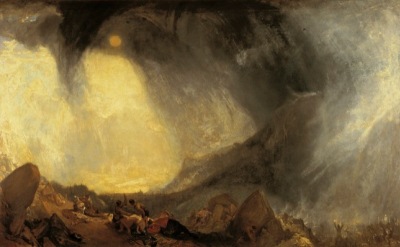
J. M. W. Turner, Snow Storm: Hannibal and his Army crossing the Alps, 1812, oil on canvas, Turner Bequest, Tate Britain, London

Snow Storm: Hannibal and his Army crossing the Alps, 1812, oil on canvas, Turner Bequest, Tate Britain, London

From 1 October 2007 through 6 January 2008 the Smithsonian had a historic exhibition of 164 works of J. M. W. Turner. I first came to know Mr. Turner on a brief visit to London in 2003 — I’m a bit of a philistine — when I saw Ulysses deriding Polyphemus (1829) and The Fighting ‘Temeraire’, tugged to her Last Berth to be broken up, 1838 (1839), and probably a few others that didn’t stick with me, on display at the National Gallery of London. Since that time he has only grown in my esteem. Getting to see Ulysses deriding Polyphemus again was like visiting an old friend. I went to see the exhibit twice in its three months in Washington, D.C., but still our time together was precious and passed altogether too quickly.

I think that a lot of art historians would say that he is not, as many amateur admirers would like to interpret him, some avant guard Twentieth Century painter, a sort of pre-Impressionist, mysteriously displaced in time. Obviously if you take the announced theme of his paintings, they are very much of their age. They aim at the sublime in nature, classical historical stories, moral edification, the contemplative and the visually soothing and pleasing. I just don’t know whether Mr. Turner would actually like us to consider the depicted event, or quickly brush past it as pretext to get to the real matter of painting, which is light, color, material — painting as the primitive actions of composition, application of material, seeing and pleasure in the most basic elements pf perception, prior to the engagement of the higher cognitive faculties.

Look for instance at Snow Storm: Hannibal and his Army crossing the Alps (pictured above). It’s a massive black swirl pushed up the side of a mountain, against a frothy, creamy snow. Anything that might constitute “the action” or the narrative of the painting is in the lower quarter of the frame, and even then only impressionistic. A lone silhouette of an elephant against an illuminated sky in the far distance is the only obvious sign of what is, at least ostensibly, being portrayed. It is a painting of the cloud, the sky, the light. The rest is pretext. It’s not even really that, I suspect. It’s a painting of the way colors interact and an experiment in what is pleasing to the mind, unbounded by depiction and representation.

From a distance the paintings may be depiction, but take a step closer. They are elaborate exercises in color and the application of paint. Your eye can cover square inch after square inch without coming upon a single recognizable feature — just differing layers of color and paint. I’m thinking here of Snow-storm, Avalanche and Inundation – A Scene in the Upper Part of Val d’Aouste, Piedmont (1837). Clip off the lower right corner and strip the title and it would be a wholly modern painting. Or some of his watercolor studies for the two Burning of the House of Parliament are depictive in title only.

In favor of this interpretation, Mr. Turner follows a trajectory similar to the Impressionists and Surrealist that would come later, in that he starts out making very realist, representational paintings in the 1790s and early Nineteenth Century, only gradually and experimentally becoming more abstract later. In the years 1810 through the 1830s you start to get these mixed representational and abstract paintings. After 1840 he starts to produce paintings that no longer have a narrative slice or corner that allows the field of abstraction to plausibly be interpreted as something — a stormy sea, a particularly tumultuous cloud — but rather entire fields of abstraction with but a shadow of depiction somewhere in the midst. Slavers throwing overboard the Dead and Dying — Typhon coming on (1840) approaches this. Snow Storm — Steam-Boat off a Harbor’s Mouth … (1842) or Yacht approaching the Coast (1850) show the full fruition of this development.

There is no substitute for being close to these paintings. The way that Turner depicts the effects of the sun on the layers and layers of cloud and other water vapor is not something that lends itself to flat, twentieth scale ink reproduction. The Decline of the Carthaginian Empire (1817) is a perfect example. You will never see what he does with the sun and the flurry of clouds above, or the way that the same light infuses the entire painting.

It’s worth noting that Mr. Turner was not a one trick pony. Venice: The Dogana and San Giorgio Maggiore (1834) and Venice, from the Porch of Madonna della Salute (1835) were quite a surprise to come upon late in the exhibit. After so many paintings listing abstract, two of such clarity of line and distinction of color was almost a shock to the senses. Obviously I wasn’t the only one with such a response as I overheard a number of other museum-goers comment to the same effect.

The painting that was missing from the collection was The Fighting ‘Temeraire’, tugged to her Last Berth to be broken up, 1838. It is perhaps his most romantic and nostalgic painting. As a part of the National Gallery collection, it was of a piece with my original acquaintance with Turner. If seeing the exhibit was like visiting old friends, it was like a visit where one of your ranks was not present.

It will be on display again in my neck of the woods at The Metropolitan Museum of Art, New York from 24 June – 21 September 2008. I may have to get up for one last peek before this once in a lifetime assemblage disbands for good.

Bleak Life Without The Daily Show and The Colbert Report

Since the Daily Show and the Colbert Report have been off the air owing to the writer’s strike, our television has sat black-screened and unwatched. There was a particularly dark bought of HGTV watching somewhere in there resulting in what one of my colleagues referred to as “a wicked TV hangover,” but I have learned that I am more or less a single-show television watcher.

Unfortunately for the cause of the writers strike, but thankfully for myself and for the nation Messrs. Stewart and Colbert are back. An election season is packed full of too much balderdash to do without them.

Apparently they’re back under some mysterious duress. As amends for knuckling under, both of last night’s shows were devoted to a thumb in the eye of their paymasters. They even got a dig in when conceding their return to air back in December (de Moraes, Lisa, “Stewart and Colbert Won’t Stay Out in the Cold,” The Washington Post, 21 December 2007, p. C7):

“We would like to return to work with our writers. If we cannot, we would like to express our ambivalence, but without our writers we are unable to express something as nuanced as ambivalence,” the two men said in a joint statement.

It’s always been a bit of a mystery how much the success of those shows are the genius of Messrs. Stewart and Colbert and how much they relied upon their staffs. Last night was bad news for the writers: Stewart and Colbert are good enough to pull it off on their own.