The Sadism of Joss Whedon

After the first episode of the Dollhouse I was markedly not impressed. It may not ever be explicit in the plot, but it’s certainly clear external to the plot that the Dollhouse is a whore house. That’s the whole premise of the tantalizing advertising campaign. They are not delivering hostage negotiators or assassins. The hard drives in the mezzanine laboratory are full of sex kitten fantasy lives. In the flashback scene to Echo’s induction into the Dollhouse, Adelle DeWitt offers her the chance to make amends, but Echo objects that she doesn’t really have a choice, does she? It’s third-world sex slavery brought to the high-tech first world.

But I think that Joss Whedon is not confused about whether or not he’s an artist. He’s fully aware that it’s his job to turn out a product that gathers eyeballs to the FOX ad stream. And a house full of stoned-eyed, will-less, child-like babes wandering aimlessly in their yoga outfits clearly has appeal for a certain demographic. Apparently dropping the false power suite professionalism in favor of after-hours yoga-clad submissiveness is the new yuppie sexuality.

Where Whedon is an artist is that in his productions, the joke is on the studio and on us. It was no accident that the premiere of a series that’s about a bunch of sex slaves leads with an episode where one of the slaves is sent out as a hostage negotiator instead of on a sexual escapade. In the final scene where Echo goes into the kitchen to retrieve the kidnapped girl from the refrigerator, I expected the refrigerator to be upright against the wall, like refrigerators usually are, but instead it was horizontal on the ground — just like the sleeping chambers to which the Actives are sent at day’s end. “He doesn’t return them. He keeps them — until he’s done with them, or until they’re worn out,” Echo says of the kidnapper. Just like the Dollhouse will use up the Actives. The Actives are a bunch of sexual kidnap victims and episode one was Whedon accusing his entire audience of fantasizing their sexual molestation. It’s the same thing that Oliver Stone did with Natural Born Killers.

Combined with tonight’s episode, I’d say that the series is off to a pretty Sadistic start.

And is it just a coincidence that Harry Lennix, a total Barack Obama look- and sound-alike, has been cast as Echo’s handler? Does the entire country get its mind wiped clean and returned to a child-like state of naïveté after each mission? But at least we’ve got a fatherly overseer in whom we can place our complete trust.

Television Disbelief

First, I can’t believe that Man v. Food is going to Beth’s Cafe. Gawd, I spent some of the best nights of my life there. Second, I can’t believe that Travel and Discovery have scheduled No Reservations and Man vs. Wild head-to-head. I have no idea how I’m going to decide between Anthony Bourdain eating a whole roast pig and Bear Grylls eating a decomposing boar.

Freedom Safely Delivered to Future Generations

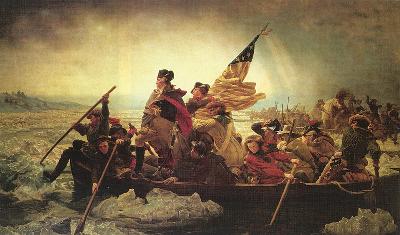
Emanuel Leutze, Washington Crossing the Delaware, 1851, Metropolitan Museum of Art, New York City

Listening to President Obama’s Inaugural Address with the variable sound quality on the Mall, I thought it was okay. An inaugural address should be more high principle and values than policy specifics and argumentation. Does the President know that he has a State of the Union Address in like 20 days? Save all of the detail and proposals and the laundry lists for then. And there was a too much of the boilerplate political rhetoric about our children and the future and freedom, et cetera.

But on a second listening, the rhetoric remains a little too detailed, but the overarching structure of the Address stands out to me, and within their context, a few lines become brilliant. The Address is constructed as a meditation on Emanuel Leutze’s 1851 painting, Washington Crossing the Delaware (above; higher resolution version here).

As SLOG’s reporter onsite Christopher Frizzelle points out (“A Review of the Speech from the Third Row,” 20 January 2009), the Address is bookended by images of storms and ice. The new President starts by saying,

The words [of the oath] have been spoken during rising tides of prosperity and the still waters of peace. Yet, every so often the oath is taken amidst gathering clouds and raging storms.

And ends with similar imagry:

… in this winter of our hardship … let us brave once more the icy currents, and endure what storms may come

Mr. Frizzelle characterizes it thus:

He is doing there what poets, namely the Romantic poets, used to do better than anyone — expressing the emotional / psychological plane of reality in terms of weather, pastoral phenomena, landscape.

The coda of the speech, the closing invocation of ice and storms, is a description of one of the darker moments during the Revolutionary War. In July of 1776 the British had landed on Staten Island and for the remainder of the year dealt a string of defeats to the Continental Army, capturing New York City, driving the Continental Army into retreat up Manhattan, across New Jersey and across the Delaware river into Pennsylvania. Washington’s army had been reduced from 19,000 to 5,000 and the Continental Congress abandoned Philadelphia anticipating British capture when the campaign season resumed in spring. It was, as President Obama described it, “a moment when the outcome of our revolution was most in doubt.”

The Continental Army encamped at McKonkey’s Ferry, Pennsylvania where General George Washington plotted a surprise attack back across the Delaware River. It was an especially unconventional move as the British had assumed the campaigning season over and established winter quarters. As President Obama relates, prior to the Christmas night crossing of the Delaware River General Washington ordered that a reading be made amidst the soldiers. The words are not General Washington’s, but those of Thomas Paine. Mr. Paine had been traveling with the Continental Army and his pamphlet, The American Crisis had just been published. It was this from that General Washington judged that the night’s inspiration would be drawn. The line that President Obama quoted from Paine is this:

Let it be told to the future world that in the depth of winter, when nothing but hope and virtue could survive, that the city and the country, alarmed at one common danger, came forth to meet it.

The victory won at the Battle of Trenton resulted in a turn away from the flagging morale of the Continental Army. When the British attempted to retake Trenton on 3 January 1777, they were outmaneuvered and quite nearly driven out of New Jersey.

The central arc of President Obama’s speech, set between the two snows and storms, reflects Thomas Paine’s image of “the depth of winter, when nothing but hope and virtue could survive.” Since it’s Barack Obama, the hope part goes without saying at this point, no? So the body of the speech addresses itself to the virtues by which the country will meet our “common danger.” Here I would like to make a list of examples, but the surprising thing about rereading this speech is how his description of the various virtues defies a simple list. They are often painted in contrasts, or without directly saying their name. I think something like constancy is a good example. “We are the keepers of this legacy.” “… the fallen heroes who lie in Arlington whisper through the ages.” For an obvious example, he says,

Our challenges may be new, the instruments with which we meet them may be new, but those values upon which our success depends, honesty and hard work, courage and fair play, tolerance and curiosity, loyalty and patriotism — these things are old.

Even when listing other values, constancy — “these things are old” — underlies them all. One of the best parts of the speech for me, especially as a leftist, was the President’s paean to workers, especially “men and women obscure in their labor.”

Among all these virtues, one receives particular recognition: unity, self-sacrifice, the common good, the gaze toward something greater than one’s self. “[Our predecessors] saw America as bigger than the sum of our individual ambitions; greater than all the differences of birth or wealth or faction.” “We will build the roads and bridges, the electric grids and digital lines that feed our commerce and bind us together.” The cynics have forgotten “… what free men and women can achieve when imagination is joined to common purpose …” “… more united, we cannot help but believe … that the lines of tribe shall soon dissolve …”

Look again now at Mr. Leutze’s painting. It’s most outstanding characteristics are an imposing river of ice between the Continental Army and the New Jersey shore, a tumult of citizen soldiers raging in boats and on the near shore. In the midst of this chaos and struggle rises the figure of General Washington, unperturbed, resolute, beyond the fray, his face fixed on distant goals and illuminated by the bursting sky.

Then study the crew of the boat. It is a microcosm of the colonies. The two oarsmen in the bow of the boat are a Scotch (note the Scottish bonnet) and an African American. There are two farmers in broad-brimmed hats toward the back. The man at the stern of the boat is quite possibly a Native American (note the satchel). There is an androgynous rower in red who is perhaps supposed to be suggestive of women. “… our patchwork heritage is our strength.”

Return now to President Obama’s Address. In this winter of adversity what persists are our virtues, above all unity. The icy currents of the bookends of the speech are the Delaware River, the middle arc of the virtues of the nation are the boat with its diverse crew of rebel irregulars. And consider the last line of the Address, “… with eyes fixed on the horizon and God’s grace upon us, we carried forth that great gift of freedom and delivered it safely to future generations.” It is a description of General Washington, father and symbol of the nation, rising out of the clamor of peoples — out of many, one — illuminated, gazing toward the future of freedom safely delivered over to the other side.

I’m not exactly a nationalist or a collectivist. I’m not so hot on all the unity talk. I more prefer an individualist, contending interest groups theory of politics. We are most markedly not one people and to say otherwise is the propaganda of an agenda. But if you dig Romanticist nationalism, then President Obama in his Inaugural Address is your artist-president, poet-in-chief.

A System of Negativity

Consider nihilism as a system of negativity. Rather than no system or anti-system, or the standard sort of system of theorem built upon axiom, et cetera, it is a system of contradiction, where each principle is canceled out by another, every theory perfectly balanced by another opposing until there is nothing left, or that the web of confusion grows so tangled that one is driven to the nihilistic act, where one has nothing left but to obliterate and wipe away the whole lot of ideas. Now consider the following two passages from Dostoevsky’s Notes from the Underground:

… on coming home on one of the foulest nights in Petersburg, I used to realize intensely that again I had been guilty of some particularly dastardly action that day, and that once more it was no earthly use crying over spilt milk; and inwardly, secretly, I used to go on nagging myself, worrying myself, accusing myself, till at last the bitterness I felt turned into a sort of shameful, damnable sweetness and finally, into real, positive delight!

Well, let us now have a look at this mouse inaction. Let us suppose, for instance, that its feelings are hurt (and its feelings are almost always hurt), and that it also wants to avenge itself. There will perhaps be a greater accumulation of spite in it than in l’homme de la nature et de la vérité. A nasty, mean little desire to repay whoever has ofended it in his own coin stirs within it more nasty perhaps than in l’homme de la nature et de la vérité; for because of his inborn stupidity l’homme de la nature et de la vérité looks upon his revenge merely as a matter of justice whereas because of its intense sensibility the mouse denies that there is any question of justice here. At last we come to the business itself, to the act of revenge. The unhappy mouse has already succeeded in piling up — in the form of questions and doubts — a large number of dirty tricks in addition to its original dirty trick; it has accumulated such a large number of insoluble questions round every one question that it is drowned in a sort of deadly brew, a stinking puddle made up of doubts, its flurries of emotion, and lastly, the contempt with which the plain men of action cover it from head to foot while they stand solemnly round as judges and dictators and split their sides with laughter at it. Well, of course, all that is left for it to do is to dismiss it with a disdainful wave of its little paw and with a smile of simulated contempt, in which it does not believe itself, and to scurry back ingloriously into its hole.

After reading Notes from the Underground it is hard not to see Nietzsche as at least partially derivative. Nietzsche was reading Dostoevsky in the years 1886-1887, including Notes from the Underground. Nietzsche wrote On the Genealogy of Morals during 1887 and it is Dostoevsky’s narrator from Notes from the Underground who is the patient that Nietzsche has on he sofa in On the Genealogy of Morals. The difference is that while Nietzsche shares Dostoevsky’s diagnosis of the sickness of the West, Dostoevsky is nostalgic for Christianity and nationalism, whereas Nietzsche advocates an experimentalism and futurism of pressing boldly on.

Durian

Durian, a large, spiky fruit of Southeast Asia known for its pungent odor

I first encountered the durian as I was studying for a 2006 Thailand vacation. I was eager to dig into the local food and the tropical fruits especially excited me. It turned out to be not much of a culinary vacation and I ate a lot less fruit than I would have hoped. I certainly never got the nerve to try the durian. Since then my fear and ambivalence has only grown, especially after this SLOG story

(Spangenthal-Lee, Jonah, “Adventures in Food with Ari and Jonah,” The Stranger, 20 April 2007) and an episode of No Reservations where Anthony Bourdain described the durian as being more like a pungent French runny cheese than fruit.

But then, on Wednesday night, I was at a dinner party where the Vietnamese host announced that there would be two disserts after the dinner: one a usual dessert, the other a challenging dessert. I had already seen the cake on the galley counter so that was known. The challenge dissert was to be a surprise. After the cake was brought to the table, our host disappeared into the kitchen and returned with the surprise dessert: durian.

I have to say that its smell and appearance are deeply intimidating. I roiled with conflicted desire: the adventuresome side desperate to taste it, my distance-operative senses sounding the alarm that this was not food and not to be put in my mouth.

So of course I tried it. Once you get it past your nose it is a wonderfully complex and delicious fruit. It has an arduous flavor that comes in a number of phases. If you divide it into four rough phases, the third quarter is the fruity high point with a wonderful, light, fresh taste characteristic of tropical fruit at the top, reminiscent of the aftertaste of strawberries as it wears on. It has a long sour tail like cheese or butter, but with an ever so slight element of rancid gym sock.

Our host explained that if you buy the durian in the husk, you never know what you’re going to get until you open it up. He recommended the packaged durian, because someone else opens it and then it only gets packed if it’s good. Good being sulfuric in this case.

The Napoleon Dynamite Problem

After casing Ben Goertzel’s blog today, the point that I find myself really chewing on is this one (“The Increasing Value of Peculiar Intelligence,” The Multiverse According to Ben, 26 November 2008):

What occurs to me is that in a transparent society, there is massive economic value attached to peculiar intelligence. This is because if everyone can see everything else, the best way to gain advantage is to have something that nobody can understand even if they see it. And it’s quite possible that, even if they know that’s your explicit strategy, others can’t really do anything to thwart it.

Yes, a transparent society could decide to outlaw inscrutability. But this would have terrible consequences, because nearly all radical advances are initially inscrutable. Inscrutability is dangerous. But it’s also, almost by definition, the only path to radical growth.

I argued in a recent blog post [“The Inevitable Increase of Irrationality,” 25 November 2008] that part of the cause of the recent financial crisis is the development of financial instruments so complex that they are inscrutable to nearly everyone — so that even if banks play by the rules and operate transparently, they can still trick shareholders (and journalists) because these people can’t understand what they see!

But it seems that this recent issue with banks is just a preliminary glimmering of what’s to come.

Inscrutability, peculiarity, the idiosyncratic are already creeping in. Mr. Goertze is right to point to the rise of the quants and mathematical finance as an example. The one that comes to mind for me is the Napoleon Dynamite problem.

NetFlix has announced a million dollar prize for anyone who can improve the precision of its recommendation engine by ten percent. The New York Times Magazine and NPR’s On the Media both did stories about it back in November (Thompson, Clive, “If You Liked This, You’re Sure to Love That,” 23 November 2008; Gladstone, Brooke, “Knowing Me, Knowing You,” 21 November 2008). It turns out that improving the quality of this sort of singular value decomposition algorithm is geometric in difficulty. Most movies are easy to predict whether someone will like or dislike them, but a small number of odd movies thwart the algorithm. Chief among them is Napoleon Dynamite. For the research group profiled in The New York Times piece, Napoleon Dynamite was responsible for a whopping fifteen percent of all recommendation errors. There is no telling on the basis of people’s past movie rating history whether or not they’ll like this movie.

But the Napoleon Dynamite problem isn’t a solitary anomaly, but rather the paradigm of a trend. What we have is a Hollywood focused on these monster, expensive productions. Increasingly the movies that Hollywood makes are global products, with as much revenue coming from abroad as from the U.S. audience, so Hollywood is careful to strip its movies of any dialogue, humor or situations which are culturally nuanced and might not translate well. So the plot and dialog that we get in big Hollywood movies today is only the most broadly recognized and basic cultural tropes. Also, Hollywood has jacked the price of a movie up to the point where viewers now almost universally make a theatre-rental division: big special effects movies that they want to see in the theatres, and the dramas for which screen size isn’t a factor. It is a division with a positive feedback loop in that movie makers are aware of it and now shape their product offerings around it.

For a particularly depressing take on this, give a listen to Malcolm Gladwell’s 2006 New Yorker Festival talk on the use of machines to produce blockbuster scripts. At the same time that institutions like NetFlix are using computers to match customers to movies with increasing efficiency on the consumer end, Hollywood is using computers to make films increasingly easy to pigeonhole and match to demographics on the production side. It’s post-Fordist cultural production perfected. Soon we will be able to take the human out of the equation and the entertainment industry will just garnish out wages.

But there is — as is always the case — a countervailing motion. Just as Hollywood productions become increasingly trite and formulaic, there is the rise of these wildly bizarre and idiosyncratic films like The Zero Effect, Adaptation, Eternal Sunshine of the Spotless Mind, Lost in Translation, The Royal Tenenbaums, I Huckabees, Burn After Reading and so on. There is this sort of shadow Hollywood with it’s own set of stars and directors branding the alt-film genera: Wes Anderson, Charlie Kaufman, the Coen brothers, Catherine Keener, John Malkovich, William H. Macy, Frances McDormand. I would be remiss if I didn’t mention Steve Buscemi here.

What we have is a hollowing out of the middle. Along a spectrum, films range from obscurantia to formulaic. In the past, most movies probably fell in some broad middle: accessible, but unique. And most movie watchers probably fell there too. But increasingly movies and the movie-watching audience is being polarized into the genera constellations at one end and the difficult to categorize peculiarities at the other. Notice that the ambiguity of suspense has been replaced by the spectacle of gore in horror; that the sort of romantic comedy for which Drew Barrymore was designed and built has completely driven the older adult romantic drama to extinction. Similarly, the sort of accessible quirky, artiness represented by Woody Allen has moved much further down the spectrum of the idiosyncratic. The people who didn’t like Woody Allen are utterly baffled by Wes Anderson.

To generalize: hitherto we have been a normal distribution society. The majority of people fall into the broad middle and are closely related. But increasingly we are on the way toward a parabolic, or inverse normal distribution society, where the preponderance resides at the antipodes and people are separated by wide gulfs. This is true across the cultural spectrum, whether it’s politics, religion, the professions and so on. In the United States it is almost happening physically with the costal regions swelling as the center of the country is abandoned to satellite guided tractors and migrant labor. Some might call this the condition of postmodernity, some might call it the dissolution of Western Civilization.

Have a Gay New Year

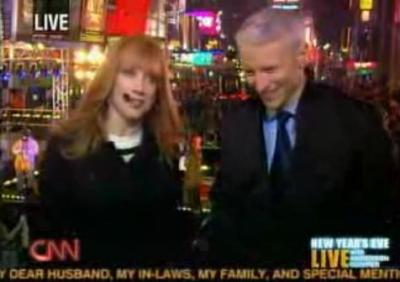
Anderson Cooper and Cathy Griffith's 2008-9 New Year's coverage on CNN

S. and I are watching Anderson Cooper and Cathy Griffith’s New Year’s show on CNN. Anderson Cooper catches a lot of flack for being high-profile and still in the closet, but he has pulled off something totally post-gay culture: he’s come out of the closet without having to have a press conference or a cover page interview with People. He’s got Cathy Griffith as his fag hag and he keeps on cutting to interviews with on-scene drag queens (Su-She in New Orleans is going to be lowered in rhinestone covered shoe in lieu of a ball or somesuch). CNN is having a totally edgy, gay New Year’s special, nothing like that middle-America friendly, stated, whitebread bullshit going on with Ryan Seacrest and Dick Clark on ABC.

The default assumption hitherto, absent active countervailing action, is heterosexuality. By having engineered a salami-slice coming-out, absent the appropriate ceremony of homosexuality, Anderson Cooper is thwarting this cultural system. I mean, we live in an era when drag queens are a regular feature of CNN’s New Year’s coverage, thanks to Anderson Cooper.

Cathy Griffith is fucking hilarious. She blurted out that they should cut away from a call with Wolf Blitzer because he was boring her, called out CNN’s on-scene reporter Richard Quest for being loaded and has admonished Anderson a number of times, “Wake up, grandpa,” for not getting one of her pop culture references. Anderson Cooper is trying as hard as he can to play along with her antics — which he obviously enjoys — but he has no emotional range.

So here’s to 2009 and the continuance of the revolution in morality.

Update, 12:57 AM, 1 January 2009: Kathy just objected to Anderson that “I don’t come to your job and knock the dicks out of your mouth.” That’s one of my favorite insults.

Repeal Day

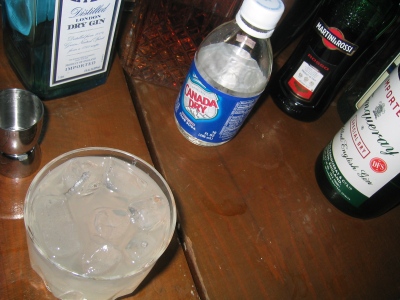
A cocktail on Repeal Day, 5 December 2008

Happy Repeal Day everybody! Here’s a drink for Franklin Delano Roosevelt and the State of Utah that brought rampant boozing back to the United States.

I’m presently exploring the Tom Collins. I’m making it with fresh lemon juice and liking it somewhat less than the soda sweetness of the one made with the bottled mix that first introduced me to the drink over Thanksgiving dinner preparations.

I’m skeptical of drinks that require added sugar. I mean, with the alcohol they’re already sweet enough. I tried to omit the sugar from last night’s Tom Collins and found, like with drinkboy’s discussion of the old fashioned, not only is the sugar important, but dissolving the sugar in some water before adding the rest of the ingredients is critical too.

I inherited a subset of S.B.’s booze collection when she left for Ireland a few days ago so I am now in gin and tequila for the remainder of the year and then some so I am a happy kid.

New York Bagels

I see that over the weekend there was much consideration of the issue of New York and Bagels. Matthew Yglesias comments (“The Stuff that Matters,” ThinkProgress, 28 November 2008):

I’ve now lived in DC long enough that I forget how much I like real bagels. But then I come back to New York for Thanksgiving and the whole sad little fantasy universe I’ve constructed for myself in which DC’s bad bagels aren’t a big deal collapses.

Kevin Drum does a little wondering as well (“Bagels!,” MoJo, 28 November 2008)

It’s hard for me to remain on topic here because Washington, D.C. is such a miserable hole of a city. It would be hard to come up with a single factor in which New York was not vastly better of a city. The only reason that anyone tolerates D.C. is that it’s the political and intellectual capitol of the country.

That said, whenever I go to New York I have a list of things that I want to do and every time it includes bagels. This visit included bagels on two out of three mornings. My friend has been living three blocks from Tal Bagels so it has been pretty convenient, but on other visits I have commuted for bagels.

I’ve heard a number of the theories (the municipal water), but I’d have to say that I think it’s a gestalt. The bagels themselves are better: crunchier on the outside, chewier on the inside. But the schemers are better too (we brought back a tub of the olive cream cheese and another of the tofu, which rather than being some vegan concession has a flavor zestier and brighter than the cream cheeses). And most important is the ambiance. Woody places with a bunch of working-class artisans in black pants, white t-shirts, white aprons, and white paper hats, with a lot of hurry and attitude is different than the hired gun Ethiopians at Au-bon-Pan. A bagel shop is a stylized thing in New York. The cream cheeses are arrayed in gigantic bowls under glass, along with a host of other Jewish foods: smoked fish, knishs, couscous salads.

My favorite bagel places in New York are Ess-a-bagle (359 1st Avenue, Manhattan, New York 10010, official site here) and Tal Bagels (977 1st Avenue, Manhattan, New York 10022), both very Jewish, and The Bagel Store (247 Bedford Ave, Brooklyn, NY 11211), a Williamsburg hipster joint, but still unbelievably good.

The Pink Pentagon

Has Foggy Bottom become the pink Pentagon? It now seems that it will be a routine part of every presidential administration — or at least of their supporters — for the next couple of cycles to tout its advanced thinking on gender issues by pointing to its high-level appointment of a woman to the position of Secretary of State.

Two out of the last three Secretaries of State have been women (Madeleine Albright, Colin Powell, Condoleezza Rice). Candidate Obama seemed to have Samantha Power on the Secretary of State shortlist and now it seems as if Senator Clinton is on the way there, purportedly to mollify her female supporters by providing the Senator with some role.

Meanwhile, the Pentagon remains an impenetrable bastion of masculinity. And not just men, but manly men. Donald Rumsfeld practically snorted puffs of superheated testosterone out his nose. Not only are women inconceivable, but apparently even so effeminate as Democrats at large are no longer allowed at the Department of Defense. President Clinton selected a Republican to head the Pentagon (William Cohen) and President-elect Obama has rumors emanating that he will retain Secretary Gates for a period, or of Senator Chuck Hagel as Secretary of Defense.

Nominating a woman to run the Pentagon would cause a political firestorm of retrograde gender imaginings, still lurking just below the surface. It will be the true, last hold out against female equality.

The two institutions have both obviously become overloaded with psychological meaning. The State Department, with its constant bias toward diplomacy, is the redoubt of verbal skills, much denigrated now that it turns out that women possess them in spades over men. And the State Department has only become an acceptable appointment for a woman as the department has declined in stature. It’s budget has been allowed to deteriorate away over the years, ambassadorships have become powerless rewards for campaign contributors and responsibility for real foreign policy making has all moved over to the Pentagon. Now that it’s the department of international social work, it’s safe to leave the place to a woman. The State Department has even got a double entendre in its unofficial name — Foggy Bottom — to suggest that it’s the proper place to send the skirts, especially the bulging middle-aged ones. They may as well run a knitting circle out of the Secretary’s office suite, whereas the Pentagon is a bastion of manly action.

If what is required is someone who can talk our enemies to death, why not go with one of the original rumors, and make Senator John Kerry the Secretary of State? If Senator Clinton is going to get a role other than leading the charge for healthcare reform in Congress, then let’s retire this gender-reifying myth and send her to the Pentagon.