The Last Days of Nature

In reaction to last week’s The New Yorker article on synthetic biology (Specter, Michael, “A Life Of Its Own,” 28 September 2009, pp. 56-65):

The objective of synthetic biology is the final subsumption of the logic of nature into the logic of capitalism. Capitalism being the logic of human desire, the objective of synthetic biology is — as with the whole of the technological endeavor — the elimination of all intercession between desire and its fulfillment. It is the attempt to return to the purity of the hallucination of the breast, to do away with despised reality testing, the creation of a world of pure subjectivity.

For a cyberpunk rereading of Hegel: Freud as the last of the Young Hegelians.

One Ping Only, Vasili

A few weeks ago I met up with some friends and we were walking through the busy Gallery Place / Chinatown area, all three of us heads down studying our various hand-helds (two iPhones and an Android). I joked that the app that we need is something like the range-finders from the Alien movies, only that does picture-in-picture on our phones so we can see what’s coming without having to look up from our immersion in our respective virtual worlds as we walk through heavy pedestrian traffic.

The absurd extent of the anxiety of influence: not only if you’ve had a good idea can you count on someone having already had it, but if you make a joke about something absurd, you can rest assured that someone is already doing that too. It turns out there is already a sonar app for the iPhone (Frucci, Adam, “iPhone’s Sonar Ruler App Measures Distance Using Sound,” Gizmodo, 21 August 2009).

(Jokes about iPhone apps follow the same formula as jokes about hitherto unnamed but always Johnny-on-the-spot when convenient members of the Smurf village: think of an absurd or inappropriate function, append “smurf”; e.g. Cuckolding Smurf finds life in the Smurf village paradisiacal; or sumrfs keep themselves free of tropical disease by regularly licking Quinine Smurf; In the case of iPhone apps, name an absurd function, then say “There’s an app for that.”)

Who Screwed Up the 1970s?

The standard narrative of the stagflation of the 1970s is the one that the right has advanced. The left has no countervailing narrative. In that of the right, the economic doldrums of the ’70s can be squarely hung round the neck of liberals: in the simplified version, because of the welfare state, no further explanation required; in the more complicated one, the inability to choose between the guns of Vietnam or the butter of the Great Society, of Keynesian fine tuning and oil shocks resulting from liberal pussyfooting around in foreign policy. The hero of this narrative is Ronald Reagan who unwound twenty years of leftist regulation and redistribution, unleashing the U.S. economy to do what it does best.

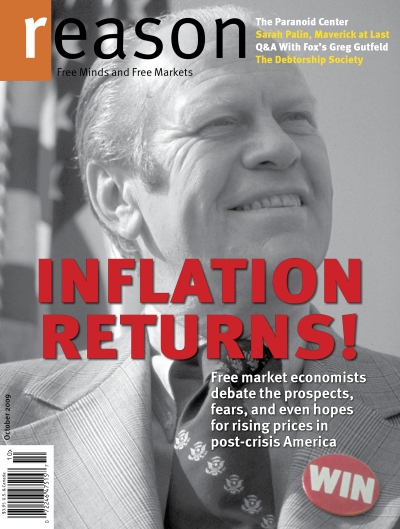
As a liberal, this is the narrative against which I must justify my policy preferences, but more basically, I think it just simplifies a much more complex story. As an example, when Reason, a right-of-center libertarian publication, decides to hold a colloquium on the renewed threat of stagflation, which president do they put on the cover as the personification of the memory of the inflation of the 1970s? Gerald R. Ford:

Reason Magazine, October 2009, President Gerald Ford as the poster-boy for inflation

Poor Gerald Ford: an honorable man whose best association is Chevy Chase spoofs from Saturday Night Live of him tumbling down the airstairs.

It should be recalled that Reagan’s first run for the presidency consisted of his failed challenge to incumbent Ford for the 1976 Republican nomination, and that the real bête-noire of the Ford-Kissinger foreign policy was not the Democrats or the left, but the anti-détente, anti-arms control neoconservatives and elements of the right who found their political figurehead after Barry Goldwater in Ronald Reagan. It should also be recalled that the policy maker credited with the defeat of the inflation of the 1970s is then Federal Reserve Chairman Paul Volcker, a Carter appointee, rather dishonorably shown the door for his efforts by President Reagan in favor of Alan Greenspan.

Super Macro

My present favorite feature on my Canon PowerShot SX200IS is the Super Macro setting available under manual mode. It’s really got me playing National Geographic photographer.

A frog, Richter farm, Susquehanna County, Pennsylvania, 13 September 2009

13 September 2009, Richter farm, Pennsylvania, a frog with whom I crossed paths far from the pond and who was all hopped out by the time he made it back to safety.

Honeybees amidst the goldenrod, Richter farm, Susquehanna County, Pennsylvania, 13 September 2009

13 September 2009, Richter farm, Pennsylvania, honeybees amidst the goldenrod of the fields.

Sociobiology as the Transcendence of Biological Ecology

The central idea of sociobiology is that the emergence of social creatures (herd animals) coincided with the creation of what might be termed a socio-cultural environment. The socio-cultural environment is as much an environment that social creatures inhabited as the material environment. As social creatures evolve, two things happen to the socio-cultural environment:

  1. As with evolution of species morphology, the maximum complexity of socio-cultural environments increases (there is selection pressure on the entire socio-cultural environment as, say, predators develop way of thwarting or exploiting the social aspect of their prey and the social species evolve to countervail this development, e.g. parasitic cordyceps and ants; that is, there is species-level selection, since a social characteristic unrecognized by a counterpart comes to nothing; consider this as an analogy for fourth generation warfare).

  2. Subsequent generations of herd animals come to rely ever more heavily upon social cohesion — as opposed to horns, honed perceptive apparatus, efficient digestion, et cetera — as their primary means of survival.

As this socio-cultural environment becomes more sophisticated and intricate and increasingly important as a means of survival, the socio-cultural environment grows in importance as the universe of factors shaping the evolution of social animals, while the objective, geological, hydrological and biological environment recedes in its evolutionary force.

Sexual selection (a type of sociobiological selection, as opposed to natural or Malthusian selection) is the sort of selection pressure that a species faces when its fellows, rather than the environment becomes the main challenge to getting its genes into the future. The shifting balance of natural selection and sexual selection in the play of evolutionary forces is meta-evolutionary. Evolution is recursive, with developments in the subjects of evolution backpropigating into the mechanism itself. In this respect every new thing in the universe (or at least in the effective realm) can potentially alter the functioning of the evolutionary dynamic. In this broadened perspective, the idea of machine or meme evolution supplanting biological evolution should not be so surprising.

Among a certain sector of the wildly technologically enthusiastic (among whom I count myself, though Matthew Crawford’s Shop Class as Soulcraft: An Inquiry Into the Value of Work is presently doing a lot to kick the piss out of this pretention), there is a notion that humans are rapidly disencumbering themselves of the material world and constructing for ourselves a world of pure ideas, information, mind-stuff. At some point in human history saber-toothed tigers, virulent microbes, droughts and tar pits ceased to be the primary challenge to humans seeking to survive and reproduce. Such extra-human threats were replaced as the primary danger by human-originating threats such as careening contraptions, shoddy construction techniques, insufficient precaution with the kitchen fire, marauding hoplites, jilted dagger-wielding lovers, corrupt institutions and flawed regimes of succession in governance. It is at the point where today it is plausible that the human socio-cultural environment has attained a level of preponderance where even the level of environmental catastrophe such as an asteroid strike that caused the mass extinctions of the past might be thwarted by the constituents of the human socio-cultural environment (on the other hand, the complexity of our socio-cultural environment might be just the sort of run-away biological factor that caused past mass extinction such as the oxygen catastrophe or the Canfield ocean thesis of the Permian–Triassic extinction event). In this conception, it is usually the the information revolution, the invention of the computer — a brain-like device — that is the cause of this transcending of matter. The advent of technology was not the key turning point. The recognition of sociobiology is that this trend is an aspect of evolution; that it long predates not only technology, but also even predates humans. In this way, we are not unique, not the penultimate branch of the tree of life, but only the latest in a succession of forms.

Update, 15 September 2009: It’s worth noting that while computers are not the revolution, nor the source of the revolution, they do form a paradigm, shaping our conceptualizations in ways that allow us to perceive the revolution.

I Know There Must be an Iron Fist Somewhere in All Obama’s Velvet

Upon a second watching, the thing that’s so striking about President Obama’s speech tonight is just how magnanimous and in-touch it was. Listen to the whole arc about the Kennedy letter: it’s almost all high principle and his concessions to capitalism and the notion that government action and the realm of individual freedom trade off is fairly surprising. But I think that he is right about where the American electorate is right now, whether they know it or not (i.e. have been intentionally misinformed).

But if the Obama administration is right about where the average American voter is ideologically, then this is a terrible indictment of their political strategy. That they are losing the P.R. war on what should be a popular policy is a powerful demonstration of the ineptness of the Democratic party.

In the afterglow of a well-delivered speech like this it’s entirely too easy to get carried away by the rhetoric. But the imperturbability of President Obama’s insistence on a reasonable tone in Washington, D.C. is remarkable. It seems as if the President is sincere about his desire to transcend partisanship. If Barack Obama manages to pull it out yet again on the base of steady-handed, even-keeled reason, my political cynicism will have been dealt a heavy blow.

On the other hand, this bipartisan talk is really tactical. Tomorrow it’s going to be balls to the wall. There’s going to be a full court press against the blue dogs and Olympia Snow. Healthcare reform passed along straight partisan lines through the budget reconciliation process will be in the mix as a negative inducement and as a real possibility (to Congressional fence-riders what the public option will be to the insurance companies). The speech was potentially the last of the nicie-nice.

Or a third possibility, with so many plans now in play (the House committees, the Senate HELP plan, the Republican plan, the Max Baucus plan, and now the administration plan), perhaps this was merely the opening move of an intensified, second round of horse trading. Perhaps President Obama is a nervy bastard playing the long political game.

Vanity Fair

David Schmader’s description of Vanity Fair (“On Spoofing GOOP,” SLOG, The Stranger, 8 September 2009):

Vanity Fair, which was designed for me by God, who forced People and The New Yorker to have a baby, then swaddled the results in ambitiously art-directed fashion ads. It is one of America’s great narcotics …

I think that Vanity Fair is the best magazine in the U.S. today, a perfect combination of superficiality and seriousness, playfulness and piety.

How Time Narrows Life’s Sumptuous Branching Complexity

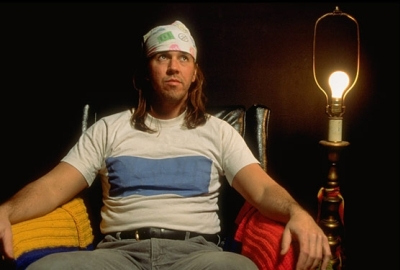
David Foster Wallace with bare lamp

Read on it’s own, the following passage from David Foster Wallace’s essay “A Supposedly Fun Thing I’ll Never Do Again” may sound pessimistic, fatalistic, oppressive. Read in context, I laughed so long and so hard that my face began to hurt. It is, nonetheless, a painful truth:

I am now 33 years old, and it feels like much time has passed and is passing faster and faster every day. Day to day I have to make all sorts of choices about what is good and important and fun, and then I have to live with the forfeiture of all the other options those choices foreclose. And I’m starting to see how as time gains momentum my choices will narrow and their foreclosures multiply exponentially until I arrive at some point on some branch of all life’s sumptuous branching complexity at which I am finally locked in and stuck on one path and time speeds me through stages of stasis and atrophy and decay until I go down for the third time, all struggle for naught, drowned by time. It is dreadful. But since it’s my own choices that’ll lock me in, it seems unavoidable — If I want to be any kind of grownup, I have to make choices and regret foreclosures and try to live with them.

For a sense of how funny this essay is, Mr. Wallace reads an excerpt here starting at 10:00 minutes in (the preceding story about the baton twirlers at the Illinois State Fair is better read here at the Harper’s Magazine 150th Anniversary on 25 May 2000).

How Hot is it in Washington, D.C. in August?

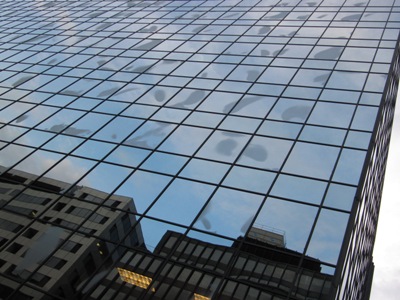
Even the buildings sweat in August, 17th and L Streets NW, Washington, D.C., 21 August 2009

So hot you have to put your entire building on a coaster. Look at the building pictured above. It’s actually so humid out and they are actually running the air conditioning so aggressively inside, that condensation is forming on the glass curtain wall of this building. It’s the case with some of the newer buses as well, that the exterior surfaces are covered in condensation.

And this has been the most mild August in my six years living in Washington, D.C.

Okay, Okay, I’ll Say Something Nice About D.C., Pt. II

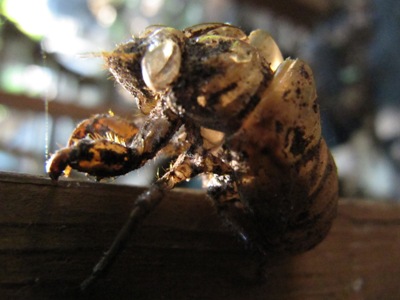
Exuviae of a pupal annual cicada in the back yard, Mount Pleasant, Washington, D.C., 27 August 2009

Okay, so I titled part I of “Okay, Okay, I’ll Say Something Nice About D.C.” as a part I, clearly indicating an as-yet-to-come part II. So now for the second nice thing I can say about Washington, D.C.

The second thing I really like about Washington, D.C. is the cicadas. The cicadas are part of a larger phenomenon of the District’s being environmentally a Southern city. The sweltering, energy-sapping heat of summer, the omnipresent sense of dank decay, the encroaching vegetation, the hot smell of rotting organic things, the storied and usually bloodied geography. I sometimes feel like I live in a Flannery O’Connor or a Carson McCullers novel.

I have listed tactile, thermoceptic, olfactive and neural aspects of this Southern sense. The cicadas are the primary aspect of aural Southern-ness.
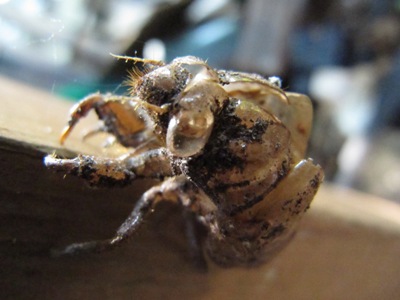
Exuviae of a pupal annual cicada in the back yard, Mount Pleasant, Washington, D.C., 27 August 2009

The amazing thing about cicadas is how improbably powerful they are. They sound more like a cyclotron or a tesla coil powering down than a natural creature. Pity the person who ends up with one camped out right outside their window blasting their amorous bug love song like the U.S. military trying to blast Manuel Noriega from the Vatican embassy.

There are individual bugs, then there is the entire population of cicadas in chorus. Up in my neighborhood they are so loud that you have to raise your voice to be heard outside. I don’t know whether it’s variance across species, or across individual bugs, or song phase, but when you get a lot of them together you can hear all different periods and amplitudes in their harmonics. And then the scores of different harmonics meld into a region-spanning, undulating wall of cicada sound of a sort that might induce seizures in certain youngsters susceptible to high-frequency stimulation. The omnipresent insistence of such a non-human activity makes it easy for one’s imagination to run away to visions of a primitive Potomac river valley untrammeled by human activity. Our stupid brick piles and asphalt pathways temporary intrusions on eternal nature.

Southernness is, among other things, a certain type of relation to nature.

The pictures above are the exuviae of a pupal annual cicada found tacked to a post in my backyard. My first year in D.C., a year of the seventeen-year cicadas, it seemed like these things were hanging everyplace. These pictures were taken with just a point-and-shoot, specifically my Canon PowerShot SX200 using the Super Macro setting.